Meaghan Oppenheimer is following up “Tell Me Lies” with a new drama series currently in the works at Hulu.
Variety has learned that Oppenheimer is developing the series “Bastards” at the streamer, on which she will serve as writer and executive producer. 20th Television, where Oppenheimer is under an overall deal, is the studio. According to an individual with knowledge of the situation, Oppenheimer delivered the script for “Bastards” to an enthusiastic response just after “Tell Me Lies” wrapped, with Hulu and 20th TV now fast-tracking the project.
The logline for “Bastards” states, “After a world-famous artist is engulfed in a public scandal, her three adult children – each from a different father and each unraveling in their own way – are forced to move back into their childhood home to take care of the teenage sister they barely know. As old dynamics resurface and secrets come to light, the siblings must confront their inheritance of love, cruelty, and chaos.”
Oppenheimer is fresh off of the success of “Tell Me Lies,” which aired its third and final season at Hulu earlier this year. That show was based off the book of the same name by Carola Lovering. Starring Grace Van Patten and Jackson White, the show follows the relationship between two college students over the course of eight years. Per Disney, all three seasons of the show have been streamed for over 350 million hours across Hulu and Disney+ since it originally launched in 2022.
Aside from “Tell Me Lies,” Oppenheimer has written for shows like “Fear the Walking Dead” at AMC. As a creator, she was behind the Facebook Watch series “Queen America” starring Catherine Zeta Jones and Judith Light and wrote the ABC pilot “Broken” that starred Anna Paquin and Blair Underwood, with Bruna Papandrea and Reese Witherspoon executive producing. In film, she wrote the drama “We Are Your Friends” starring Zac Efron and Emily Ratajkowski.
Oppenheimer is repped CAA, Untitled Entertainment, and Yorn Levine Barnes.
The Directors Guild of America has extended the employment contract of Russell Hollander as national executive director through the end of 2029.
The extension comes about two weeks before the DGA is set to begin its collective bargaining process with the Alliance of Motion Picture and Television Producers on May 11. Hollander is a more than 25-year veteran of the guild who has been at the helm since 2017.
DGA president Christopher Nolan confirmed the contract extension for Hollander on Monday. Amid the massive swings in the entertainment and media landscape, the role that guilds play in protecting the interests and rights of artists could not be more vital.
“For nearly a decade as our National Executive Director, Russ has been a steward for the Guild and its members, seeing us through a period of tremendous upheaval in our industry,” Nolan said. “From the pandemic to the strikes and the global contraction in production, Russ has always prioritized and protected the interests of our members, working closely with me, past Guild Presidents, and our National Board. We are grateful for his continued service to our community.”
Hollander joined the DGA in 2001 in New York as assistant executive director.
“I’m honored by the Board’s continued confidence in my service to the membership, especially during times of incredible change,” Hollander said. “The beauty of our Guild is our defining, singular mission to advance the creative and economic rights of our members – and the secret to our longstanding success is the strong partnership between our elected leaders and our professional staff to fulfill that purpose. At a time when the rights of workers need strong champions, it is a privilege to dedicate myself to that purpose and to the members we serve.”
Payments platform Infinite announced the launch of Infinite Accounts, a product that combines traditional banking and stablecoin functionality. The accounts are issued through Erebor Bank, N.A., which provides the underlying infrastructure and is a member of the FDIC.
The new offering gives businesses access to dedicated bank accounts with unique routing numbers. These accounts support deposits, withdrawals, ACH transfers, and domestic and international wires. At the same time, they allow interaction with stablecoin networks through a single interface.
Infinite also supports minting and burning of stablecoins linked to fiat funds. The system handles routing between blockchain networks and traditional payment rails, while managing compliance and reconciliation processes in the background.
The company said the solution is aimed at platforms and developers. Through APIs, partners can embed financial services into their own products under their brand. This removes the need to build payment infrastructure or manage direct banking integrations.
Funds held in bank accounts may be eligible for FDIC insurance, while stablecoins are not insured and may carry additional risks.
Tria, a self-custodial neofinance app, has integrated Decibel to expand trading features inside its app. The update allows users to access perpetual contracts directly without moving funds or using external platforms.
The integration connects Decibel’s central limit order book to Tria’s interface. Users can place and settle trades while keeping full control of their assets. The system runs on the Aptos blockchain.
The move addresses fragmentation in digital asset markets. Tria combines trading, yield tools, cross-chain swaps, and card payments within one balance.
Tria reports more than 500,000 users across over 150 countries. The company is backed by investors, including Polychain and the Ethereum Foundation. The integration with Decibel went live on April 21, 2026.
Virginia man buys 20 tickets for one lottery drawing, wins 20 times
March 27 (UPI) — A Virginia man bought 20 identical tickets for a single Pick 4 lottery drawing and ended up winning $5,000 for each ticket — a total of $100,000.
“We’ve got something to say about it,” Madonna and Carpenter wrote in a caption in an instagram post, confirming the song would release at 3 p.m. on April 30th.
The song comes as Madonna continues to ramp up the rollout for her upcoming album Confessions II, her first album in seven years. The pop superstar played a pop-up show at famed West Hollywood bar The Abbey over the weekend, and she started marketing the album on gay dating app Grindr late last week as well.
She released the album’s debut single “I Feel So Free” last week as well.
Madonna and Carpenter performed “Bring Your Love” during Madonna’s much-discussed surprise appearance at Carpenter’s Coachella headlining set, where the two also performed “Vogue” and “Like a Prayer.” Madonna came out in the same outfit she wore at her own Coachella performance from 20 years ago, when she was in her original Confessions on a Dance Floor era. Days after the set, she said that outfit had gone missing, offering a reward for anyone with information on its whereabouts.
“These aren’t just clothes, they are part of my history,” Madonna wrote.
Confessions II is set for release on July 3, just over seven years after her 2019 album Madame X and more than 20 years since the original Confessions on a Dance Floor.
Morning Minute is a daily newsletter written by Tyler Warner. The analysis and opinions expressed are his own and do not necessarily reflect those of Decrypt. And check out our new daily news show covering all of the top stories in 5 minutes or less, downloadable on Apple Pod or Spotify.
GM!
Today’s top news:
Bitcoin notches highest weekly close since January at $78,500 before overnight selloff
BTC ETFs see $813M in net inflows over the past week
DeFi United rallies to close $200M bad debt gap for Aave
Western Union to launch stablecoin on Solana, along with a Stable Card
NFTs post major weekly rally with leaders up 15-20%; Punks pass 31 ETH, BAYC near 10
📈 Blue-Chip NFTs Post Their Best Week of 2026
The NFT market put up its strongest numbers in months this past week, with nearly every major blue-chip collection gaining double digits.
CryptoPunks crossed 30.95 ETH ($72,000) up 16.2% on the week. Bored Apes are back above 9.65 ETH after two grail sales in the past 24 hours: a Gold Fur for 121.9 ETH and a Trippy Fur for 49 ETH.
The move is broad. Azuki is up 49%. BAKC up 50.1%. Azuki Elementals up 37.5%. Otherside Koda up 32.2%. Meebits up 29.3%. MAYC up 24.2%. Nouns posted a 284.6% gain but on just 33 sales and 51 ETH in volume, so that number needs context. The only red on the board: Hypurr, denominated in HYPE, down 6.1%.
While Punks are still up top, it’s the Bored Apes leading the way in this run. They’re up nearly 100% over the past month on the back of their new CEO and chatter of an IRL clubhouse, and they’re bringing energy back into NFTs. Vibes are good again (of course the green candles help).
As to why NFTs are making their move at this point of the cycle, many are pointing to the end of the OpenSea farming program. Effectively, there have been incentives to trade NFTs across marketplaces like Blur, Magic Eden and OpenSea for most of the past 3-4 years. And incentive programs have historically destroyed demand for NFT collections.
Now those farming programs are over and a true supply and demand economics can kick in again. Let’s see how strong the demand is…
💰 DeFi United Hits Its Target—Aave’s Bad Debt Crisis Has a Resolution
Six days after the $292 million Kelp DAO exploit nearly broke DeFi’s largest lending protocol, Aave founder Stani Kulechov posted Saturday that the DeFi United recovery fund has reached its target.
His exact words: “The recovery fund has now been reached for the purpose of fully backing rsETH, subject to pending votes, indicative agreements, and successful execution.”
Arkham confirmed approximately $160-161 million raised against roughly $200 million needed. The largest contributors are Mantle and Aave DAO, together putting in 55,000 ETH. Stani personally contributed 5,000 ETH (~$11.7M). EtherFi added another 5,000 ETH, Lido 2,500 ETH, and Golem Foundation 1,000 ETH. LayerZero, Ethena, Frax Finance, and Ink Foundation have indicative commitments still pending formalization.
The Arbitrum Security Council’s frozen $71.5M in attacker funds adds a recovery buffer, though its disposition is also pending a governance vote.
The caveat in Stani’s post matters—this isn’t settled yet. Governance still has to play out. But the worst-case $230 million bad debt scenario appears off the table.
DeFi United was designed specifically to avoid a 15% depeg across all rsETH holders that would have left Aave with $124 million in unrecoverable bad debt. It looks like it worked.
⚖️ DOJ Drops Powell Probe, Warsh Confirmation Now on Track
The Department of Justice dropped its criminal investigation into Federal Reserve Chair Jerome Powell on Friday, removing the last major obstacle to Kevin Warsh’s Senate confirmation.
US Attorney Jeanine Pirro, who had vowed just two days earlier to continue the probe, announced she was closing the investigation and referring the matter to the Fed’s own inspector general, which had already been examining the central bank’s multibillion-dollar headquarters renovation since last summer.
The move satisfied Sen. Thom Tillis, who dropped his confirmation hold Sunday morning, telling NBC he had received the assurances he needed “to feel like they were not using DOJ as a weapon to threaten the independence of the Fed.” The Senate Banking Committee scheduled a confirmation vote on Warsh for Wednesday. Powell’s term as Fed chair ends May 15.
The politics around all of this remain messy. Trump told CNBC Friday he would be “disappointed” if Warsh doesn’t cut rates immediately after taking the role. Sen. Elizabeth Warren called the DOJ’s move “just an attempt to clear the path for Trump’s sock puppet.” And Powell has not said whether he will remain on the Fed’s board of governors after his term as chair ends (his board seat runs until 2028). That question may get answered Wednesday when Powell holds what is expected to be his final post-FOMC press conference.
💰 Western Union Is Launching a Solana Stablecoin Next Month
Western Union CEO Devin McGranahan used the company’s Q1 2026 earnings call last week to deliver a line that would have sounded absurd five years ago: “It is no longer a question of if Western Union will be active in digital assets. It is now how fast we can scale.”
The 170-year-old money transfer giant confirmed its U.S. dollar-backed stablecoin, USDPT, is in final preparation and will go live in May, ahead of its original first-half 2026 target. USDPT is built on Solana, issued by Anchorage Digital Bank (a federally chartered crypto custodian), and backed 1:1 by US dollars.
The stablecoin thesis is straightforward for WU: SWIFT is slow, expensive, and closed on weekends. Solana settles in seconds at sub-cent fees. For a company that processed 4.5 billion transactions in 2024, the cost savings compound quickly. McGranahan is also pitching USDPT as a way for Western Union to “own the economics linked to stablecoins”—capturing float, exchange spreads, and transaction fees that currently go to third-party stablecoin issuers like Tether and Circle.
Alongside USDPT, Western Union is launching a Digital Asset Network connecting crypto wallets to its 360,000+ retail cash payout locations in 200 countries via API. A USD Stable Card, letting consumers hold and spend dollar-denominated stablecoin balances anywhere cards are accepted, is planned for later in 2026, with high-inflation markets like Argentina as the initial target.
📉 Trump Hosts $TRUMP Meme Coin Holders at Mar-a-Lago
Saturday’s Mar-a-Lago gathering brought together the top 297 $TRUMP token holders for what the organizers billed as “the most exclusive crypto and business conference in the world.”
The top 29 got a private champagne reception with the president. Attendees included Tether CEO Paolo Ardoino, venture capitalist Tim Draper, and ARK Invest’s Cathie Wood.
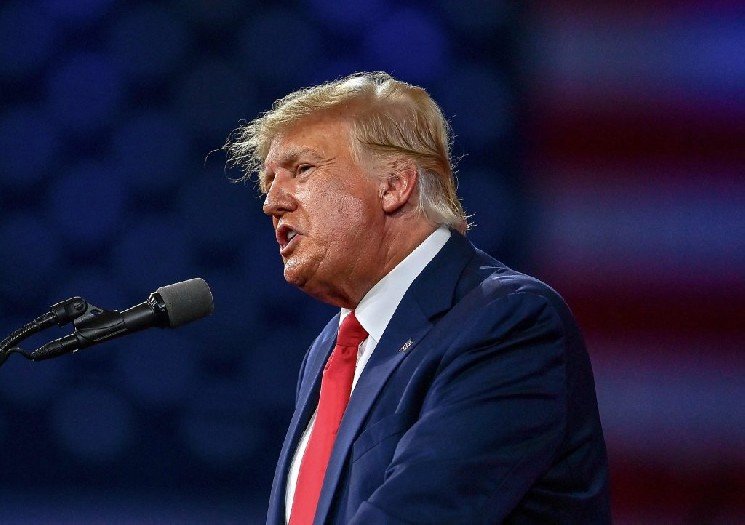
Trump gave a 45-minute keynote in which he vowed he would not let banks derail the Clarity Act. “The crypto industry was created in America, its growth has been led by America, and its future will be made in America,” he said. He also touched on AI, the Iran war, and Trump-branded sneakers.
The token fell 14% on Saturday despite the event. $TRUMP is now down nearly 47% year-to-date and more than 90% from its January 2025 peak. Meanwhile, Reuters separately found that the Trump family has taken in more than $1 billion from crypto asset sales, including at least $336 million tied to meme coin sales in the first half of 2025.
Token holders are losing, while the Trump family is winning…
🌎 Macro Crypto and Markets
Crypto majors are slightly red after an overnight selloff; BTC -0.4% at $77.8k; ETH -0.7% at $2,320; SOL -2% at $85; HYPE +3% at $42.4
Stable (+8%), Pengu (+6%), and JUP (+5%) led top movers
Oil -1% at $95; Gold +0.1% at $4,710
Stock futures are flat ahead of the Monday open
Bitcoin notched its highest weekly close since January last night at $78,450
Chainlink listed its Data Feeds, Data Streams, and Proof of Reserve services on the AWS Marketplace Thursday, giving millions of AWS developers direct access to blockchain oracle infrastructure through standard cloud procurement
More quantum progress as an independent researcher broke a 15-bit elliptic curve cryptography key on a publicly accessible IBM quantum computer Thursday, winning Project Eleven’s 1 BTC Q-Day Prize
Corporate Treasuries & ETFs
The Bitcoin ETFssaw $14M in net inflows on Friday, with $813M in total for the past week; the ETH ETFs saw $23M in inflows and $155M in total for the week
Metaplanet issued 8 billion yen (~$50M) in zero-interest bonds Thursday, its 20th consecutive bond issuance, with proceeds going directly to Bitcoin purchases
Henry (+100%), Belka (+100%) and Cards (+30%) led notable movers
💰 Token, Airdrop & Protocol Tracker
Werstern Unionis going to launch its stablecoin USDPT on Solana next month
Litecoin suffered a 13-block chain reorganization Saturday, reversing roughly 32 minutes of network activity after attackers exploited a vulnerability in its MimbleWimble Extension Block (MWEB) privacy layer to push invalid transactions through unpatched mining nodes
🚚 What is happening in NFTs?
NFT leaders were very green on the wek, up 15-20%; Punks +6% at 31 ETH, BAYC +22% at 9.6 ETH, Pudgy +20% at 5.26 ETH; Hypurr’s -6% at 365 HYPE
Nouns (+240%), BAKC (+50%), MAYC (+40%) and Azuki (+40%) were notable weekly winners
There were multiple 6-figure NFT sales in the past week spanning gold Bored Apes, an Ether Rock, a Lost Robbie and 3 Skulls of Luci; there also was a $600,000 loan against an XCOPY “Last Selfie”
Daily Debrief Newsletter
Start every day with the top news stories right now, plus original features, a podcast, videos and more.
Islamabad, Pakistan – Iranian Foreign Minister Abbas Araghchi has discussed with regional interlocutors a proposal aimed at reopening the Strait of Hormuz but deferring talks with the US on Tehran’s nuclear programme for later, during a 72-hour diplomatic sprint across three countries seemingly aimed at securing a broader buy-in for the plan.
Araghchi on Monday met with Russian President Vladimir Putin in St Petersburg, after visiting Islamabad twice in two days – the two trips sandwiching a meeting in Muscat, Oman. Sources close to these diplomatic efforts told Al Jazeera that senior intelligence officials from several countries were present at the Muscat talks.
Recommended Stories
list of 4 itemsend of list
Discussions in Muscat focused on the Strait of Hormuz, regional security guarantees, and the framework for a potential settlement, with nuclear-related issues set aside for a later stage.
Iran officially submitted its latest proposal to end the war with the US to Pakistan, which is transmitting messages between Tehran and Washington after direct talks on April 11 in Islamabad failed to deliver a breakthrough.
The White House has not confirmed the contents of the Iranian proposal, also reported by the Associated Press. Spokeswoman Olivia Wales said the US “will not negotiate through the press” and would “only make a deal that puts the American people first, never allowing Iran to have a nuclear weapon”.
But it is unclear whether US President Donald Trump will accept the Iranian proposal to push back nuclear negotiations. Speaking to Fox News on Sunday, Trump said Iran already knew what was required.
“They cannot have a nuclear weapon. Otherwise, there’s no reason to meet,” he said, adding that Tehran was welcome to reach out. “You know there is a telephone. We have nice, secure lines.”
The latest diplomatic efforts are unfolding against a ticking clock.
Under the 1973 War Powers Resolution, Trump faces a May 1 deadline to obtain congressional authorisation to continue military operations against Iran, now in their ninth week. A fourth bipartisan Senate bid to invoke the resolution was defeated 52-47 on April 15. Republican lawmakers have largely backed Trump so far, but several have said that support will not extend beyond the 60-day window without formal congressional approval.
Pakistan at the centre
During the first of his two visits to Islamabad, Araghchi on Monday met Pakistan’s Prime Minister Shehbaz Sharif, Deputy Prime Minister and Foreign Minister Ishaq Dar, and Army Chief Field Marshal Asim Munir.
He then travelled to Muscat, and returned to Pakistan on Sunday, meeting Munir again before departing for Moscow.
Araghchi said in a message on social media after his departure that Pakistan had “played an important role in mediating negotiations between Iran and the United States recently”, adding that “incorrect approaches and excessive demands of the United States” had prevented the previous round of talks from achieving its objectives despite “some progress”.
Senior Pakistani officials familiar with the discussions said Islamabad would continue its efforts as an honest facilitator.
Iranian state media, however, struck a firmer tone.
The Fars News Agency, close to Iran’s Islamic Revolutionary Guard Corps (IRGC), said Araghchi had relayed messages through Pakistan outlining Tehran’s red lines on nuclear issues and the Strait of Hormuz. These, it said, were “an initiative by Iran to clarify the regional situation”.
Aizaz Chaudhry, a former Pakistani foreign minister, said the conduct of the talks had been notable in itself.
“I have seen a commendable display of confidentiality. This is a disciplined and professional method to conduct these talks,” he told Al Jazeera.
A widening circle
Beyond visits to Pakistan, Oman and Russia, Araghchi held telephone calls with the foreign ministers of Qatar, Saudi Arabia, Egypt and France over the past three days.
Iranian Foreign Minister Abbas Araghchi meets with Omani Foreign Minister Badr Albusaidi in Muscat, Oman on April 12, 2025 [Handout/Iranian Ministry of Foreign Affairs via Reuters]
Qatar’s Prime Minister Sheikh Mohammed bin Abdulrahman bin Jassim Al Thani spoke directly with Araghchi, warning that sea lanes must not become “a bargaining chip or pressure tactic”.
Saudi Foreign Minister Prince Faisal bin Farhan Al Saud was briefed on “developments related to the ceasefire”. Egypt’s Foreign Minister Badr Abdelatty spoke with both his Qatari and Iranian counterparts. France’s Jean-Noel Barrot insisted that Europe had played a “constructive role” in the crisis.
After the meeting in Muscat, Oman’s Foreign Minister Badr Albusaidi called for “practical solutions to ensure lasting freedom of navigation”.
Dania Thafer, executive director of the Gulf International Forum, said the flurry of calls pointed to cautious engagement rather than strategic realignment.
“Although Iranian leadership did not physically visit Qatar or Saudi Arabia, there were phone calls, and that indicates a willingness to maintain contact without a full diplomatic embrace,” she told Al Jazeera.
Prior to the fragile ceasefire currently in place, Iran had fired a daily barrage of missiles and drones at Saudi Arabia, Qatar and other Gulf countries, angering them. Still, Qatar, Oman and Saudi Arabia have indicated a desire to pursue diplomacy over retaliation – if Iran commits to not attacking them again.
At the same time, the closure of the Strait of Hormuz has effectively choked a bulk of their energy exports.
“Among regional players, the most emphasised topic by far is the Strait of Hormuz and maritime security,” said Thafer.
Reza Afzal, an Iranian journalist and political analyst, said the Gulf states’ posture had shifted since 2015.
“Countries that had opposed the nuclear deal [JCPOA] at the time now understand that a guaranteed agreement with Iran served their interests, particularly after Iranian military actions during the war highlighted the costs of sustained hostility,” he told Al Jazeera.
Chaudhry, the former Pakistani diplomat, said the current conversations extended beyond any single issue.
“This is not just necessarily about nuclear issues, but mainly about how this war will eventually end and what happens after that, what security architecture we can expect. These are the conversations everybody is having,” he told Al Jazeera.
Russia’s quiet presence
Iran’s ambassador to Russia, Kazem Jalali, confirmed Araghchi’s Moscow visit would cover “the latest status of negotiations, the ceasefire and surrounding developments”.
Russian President Vladimir Putin, left, greets Ambassador of Iran to Russia Kazem Jalali, right, and Iranian Foreign Minister Abbas Araghchi, centre, prior to their talks at the Kremlin in Moscow, Russia, June 23, 2025 [Alexander Kazakov/Sputnik/Kremlin Pool Photo via AP Photo]
Iranian President Masoud Pezeshkian has spoken with Putin three times since the war began. Jalali described the trip in ideological terms, positioning Iran and Russia as standing in a “united front” against what he called “the world’s totalitarian forces”.
Taimur Khan, a research associate at the Institute of Strategic Studies Islamabad, said Russia brought three key assets, from Iran’s perspective: a long-standing strategic relationship with Tehran, a veto on the United Nations Security Council, and a technical role in the original nuclear deal.
“Moscow cannot guarantee US sanctions relief, nor can it substitute for direct US-Iran understandings. Its value is more as a diplomatic stabiliser, technical facilitator and geopolitical counterweight,” Khan told Al Jazeera.
Tehran-based analyst Javad Heiran-Nia said the Moscow visit also appeared to address more specific concerns alongside the broader diplomacy.
“The trip was likely linked to questions around Iran’s enriched uranium stockpiles and military cooperation between Tehran and Moscow,” the analyst said. Russia has offered to take over Iran’s enriched uranium.
The JCPOA lesson
Behind Araghchi’s outreach lies a structural lesson that analysts say Tehran has drawn from the collapse of the 2015 nuclear deal.
When Trump withdrew from the Joint Comprehensive Plan of Action (JCPOA) during his first term in 2018, Iran was left without regional backing and without a guarantor capable of holding Washington to its commitments.
Khan said Tehran had drawn lessons from that experience.
“European states, who were part of the JCPOA negotiations, also cannot be reliably depended upon in times of crisis,” he said. “FM Araghchi’s outreach appears to be part of a hedging strategy to build diplomatic insulation, reassure neighbours, and create a wider constituency against escalation.”
Jauhar Saleem, a former ambassador and president of the Institute of Regional Studies in Islamabad, said Iran’s calculation was also tactical.
“Ideally, Iran would not want a deal vulnerable to the US election cycle,” he told Al Jazeera.
Tehran, he said, appeared to be playing a longer game. “This strategy also fits well with Iran’s waiting game tactic in the face of what they perceive as US desperation for a quick exit.”
Heiran-Nia offered a contrasting historical perspective. Unlike during the original negotiations, he said, Gulf Arab states had supported diplomacy even before the 12-day war in 2025.
“Even at the time of the JCPOA’s conclusion, the Gulf Arabs, especially Saudi Arabia, had shown serious opposition,” he told Al Jazeera.
Mehran Kamrava, professor of government at Georgetown University in Qatar, said the current outreach should be seen as part of a longer trajectory of Iranian relationship-building with Gulf states in recent years.
The gaps
To be sure, Iran’s outreach only matters if the US agrees to a deal, analysts point out.
Trump cancelled a planned Islamabad visit by envoys Steve Witkoff and Jared Kushner on Saturday, saying Iran had “offered a lot, but not enough”.
He also said China could “help a lot more” on Iran. Trump is scheduled to meet President Xi Jinping in Beijing on May 14-15.
Thafer said a broader accommodation remained distant.
“What Iran is asking for goes well beyond a deal on the strait. It is asking for full regional realignment, and that is something the Gulf states are unwilling to offer, particularly after these attacks,” she told Al Jazeera.
Afzal, the journalist, said the domestic Iranian dimension on Hormuz was often underestimated. Public opinion inside Iran, he said, opposed any reopening of the strait without tangible concessions. “Tehran would continue to use the strait as leverage until Washington agreed to compromise,” he told Al Jazeera.
Several deadlines are now converging: the May 1 War Powers threshold, Trump’s China visit, and the approaching Hajj season.
With millions of pilgrims expected in Saudi Arabia in late May, Riyadh’s diplomatic and logistical bandwidth will be constrained, making any escalation during that period particularly costly for a Gulf state that is both a key interlocutor and the custodian of Islam’s holiest sites.
Senior Pakistani officials said that Islamabad remained ready to host another round of formal talks, but that substantive negotiations were likely to continue out of public view, with visible engagement reserved for when a deal is within reach.
“They [the Gulf countries] are in a tight corner and may have to walk a tightrope, both strategically and diplomatically,” Saleem told Al Jazeera.
The prime minister says the federal government will put up money alongside private investors to fund major projects.
Published On 27 Apr 202627 Apr 2026
Canadian Prime Minister Mark Carney says his government is developing a government-owned investment fund.
Carney said on Monday that the fund, a first for the country, will invest in major Canadian industrial projects in areas such as energy, infrastructure, mining, agriculture and technology. It will begin at 25 billion Canadian dollars (US$18bn).
Recommended Stories
list of 4 itemsend of list
The prime minister said the federal government will put up funds alongside private investors. The money will help finance major projects that Carney’s government is focused on building as Canada seeks to diversify away from the United States.
US President Donald Trump has threatened Canada’s economy and sovereignty with tariffs and claims that Canada could be “the 51st state” in the US.
Carney is a former central banker in England and Canada as well as chairman of the board of directors for Bloomberg.
“We take a lesson from other jurisdictions that had the foresight many decades ago to start sovereign wealth funds,” Carney said. “In some cases, they began with a domestic focus then outgrew the scale of the domestic focus.”
Sovereign wealth funds invest in assets, such as stocks, bonds and real estate. They are typically funded by a country’s budgetary surpluses, which Canada currently does not have. The announcement came a day before Carney’s government announces its spring economic update.
There are more than 90 sovereign wealth funds around the world. They manage more than $8 trillion in assets, according to the International Forum of Sovereign Wealth Funds, a London-based organisation made up of roughly 50 of these entities.
Trump ordered the creation of a US sovereign wealth fund last year. In the US, more than 20 sovereign wealth funds exist at the state level, according to an analysis from the Center for Global Development, a Washington, DC-based nonpartisan think tank.
Dylan Carter, who appeared in Season 24 of the singing competition “The Voice,” died in a car accident in South Carolina on Saturday night. He was 24.
“Our family is heartbroken to hear about the passing of Dylan Carter in a car accident,” wrote Thomas Hamilton Jr., the mayor of Moncks Corner, S.C. “As a gifted singer, he frequently entertained our community with his performances at Town events. His kindness and charm earned him immense respect, and his absence will be deeply felt. To the loved ones and acquaintances of Dylan, we offer our sincerest condolences during this difficult period. The Town of Moncks Corner, its Council, and entire staff extend their deepest sympathies. He was much more to our family than an entertainer he was our friend and we are deeply saddened.”
During his blind audition on “The Voice,” Carter made the four judges, Reba McEntire, Niall Horan, John Legend and Gwen Stefani, all turn their chairs around. He sang Whitney Houston’s “I Look to You” in tribute to his mother, who had died a year earlier. Carter joined McEntire’s team and was later eliminated in Episode 12 after singing country artist Cody Johnson’s song “Til You Can’t.”
Carter also co-founded a non-profit in his community called The Local Voice, which aided women fighting breast cancer. He performed at fundraising events for the charity.
“With heavy hearts we share the passing of Dylan Carter, co-founder of The Local Voice, talented musician, and someone who meant so much to our community,” the non-profit wrote on Facebook. “Dylan was the heart of what we do. He believed every voice matters and lived that every day. Through his music, his kindness, and his smile, he brought people together and made everyone feel seen. A proud Lowcountry native, Dylan also owned Sunny Days RV & Campground and worked as a realtor, always helping others find a place to belong. We are heartbroken, but find comfort knowing he is in heaven with his mother. We are so grateful for Dylan, for the love he gave this community, and for the impact he leaves behind. We will carry his light forward and continue this mission in his honor. Please keep his family in your prayers in the coming weeks as they navigate this tremendous loss.”