Ross White and Tom Berkeley, the filmmaking duo behind the Oscar and BAFTA winning short film “An Irish Goodbye,” have teamed up with Studiocanal, Working Title, Parkville Pictures and Film4 for their feature debut and landed two hugely in-demand stars as their leads.
“The End of the World as We Know It” will see BAFTA winner Jack O’Connell (“Ink”) and BAFTA nominee Odessa A’zion (“Marty Supreme”) play a pair of star-crossed loners who meet on an epic pilgrimage to prove the earth is flat.
Described as an “unlikely adventure in truth and love,” the film is being written and directed by Berkeley and White, with production set to begin Canada in November. Tim Bevan and Eric Fellner produce for Working Title Films, while producing for Parkville is Olivier Kaempfer (who previously worked with Studiocanal to produce the recent TIFF-bowing dark comedy “Everybody Wants to F— Me” starring Taron Egerton and with Working Title on the rom-com “Finding Emily,” released earlier this year by Focus).
“The End of the World as We Know It” is fully financed by Studiocanal. Film4 will co-finance and executive produce. Anna Marsh, Ron Halpern and Joe Naftalin will executive produce for Studiocanal. Katherine Pomfret and Thea Paulett will executive produce for Working Title. Amanda Drake of Notable Studios is EP. Studiocanal will release the film theatrically in its territories of the U.K., France, Germany, Italy, Poland, Benelux, Australia and New Zealand, and is also handling worldwide sales.
“’The End of the World as We Know It’ is a story we discovered hiding in the strangest of places, but one that seemed to speak profoundly to our collective search for meaning, belonging and love in an increasingly disparate world,” said Berkeley and White. “We feel intensely lucky to have the inimitable Jack O’Connell and Odessa A’zion bringing these star-crossed loners to life and, with the backing of the wonderful teams at Studiocanal, Working Title, Parkville and Film4, we can’t wait to take audiences on their unique, cinematic journey.”
White and Berkeley’s short black comedy “An Irish Goodbye,” starring Seamus O’Hara, James Martin, Paddy Jenkins and Michelle Fairley, became an awards season smash after playing in more than 60 international film festivals in 2022 and 2023. Following two estranged brothers who reunite in rural Northern Ireland following their mother’s death, the film went on to win the 2023 Academy Award for Best Live Action Short, the BAFTA award for Best British Short Film and the IFTA Award for best short film.
Tom Berkeley and Ross White
Getty Images
“End of the World as We Know It” sees Studiocanal reunite with long time collaborators Working Title following the recent global release of “Pressure.” Working Titles other recent releases including “Sense and Sensibility,” “Finding Emily,” “The Sheep Detectives,” “Crime 101,” “Goodbye June,” “Bridget Jones: Mad About the Boy,” “The Substance,” and upcoming title “Werwulf.”
Studiocanal’s upcoming slate includes Danny Boyle’s “Ink,” which opened the Venice Film Festival, “Elsinore,” starring Andrew Scott and already amassing predictions as an award season frontrunner, and “Everybody Wants to F— Me,” due for release in 2027. Alongside “Ink,” which launches in the U.S. on Dec. 11, Studiocanal also released the O’Connell-led “’71” in the U.K. in 2014 and produced “Back to Black,” in which he starred alongside Marisa Abela.
Enjoying something of career highpoint at the moment, O’Connell has several major titles incoming, including John Krasinski’s “A Quiet Place Part III” opposite Emily Blunt and Cillian Murphy, and Grant Sputore’s “Godzilla x Kong: Supernova,” the latest chapter in Legendary’s Monsterverse, alongside Dan Stevens, Kaitlyn Dever and the late Sam Neill. He represented by Conway Van Gelder Grant in the U.K. and UTA and Range Media Partners in the US
Since breaking out in “Marty Supreme,” A’zion landed a series regular role on Rachel Sennott’s HBO series “I Love LA” and will next star alongside Naomi Watts, Sarah Paulson, Dianne Wiest and Toby Wallace in Cody Fern’s directorial debut “Mother Courage,” and also in Justine Triet’s upcoming comedy “Fonda” alongside Andrew Scott, Allison Janey, Benedict Wong and Cherry Jones. She is represented by UTA, Luber Roklin, Granderson Des Rochers, and The Lede Company.
Berkeley and White are represented by Francesca Devas at Independent Talent and Craig Kestel and Marco Alvarez at WME.
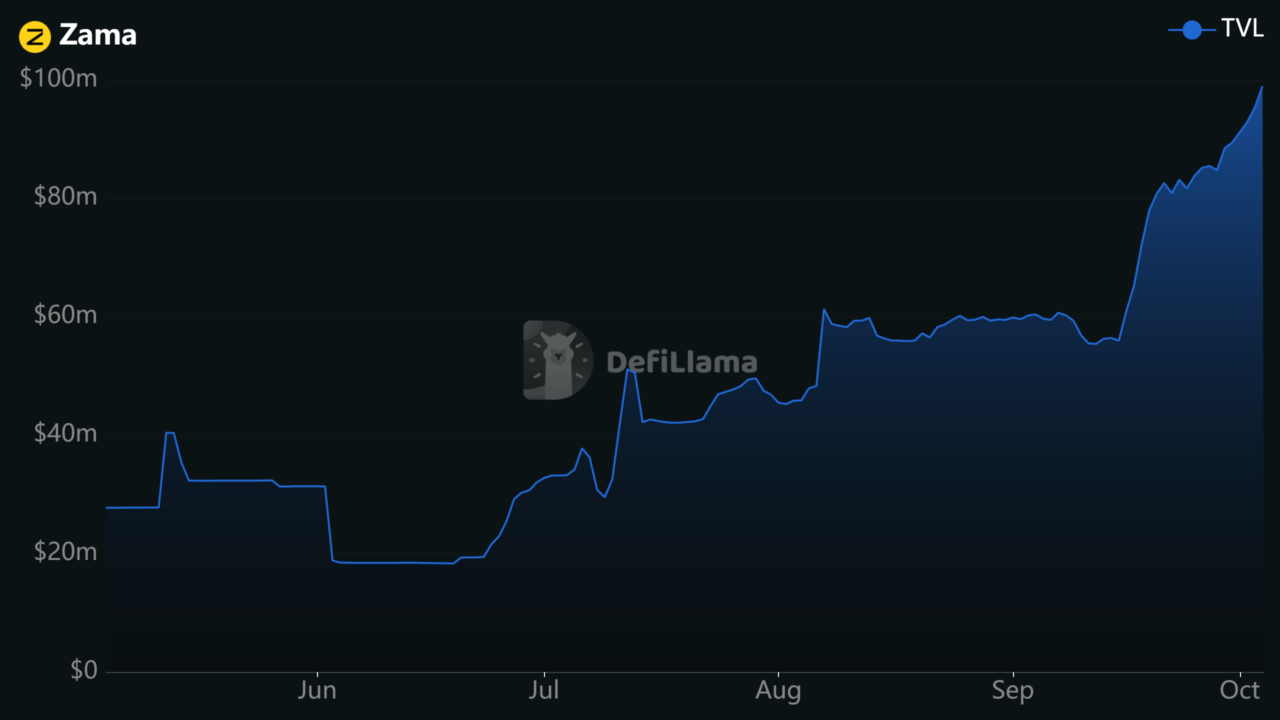
One of the biggest factors standing out behind the latest advance is the continued growth of the $ZAMA ecosystem.The network’s Total Value Locked (TVL) has climbed to a new all-time high at $99 million, indicating that more capital is being committed to the protocol.
Moreover, growth across Morpho vault expansion and Zama Swap has contributed to the increase, pointing to improving ecosystem usage and stronger investor confidence.
Source: DeFiLlama
Derivatives activity supports the breakout
Besides the position long-term and holders sentiments, market participation has also strengthened across both spot and derivatives markets.
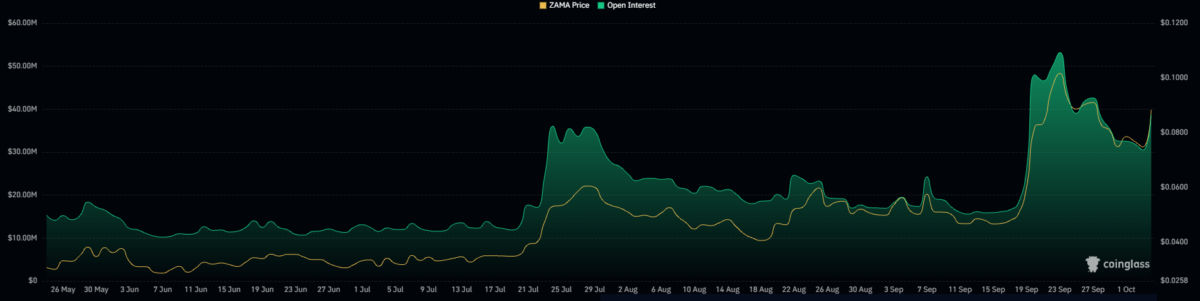
The network’s open Interest has spiked by more than 29% to $38.71 million. This suggests fresh capital is entering the futures market. As a result, traders position for further bullish advances.
Source: CoinGlass
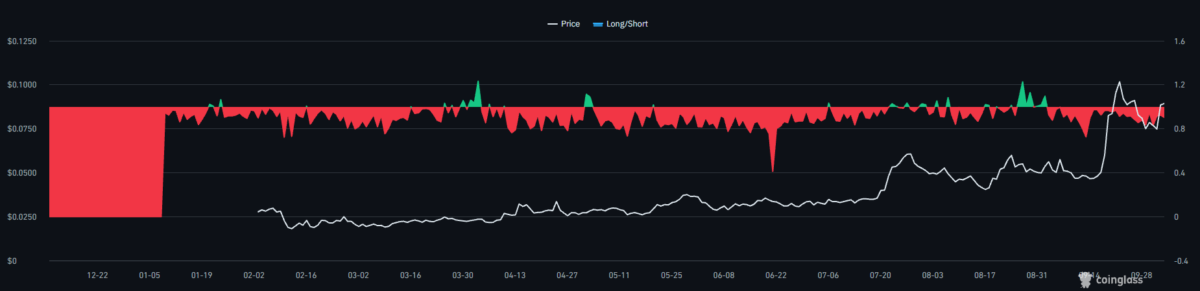
Among the open leveraged positions short slightly have the upper hand. At the time of writing , the token’s long/short ratio stood at 0.94.
Source: CoinGlass
Despite the cautionary signals from the shorts’ slight dominance, both spot and futures trading volumes surged by more than 100% over the past 24 hours, highlighting broad-based demand from different classes of market participants.
The network spot volume had surged by 140% to $115 million while its spot volume surged by 140% to $65 million.
Source: CoinGlass
Can $ZAMA reclaim $0.108?
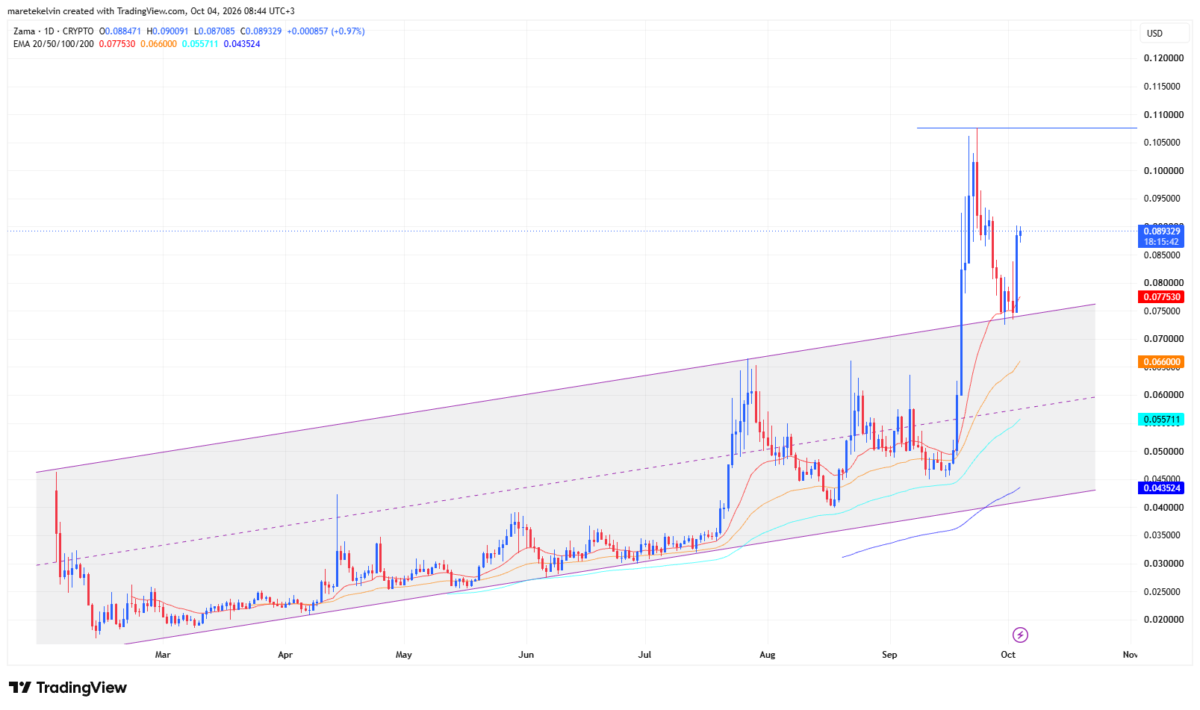
On the daily chart, the next major technical objective for bulls sits around the $0.108 swing high. A continued expansion in TVL, sustained growth in Open Interest and elevated trading activity could provide the momentum needed for buyers to challenge that level.
However, after a rapid 17% advance, a short-term profit-taking before the next bullish push could be on cards. This is more so given that short dominance among the leveraged position giving a hint.
All in all, the long term structure leans to the bulls favor and most fundamentals and on-chain metrics support an extended bullish momentum in the long run.
Chainalysis attributed the $387 million Bitget hack to North Korea-linked actors, saying it pushed Pyongyang’s 2026 crypto theft total past $1 billion.
Within three hours, the funds moved across 23 transfers onto Ethereum (49.7%), XRP (40.8%), Zcash (7.6%) and Tron (1.8%).
The firm said it used in-house AI to accelerate tracing—compressing 20+ hours of work into minutes—echoing earlier DPRK assessments from Bitget’s CEO and Elliptic.
Blockchain analytics firm Chainalysis has pinned last month’s $387 million Bitget exchange hack on North Korea, adding its weight to a growing consensus that Pyongyang’s hackers were behind one of the year’s largest crypto thefts.
In a report published Wednesday, Chainalysis attributed the Sept. 24 breach to actors tied to the Democratic People’s Republic of Korea, saying the heist pushed the total value of crypto stolen by North Korea-linked groups in 2026 past $1 billion.
The firm said it had been working with Bitget and law enforcement to trace the funds across multiple blockchains since the attack.
Chainalysis laid out how quickly the money moved. In the first three hours, $387 million left Bitget across 23 transfers and landed on four networks: Ethereum, which took nearly half at 49.7%, followed by XRP at 40.8%, Zcash at 7.6% and Tron at 1.8%.
From there, the attackers ran the funds through cross-chain liquidity and messaging protocols, instant swaps, and laundering services to obscure the trail.
The stolen XRP drew particular attention. Rather than routing it to an exchange, the attackers pushed it through a cross-chain liquidity protocol and pulled Bitcoin out the other side, with tens of millions of dollars moving that way over roughly a day and a half before reaching attacker-controlled Bitcoin addresses now under watch.
BitcoinBTC · USD
$86,078+3.61%
Sep 28Sep 30Oct 2Oct 3Oct 5
$86.8k$85.5k$84.2k$83.0k
24h HighHigh$86,949
24h LowLow$85,098
VolVol$1.1B
Market projectionsOdds by Myriad
→
Notably, Chainalysis said it leaned on in-house AI to keep pace, building custom automation that compressed what it estimated as more than 20 hours of manual bridge reconciliation into under 10 minutes.
The firm stressed the technology accelerated its investigators rather than replacing them, with humans still directing the work.
The attribution echoes earlier assessments. Bitget CEO Gracy Chen said the attack’s patterns matched North Korean hackers, and the blockchain analytics firm Elliptic called a DPRK link “highly likely.”
The hacker’s crypto laundering has played out in public, with eagle-eyed sleuths tracking every move. The attacker began hiding funds in Zcash’s shielded pool, while swap services split in their response: Near Intents rejected more than $50 million in swaps tied to the hacker, only to be hacked itself days later, while Thorchain kept processing.
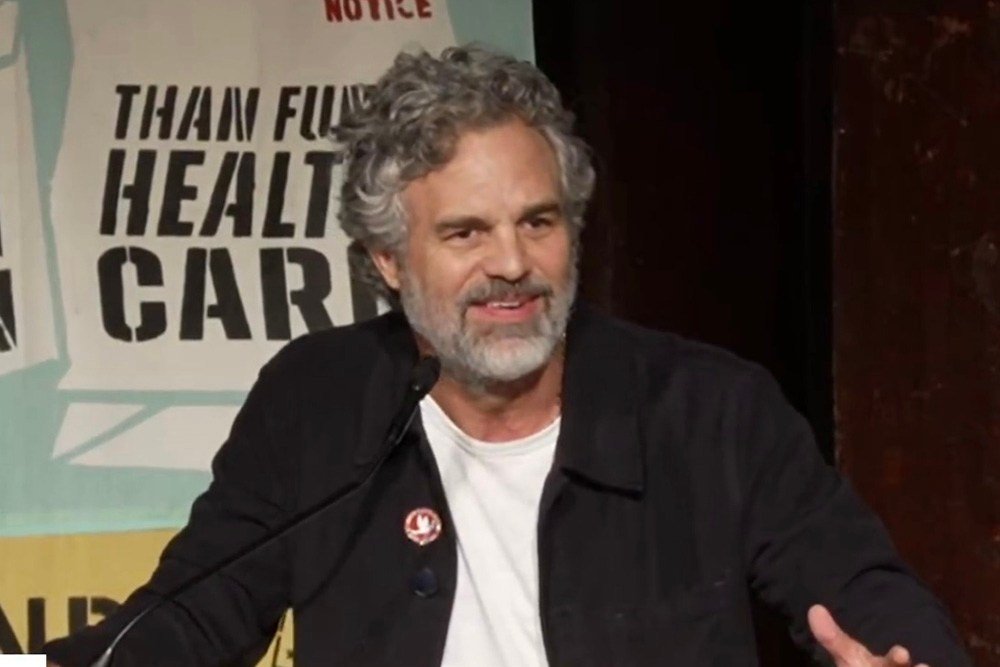
Mark Ruffalo made a passionate speech at a Hands Off Our Vote event in New York City on Sunday night, slamming U.S. President Donald Trump and saying he’s going to “Hulk out” if he attempts to restrict voting in the upcoming midterm elections.
The midterms are set to take place on Nov. 3 and could have a large impact on U.S. politics, giving Democrats the chance to take back control of Congress and curb Trump’s agenda. The Hands Off Our Vote rally on Sunday was meant to mobilize voters and also featured speeches from Robert De Niro and Mo Amer.
Taking the podium at the event, Ruffalo began: “This is a big, big deal, this election. There’s a lot hanging in the balance. And we all know that we’re going to kick their asses — but we all know that they’re going to steal it. They’re going to do everything in their power, and it isn’t going to be over the night we all win.”
The “Avengers” and “Spotlight” actor then pointed out the issue of cybersecurity in voting, calling out Elon Musk in the process. “We need to be on guard for what we may not see coming: Elon,” he said. “That’s the cybersecurity of these elections. And while I’m not an expert, I’ve been talking to experts. And the one thing I’ve heard repeatedly is that there is a vulnerability of the votes when they’re transferred from the polling places to the county headquarters and then to the states.”
In order to counter this, Ruffalo encouraged voters to join the organization Free Speech for People in challenging insecure voting systems to make sure election results are as accurate as possible and “safe from any domestic or foreign interference,” as he put it.
Ruffalo then turned his attention to Trump, saying: “We gotta get this dumbass, fool ass, tired ass, lame ass, duck ass out of office. We got to make him a lame duck! We have to stop his policies now. Another two years of this, and who knows what he’ll be doing? He’s calling to throw Democrats out of the country. And he means it! The guy means everything he says. I know we’re all tired, we are so tired, but we can’t give up now … They’re going to try and stop us from taking our country back, and we’re not going to let ’em. Trump, we’re not letting you! Hands off our fucking vote!”
At that moment, a person in the crowd yelled out, “You tell ’em, Hulk!” — referring to Ruffalo’s role in the Marvel Cinematic Universe as the giant green superhero.
Ruffalo laughed and responded, “I’m gonna Hulk out. You won’t like me when I’m angry.” He paused and added: “Hey, I’m still here! They thought I was out for the count — I’m still here, I’m still playing the Hulk.”
He concluded his speech by telling the crowd not to be afraid or intimidated — and to, of course, get out and vote.
“We can’t hide. We have to be together and we have to fight for each other and we have to be brave. Our time to be brave is coming, I’m telling you brothers and sisters,” he said. “They’re going to do everything they can to keep us in our homes. They’re going to do everything they can to make us feel small. They’re going to do everything they can to make us feel lost, to make it feel inevitable. It’s not inevitable! We’re inevitable — the truth is inevitable.”
Ruffalo is no stranger to speaking out for what he believes in. His appearance at the Hands Off Our Vote event comes just over a month after he caused controversy with his criticism of the Paramount-Warner Bros. merger, which has now been approved and is expected to close this week.
In late August, he shared a clip on Instagram of Paramount board member Safra Catz outlining “really profoundly scary technologies” that Oracle — the tech giant co-founded by Larry Ellison, father of Paramount Skydance CEO David Ellison, who is involved in the merger’s financing — used to help the Israeli military after the Oct. 7 terror attack. He also likened Larry Ellison to a “classic oligarch” and warned of the consequences if Paramount and Warner Bros. are allowed to merge, alleging that the Ellisons “are crushing workers and consolidating the wealth of the world for their own power and concentrated dominance.”
In response, Paramount accused Ruffalo of invoking “antisemitic tropes,” and he was also called out by Jewish advocacy groups. Ruffalo denied the accusation, saying in a statement that it was “appalling and fundamentally dishonest.”
After the news that the merger had closed last week, Ruffalo once again spoke out against it. “This merger will stifle creativity, weaken free speech, and cost people their jobs — it is a bad deal for this country and should never have been approved,” he wrote. “This is an incredibly disappointing outcome for the hundreds of thousands of us who stood up to block it, but it’s also not the end. This grassroots movement isn’t going to fade away and neither is our resolve.”
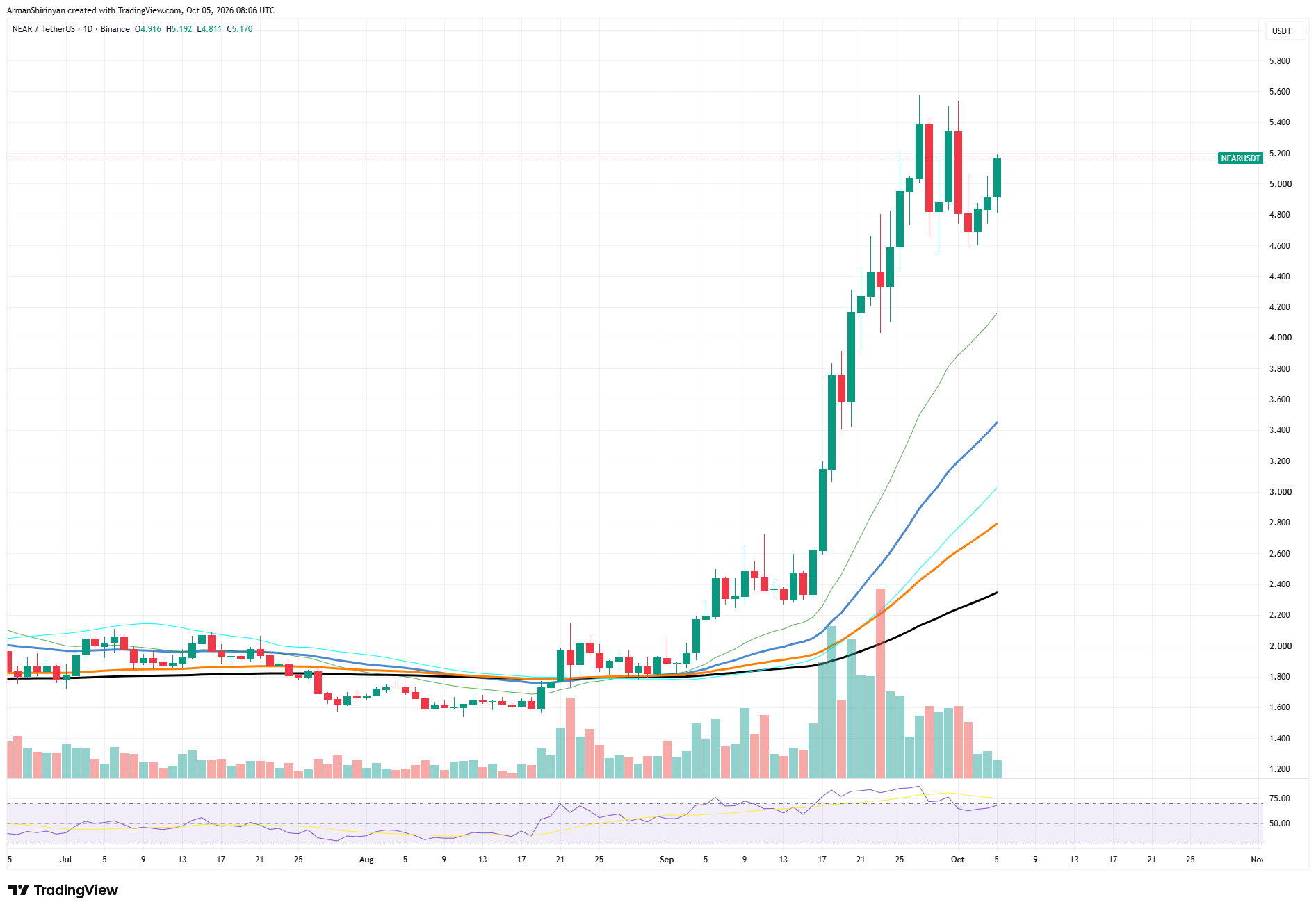
Such a breakout could reopen the path toward $6.00 and potentially extend the current price-discovery phase.
Momentum remains elevated but has cooled from extreme conditions. The daily RSI previously pushed into overbought territory above 70 during the vertical portion of the rally. It has since retreated before beginning to turn upward again. This reset is constructive because $NEAR managed to reduce its momentum excess without giving back most of the gains from the September advance.
Heavy Long-Term Trend Extension
The moving-average structure also remains strongly bullish. Price trades far above all major averages, while the shorter-term averages continue rising rapidly. The downside is that $NEAR remains heavily extended from its longer-term trend, increasing the probability of violent corrections even if the broader uptrend survives.
For now, $4.60 is the critical support level. Losing that level would weaken the latest reversal and expose approximately $4.20, followed by the rapidly rising short-term moving average. Conversely, holding above $5.00 and breaking $5.60 would confirm that buyers have regained control.
$NEAR‘s rally therefore does not appear technically exhausted yet. But after a move of more than 200% from the August lows, continuation increasingly depends on converting the $5.40–$5.60 supply zone into support rather than simply maintaining bullish momentum.
The subsequent recovery is what makes Brandt’s chart interesting. $XRP rebounded rapidly toward $1.60–$1.65 and has since moved sideways around $1.50. This consolidation could potentially serve as the “handle” portion of the formation, although confirmation remains absent while $XRP trades below Brandt’s $1.6572 resistance.
The daily chart provides some support for the bullish interpretation. $XRP remains comfortably above its major moving averages, including short-term support around $1.45 and a cluster of longer-term averages around $1.35–$1.40. The earlier descending trend line has also been broken, removing one of the major technical barriers that constrained $XRP throughout September.
Momentum is relatively healthy. The RSI sits in neutral-to-bullish territory rather than returning to the heavily overbought state seen during the August breakout. That gives buyers some room if another growth period starts.
$XRP rises again
However, $1.65–$1.66 remains the decisive barrier. $XRP has already produced several upper wicks around this area, indicating that sellers remain active. A convincing daily breakout above $1.6572 would strengthen the cup-and-handle interpretation and could put the August high around $1.70 back into focus. Beyond that, the psychological $2.00 level would become increasingly relevant.
Failure to break resistance would leave $XRP trapped inside its current range. Initial support sits around $1.48–$1.50, followed by approximately $1.45. Losing those levels could invalidate the developing handle and expose the $1.35–$1.40 region.
For now, Brandt’s cup reference looks less like a confirmed signal and more like a setup awaiting its trigger: $1.65.
The audio version of this article is generated by AI-based technology. Mispronunciations can occur. We are working with our partners to continually review and improve the results.
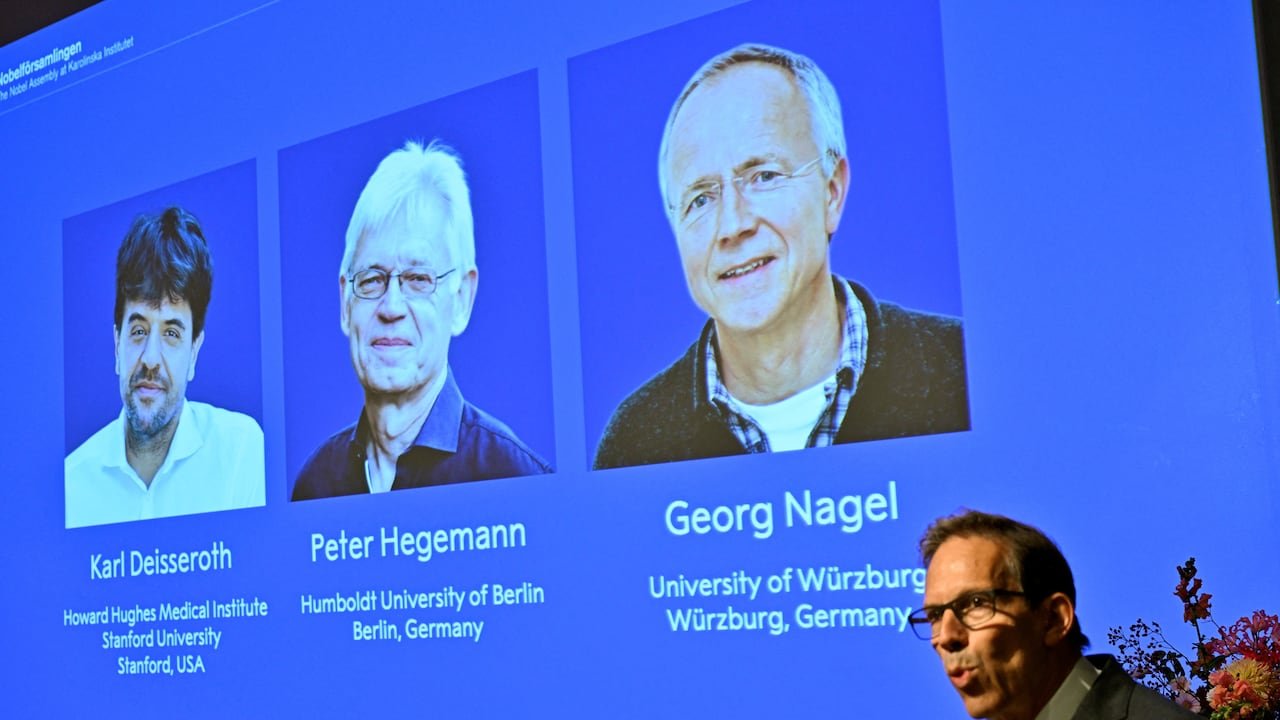
Scientists Karl Deisseroth, Peter Hegemann and Georg Nagel won the 2026 Nobel Prize in Physiology or Medicine for “discoveries concerning light-gated ion channels and optogenetics,” the award-giving body said Monday in Stockholm.
Optogenetics “makes it possible to switch on, or off, the activity of individual nerve cells in a living brain,” said Thomas Perlmann, secretary general of the Nobel Assembly at Karolinska Institutet.
“This method is now being used in laboratories around the world to reveal the brain’s mysteries,” he said.
Deisseroth, a 54-year-old American, Hegemann, a 71-year-old German, and Georg Nagel, a 73-year-old German, were all surprised to learn they had won, Perlmann said.
“All three said the same thing, that they thought it was absolutely wonderful to receive the prize with the other two, and they call them … friends. That it’s such an honour to receive them together. So that’s something they conveyed,” Perlmann said.
The Nobel Prizes come with a prize amount of 12 million Swedish crowns ($1.7 million Cdn), which the three scientists will split. Deisseroth is based at Stanford University in California, with Hegemann at Humboldt University in Berlin and Nagel at Germany’s University of Wurzburg.
In clinical trials, researchers are restoring vision to people blinded by a condition called retinitis pigmentosa by inserting a light-sensitive protein in the retina.
Researchers also hope optogenetics could improve cochlear implants, allowing more precise stimulation of the auditory nerve than current electrical devices.
Advancements over decades
In the early 1990s, Hegemann investigated how the alga Chlamydomonas reacts to light in half a millisecond. He hypothesized that a single protein captured light and acted as an ion channel. Nagel tested this by injecting Chlamydomonas genes into frog eggs, discovering channelrhodopsin-2 — an ion channel that opens when exposed to light.
In 2003, they published that this protein could be introduced into human and hamster cells to generate electrical impulses using light. In 2005, Deisseroth demonstrated the technique in rat nerve cells, and the method was named optogenetics a year later.
Prizes for chemistry and physics will be awarded Tuesday and Wednesday, literature on Thursday and the peace prize on Friday. The economics prize will be announced Oct. 12.
The Nobel Prize was created by wealthy Swedish chemist and entrepreneur Alfred Nobel, who in his will dictated that the bulk of his estate should be used to fund “prizes to those who, during the preceding year, have conferred the greatest benefit to humankind.”
A bust of Alfred Nobel in the Nobel Forum in Stockholm on Oct. 5, 2026. (Tom Little/Reuters)
Nobel is best known as the inventor of dynamite, but also wrote poetry and drama and could speak Russian, French, English and German by the age of 17. The five original prize categories reflect the interests closest to his heart.
Nobel died in 1896, with the first prizes bearing his name following five years later.
The Nobel prizes are presented to the laureates on Dec. 10, the anniversary of Nobel’s death.
On the surface, Nick Cholmsky looked like a thriving teenager.
Growing up in Ottawa, he says he was athletic and heavily involved in basketball, had friends and a close relationship with his family.
But underneath all that he says he was deeply depressed. The symptoms began in middle school and became much worse by Grade 11.
At 16, he had begun entertaining suicidal thoughts.
Nick Cholmsky, who grew up in Ottawa, experienced depression as a teen. He says online messaging encourages boys and men to stay silent about their psychological struggles. (CBC)
Even as his depression and anxiety grew stronger, Cholmsky believed he couldn’t say anything, because “being a man” meant pushing negative thoughts down, and that any sign of weakness would cause him shame.
“Looking back, so much of that [congenial attitude] was for sure just a performance, me acting the way I thought I was supposed to act as a man,” said Cholmsky, now 21.
There’s a common problem everywhere and it’s how men and boys are feeling. And they are not feeling great.– Federal Health Minister Marjorie Michel
Earlier this year, the federal government reported on a wide range of data showing that the mental health of young men has deteriorated since 2012. Between 2012 and 2022, the number of men aged 15 to 24 who self-reported mood disorders increased from 11 per cent to 16 per cent, while self-reported generalized anxiety disorders increased from four per cent to 10 per cent.
Those who reported their mental health as “very good” or “excellent” plummeted from 70 per cent to 52 per cent in that same time period.
A separate report shows that men are three times as likely as women to commit suicide and that it’s the second-leading cause of death in boys aged 15 to 34 (after unintentional injuries).
“There’s a common problem everywhere and it’s how men and boys are feeling. And they are not feeling great,” federal Health Minister Marjorie Michel told CBC News.
“There is a lot of anxiety [about] their role as men and boys.”
Social media use, gambling major issues
Research implicates a variety of factors in men’s depression, most prominently social isolation, social media use and online sports betting.
Data from the Canadian Medical Association Journal shows a huge rise in young men calling helplines with gambling addictions. (Health Canada reports men are three times more likely than women to have a gambling problem.)
Canada legalized single-event sports betting in 2021. In 2022, Ontario became the first province to allow private companies to operate alongside government-regulated industry.
A separate report released this month by the Institute for Clinical Evaluation Sciences (ICES) showed that since 2022, emergency room visits for gambling disorders had doubled — largely with young men showing up in a psychological crisis, such as suicidal ideation or psychosis, as a result of gambling losses.
“The gambling stats didn’t surprise me at all when I heard them,” said Cholmsky. “I saw kids in middle school gambling.”
WATCH | Investor and podcast Scott Galloway on male potential:
Scott Galloway on male potential
U.S. investor and podcaster Scott Galloway talks to CBC News about the impacts of the manosphere and the loss of ‘off-ramps to the middle class,’ and how young men are being impacted.
Whether the stress is the result of gambling or something else, Cholmsky says online messaging encourages boys and men to stay silent.
“When I was going through some of my worst mental health times, I was online a lot and it was really the height of Andrew Tate,” Cholmsky said.
The U.S.-born Tate is one of the best-known influencers in the manosphere, famous for espousing strict rules for being an alpha male, such as maximizing fitness, maintaining control over relationships and emotions and making as much money as possible.
He retains a large following despite being in U.S. detention on multiple criminal charges, including sex trafficking.
“[Tate’s] message, and a lot of that manosphere messaging for boys, is ‘be a man, be tough, make lots of money,’” Cholmsky said.
There are also trends like “looksmaxxing.” Influencer Braden Peters, also known as Clavicular, has amassed a huge following telling young boys sometimes to smash their own faces with hammers to be more conventionally beautiful. His content has more than 40 million likes. Peters was charged with rape last month.
Experts warn dangerous role models like this can have real-world impacts.
“The manosphere is radicalizing young boys who don’t know where they fit — and that should concern us all,” said John Oliffe, Canada research chair in men’s health promotion at the University of British Columbia.
Oliffe says this was “amplified” by the earliest parts of the COVID-19 pandemic when global lockdowns increased isolation and the loss of social connection. Vulnerable teenagers often found themselves lost online.
“There continues to be a whole world of pain in some of that unregulated content,” Oliffe said.
John Oliffe, Canada research chair in men’s health promotion at the University of British Columbia, says the radicalizing effects of the manosphere should worry us all. (Nav Rahi/CBC)
Adam Kunder, a 33-year-old former firefighter who lives in Toronto, says he also felt he needed to keep his problems quiet. He suffered mental health issues and hit “rock bottom” before beginning to find help in the summer of 2024.
“As a man, you think you are supposed to be strong, push any bad feelings down, suppress depression or sadness or fear,” he said.
Kunder says he has lost multiple friends to suicide and says you never would have known they were suffering.
Gender roles and ‘toxic masculinity’
Kunder said the world is changing in ways that are becoming confusing for many men.
The emphasis on women’s parity in the labour force and society, as well as a greater acceptance of non-traditional gender identities, has upended expectations.
“At one point we knew we were supposed to be the provider and protector, and the idea of ‘toxic masculinity’ wasn’t a thing,” he said.“I think men are really trying to figure out what it means to be a man in today’s world.”
WATCH | Why manosphere influencers appeal to young men:
Why ‘manosphere’ influencers are appealing to young men
Critic Amil Niazi joins Commotion with Elamin Abdelmahmoud to discuss Louis Theroux: Inside the Manosphere, a documentary about the online world of toxic masculinity, and examine the rising popularity of “manosphere” influencers among young men.
Oliffe pointed to other troubling patterns for young men.
“There are increasing lower rates of boys heading to universities, and very serious challenges in male-dominated industries such as construction, that as a society, we should not ignore.”
Oliffe said that while the trades offer good careers, they often see high rates of substance use and mental health issues, as the necessary physical labour and harsh working environments can “heighten these risks.”
Oliffe said that in the last decade, there has been “low government investment in men’s mental health.”
“I think the theme of silence is a very regrettable period in history, where on one side we talked about equity and inclusion, and then in effect ostracized 50 per cent of the population,” Oliffe said.
Health Minister Michel said that when she brought this issue to the federal cabinet, she was met with some resistance. Some colleagues told her it took “courage” to broach the mental health of boys and men, given it could even be politically risky to talk publicly about the issue.
“I said ‘courage’? This is not courage. We are ministers of health, it is our job to take care of the entire population,” she said.
“Men don’t know how to ask for help. And when they are struggling, they don’t know how to express it.”
Government strategy to come by early 2027
The federal government will soon launch its first-ever mental health strategy for boys and men.
The agency told CBC that some of what they hope to invest in will be “mentorship, peer support, sport and recreation,” while “promoting healthy relationships, positive social norms and safer online environments.”
Toronto resident Adam Kunder says he feels it’s his duty ‘to show up for men who are suffering and to hear them out and just let them know it’s all OK.’ (CBC)
For Robert Whitley, a men’s health expert and professor of psychiatry at McGill University in Montreal, part of the problem is the way society now views masculinity.
“Traditional masculinity has been denigrated in the popular mind whether it’s through the media, through influencers, through commentators,” he said. “The problem sometimes is a lack of masculinity.”
He says there’s a need for positive male role models.
“I’ve said many times before, it’s not a crisis of masculinity, there’s a crisis of mentorship,” said Whitley.
For example, data from Statistics Canada shows only 25 per cent of teachers across elementary and high school systems in Canada are men. And at the organizations that step in to fill the mentorship gap — like the Big Brothers and Big Sisters of Canada — 70 per cent of volunteers are women.
“We’re getting young men who are getting to the age of 18, 19, 20, who have never had a male role model in their lives,” Whitley said.
Kunder and Cholmsky both say their mental health began to recover after they started asking for help, and they’re now working to be role models for other young men.
“I feel like it’s my duty in a way to show up for men who are suffering and to hear them out and just let them know it’s all OK,” said Kunder, who coaches and works with other men.
Last month in Ottawa, Cholmsky was awarded top 21 under 21 for his work in mental health advocacy and challenging “harmful stereotypes around masculinity and mental health.”
“We all need to be doing our part to talk about this stuff,” he said.
The Justice Department argued that Donald Trump can legally ban CNN, MS NOW and Politico from the White House because he determined that they didn’t meet the “minimum requirements of professionalism.”
Last month, a federal judge granted the three outlets a temporary restraining order that forced the White House to reinstate dozens of their reporters’ hard passes. The outlets are now asking the judge to extend that 14-day order for a longer term via a preliminary injunction, claiming that Trump’s ban is a violation of their First and Fifth amendment rights.
U.S. District Judge Timothy Kelly, a Trump appointee, has said that he is bound by the precedent set in In a 1977 D.C. Circuit opinion, Sherrill vs. Knight, in which the judges ruled that “the protection afforded newsgathering under the First Amendment guarantee of freedom of the press requires that this access not be denied arbitrarily or for less than compelling reasons.”
In a court filing on Friday, the DOJ claimed that the Sherrill case still would allow for the president to restrict the three outlets from accessing the White House grounds because the White House has a “compelling interest.”
The DOJ lawyers claimed that the Sherrill decision does not “prevent the President from concluding that bona fide journalists would identify sources instead of relying on anonymous sources, commit to factual accuracy, and provide the White House an opportunity to comment, rather than ‘perform their duties in a way that … interfere[s] with the White House’s daily operations.’ …At a bare minimum, it is a significant violation of decorum to publish classified and sensitive national security information.”
The news outlets’ legal team has rejected that assertion, writing in a filing earlier this week that Trump’s “statements also make clear he implemented the ban to coerce more favorable coverage from CNN, MS NOW, and Politico, and to deter other journalists and news organizations from newsgathering and reporting that the President might view as negative. And his administration has continued to retaliate against Plaintiffs even after the temporary restraining order, only underscoring that Defendants’ motive is to punish and chill journalism they dislike.”
Even as access to the White House grounds has been reinstated, the White House has continued to restrict CNN from coverage of TV pool assignments, including travel with Trump on Air Force One.
The outlets’ lawyers, led by Theodore Boutrous Jr., also noted that Trump and other White House officials “overlooked that the First Amendment protects reporting on matters affecting national security.”
Kelly has set a hearing for Thursday on the news outlets’ motion for a preliminary injunction.
In granting a TRO, Kelly concluded that the White House failed to provide due process to the news outlets.
The DOJ has pointed to letters sent to the outlets as evidence that they were given due process. But those letters were sent on Sept. 22, four days after Trump’s ban was started.
The judge also has noted that some of the objectionable stories cited by the DOJ do not have to do with national security. Kelly wrote in his order that “even the justifications provided to Plaintiffs after this case was filed are ambiguous about the true purpose of the revocations: while Defendants’ letters to Plaintiffs mention national security concerns, they purport to identify reporting that ‘threatened national security and/or spread falsehoods’ leaving open the possibility that all the stories fall into the later bucket, rather than the former.”
Just a month away from the volatile midterms and a president way down in the polls, there was once again a plethora of political material ripe for this week’s SNLcold open, and the NBC late-nighter went full MAGA, with some Mitch McConnell on the side.
Played by Mickey Day, the wheelchair bound 84-year-old Kentucky senator offered a premature “Live from New York” before being cut off by RNC ad consultants desperate to turn things around for the GOP. To that, there was a “He tricked us” (in Spanish) Marco Rubio, portrayed by the always on point Marcello Hernández, and a 2028 J.D. Vance (Jeremy Culhane) that no one wanted to actually put in a spot.
Then there was Colin Jost’s Pete Hegseth, putting the fun in whack job Defense Secretary once again.
“What’s up, schlong donkeys?” the Saturday Night Live Weekend Update co-anchor began in what might have been one of the greatest campaign ads ever (we’re talking 1954 Daisy level) if it was real. “Now listen up, okay, because I need all you patriots at home to do the gayest thing ever and vote. Thanks to me, the military finally has its priorities and sexuality straight.”
Tossing in some slam poetry, Jost’s Hegseth added: “In conclusion, vote, I guess. And remember, even if you’re stationed overseas, you can still vote by mail, which is the only by mail I’m cool with.”
Of course, this being a MAGA parody and being SNL, the joke had to go further. Having said that, unlike many too-long cold opens, this semi-morbid midterm skit work at the extra length – entirely because POTUS came to cook, base loathing and all.
“I’m President Trump and I approve this ramble,” started a typically and wonderfully unhinged James Austin Johnson.
Drawing from the fiction that is so much of Trumpland’s facts, he added in the fake ad: “We’re getting mogged out there, but not for long because I have a solution. If the Republicans win, I’ll give everyone $5,000, and that is not a bribe because I have no intention of following through on that promise.’
“So, just pretend I’m on the ballot, okay? You have to use something called imagination. Imagination makes a MAGA nation. Wow, that’s pretty good. I can already see that written on the back of an obese woman’s booty shorts in dirty, disgusting Myrtle Beach. What a hell all this country is! It’s full of awful people.”
Perhaps, but not in tonight’s spot-on cold open.
Delayed a tad again on the West Coast like last week’s season opener thanks to college football, tonight’s SNL is the second show of the 52nd season.
Verity star Dakota Johnson is hosting SNL for the third time. Coming off a big box office start for the Collen Hoover thriller, Johnson is joined by Turnstile as musical guest, the Maryland rockers’ SNL debut. Next week will see one-time dumped cast member Shane Gillis back for his third time hosting. The October 10 show will see the much-acclaimed Rosalía returning for her third SNL appearance.