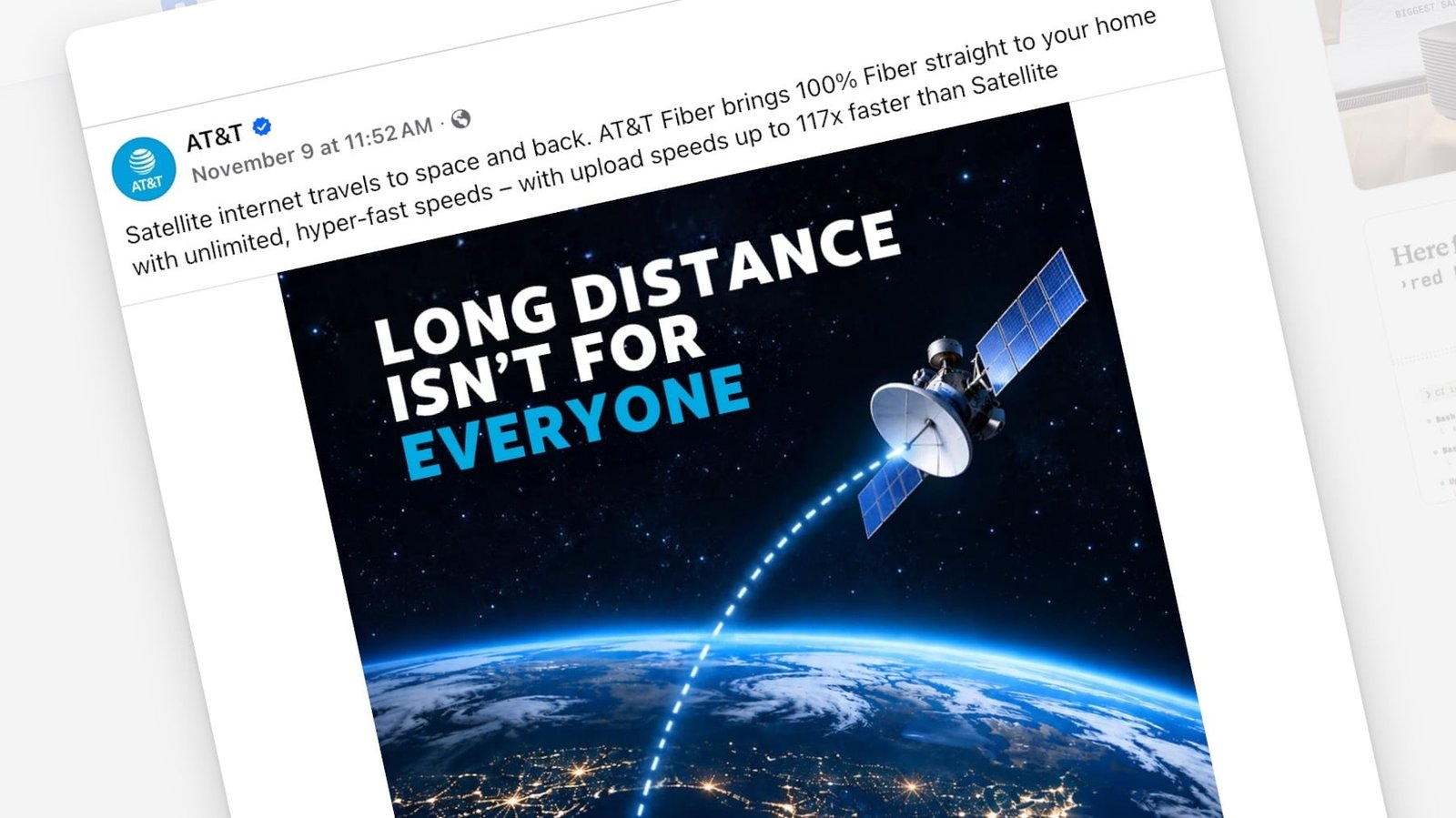
As Starlink tries to attract new US users, AT&T is pushing back in a new ad touting fiber internet over satellite-based broadband.
The ad, which AT&T posted on Facebook earlier this month, contains a link to its home internet service that reads “Skip Space. Go 100% Fiber.” It also takes a veiled shot at Starlink by saying: “Satellite internet travels to space and back. AT&T Fiber brings 100% Fiber straight to your home with unlimited, hyper-fast speeds—with upload speeds up to 117x faster than Satellite.”
Although the ad does not name Starlink, some Facebook users made the connection to SpaceX’s satellite internet service. “Run fiber to my house and I’ll switch from Starlink,” one user responded.

(Credit: Facebook/AT&T)
I discovered the ad on Facebook after seeing a TV commercial for it on Saturday night via Amazon’s Prime Video. “Satellite has to go to space,” it says. Unfortunately, AT&T’s ad never appeared again, even though I watched numerous ad breaks on the streaming service, so I wasn’t able to record it.
AT&T didn’t immediately respond to a request for comment. But there have been growing signs that Starlink has successfully pulled subscribers away from traditional ISPs in the US. In Q3, Starlink gained four subscribers for every one it lost, mainly from providers including Spectrum, Xfinity, and even AT&T, according to market research firm ST3 Insights.
Specifically, Starlink was estimated to convert over 11,000 customers from AT&T’s fiber and legacy DSL business, according to ST3 Insights. That said, nearly 5,000 customers also appeared to switch from Starlink to AT&T’s internet, including its fixed wireless access, during the same period.
Though Starlink has been seen as a broadband solution for remote and rural areas of the US, it’s also gaining traction in urban areas and among customers looking for an alternative to a shoddy ISP, according to Ookla.
Recommended by Our Editors
Starlink’s recent growth has also been tied to SpaceX offering discounts and expanding its 100 Mbps plan, which started at $50 per month before going up to $55. This month, SpaceX became even more aggressive on pricing by offering 30% to 50% discounts on its Residential plans for new subscribers across large parts of the US. But in other areas, SpaceX has imposed controversial dynamic pricing that can raise or lower the rate, depending on supply and demand.
It’s true AT&T’s fiber can offer gigabit speeds, far faster than 300-400Mbps top download speeds on Starlink, where users also face network congestion. However, AT&T’s fiber network doesn’t reach every area in the US. Hence, the carrier’s ads touting fiber over satellite can only go so far. On Facebook, one user wrote: “Me waiting for you to bring fiber into my neighborhood. Until then, Starlink wins over the copper currently installed.”
About Our Expert

Michael Kan
Principal Reporter
Experience
I’ve been a journalist for over 15 years. I got my start as a schools and cities reporter in Kansas City and joined PCMag in 2017, where I cover satellite internet services, cybersecurity, PC hardware, and more. I’m currently based in San Francisco, but previously spent over five years in China, covering the country’s technology sector.
Since 2020, I’ve covered the launch and explosive growth of SpaceX’s Starlink satellite internet service, writing 600+ stories on availability and feature launches, but also the regulatory battles over the expansion of satellite constellations, fights with rival providers like AST SpaceMobile and Amazon, and the effort to expand into satellite-based mobile service. I’ve combed through FCC filings for the latest news and driven to remote corners of California to test Starlink’s cellular service.
I also cover cyber threats, from ransomware gangs to the emergence of AI-based malware. In 2024 and 2025, the FTC forced Avast to pay consumers $16.5 million for secretly harvesting and selling their personal information to third-party clients, as revealed in my joint investigation with Motherboard.
I also cover the PC graphics card market. Pandemic-era shortages led me to camp out in front of a Best Buy to get an RTX 3000. I’m now following how the AI-driven memory shortage is impacting the entire consumer electronics market. I’m always eager to learn more, so please jump in the comments with feedback and send me tips.
Leave a Reply