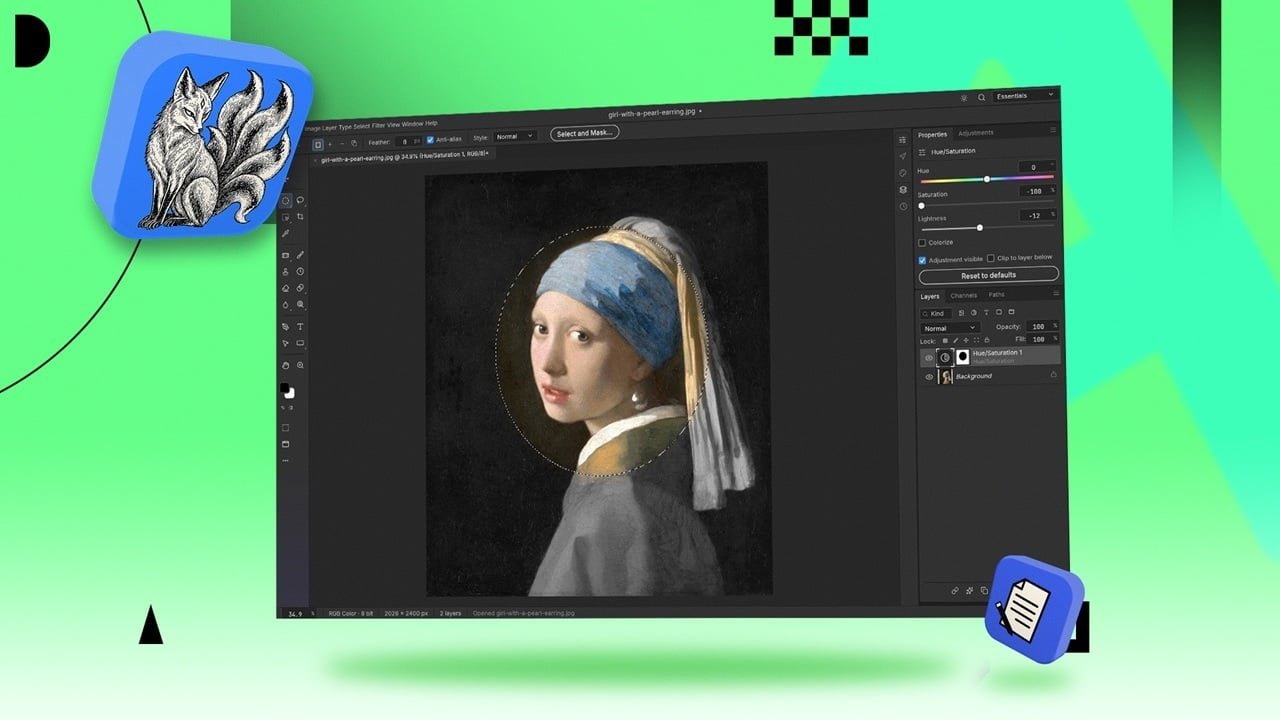
AI coding tools have graduated from helpful autocomplete bots to full-blown software engineers. Today, off-the-shelf models can spin up functional applications from scratch in a matter of hours—from niche multi-monitor utilities to sprawling, zero-cost clones of Adobe Photoshop and Microsoft Office. But as the barrier to entry collapses, it leaves behind an urgent legal and ethical minefield: Is reverse-engineering industry-standard software legal? Are these vibe-coded apps a genuine threat to professional developers, or just fragile, insecure knockoffs? To separate hype from reality, I spoke with engineers, founders, and IP lawyers to understand what happens when anyone can clone any app.
What Counts as a Vibe-Coded App?
A point of clarification: When I say AI apps, or vibe-coded apps, I’m talking about software generated by prompting an AI model or, at least, created with significant assistance from one. It’s fairly common to call something vibe-coded when you actually think it’s slop (buggy, insecure, or otherwise poorly made by or with an AI model), but I use the term to differentiate between apps largely coded by humans and those coded by AI models.

My Stagehand app isn’t flashy, but it gets the job done, and it makes my digital life easier (Credit: Ruben Circelli)
Take Stagehand, a utility I vibe-coded with Opus 5.5 that makes managing a multi-monitor setup on Windows 11 easier. I didn’t write any of the code; instead, I prompted an AI model, and it wrote the code for me. Stagehand relies, in part, on Equalizer APO, a free, human-written utility that’s been around for well over a decade, long before AI models became accessible to consumers. So, Stagehand is vibe-coded, while Equalizer APO isn’t. Nonetheless, both apps work for me, regardless of the use of AI during their development.
PhotoCraft Took a Day. Photopea Took 14 Years
Stagehand, of course, is just a small-scale example of what AI models can create. ArtCraft, the aforementioned suite that includes clones of popular creativity and productivity apps, is a different matter entirely. Those apps aren’t just infinitely more complex—they also pose some thorny questions for traditional software companies and developers.
To get some background and perspective on the project, I spoke with ArtCraft’s founder and CEO, Brandon Thomas, about the AI-assisted development process for PhotoCraft (ArtCraft’s open-source Photoshop competitor) and more.

No, this isn’t Photoshop; it’s actually PhotoCraft, which looks identical (Credit: ArtCraft)
Although Thomas is a seasoned software development professional who knows how to code, he developed the first version of PhotoCraft by prompting an AI model. He explains, “I laid out how it was to be architected. I planned out that the UI components need to live in a different place than all of the functional components, all of the file format reading, and all of that. That all of these things need to be independently tested and vetted.” He allowed the AI to look at screenshots of Photoshop’s interface and to rely on its preexisting understanding of how the app works, but forbade it from accessing bytecode, source code, or the underlying application itself. Thomas spent about 24 hours creating the first version.

Though Photopea is clearly inspired by Photoshop’s look, it’s not trying to recreate it exactly (Credit: Photopea/PCMag)
This kind of workflow isn’t the norm for software development in 2026, even if AI tools continue to proliferate. For example, when I spoke with Ivan Kutskir, the creator of Photopea, a popular online photo editor and free alternative to Photoshop, he said, “Not a single line of Photopea is written by AI.” He continued, “I’ve never spent thousands of dollars on AI models” and instead only “talk to AI models sometimes, e.g. when figuring out how various APIs work.” This makes sense, of course, given that Photopea began developing in 2012, well before the advent of AI models.
No governing body certifies apps as vibe-coded or not, so the functional distinction between something like PhotoCraft and Photopea is ultimately somewhat flimsy. Does the use of AI in an app’s development really matter to you if it works well?
How Close Are AI Clones to the Real Thing?
I’m many things—a gamer, a journalist, and one of those self-important people who describes himself as a foodie—but I’m not a heavy user of Adobe’s creative software. Luckily, here at PCMag, we have experts who are, such as our resident camera specialist, Jim Fisher.
Fisher used PhotoCraft (alongside LightCraft, ArtCraft’s take on Adobe Lightroom) and came away largely impressed by its performance. He wrote, “I’m pleasantly surprised by just how close ArtCraft’s LightCraft and PhotoCraft recreate their Adobe counterparts.” However, that’s not to say these apps can do everything as well as Adobe; Fisher calls out minor complaints such as the lack of Camera Matching color profiles, a less advanced noise reduction engine, and slightly less fine detail in rendered images, among other things.
It’s hard not to be blown away by the fact that a free application like PhotoCraft, which took only a day to get the first working version, can legitimately compete with Photoshop. This is doubly true because their practically identical interfaces mean switching requires almost no workflow adjustments.

While WordCraft looks like Microsoft Word, it still has a ways to go in terms of features (Credit: ArtCraft)
Some ArtCraft apps are less competitive with the apps they emulate, however, and it isn’t shy about pointing out those gaps. Take, for example, WordCraft, ArtCraft’s take on Microsoft Word. Based on the official parity assessment, WordCraft is only roughly 60% ready for real work at the time of writing, which probably won’t tempt too many people to switch over from Word. That said, the first version of Microsoft Word was launched in 1983, more than four decades ago, while the first commit to WordCraft’s GitHub occurred on October 6, 2026.
“I do not see anything in the world of software engineering that these [AI] models will not be able to do.”
Thomas is optimistic, if not outright bullish, about achieving parity: “I do not see anything in the world of software engineering that these [AI] models will not be able to do.” He continued, “I think small teams of people or even individuals will be able to build anything they imagine.”
Parity aside, good software is more than just the features it supports. According to Italo Vignoli, spokesman for The Document Foundation, which is the home of the LibreOffice project, “The world is not made of developers.” He continues, “Even very smart people can look like basic users of technology.” Accordingly, and especially for apps aimed at non-technical people, such as LibreOffice’s word processor (Writer) or WordCraft, Vignoli says, “The community is fundamental, because the community is what creates the link between the project and the users. Otherwise, if a user finds a bug, what happens?”

ArtCraft’s official Discord is incredibly active, with new users joining almost constantly (Credit: Discord/PCMag)
I brought this idea to Thomas, and he wasn’t fazed, telling me that ArtCraft has a Discord community that’s grown so rapidly that a representative reached out to assign him an official support contact. And this isn’t just a community of users, either. ArtCraft started with Thomas, but it’s grown much bigger than him, becoming a collective development effort similar to Linux. According to Thomas, a core team of around 30 contributors is already working on Craft apps alongside him, while thousands of developers collaborate with them. The answer to Vignoli’s question of what happens when a bug gets discovered is simple: In ArtCraft’s case, the community built a Discord bot for filing bug reports.
Photopea’s Kutskir isn’t worried about developers like ArtCraft or apps like PhotoCraft replacing him just yet. “Even if I try to learn everything and make the ultimate app…and make it in a month, that doesn’t mean I’ll be able to attract the users from other apps.”
Though an app like PhotoCraft is impressive, it’s hard not to see Kutskir’s logic. If you’re already happy with Photopea (or any other photo editor), is there really much practical reason to swap over to PhotoCraft, especially given how new it is?
Are Vibe-Coded Apps Just Buggy, Insecure Slop?
Whether to swap over to an app like PhotoCraft is more than an existential question; it’s also a practical one. AI apps can be more private and respectful of your data, considering they often don’t require sending your data to a corporation’s servers, but reliability and security issues are still commonplace.
For example, I’ve vibe-coded three feature-complete apps that do exactly what I want them to, as well as a handful of mods. Each time, bugs and unintended interactions popped up that I had to squash. I’m not a programmer, though, so I can only catch these by using my apps or if an AI model’s test suite catches them. But even if you’re a programmer overseeing an AI model, manually reviewing every single line of code it outputs is often unrealistic and would otherwise seriously undercut the tool’s benefits.

I love my Warframe calculator app, but it took a lot of work to get it functioning properly (Credit: Ruben Circelli)
If you take the pulse of online communities’ feelings on the reliability of AI apps, you quickly get the sense that vibe-coding produces only slop that barely works at best and is inevitably filled with bad design decisions and inefficiencies. To some extent, I’ve seen developers express similar concerns, albeit not as strongly and phrased differently. For example, Photopea’s Kutskir sees the current crop of vibe-coded apps as often “pretty buggy, especially if you use them for more than 10 minutes.”
According to LibreOffice’s Vignoli, AI apps, especially those like DeckCraft, GridCraft, and WordCraft (ArtCraft’s take on PowerPoint, Excel, and Word, respectively), are often “more like a technical exercise than something that can enter the market in a proper way.” Vignoli compared the “over seven million” lines of code in LibreOffice with vibe-coded apps, whose lines of code are often in the thousands. For Vignoli, this is a measure of the depth and reliability of LibreOffice’s features that AI-generated competitors may struggle to match. For reference, WordCraft’s current alpha build spans 88,000 lines of code, including documented bugs and issues.

Though LibreOffice is mature software, that doesn’t mean it’s bug-free (Credit: Bugzilla/LibreOffice)
When I brought these concerns to Thomas, he joked about having a grudge against LibreOffice (or maybe it was OpenOffice, LibreOffice’s predecessor, Thomas mused) for losing a paper he was writing back in college, which is an experience that underpins his actual point. “I’ve had files get corrupted because the software was poorly coded. It’s definitely been a thing that I’ve been frustrated at. Bugs are going to happen. This is what maintaining an online service is like, and the [AI] models and tools that we build will help us [deal with bugs].”
Thomas sees bugs as an inevitable part of any software, but he sees AI as uniquely well-equipped to address this problem, especially as AI models become more advanced. “Software is going to be more reliable, not less reliable,” he argues. I’ve used Windows since long before AI went mainstream, so I definitely don’t have any illusions that 100% human-written software is uniquely resistant to bugs. Accordingly, I’m at least open to the possibility that an always-on machine, overseen by a developer, might be able to churn through bugs more effectively.
Security is an entirely different beast. With ArtCraft, the Craft apps are open-source and work offline, and a sizable community engages with the code daily. So, the potential for serious security risks feels relatively low. However, this is largely due to the nature of ArtCraft’s apps, not a testament to the quality of their code or engineering.
Unfortunately, AI poses a major threat to software security. Anthropic had to suspend access to its Fable 5 model days after launch to comply with US export controls tied to cybersecurity concerns, though access was restored a few weeks later. Separately, OpenAI got into hot water when its models escaped a testing sandbox in July and hacked Hugging Face to cheat on a security evaluation. (Disclosure: Ziff Davis, PCMag’s parent company, filed a lawsuit against OpenAI in April 2025, alleging it infringed Ziff Davis copyrights in training and operating its AI systems.) Meanwhile, researchers identified thousands of vibe-coded apps with “virtually no security or authentication of any kind.” The jury might be out on whether AI will ultimately make software less buggy, but the deliberations are over about AI’s overall impact on software security, and the verdict isn’t great.
Are AI Clones Like ArtCraft Legal? I Asked a Lawyer
When you launch an app called PhotoCraft, and it looks and works exactly like Adobe Photoshop, you might rightfully ask about the incredibly large elephant in the room: Is it legal? I’m not a lawyer, so I spoke to one, Thomas Dunlap, about the rise of AI clones and other vibe-coded apps. Of course, this isn’t legal advice, just one lawyer’s opinion.
Is what ArtCraft is doing illegal? The short answer is probably not, but there are some nuances to keep in mind. According to Dunlap, “Reverse engineering software is generally legal in the United States. Courts have treated it as fair use for decades.” However, he notes that “breaking a license agreement, infringing a patent, or copying a product’s name or look” are all separate legal questions that could pose problems for ArtCraft, depending on the specifics of its situation, which he’s not familiar with.
In my non-legal mind, video game emulators are a great example of a parallel case. As mentioned, reverse engineering, the same process used to create emulators, is generally protected under the law, which is why companies like Nintendo and Sony historically haven’t had much success taking them down via the court system. Even in the rare instances in which they are successful, the underlying emulators don’t actually go away.
With Yuzu, a Nintendo Switch emulator that shut down in 2024 after Nintendo filed a lawsuit, the problem wasn’t reverse engineering. Nonetheless, Yuzu didn’t really die: It was immediately forked, and some forks like Eden and Citron live on today. And if those get taken down, you can be sure that other Nintendo Switch emulators will rise up to take their place, just as Eden and Citron did to Yuzu.
So, even if there is a legal case against ArtCraft, the code for its apps is freely available on GitHub. In the case of a lawsuit, other developers keen on taking up the project could (and, inevitably, would) immediately fork it. According to Dunlap, legal or illegal, the genie’s out of the bottle, so while a lawsuit can take down a company, it can’t delete all the forks of an application already out there.
“We need some kind of agreement with industry and government and creators that allows creators to get paid, allows industry to get paid, and allows the government oversight in the process to regulate the disputes between the two and consumers.”
However, we aren’t just in the Wild West of software development now, or at least we don’t have to be in Dunlap’s estimation. “We need some kind of agreement with industry and government and creators that allows creators to get paid, allows industry to get paid, and allows the government oversight in the process to regulate the disputes between the two and consumers.”
While he admits this isn’t the perfect example, Dunlap looks to what happened with the film and music industries during the rise of BitTorrent in the early 2000s as a model: “We need to come up with the Netflix and Spotify of the world for AI.” He sees the problem with AI clones as an extension of the larger question of how to pay creators when an AI model trains on their work. If the original creators get paid, there’s much less reason to take issue with clones.
Gabe Newell, co-founder of Valve Software, famously said, “Piracy is almost always a service problem and not a pricing problem.” Of course, as discussed above, ArtCraft might not be doing anything that could be reasonably considered piracy. Nonetheless, people wouldn’t be interested in PhotoCraft if they were happy with Photoshop. Just take a look at Epic’s post on X about how its vibe-coded launcher opens faster than Steam: No one cared because Steam doesn’t have a service problem, and the Epic Games Store does. I agree with the top reply: Even if Steam took four hours to launch, I’d still use it over Epic’s launcher.
Robin Hood or Rip-Off? The Ethics of AI Clones
Even if AI apps aren’t especially buggy, don’t violate the law, and work well, are they simply unethical? Is it one thing for me to vibe-code a cute little utility tuned for my unique blend of hardware and another thing to use AI to quickly spin up free clones of existing software that took enormous amounts of effort, money, and time to make?
Furthermore, while ArtCraft’s apps are free and open-source, the company ArtCraft sells subscriptions for the AI credits needed to generate AI images and videos using third-party models. But keep in mind that ArtCraft is less a traditional company than Thomas’ brand, backed by a community of contributors.
LibreOffice’s Vignoli approaches this ethical question from the perspective of somebody who got his first tech job back in 1982, giving him a front-row seat to the rise of a newcomer to the office software space: Microsoft Office. Vignoli remembered that “In the late ‘90s, there was a wave of clones, because Microsoft claimed to have exceeded 90% of market share.” He explained, “They were trying to mimic Microsoft Office, maybe with reverse engineering, maybe with other ways of developing software, but they were not adding anything.” If clones didn’t kill Microsoft Office over the last three decades, are they really that dangerous?
Recommended by Our Editors

Long before LibreOffice, StarWriter tried to replace Microsoft Word (Credit: StarWriter)
Photopea’s Kutskir, who came up in tech in a very different era, made a similar point. “Cloning could mean anything, right? You could see a Ferrari on the street, and I’ll give you two tons of steel and say, ‘Clone a Ferrari for me, please. Here is the hammer and a screwdriver.’ It’s not that easy.” Though Kutskir agrees that if you’re stealing code or violating copyright, that’s a separate issue, he ultimately thinks, “If [AI models] can actually generate functioning tools, which have the same user interface as Photoshop or 3D Studio Max or anything, then [these] would be very useful tools many people will start using.”
When my colleague Jim Fisher tested ArtCraft and PhotoCraft, he wasn’t sure if the question of whether you should use them came down to how they performed. Rather, it came down to whether you’re comfortable with an app that so closely copies Adobe’s software. However, Fisher said he wouldn’t argue if you view ArtCraft as a modern-day Robin Hood.
For Thomas, that’s exactly how he sees ArtCraft. Although he’s a software developer by trade, he’s also a filmmaker with dreams of making epic sci-fi movies he’d never normally have the budget to make. But when he turned to technology, it seemed to turn away from him. “Tech companies realized they had moats and began to wall themselves off from other companies. You couldn’t port your data from one silo to another: It remained locked inside of one thing, and [tech companies] started becoming more and more extractive.”
“The moats of the tech companies not only have collapsed, they’re like an inch tall and you can just walk right over and you can build anything your heart imagines.”
In the face of rising consolidation and monopolization in tech, David just couldn’t keep up with Goliath in Thomas’ estimation. “It’s very hard for any other company or startup or individual contributor to go and build something, because after working your 9-to-5 or 11-to-7, you don’t have a lot of energy to work on something,” he told me. “There was never enough free energy in the system for people to go and build alternatives to these things because they were mechanized by lots of capital.”
To Thomas, AI is the answer to these existential problems. “If diligent people use these models to their advantage, they can build really cool things, and you don’t have to have a great big technical reservoir to do it. You can learn on the spot…The moats of the tech companies not only have collapsed, they’re like an inch tall and you can just walk right over and you can build anything your heart desires.”
I asked Fisher what he thinks about the above perspectives. For him, “Homebrew, open-source alternatives to big-name software aren’t anything new, but AI has clearly changed the scope of what’s possible.” However, he has “some reservations about embracing software written with AI tools, especially apps like PhotoCraft that are intended to be pure copies of the original” because “[t]here’s a real, human effort that goes into creating anything from scratch, whether it’s Photoshop, a photograph or painting, or a novel” lost with “AI tools [that] scrape the existing human effort, throw it in a blender, and create something new.”

Adobe as a corporate entity reaps the majority of the rewards of its software sales, not individual humans (Credit: Adobe/PCMag)
While I agree that an app made by prompting an AI model certainly feels different than one made by human beings hunched over a keyboard for months, if not years, when we’re talking about digital tools, the name of the game for me is functionality. If somebody can prompt an AI and come out the other end with a free tool that does everything a paid version of that tool can, why shouldn’t they use the free one? Should Adobe really have an exclusive claim to all the features, for example, that Photoshop offers, especially in our capitalist world controlled by what’s ostensibly a free market?
If you’re truly reluctant to use an app like PhotoCraft purely because of ethical concerns about its creation, I’d expect you not to order things from Amazon or have a smartphone, among other things, because it’s all too easy to have similar concerns about those technologies. However, I expect some people’s reticence comes less from a clearly staked-out ethical or moral position and more from a general unease about AI, which is definitely relatable. Either way, like with legal questions about vibe-coding, the cat is out of the bag. People will inevitably make (and clone) more apps with AI.
What Happens When Anyone Can Clone Any App?
Today, you need an expensive subscription (or even more expensive API access) to a cutting-edge AI model, such as Opus 5.5, to quickly build and iterate on apps like those in the ArtCraft suite. But historically, low-cost Chinese models and even local models don’t lag far behind the cutting edge in performance, so everyone will soon have access to this technology. And that’s to say nothing of what Opus 6 or 7 will be capable of, among other models.
Whether Adobe strikes ArtCraft down or Anthropic installs more guardrails onto its models to prevent reverse engineering, AI is here to stay, and so are AI apps. As with the road from BitTorrent to Netflix, from illicit game key generators to Steam, or from Limewire to Spotify, software companies will have to adapt to the accessibility and ubiquity of free alternatives that do what their apps do. To borrow Newell’s logic, AI apps are solutions to service problems.
But what does this all mean for users? I’m reminded of a character from the 2000s-era NBC sitcom 30 Rock, Dennis Duffy (better known as the Beeper King). According to Duffy, “The beeper’s gonna be making a comeback. Technology’s cyclical.” The beeper has not, in fact, made a comeback, but technology might just be cyclical. I talked with Thomas about the bygone days of Web 1.0 and early Web 2.0 (aka the 2000s), when software was relatively simple and easy to modify. It was less locked down and wasn’t ubiquitously in the cloud or built around subscriptions.
Then, the 2010s happened. Software became much more complicated and proprietary, charging you monthly fees to run on remote servers. Now, in the AI age, this isn’t even a design decision anymore; it’s a practical reality: You don’t have thousands of dollars to blow on the memory necessary to run the models powering various AI features. But thanks to AI models, you can once again create and modify software however you want, and you can do so relatively cheaply, easily, and quickly.
This is empowering. But just as a ruler is empowered to be a tyrant if they so choose, I don’t know if this new paradigm is a change for the better. For example, I vibe-code simple mods for video games to tweak systems and add in quality-of-life features. If everyone starts doing that, what happens when the video game industry no longer has a pool of beloved, expert modders to hire? Would that ultimately make games worse, or does it not matter in a world where professional game developers themselves increasingly use AI tools?

AI mods are literally everywhere in 2026, and I’m not sure what that means for the gaming industry (Credit: Thunderstore/PCMag)
If we all switch to free, open-source, vibe-coded apps that do what existing apps do but for free, will we eventually arrive at a point where nobody is left to innovate and make anything new to copy? Who’s to say that Adobe and Microsoft have perfected entire genres of software, after all? Separately, will we have to retrain coal miners to prompt AI models rather than code, and will software developers get the same treatment? I don’t have good answers to these questions; nobody does.
Of course, the economic impact of AI-coded software is huge. The rise of AI Office clones probably won’t hurt Microsoft all that much, given how firmly entrenched the suite is in the daily lives of millions. And AI companies themselves are obviously capitalizing on API costs, the data center build-out, and subscription fees. But will developers like Photopea’s Kutskir eventually have to close up shop? Is making apps with AI actually democratizing software, or merely lining Anthropic’s or OpenAI’s pockets rather than Adobe’s or Microsoft’s? Again, I don’t have an answer here.
My Verdict: Use What Works (With One Exception)
After speaking with developers and legal experts, my verdict remains unapologetically pragmatic: I’m going to use whatever works. If my vibe-coded utility solves a headache faster than commercial software, I’ll keep running it. If PhotoCraft delivers what I need without an Adobe subscription, I’ll use it. Call it self-serving, but like most people, I have deadlines to hit, bills to pay, and free time to protect—I’m not interested in running an ethical audit every time I launch an app.
Where I draw the line, however, is human expression. I have zero interest in AI-generated art, whether that’s a song, a video game, or anything in between. Conflating digital utilities with creative soul might be a messy, contradictory line in the sand, but it’s mine. In an era when anyone can clone anything, everyone will have to find their own.
About Our Expert

Ruben Circelli
Writer, Software
Experience
I’ve been writing about consumer technology and video games for over a decade at a variety of publications, including Destructoid, GamesRadar+, Lifewire, PCGamesN, Trusted Reviews, and What Hi-Fi?, among many others. At PCMag, I review AI and productivity software—everything from chatbots to to-do list apps. In my free time, I’m likely cooking something, playing a game, or tinkering with my computer.
Leave a Reply