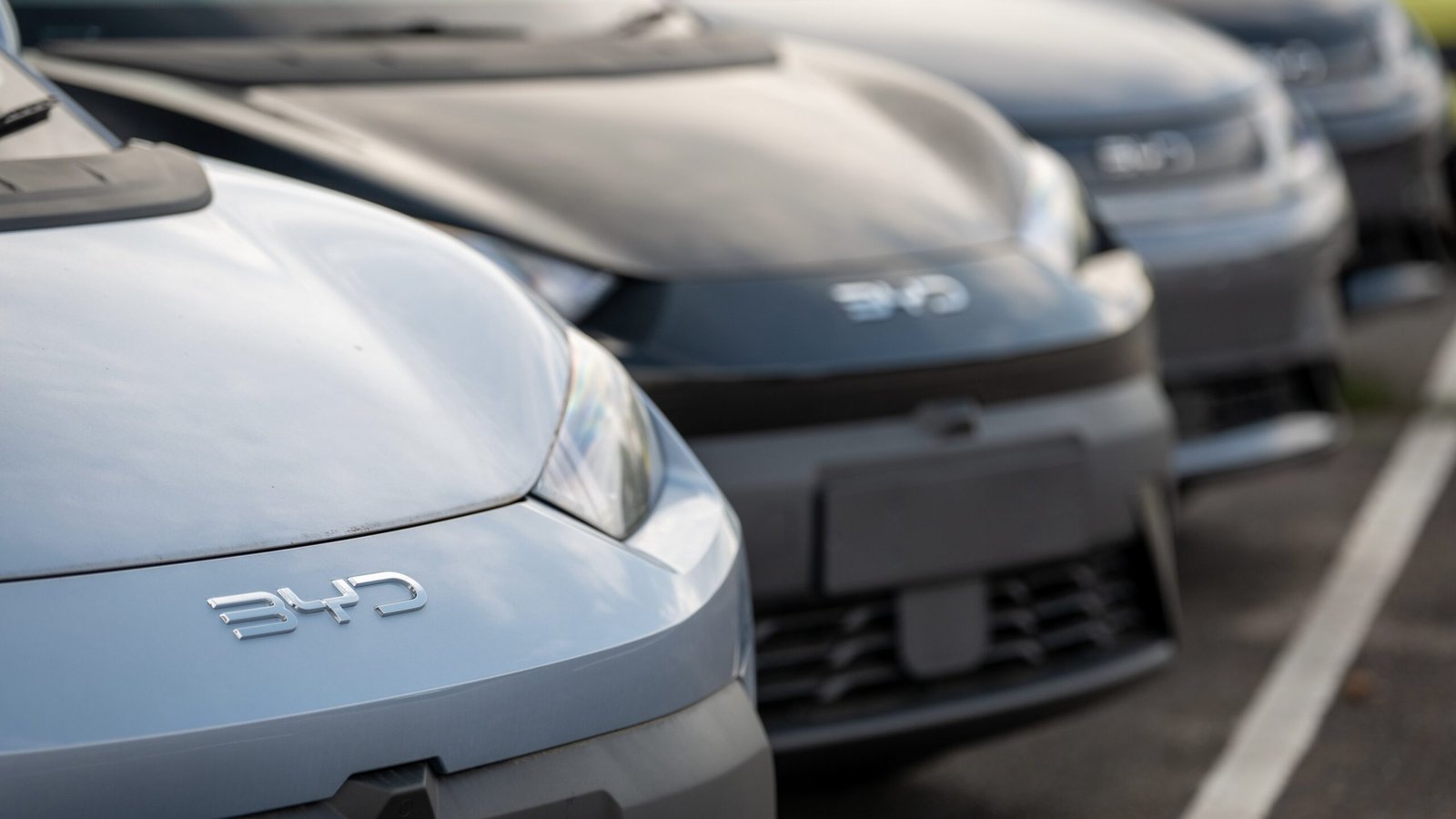
A bipartisan group of legislators is trying to advance a bill that would essentially put square wheels on Chinese cars in the US.
The Connected Vehicle Security Act of 2026 would go miles beyond past moves to make China’s booming auto industry unwelcome in the US and ban the “importation, manufacture, sale, resale, or introduction into interstate commerce” of connected cars made or designed by firms in the PRC as well as Iran, North Korea, or Russia.
Backers of this measure–starting with Sens. Bernie Moreno (R-OH) and Elissa Slotkin (D-MI), who introduced it as S.4429, and Reps. Debbie Dingell (D-MI) and John Moolenaar (R-MI), who then sponsored a companion bill as H.R.8730–invoke the risk of the Chinese Communist Party requiring surveillance through these vehicles and its history of subsidizing its auto industry.
“These cars have enormous amounts of data-collection capabilities,” Moreno said on a panel hosted Monday at the American Enterprise Institute in Washington, moderated by AEI fellow Chris Miller. “Imagine TikTok, but on steroids.”
(Allegations of Chinese surveillance via the social platform now controlled by a US-led group of investors remain unproven; the Supreme Court only held those concerns credible last January when it upheld a law banning app-store and hosting transactions with TikTok.)
Citing scenarios of Beijing directing Chinese carmakers to exfiltrate data from connected cars or take control of them remotely, Moreno called these vehicles “obviously an insane national security threat.”
Sitting alongside Moreno, Moolenaar backed up his risk assessment. “Their national security laws basically require anyone to do the bidding of the CCP,” he said of Chinese carmakers.
The Biden administration thought this enough of a risk to issue a regulation in its last days restricting connected-car systems from China. In June, the Commerce Department used that authority to deny Polestar, partly owned by the Chinese automotive giant Zhejiang Geely Holding Group and Geely-owned Volvo, permission to sell its EVs in the US after the 2026 model year.
A May 15 AEI report noted a report by Norwegian researchers who found that Chinese-made battery-electric buses in use in that country had a component allowing remote shutoff. That conservative think tank highlighted restrictions imposed on Chinese cars by the UK, Israel, Norway, and Poland–for example, barring them from the vicinity of military bases–but did not call for a ban on their import.
An Unyielding Statute
The Connected Vehicle Security Act, like the existing connected-car rule, would allow the Secretary of Commerce to issue waivers to the ban. But at AEI, Moolenaar and Moreno did not suggest that any would be forthcoming as long as China’s current government holds power.
“We hermetically seal our market,” the senator said. “We go way beyond the current connected vehicle rule to go through the entire supply chain.”
Moreno brought up Waymo as one company that would have to comply by parking its new Ojai minivans, based on Geely’s Zeekr model. “We’ve had great conversations with Waymo,” he said. “I think as a result of this bill they’re going to shift gears, hopefully […] to a Detroit-based vehicle.”
Waymo declined to comment on the record, but that Alphabet subsidiary has already emphasized how connected parts in its robotaxis don’t come from or talk back to China.
“The technology that collects data and makes our vehicles autonomous—the software, sensors, and computing systems—is developed in the US,” spokesperson Sandy Karp told PCMag contributor Rakesh Agrawal as part of an Ojai test drive in San Francisco last month. “Waymo installs the autonomous driving technology on stripped-down, disconnected OEM-provided vehicles in our Arizona manufacturing facility.”
The seal that Moreno described would meet land borders with Canada and Mexico, since the statute uses a legal definition of “import” that includes “any bringing in” of a product. The senator said a driver rolling up to a US border crossing in a Chinese vehicle would meet a U-turn sign: “They’ll have to buy another car, because their car will not be allowed in the United States of America.”
A separate bill, the Protecting America from Chinese Cars Act introduced by Slotkin and Rep. Haley Stevens (D-MI), would make that no-crossings rule explicit, but it has yet to draw more sponsors.
Cooling Towards China
Chinese vehicles are off to a fast start in Mexico, with estimates putting the share of PRC-manufactured vehicles in 2025 at 15% to 19% of the total market. But those imports have since plunged after Mexico imposed a 50% tariff starting in January.
In Canada, meanwhile, Prime Minister Mark Carney has responded to US unfriendliness–including tariffs on its exports and repeated threats of annexation by President Trump–by inking new deals with China that include allowing the import of 49,000 Chinese EVs at a 6.1% tariff.
Moreno called Canada’s slight opening of its EV market a “totally crazy move” but did not mention the things Trump has done to earn Canadian ire.
Canada had begun charging a 100% tariff on Chinese vehicles in 2024, matching President Biden’s imposition of the same rate earlier that year. Governments have usually cited China’s auto subsidies as the reason for these taxes, and Moolenaar and Moreno agreed that they represent unfair competition. “They’ll use trade practices to drive our businesses out of business,” the congressman said.
In Europe, the continued growth of Chinese EVs has recently led to calls for higher tariffs for the same reason.
Recommended by Our Editors
But China’s progress isn’t just a matter of prices. Automakers like BYD, the largest EV manufacturer in the world, have been doing innovative work that has earned recognition from competitors. Last year, Ford CEO Jim Farley, who had a Xiaomi SU7 sedan specially imported for him to drive–called China’s rapid progress as “the most humbling thing I have ever seen.”
Moreno, however, suggested that China’s success in EVs was part of a plot to make American expertise in building internal combustion engines irrelevant: “They pulled off the greatest scam on Earth.”
Privacy, Please
The House and Senate versions of the connected-vehicle bill have drawn dozens of co-sponsors, but it’s unclear if that will mean anything in a historically unproductive Congress. Moreno said backers hope to get this measure added to the must-pass National Defense Authorization Act spending bill.
Meanwhile, people already have good reasons to worry about the privacy of connected cars regardless of the national flag on the sticker.
A 2023 report by Mozilla flunked all 25 car brands evaluated on privacy standards, and a 2024 investigation by researchers for Sens. Ron Wyden (D-OR) and Ed Markey (D-MA) found weak data-protection practices across the industry, including at American automakers.
Neither lawmaker at AEI mentioned this, so I asked if they had plans to address those anxieties.
“We should have guardrails to make sure we’re protecting people’s privacy,” Moolenaar said. “But there’s a huge difference between the American government and the Chinese government.”
Moreno decried defaults that require a customer to “go through 17 different screens” to opt out of having their data circulated. “It should be no unless I actually say yes,” he said. “Let the person choose.”
Congress as a whole has not acted as if that is a priority, year after year failing to enact any sort of comprehensive privacy statute. This year’s attempt, a Republican-written measure called the SECURE Data Act, is narrower than previous tries, has only been introduced in the House so far, and has only eight co-sponsors listed. Moolenaar is not among them.
About Our Expert

Experience
Rob Pegoraro writes about interesting problems and possibilities in computers, gadgets, apps, services, telecom, and other things that beep or blink. He’s covered such developments as the evolution of the cell phone from 1G to 5G, the fall and rise of Apple, Google’s growth from obscure Yahoo rival to verb status, and the transformation of social media from CompuServe forums to Facebook’s billions of users. Pegoraro has met most of the founders of the internet and once received a single-word email reply from Steve Jobs.
Leave a Reply