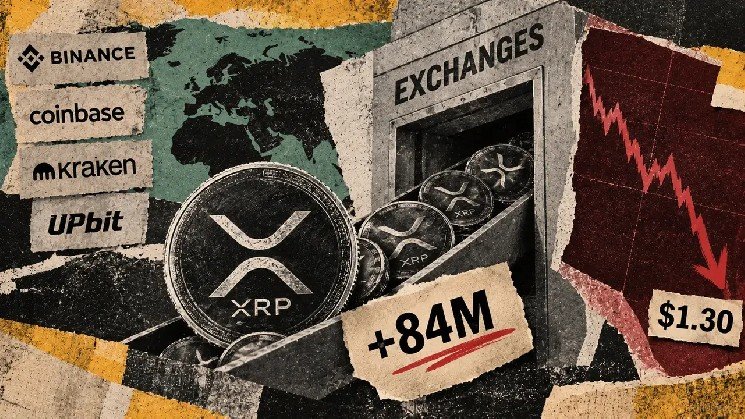
A three-day build and a separate weekly view
The downloadable balance figures show three successive positive daily changes:
The dates label changes from the preceding day’s snapshot. Together, they cover approximately 08:00 UTC on Oct. 12 through 08:01 UTC on Oct. 15. Over that interval, tracked holdings rose from about 21.973 billion to 22.057 billion $XRP.
Each observation from Oct. 12 through Oct. 15 retained 699 wallets and 24 exchanges, with no newly added wallets or exchanges excluded for coverage changes.
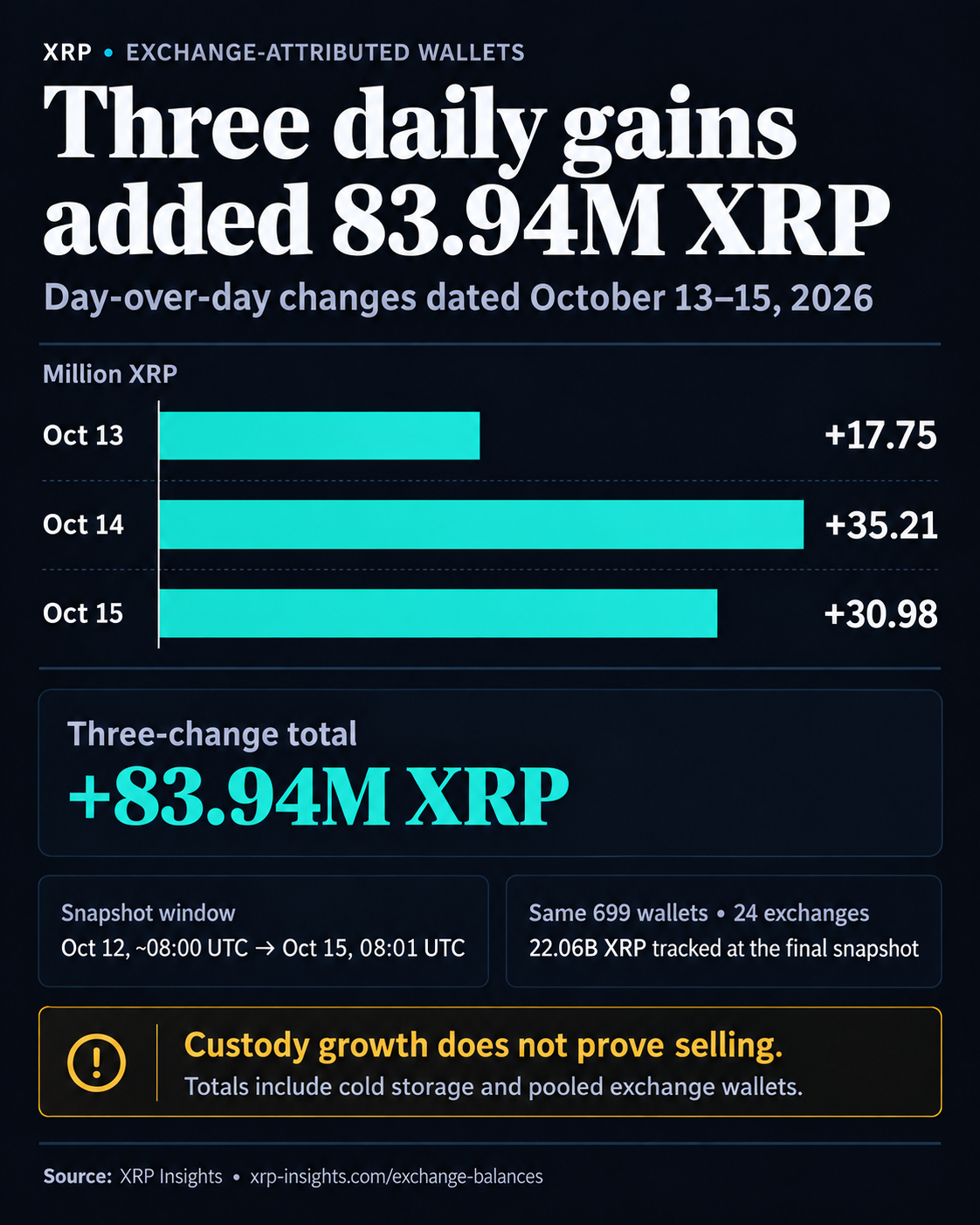
That consistency matters because discovering another exchange wallet can increase a provider’s reported total without any $XRP moving. Here, the provider’s records show a balance increase within the tracked set.
The venue breakdown answers a different question. For Oct. 8–15, $XRP Insights reported an increase of 82.35 million $XRP, or 0.37%, in the same tracked wallets. That seven-day figure overlaps the latest three daily gains; the two totals cannot be added.
Binance-attributed wallets accounted for 54.61 million $XRP of the weekly net increase, the largest positive venue change and roughly two-thirds of the total. Upbit added 11.58 million $XRP, Kraken 9.17 million, Coinbase 8.09 million and Bithumb 5.81 million over the same week.
The build was not uniform. Bybit’s tracked holdings fell by 4.22 million $XRP, while SBI VC Trade and Bitfinex each declined by about 3.4 million and Uphold by 3.04 million. These offsets help explain why the sum of the largest gains exceeds the net increase.
The venue breakdown covers Oct. 8–15. Binance’s 54.61 million $XRP addition belongs to that weekly window; the three-day total is an aggregate across the tracked wallets.
$XRP Insights counts hot wallets, deposit hubs and cold storage. Exchange-controlled wallets can pool customer balances and institutional custody assets, so the total does not measure $XRP available on an order book.
The latest dataset includes about 480.2 million $XRP classified as wrapped-token reserves or other funds, including insurance and charity holdings. Binance’s grouping also includes Binance-Peg $XRP backing and a separately identified Binance.US affiliate wallet.
Shared-address accounting adds another limit. Official $XRP Ledger payment documentation explains that destination tags tell an exchange which customer to credit in its own systems. A ledger balance therefore cannot reveal each customer’s orders or trading intentions.
The tracker uses validated ledger balances and XRPSCAN wallet labels, carrying forward the last value if a read fails. Transfers between tracked and untracked exchange addresses can alter the measured total without a customer deciding to trade.
CryptoSlate’s Oct. 8 supply analysis examined the distinction between custody and executable supply. Its Oct. 12 trading report covered Oct. 8–10 spot turnover and earlier futures rebuilding.
Executed trades would test the supply risk
For $XRP holders, the immediate question is whether the additional balances accompany sustained selling on the venues involved. Further same-wallet growth alongside seller-initiated spot executions would strengthen that concern. A balance reversal or an identified custody transfer would weaken it.
The next test is seller-initiated spot trading on the same venues and over a defined window: incoming sellers accepting resting buyers’ orders.
Direction labels also vary. Coinbase’s trade-record definitions define side as the resting order’s side: a buy record describes a buyer whose order was met by an incoming seller. Venue-specific definitions therefore matter when measuring seller-initiated activity.
The reported $3.1 billion of 24-hour turnover cannot answer that question. It measures aggregate activity, rather than seller aggression tied to the wallet window.
Leave a Reply