It’s the boiling point scenario every film composer sweats: playing your ideas for the director for the first time.
In many modern cases, it can be over the phone or over Zoom. For John Powell, who was on this day in early January sitting feet away from Pierre Coffin, the lead director of Illumination’s Minions & Monsters, it was in person.
“It’s a very dangerous moment,” Powell says of the pivotal minute. “It can go so horribly wrong.”
Coffin reached out to Powell, one of the preeminent animation composers known for his scores for How to Train Your Dragon and Shrek, to work on his first Minions movie. It was going to be the first feature in the Despicable Me franchise not scored by Heitor Pereira. Powell had flown to Paris and met with Coffin at Illumination’s offices, heard his wants and needs, spotted the movie, then started to write. Powell, remaining in the city, emerged a week later with some musical cues.
“I said to him, ‘OK, it’s probably time you come and listen to some things,’” Powell recounted. “And that moment is the difference between talking about music and then listening to music.”
It’s a moment either magical or embarrassing, where it’s thumbs-up or back to the drawing board. And as to why he was subjecting himself to in-person judgment, it was to make sure that Coffin was giving his honest assessment. “He could have been saying one thing and his body language would have told me how uncomfortable he was if it wasn’t really working for him and if he was trying to be polite. And we didn’t really have time for that.”
Powell needn’t have worried; Coffin loved what he heard. In early April, just under three months before the movie’s July 1 release , Powell was on the Sony lot’s Barbara Streisand Scoring Stage, giving direction and feedback as he commanded an army of recording engineers, mixers, orchestrators and music editors.
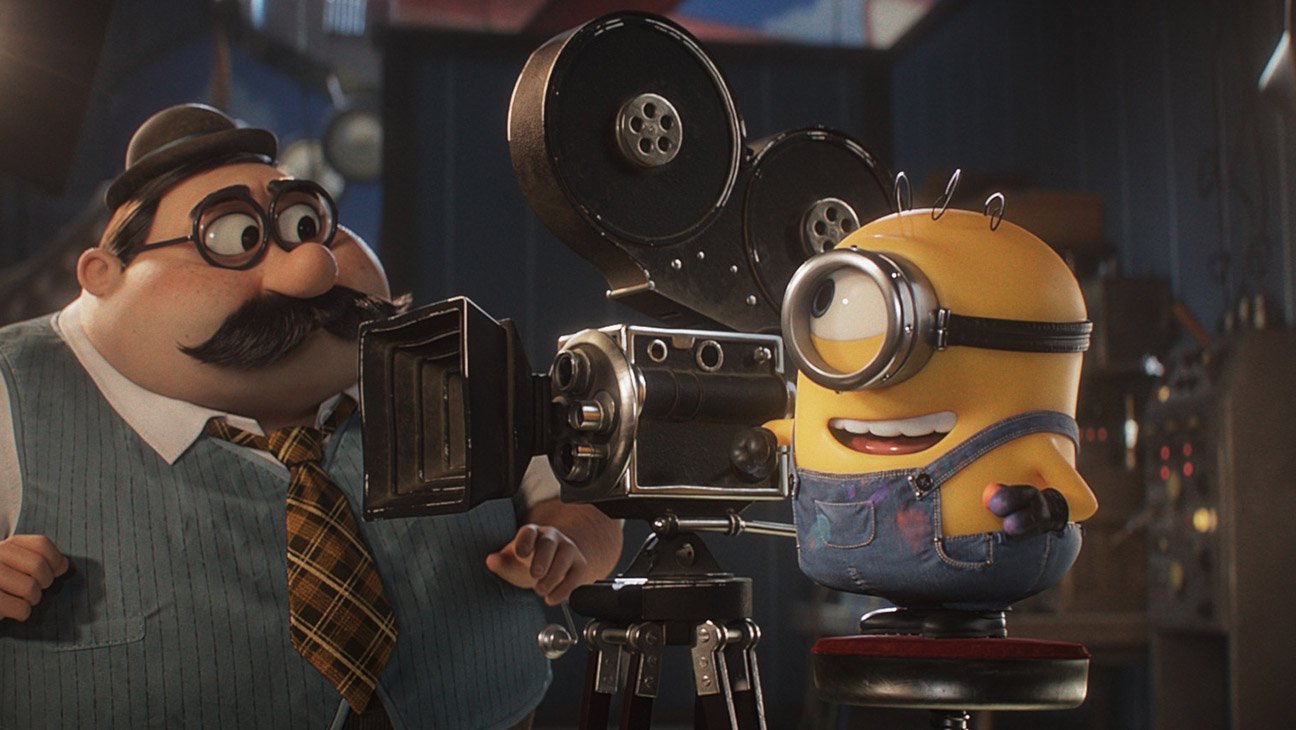
Minions & Monsters sees the pint-sized yellow troublemakers in 1920s Hollywood trying to make a creature feature. The movie is “wall-to-wall music” according to Powell, and it let the composer indulge in various styles and eras he normally wouldn’t be able to. Powell tried to capture Hollywood’s Golden Age and its musical traditions into one score, name-checking Franz Waxman (Bride of Frankenstein, Sunset Boulevard), Max Steiner (King Kong, Gone with the Wind), Carl Stalling (Looney Tunes), Bernard Hermann (Psycho) and John Williams (Star Wars) as inspirations. And sure, why not throw in some Alexander Borodin and Pyotr Ilyich Tchaikovsky?
(While he wasn’t able to staff players who worked on those movies, obviously, he is pleased that he had some players who did music on Animaniacs and Freakazoid!, which had music by Stalling successor Richard Stone.)
Powell then cranked everything to 11.

John Powell
Courtesy of Subject
“Overly emotional, overwrought, overplayed, overwritten. Just over. Everything was over,” he says, laughing. “It helps elicits laughs [but] would be very dangerous if I was doing a serious film.”
Powell notes that in Hollywood’s Golden Age, very dramatic music was the norm. Now, 70 to 80 years later, the language of cinema has changed, and so has the audience’s understanding of it.
“So you come to this point where you have to do it very carefully now,” he notes, speaking about the overblown music. “Until you get a call from Pierre who said, ‘I want you to do that thing,’” And I said, ‘You sure?’ “And he said, ‘Oh yeah, absolutely.’ It’s not like any other Minions movie.”
It was a massive music session, a rare sight on a Hollywood studio lot in a time when much of the scoring had moved not only out of Los Angeles but out of the country due to tax credits and other economic factors. For about three weeks, pure decadence in movie music time frame, the stage was filled with upwards of 80 musicians (30 violinists alone!) who played and replayed and replayed cues. On some days, an extra 25 brass players were brought in. Some days had extra percussion. Then there were the days with a 60-piece choir.
“I hope everybody who reviews the score uses the word ‘indulgent’ because by God, it was,” he says, laughing.
And, he says, the recording of this score could only have been done in Los Angeles, where talented movie musicians can be found in one place.
“One of the things I said to the musicians at the very end was, ‘Thank you for your time.’ And I was saying this very much for everybody in the booth as well. It’s like, we didn’t just pay you for your time these (three) weeks. We paid you for the years and years and years and years and years it took for you to get to be good enough to be here. And that was the value.”
Check out a featurette the Minions & Monsters score below.
Leave a Reply