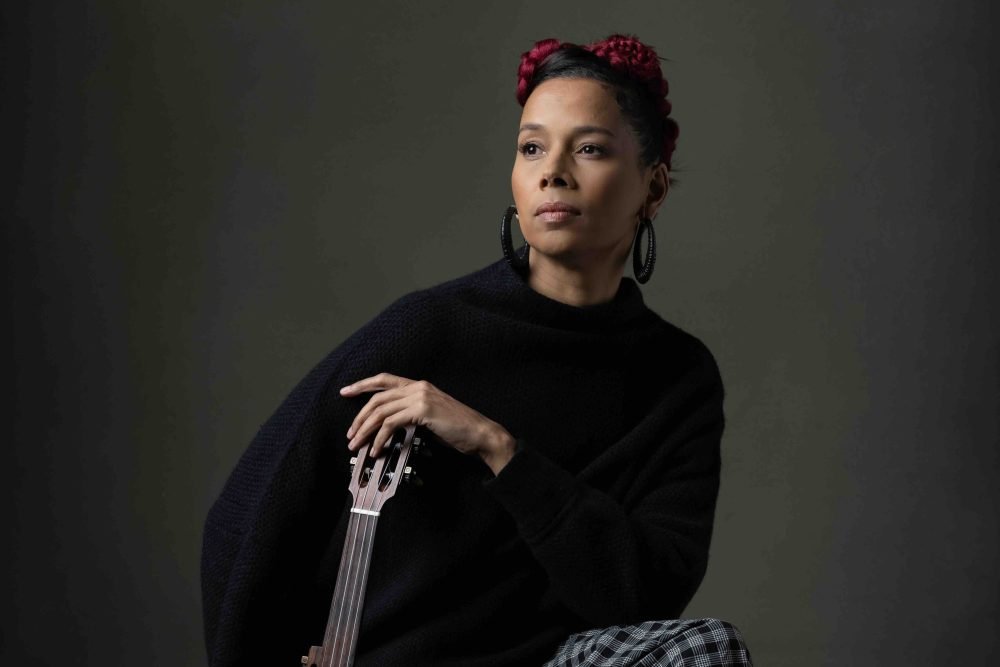
If roots music in America has a poster woman, it’s Rhiannon Giddens, who we can always picture with her banjo, even if she’s doing projects as far afield from that as an opera. She has just announced her seventh album, “Hope Is the Thing With Feathers,” which she describes as a “culmination” of the two decades she has spent becoming a leading figure in Americana music. Some sort of musical turn may be ahead, Giddens hints, but for right now, she wanted to throw a party on record, bringing together most of the musicians who’ve been with her on the journey since she co-founded the Carolina Chocolate Drops, recording a mixture of original material and folk standards or classics live in the studio in Louisiana. The new album, with a title track inspired by Emily Dickinson, will arrive Sept. 18.
“I feel so beautiful about so many things,” she tells Variety, “amidst the just horrible nature of what’s going on in the world right now. So it’s a weird position, but I just will just continue to fight all of that with joy and kindness.” And with fiddles, accordions, guitars and her current instrument of choice, the minstrel banjo. The first single from the album was released Thursday, the uplifting ballad “Carolina Rain,” written and recorded with a longtime music partner, Dirk Powell.
Others contributing to the sessions include her fellow Carolina Chocolate Drop, fiddler Justin Robinson, with whom she made a duo project last year, the Grammy-nominated “What Did the Scarecrow Say to the Crow,” an album of old-time songs recorded entirely outdoors; the Italian multi-instrumentalist Francesco Turrisi, with whom she made two duo albums, including a Grammy winner for Best Folk Album, 2021’s “They’re Calling Me Home”; longtime bassist Jason Sypher; Congolese guitarist Niwel Tsumbu; percussionist Charly Lowry; and, keeping things in the family, her nephew Justin Harrington on bones, her sister Lalenja Harrington on vocals, and Powell’s daughter Amelia Powell on acoustic guitar.
She’s had untold amounts of other irons in the fire, including such quick detours as working on the “Sinners” soundtrack and performing on Beyonce’s “Cowboy Carter” album. More recently, she filmed a lead role in the festival-bound independent film “An Ode to Mary Joe,” where she acted alongside Ed Helms, Regina Taylor, Jason Isbell, Steve Earle and John Sayles. Variety caught up with her about the movie and about her recently formed Biscuits & Banjos Foundation as well as the forthcoming Nonesuch album.
Every album of yours has its own musical concept. This is obviously different from the last one, “What Did the Blackbird Say to the Crow?,” which was just two people, whereas this has a much more extensive complement of players. What was the initial directive on this one?
I’d say it was really all about celebrating my musical family. It’s been the last 20 years — 21 years, really, if I date it back to 2005, when I met the other original Chocolate Drops at the Black Banjo Gathering; that’s kind of where I place the beginning of my career. Along the way I’ve made many musical friends, and the family slowly expands over the years, and so what happens is that we have this deep musical common language that we’ve developed by playing with each other. So I had all the different branches that I could — everything but Silkroad Ensemble, really — come together for this record. It’s all the people that I’ve been creating music with over the years, including my blood family, who were the first people that I made music with when I was 4 or 5 years old, when I started singing with my sister. It means a lot to have so many people represented on one project.
Talk a little bit about “Carolina Rain.” It’s not hard to see why this would be the first single; it feels contemporary to the ear and may be an easy entry point compared to some of the songs that really get into old-time music. It’s a beautiful song, and of course, Carolina’s in the title, and you’ve got a fair amount of Carolina sprinkled through this album. Where did that song come from?
I wrote it some years ago with Dirk, my longtime songwriting partner. We wanted to have it really be part of the sound that I created with this sort of combined band of the old-time folks and then also Francesco and Nihil and some of the people from the latter part of my sort of journey, all together. So we have the accordion and the banjo and the fiddle and the African guitar and everything kind of coming together. It just says a lot of things that I believe. You know, I am not really made for this industry. Even you saying it’s a more modern song, before people have to grapple with the old-time aspects of the record… I mean, it’s just like, I’m not really made for this world. And I’m having a career in spite of that. So I’m super grateful that I get to do what I do, that I get to foreground the musicians that I get to foreground and be a part of what I’m doing. But, it’s a great song; that’s all I know. Whether it’s more commercially viable, I don’t know, and I don’t really care.
For me, the verses say a lot. We’re so focused on money and stature and status that we’re destroying ourselves and our environment. And I don’t know that a song does anything other than just create a moment that maybe makes people think of something, or maybe makes them feel good for a second. But if I’m gonna make a song, I’m gonna make a song that has my philosophy in it, you know? And that a lot of people that I know, including my collaborators like Dirk, and the other people on the record, we’re all making music because we believe in it and we love it, not to be famous and rich and all that stuff. So that really kind of plants a flag in the sand as far as I’m concerned, for what I think and feel.
Is there a key line in “Carolina Rain,” for you?
All of the words are combining in my brain. It is a song about singing about money, and how I don’t care about it. I do, obviously, because I have to pay for stuff and I have to support my family, but it’s not why I do anything, for money. Especially as I’m 49 and I’ll be 50 next year, going through menopause, I’ve had these big changes in my life, and I’m seeing what’s going on in the world, and I just want to focus on what’s real: being with my loved ones, getting enough of what I need and sharing the rest. That’s all I care about really, and that song says it pretty clearly — “Just you and me, in love again, alive”… that’s it. We’re so blessed to be alive where there’s so many people being killed all over the world, bombed, dying of starvation, dying of disease. To be alive, it should be a right, but it is a privilege. That’s the way we’ve sort of set up our world, that it is a privilege to live in good health and with your needs met. So what are we doing with that privilege? If we’re not uplifting other people, if we’re not sharing that privilege, then as far as I’m concerned, we’re not doing it. I’m just getting philosophical in my old age, but I believe that that’s the only way forward, and I will stand on that.

Rhiannon Giddens ‘Hope Is the Thing With Feathers’ album cover
Nonesuch Records
Along the lines of the state of the world, one other original song to ask about from the album is “Wish in Vain,” which is about the refugee crisis around the globe.
Really for me, it’s all about connections. That’s why I write in a traditional way so much, because so many of the old songs are saying the same stuff that people are going through now. So it doesn’t matter which refugee crisis you’re talking about or which decade or which century; they all are the same thing. It’s people in power doing something so that people who don’t have power are being forced out, or they have to go for economic reasons, or they’re getting bombed. When that happens, nobody leaves their home, their ancestral land, their loved ones, unless they have to. That’s just human nature. And so when you have to leave, what happens? You miss your loved ones. You miss your culture. You miss your food. You miss the same stuff that other people 200 miles away who are going through the same thing also miss. People 200 years away also miss the same stuff. So that’s always my question: when we look at the past, it never should be just to look at the past. It’s always how can we use that to investigate and make a comment on what’s happening right now and to see people’s humanity? These are the only ways forward that make any sense whatsoever, is to restore people’s humanity by comparing struggles and going, “You know, gosh, they’re going through the same thing we’re going through,” or “that we went through two generations ago, they’re going through now.” How can we reroute and rethink about how we exist in the world?
Why did the Emily Dickinson poem resonate as something that should be the title of your album as well as a song on the album?
What we’re trying to do with our music and with our art is keep this idea of the best part of us, as humans, represented in music and art. It’s really where we come together in joy and humanity. I was just in a hotel room looking at that poem and just thinking about here’s this woman who really had such a prescribed life, and she was able to let her imagination soar way beyond where her physical body was. You know, hope is such a deeply human concept. It just really, really inspired me, and then the tune just came to me, and I sang it right into my phone a cappella. Then the other part of it was really kind of finished with Niwel’s beautiful harmonic accompaniment. And I really think about the way that we can collaborate even if we’ve never met the person [as with Giddens “collaborating” with Dicksinon]. We can make something new out of something old, and then hopefully somebody else will do it sometime. I mean, that poem’s probably been made into songs a million times. So, maybe somebody will make something out of this version, maybe they won’t. But it’ll make a whole ‘nother set of people listen to the words in a different way, I hope.
You do a traditional number called “Cluck Old Hen,” and you left in some chatter at the beginning where you’re saying, “Hell yeah!” It accentuates that this album was recorded live, in the studio.
Yeah, it was down in Breaux Bridge in Louisiana at Dirt Studio, where I did “Freedom Highway.” We did it in several different sessions kind of right off the road, and you can really feel that. We did a long tour, and then we’d go in for a couple days and we’d just rip through some tunes that we’d been playing together, so you feel that energy and the comfortableness. And I really wanted to leave some of that vibe in, because I feel like a lot of times recordings are so clean and so separated, and I’m kind of wanting to get away from that. I have been for the last couple projects, especially the last one obviously — I was really going far out with recording outside and stuff. This was in a studio, but a small studio, and there was no separation and very little overdubbing and people playing together like we’d been playing. I really wanted to leave a little bit of that (talking) in, just to get that vibe of you kind of snuck into the session and you’re just sitting in the back, watching it all go down.
Rhiannon Giddens – Karen Cox
Karen Cox
This is not as big a pivot from your previous album as that album was from “You’re the One,” which was more contemporary and, as you put it, more produced. Do you think you have more sort of “You’re the One”-type albums in you, or do you kind of feel like this is really sort of a groove you’ve settled into now, with the blend you have arrived at for this album?
Hmm. I feel like this is a culmination of a lot of things for me. I won’t say it’s an end. But I’ll say it feels like there’s a little bit of a turn coming. You know, we all know I’m not gonna be a pop singer. We all know that I’m not gonna be a super commercial singer at this point. But I definitely think that there’s a lot of things that I would like to investigate and explore, and so it feels like this is a good punctuation point for me. This record, it’s kind of the end of 20 years of being a roots and Americana artist. And it’s not saying I won’t work with these people again; obviously, I will, and I have been. But it definitely feels like a moment of reflection. This is in some ways a culmination for me of a lot of relationships, a lot of time spent, a lot of musical languages that I’ve been learning and trying to really get as good as I can in, and a type of songwriting that I feel really good about. So it’s a moment of “Let’s pause and have a little party.” It’s been a great career so far, and we’ll see what the next few years bring. But I’m really happy that this is coming out at this point.
You know, Biscuits & Banjos [her festival in Durham] was last year. I did a 250 show for Carnegie Hall. I’m curating my own festival in Hamburg, at the Elbphilharmonie. And Silkroad Sanctuary Project has gone really well. I’m getting these opportunities to foreground a lot of really great people. So I feel like last year and this year definitely feels like I’m seeing the work that I’ve been putting in really flowering and growing fruit, and my musical family just growing. I feel so beautiful about so many things amidst the just horrible nature of what’s going on in the world right now. So it’s a weird position, but I just will just continue to fight all of that with joy and kindness.
And then also fight it with unflinching looks at our history, which is something I’m in right now as I work on a book and I work on the really uncomfortable aspects of American history. I’s been a very sobering thing, to really dig into the archives and to really look at what our entertainment industry is based on, in terms of racism… I mean, that’s coming. So this is a great moment to be like, “Let’s play some old-time music!”
So the sobering book is on the way?
Yeah, I’ve gotta finish writing it. This isn’t the interview for that project. But it’s just to say, to write that book, I’m digging hard into some pretty uncomfortable aspects of American cultural history, so that has been on my mind a lot. So I’m very glad that this record is on the lighter side… I mean, there’s a couple of hard-hitting songs on there —”Step Away Blues” is pretty intense. But I’m happy that “Carolina Rain” is coming out and it’s just like, yay! You know? I need a little bit of “yay” right now.
We want to ask about your film role, in “An Ode to Mary Joe.” Is that already filmed and in the can?
I filmed it in November. The movie is almost done, and it’s amazing. I’m so proud of it. I can’t wait to actually really get into talking about it because it was such an intense, incredible experience and I got to work with so many cool people. I learned so much about who I am as an artist as well as just the whole industry. Despite what you see when you look at the big blockbuster movies, when you look at independent filmmaking, the world is full of people who just fucking love movies, and they love telling stories, and they just want a good script to see the light of day. … You’ve got people on the other end of the spectrum with next to nothing, managing somehow to make really incredible pieces of art. So it’s just wild — there’s not much in between, but that’s what’s happening to every industry. The middle class is getting hollowed out. There’s the same with with musicians. The middle part’s getting scooped, and then you have either all the money in the world and all the investors in the world, and then the people that have all the things to say in the world and hardly any money and you’re fighting and scrapping for everything, but you have control over what’s happening with it. So it’s an interesting time.
Any idea when people will be seeing the film, either in a mass way or at festivals first?
All I know is that we’re trying to get it in some festivals and hoping that people bite. It’s a great story and it deserves to be seen, whether people like what I did in it or not. It talks a lot about a lot of people in America right now who are struggling, and it really makes a lot of really beautiful points about what’s happening right now, which I think people will connect to. I hope it gets seen by the people who those folks who will draw something positive from it, whether it’s on Netflix or in movie theaters or wherever it ends up.
Just to ask briefly about the Biscuits & Banjos Foundation, what gave you the idea that you wanted to sort of uplift people in an ongoing way, not just through the festival of that name?
Yeah, it comes out of a festival that so many people put so much sweat, blood, and tears into. It turned out really well, but it’s hard to put on a festival if you’re trying to do it in a community-minded way where you’re making connections that are long-lasting and not looking for corporate support — it’s hard and it’s expensive. Especially now, the climate of doing what we’re doing in particular has kinda got a bullseye on its back in terms of the subject matter. There’s a group of people who want to support this work, and so I wanted to take the energy that Biscuits & Banjos built with the good will in Durham. We’re continuing to do events every year around that time. This year we had a dance, we had some talks, and then we had a great concert with the Blind Boys of Alabama, Mavis Staples and my band. And so we’re gonna hopefully keep the Biscuits & Banjos idea and thought alive with this foundation to continue to hopefully get up to another full festival. You know, maybe it’s every five years, I don’t know. Now that we’ve had the first one, I want to now make sure everybody’s compensated really well and make sure I don’t have to ask for friend and family rates when I’m asking people to come play my show. It’s got to stand on its own two feet. So the foundation really is to jkeep that energy going, as a place where people can donate, and something that can pick up the slack now that funding is drying up in other areas, because of what’s happening with the government and these kinds of things. It’s trying to keep things rolling, like providing banjos, for example, for some groups around the country who want to get banjo circles going, because not everybody has the money to buy a banjo. We’re just providing and making sure that people have access to these instruments and so that this work can continue.
Ebru Yildiz
“Hope Is the Thing With Feathers” track list
Angel Fire Rise
Hope Is the Thing with Feathers
Step Away Blues
Wish in Vain
Carolina Rain
High on a Mountain
Freight Train
Walk With Me
Cluck Old Hen
Going Home
Tour Dates:
July 17 – Trumansburg, NY – Finger Lakes GrassRoots Festival
July 18 – Oak HIll, NY – Grey Fox Bluegrass Festival
July 19 – Hanover, NH – Hopkins Center for the Arts
July 22 – Wilmington, NC – Greenfield Lake Amphitheater
July 25 – Lyons, CO – RockyGrass
July 28 – Bar Harbor, ME – Criterion Theater
Aug 20 – Lenox, MA – Seiji Ozawa Hall, Tanglewood *
Aug 21 – Waterloo, NY – The Vine Theater at del Lago Resort *
Aug 22 – Chautauqua, NY – Chautauqua Institution *
Nov 01 – Minneapolis, MN – Walker Art Center (Mack Lecture Series)
Nov 14 – New York, NY – Carnegie Hall (with Silkroad Ensemble & Yo-Yo Ma)
Nov 25-29 – Hamburg, Germany – Elbphilharmonie
- Performance with Silkroad Ensemble — “Sanctuary: The Power of Resonance and Ritual”
American Tunes: Lift Ev’ry Voice and Sing Tour
June 26 – Seattle, WA – Chateau St. Michelle (with Mary Chapin Carpenter and Hurray for the Riff Raff)
June 27 – Bend, OR – Hayden Homes Amphitheater (with Mavis Staples, Mary Chapin Carpenter and Hurray for the Riff Raff)
July 30 – Bentonville, AR – The Momentary (with Mavis Staples, Mary Chapin Carpenter and Hurray for the Riff Raff)
Aug 1 – Asheville, NC – Hellbender by The Orange Peel (with Mavis Staples, Mary Chapin Carpenter and Hurray for the Riff Raff)
Aug 2 – Pelham, TN – The Caverns Outdoor Amphitheater (with Mavis Staples, Mary Chapin Carpenter and Hurray for the Riff Raff)
Leave a Reply