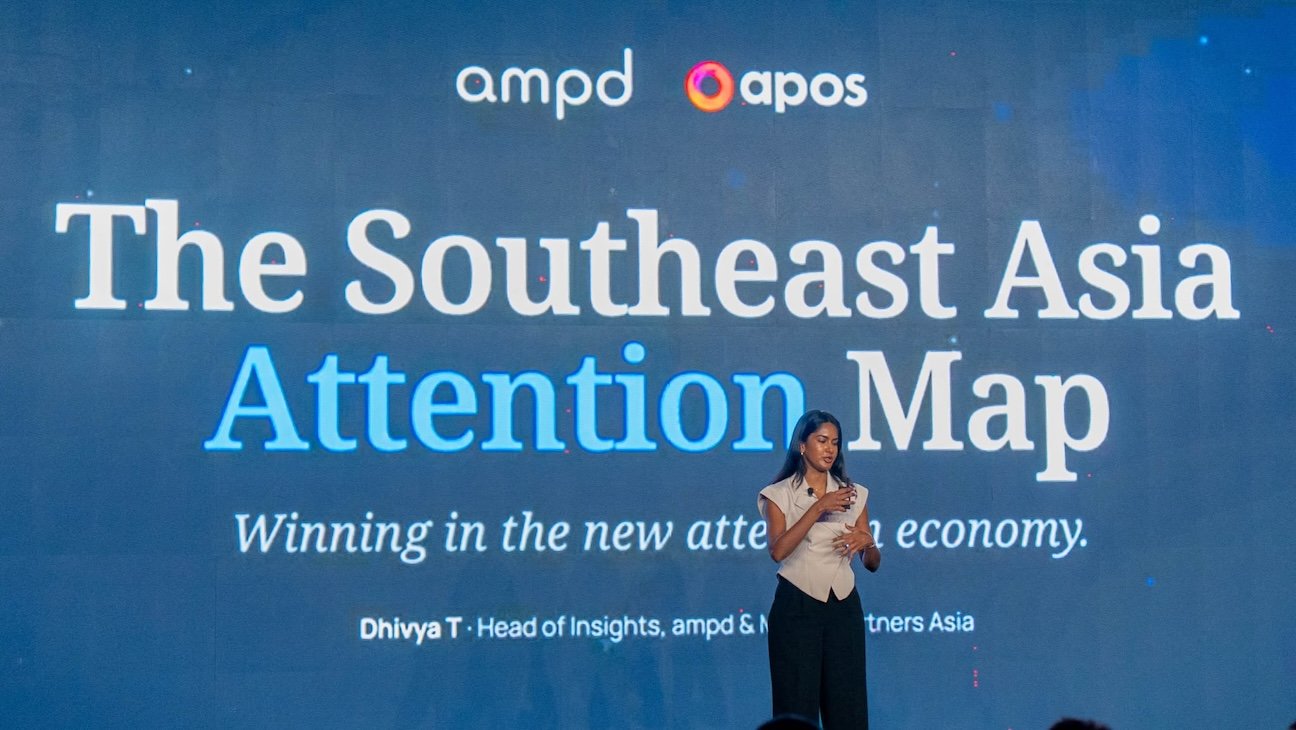
For all the money and content streamers are pouring into Southeast Asia, premium video commands a strikingly small slice of the region’s attention — only about 8 percent of the time people spend on their screens. That was one of several surprising takeaways from a presentation by Dhivya T., head of insights at ampd, the data arm of APOS organizer Media Partners Asia, who spoke at the Bali conference about how streaming and new mobile-first formats have scrambled how Southeast Asians actually use their screen time, and what it means for the many companies courting them.
According to ampd’s data, premium VOD users in the region spend around five hours a day on mobile leisure, with streaming just 8 percent of it — and once their TV screen is included, premium content still averages only about an hour a day. More striking, that share barely moves no matter the hour — premium video holds flat at 7 to 8 percent at every part of the day.
“There’s no primetime anymore,” Dhivya said. Consumers, she argued, graze across social, messaging, video, premium and microdrama side by side, all day, with no single category owning a slot. And the point, she stressed, isn’t for streamers to strategize on how to grow that 8 percent.
“The split isn’t a share to be won, it’s a need to be met,” she said.
Ampd’s research also found that even committed long-form viewing rarely involves undivided attention, as a third of premium sessions usually run a second screen, typically a local app. The phone isn’t beating the television, Dhivya said. Instead, the two run at once, “the committed screen and the restless screen, stacked.”
She divided users’ screen habits into two categories: fast attention versus slow. Fast attention — social, messaging, short video — “is served to you,” a scroll of quick hits chosen by algorithm. Slow attention is the lean-back, committed viewing a consumer chooses for themselves.
“Fast wins the most minutes in the day,” she said. “Slow wins the deepest ones.”
Dhivya suggested that audiences and brands now get built in the fast world — and that the deeper, paying engagement must have its roots there, too. As an example, she highlighted Backrooms, the A24 horror hit drawn from a 4chan meme and directed by 20-year-old YouTuber Kane Parsons, which became the studio’s biggest-ever opening before earning more than $260 million worldwide.
The same pattern, Dhivya said, has been shown in Southeast Asia, where Netflix‘s Thai film My Dearest Assassin rode the 13-million-follower Instagram reach of its star, Baifern; and where Indonesian viral X threads have spawned theatrical hits from Dusun Mayit to the horror phenomenon KKN di Desa Penari.
As she put it: “Built in the fast world,” but “banked on premium.”
That pattern, Dhivya argued, is why the microdrama has suddenly become such a surging new streaming format — and the subject of various deals at APOS this week. By integrating premium storytelling structure, serialized arcs and cliffhangers into a mobile-first delivery and pay-per-episode monetization, the format does something new: it builds an audience and charges it in the same fast-attention layer. “It collapses the funnel,” she said.
Microdrama is “the new top-of-funnel for premium” — a way to capture attention with polished stories, monetize it on the spot, while also steering the most engaged viewers toward the longer-form, more premium version. “The fast layer stops being only where you build awareness,” she said. “It becomes where you start to earn.”
She added: “Winning the conversation and culture is core to building deeper engagement, and monetization follows.”
For the studios and streamers in attendance, the presentation also mapped whose content is winning, market by market. Where a local industry has real scale, Dhivya said, homegrown stories outperform the oft-dominant Korean imports. Local titles lead in Indonesia and Thailand, while Korean and U.S. fare still tops Malaysia and the Philippines. Among titles that travel within the region, Thai content reaches furthest, drawing 6.4 million viewers elsewhere in Southeast Asia across every market and spanning genres from crime and thrillers to horror and boys’-love romance. Indonesian horror also travels, she added — strongest in the Philippines, via Netflix — while the Philippines itself looks like the region’s next potential growth market, with local hits proven at home but not yet reaching abroad.
Leave a Reply