Virginia Woolf herself was not the greatest admirer of her 1919 novel “Night and Day,” a complex and somewhat elusive work that wove a pensive reflection on women’s suffrage through a quasi-Shakespearean rotation of misbegotten and rearranged courtships — in a style far removed from the angular modernism of her later works. It remains perhaps the most underexposed of her books, and though it’s easy to imagine the period romantic comedy that Merchant-Ivory-style filmmakers might have made of it, it’s taken until now for anyone to attempt an adaptation. Though Tina Gharavi‘s film stresses its allegiance to the text with the title “Virginia Woolf’s Night & Day,” it’s actually quite a departure: Playing down the novel’s tangled relationships in favor of a straightforwardly empowering celebration of female agency and education, it trades some of the author’s elegance and nuance for a more crowdpleasing message.
Whether it finds many crowds to please remains to be seen. London-set and broadly accessible, “Virginia Woolf’s Night and Day” was a fitting opener for the second edition of the SXSW London multimedia fest, a few weeks ahead of its U.K. theatrical bow. But given its relatively low-profile source material and a solid cast of known names who nonetheless aren’t major big-screen draws, the film might fare better on streaming platforms internationally. For Iranian-born filmmaker Gharavi, who landed a BAFTA nomination for her punchy 2013 debut feature “I Am Nasrine,” this handsomely dressed and mounted production proves she can handle the demands of British heritage cinema, though it’s a less interesting direction for her.
An American who can seem amorphously international when required in such projects as “Cyrano” and “Widow Clicquot,” Haley Bennett is a vivacious and likable anchor for the film around her. She sports a convincing cut-glass accent as Katherine (or Kit, when the mood takes her), a spirited and intellectually curious young woman in Edwardian London with a particular passion for astronomy — one of many fields of study then barred to women, even relatively well-to-do ones like Katherine. She must disguise herself as a man to attend lectures at the Royal Astronomical Society, while her dreams of continuing her personal research at Cambridge face a patriarchal wall of opposition.
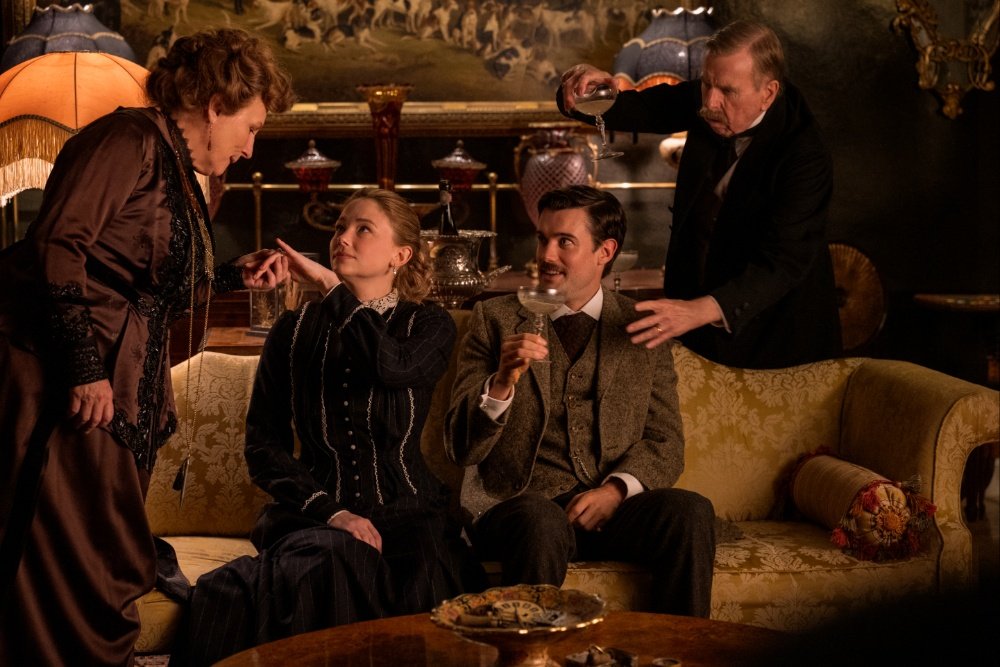
Her stuffy father (Timothy Spall) would prefer she find herself a suitable husband; she eventually accepts the proposal of her childhood friend William (comedian Jack Whitehall, easily adapting his signature posh-bozo persona to the period), a foppish and untalented poet, to get everyone off her back. Her cousin Cyril (Misia Butler), her closest male ally, is aghast at her pragmatism in this regard; in a major change from the novel, where the character unapologetically fathered children out of wedlock, here he’s a marginalized gay man, unwilling to live a lie to cut an easier path through the world. Naturally, no sooner has Katherine entered a loveless engagement than she strikes sparks with Ralph (Elyas M’Barek), a literary editor commissioned by her father to tame the unwieldy manuscript of her would-be writer mother (Jennifer Saunders) — an ostensibly kind but ultimately controlling male gesture.
Though it’s at the core of the novel, Katherine’s relationship with Ralph never comes into focus in Justine Waddell’s adaptation, as every male character bar Cyril is given pointedly short shrift in the film. More screen time is given over to her burgeoning friendship with firebrand suffragette Mary, played by singer Lily Allen in a deliberately anachronistic performance — her forthright speech and manner beamed in directly from the 21st century. The two women bond more closely here than they do in the novel, where their individualist and more community-minded stances were subtly contrasted; the film prefers a more robustly unified representation of female solidarity, driven home by dialogue that comes close to speechifying at several points. (On at least one occasion, when an incensed Katherine gives a sexist university selection panel what for, this streamlined progressive rhetoric is quite satisfying.)
Still, sometimes Bennett’s lively, headstrong performance feels like it’s swimming not just against outdated social currents, but the film’s own staidness. As much as Gharavi tries to energize proceedings with a bobbing handheld camera and an electro-tinged score that, in the closing credits, finally bubbles over into ethereal, Ellie Goulding-style pop, “Virginia Woolf’s Night & Day” can feel talky and stiffly didactic, however sincere in its convictions. Well-meaning but ultimately familiar in both message and delivery, the film speaks much of the bolder future ahead, but the filmmaking does little to disrupt the status quo.
Leave a Reply