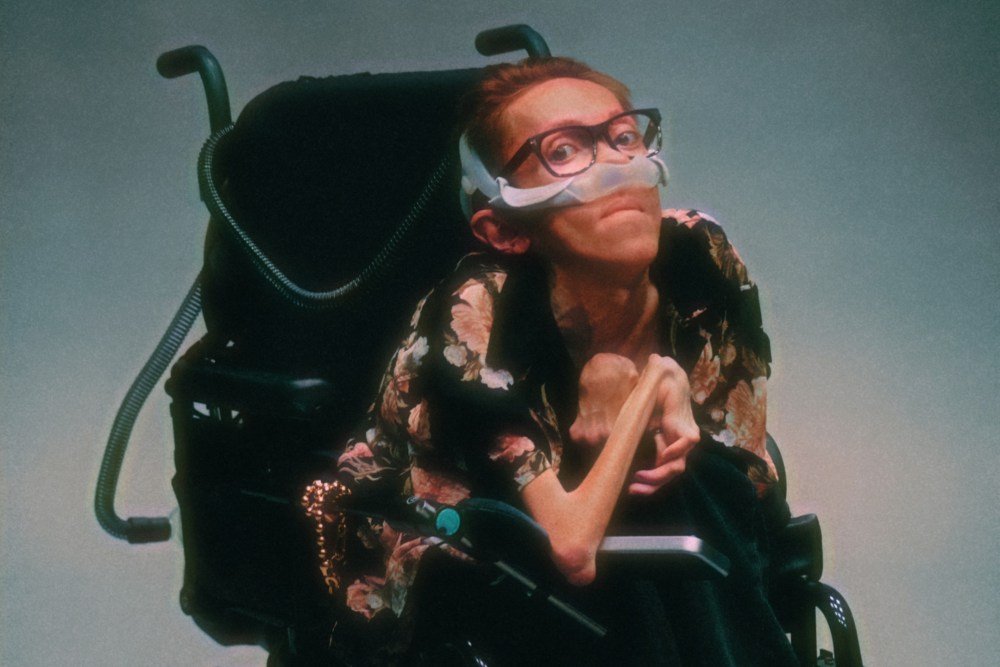
It’s uncommon to meet an actor bold enough to call Ari Emanuel, the executive chairman of WME Group and one of the most powerful people in Hollywood, a “prick” on the record.
But it’s also uncommon to interview an actor as unfiltered as Steve Way.
“I want an agency to whore me out,” he says. “Let’s make a ton of money together. Let’s change the world.” I joke that I’ll pass along his exact words to all the big companies. “Just get Ari on the phone,” he retorts. “Ari loves me. Except he won’t hire me.” That’s when Way mutters the p-word — under his breath for plausible deniability, but certainly still with the intention of being heard, smirking at the sound of my laughter. This is one of the last things he says to me before we wrap up our interview. A light blue Labubu that he’s clipped to his motorized wheelchair gives a wink as he rolls away.
It’s impossible to fault Way, 35, for his ire. That’s partially because it’s well delivered — he’s got 15 years of stand-up comedy under his belt — but mostly because he works in an industry that seems determined to shut out people like him. Best known for his recurring role in Ramy Youssef’s self-titled dramedy series, and now giving an impeccable supporting performance in Hulu’s “Furious,” Way has no agent or manager. “And we know why,” he says, referring to his chair, his ventilator and the muscular dystrophy diagnosis he received at age 4.
“I don’t have representation. And it’s frustrating, because I used to,” Way says. With his first agent, he got “nothing. Just nothing.” He signed with someone new, who later jumped to another agency and didn’t bring Way with him.

Left to right: Ramy Youssef, Steve Way and Bella Hadid in “Ramy” Season 3.
Courtesy of Hulu
Way spent years wondering whether he’d be able to book a project without the support of Youssef, a close friend since childhood. Then, with “Furious,” he received something actors spend their whole careers dreaming of: a role written expressly for him.
“Furious” is helmed by Elizabeth Meriwether, the writer-producer famed for creating “New Girl” and “The Dropout,” whom Way first met in 2025 when they appeared together on a WGA panel about on-screen depictions of caregiving. “I did the panel really high,” Way admits. He’d been on a stand-up tour as Youssef’s opener, and needed to relax after all the travel. “We’re going down the line talking about what we’re working on. Full resumes. And it got to me, and I was like, ‘I’m unemployed. If anyone wants to put me in their stuff, [I’ll join] gladly,’” Way recalls. Meriwether took his stoned comments to heart. “Two months later, I got an email from her people saying she wrote a part for me. That was it.”
Way stars in the series as the love interest of the serial killer played by Lola Petticrew. To everyone else, Catherine is a sociopath. But to Alden, she’s simply a kindhearted in-home health aide who perhaps has a few secrets. As she feeds and bathes him with a gentle touch and a warm gaze, he returns the favor by giving her the benefit of the doubt about her shady comings and goings. Wanting to make the most of the time he has left after learning from doctors that his health has seriously worsened, Alden later proposes to Catherine with his late mother’s engagement ring, then begins abetting her crimes.
There’s a profound sadness to the role, but “Furious” still makes plenty of room for the humor Way is known for. He applauds Meriwether for writing a disabled character who confronts his mortality but still has an identity beyond that, including a sense of humor. “When I read my first line — ‘You little slut!’ — I thought, ‘How does Liz know I would say that?” he says, smiling. “Right away, I knew that she would do the character justice.”
When Danny (Scoot McNairy), a cop, suggests that Catherine is using him, Alden is resolute. “I don’t fucking care,” he says. “You think love is only when people do everything that you want them to do. That’s fucked up.”
Way intimately understands that sentiment. “Everything is transactional. And as a disabled person, it’s very empowering to understand that. Caregiving is a two-way street. It has to be in order to work.” And the concept, in his eyes, isn’t exclusive to the relationship between disabled people and their aides. “Society has told a lot of lies about disabled people, mostly that we’re a burden. It’s not true. And to understand that is to accept that everyone, at some point in their life, receives care.”
“When you take the subway, you don’t do that alone. Someone’s driving,” Way continues. “When you get DoorDash, that’s a level of care. So when Alden says that to Scoot’s character, in a way, he’s trying to radicalize him. Like, ‘You don’t get it, man.’” Smiling, he offers a phrase borrowed from his friend Danny Kurtzman, a fellow actor-producer with muscular dystrophy. “’Disabled love is the best love.’ Because of how intimate it is. How close you have to be,” he says.
Lola Petticrew and Steve Way in “Furious.”
Courtesy of Disney
In Way’s opinion, “Alden and Catherine have the best relationship in the show: They had to get everything [uncomfortable] out of the way first and set up boundaries to make sure they could handle it. Like, ‘What’s your history with this person who’s keeping you alive? What do I do for them?’ It’s delicate, but there have to be boundaries, because it’s easy for any caregiver to get burnt out. That was really fun to figure out.”
“Furious” was everything Way would have hoped for in terms of disability accommodations, thanks to the help of an on-set accessibility coordinator. “She made sure I was OK and advocated for me when I was really in the zone. Not once did I ever feel unsafe or not taken care of. It allowed me to just focus on the character. I wanted to feel the love and trust, to find our routines. Like, how would she would shower me? But also something as delicate as: How do we sit across from each other? How do we face each other lying down in a bed?”
There were still moments when Way found himself pushing against his limits, physically. “There were some scenes that were uncomfortable — lying down for any extended period,” he says. But the discomfort was worth it to him. “I was locked in. Nothing else mattered; I just turned it off. The only thing that matters is the art that we’re operating here. That was my temporary. Yeah, the art. That’s it. The right thing for art, you know. That’s something that I realized no one can take away from me.
Before “Furious,” Way wasn’t sure if his three-season run on “Ramy” had been enough to prove his talents to the industry. “I was scared people wouldn’t take me seriously. One time could be a fluke,” he says. “But twice? I’m pretty good at this.”
Courtesy of Disney
There’s still a long road ahead. Twice, Way has worked with a studio to develop a series he would create and star in himself, but both Apple TV and NBCUniversal ultimately passed. “It’s about the inner workings of a facility for disabled people,” he says. “We want to have a full disabled cast and show what it’s like to live in one building with not enough caregivers, with an administration who has no idea what they’re doing, in a country that doesn’t treat us the best. I think a lot of people will relate to it, and they’ll see the absurdity in our day-to-day.”
Slyly, he adds, “Shoutout Netflix!” — the streamer he hopes will be his next suitor.
He’s gone through something similar with his stand-up comedy. He dreams of headlining his own tour. “It’s so hard to find accessible venues, but they’re out there. I gotta do my hour first, though,” he says. He’s already prepared — and taped — a full set he feels ready to show the world. He just hasn’t found a platform willing to help him turn it into a special. “Shoutout HBO!” he says.
It’s par for the course at this point. “I’m numb to the noes,” Way says. “Because the noes have never stopped. And that’s OK. That’s just life; it’s no one’s fault. But it’s tough, because I have these big opportunities, and I don’t trust them.” With “Furious,” he tells me, he didn’t fully believe he’d get to be on TV again until his first day on set. “So when I hear that someone is interested in my show, I’ll take a meeting, but I don’t expect anything.”
Still, he’s built more than he ever imagined for himself when he was younger. “I didn’t think I could have a career of any kind, because everyone told me I wouldn’t live long,” he says. “I almost died when I was 14, and I wasn’t supposed to live past 18. Then, when I was 25, my doctors told me I’m good. I was like, ‘Fuck! What now?’ I wasn’t good at anything besides telling jokes.”
So he keeps telling them. “The only thing that’s gonna stop me is my heart,” he says.
And he’s also starting to enjoy the effects of the opportunity Meriwether gave him in “Furious.” For the first time, Way has a publicist, which he says has been “wonderful.”
“It’s nice to respond to emails for once instead of initiating them, which is what I do every day,” Way says. Without a team behind him, the burden of seeking out the few roles available to disabled actors falls on him alone. “It’s tiring,” he says. “Espresso helps. Vodka helps. But I can’t run on that stuff forever.”
Leave a Reply