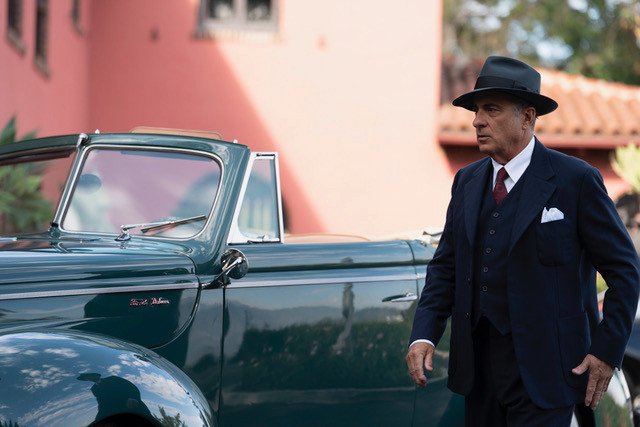
In the opening scene of “Diamond,” we watch Andy Garcia, as a Los Angeles detective who looks like he stepped out of a Hollywood movie from the ’40s, put on his private-eye regalia — the three-piece suit, the pocket handkerchief he carefully irons, the fedora — and then grab his money clip from a tray of artifacts before he goes out. The movie, with its period trappings and mournful jazz soundtrack, appears to be priming us for some old-fashioned moody film-noir fun. But then Garcia’s detective, terse and fastidious, introducing himself as “Diamond, Joe Diamond,” steps out into the streets of L.A., and the first thing to confront him is a police car that’s right out of the 21st century. So are the streets, the skyscrapers, the restaurants. They’re all Los Angeles today. So what’s this relic of a detective doing smack in the middle of it?
For a while, “Diamond” almost looks like a surrealist comedy, as Joe tools around the city in his vintage green 1940s Ford DeLuxe convertible, having encounters with people who are totally contemporary, while he himself remains a pure piece of period pulp. “The Long Goodbye,” Robert Altman’s funny and dazed 1973 riff on the Hollywood detective mystique, featured a Philip Marlowe — played by a sleepy-eyed, shambling Elliott Gould — who was a gumshoe out of water, only the movie presented him as an L.A. eccentric, lost in his movie-fed dreams. “Diamond,” by contrast, looks like it could be a Woody Allen fantasy comedy like “Midnight in Paris,” with a hero who’s literally a man out of time.
Garcia, who wrote and directed the movie, has come up with some crisply clever faux-noir dialogue, and part of the joke is that Joe speaks in his hardboiled pensées while everyone else talks like a normal person. “I always know what they mean,” he says. “Even when they don’t mean it.” Bogart (or maybe Yogi Berra) couldn’t have put it better. Garcia sets this all up in a sly way, without overstating it. The people Joe meets may mock his antique quality, but they take him seriously. No one questions that he is the way he is. Maybe that’s because of his one claim to fame — he rescued a flamingo that had been kidnapped (for its valuable fathers), and now that’s part of his legend. All driven by social media, of course, even though Joe himself wouldn’t dream of carrying a cell phone.
I would have been happy to watch the Woody Allen version of this movie, and “Diamond,” for a while, is an amusing mystery-satire. Much of it is set in prewar L.A. locations like the Bradbury Building, which are milked for their seedy nostalgic grandeur. And what saves the character of Joe from terminal quaintness is that Garcia draws on the gruff, slightly jaded quality that he has acquired with age. His Joe is a real cynic, with demons in his closet; his rejoinders come from a tough place.
The film lures us into a mystery that’s a knowing gloss on all those old detective movies, as Joe is hired by Sharon Cobbs (Vicky Krieps), a platinum-blonde femme fatale whose older tycoon husband was just murdered. She’s the chief suspect — in fact, the only suspect. There are sinister types on the sidelines, and a corrupt cop, McVicar (Brendan Fraser), who is Joe’s long-time frenemy; he’s already planning to nail Sharon for the crime. But why is everyone so certain that she did it? It looks like a frame-up, as the movie establishes a tone that’s two parts “The Big Sleep,” two parts “Chinatown,” and one part Woody Allen meets “Saturday Night Live.”
You can feel Garcia’s joy in reviving these old-movie tropes, and the plot he’s comes up with seems sturdy enough to work on its own terms. But right around the time that Danny Huston shows up as some sort of Mr. Big (we’re cued to notice that he’s the son of John Huston, who played the heavy in “Chinatown”), the plot, which we think is going to expand into a ripe conspiracy, ends up taking a back seat.
The focus turns to Diamond himself. He hangs out in the legendary L.A. bar Cole’s French Dip (the place that invented the French dip sandwich and has been open since 1908). There, he drinks rye with his longtime bartender buddy, played by Bill Murray. One night, into the bar wanders Angel (Rosemarie DeWitt), who looks as caught in the ’40s as Joe is. It might be love at first sight, as they stare moonily at each other and then go out to dance. But it turns out that these two have a past. And the more we learn about Joe’s past, the more we learn why he is the way he is.
As that happens, the movie, appealing as it is, begins to sag. “Diamond,” while it has a built-in irreverence (notably when Dustin Hoffman shows up as a coroner obsessed with telling bad jokes), actually depended on our having a dramatic investment in the conspiracy it set up. When Garcia turns his attention to Joe Diamond’s traumatic backstory, the air starts to leak out of the plot. The second half of “Diamond” feels more fully worked out on paper than it plays onscreen. Yet it’s a movie I enjoyed much of, and am glad I saw. A great deal of tender loving care, and Hollywood obsession, has been poured into it, and it’s amusing to see how the quality that’s always made Andy Garcia such an appealing actor — his way of being direct but holding something back with a twinkle — fits so snugly into an old-movie reverie.
Leave a Reply