In these terrible, wounded times, when geopolitical upheaval has consequences so personal we might trip over them at our own doorsteps, and when our own attempts to live normal lives come freighted with guilt that we’re essentially dancing while others die, there is sobering value in a film like Emmanuel Marre‘s unsparing “A Man of His Time,” the director’s solo feature debut after co-directing 2021’s impressively scathing “Zero Fucks Given.” This World War II-era drama, rather than celebrating or vilifying the heroic/villainous stories of the exceptional few, shifts focus onto a representative of the unexceptional many — a man “of his time” who, through his actions and silences and willful self-delusion, reaps the benefits of an evil ideology without ever believing himself to be its fellow traveller.
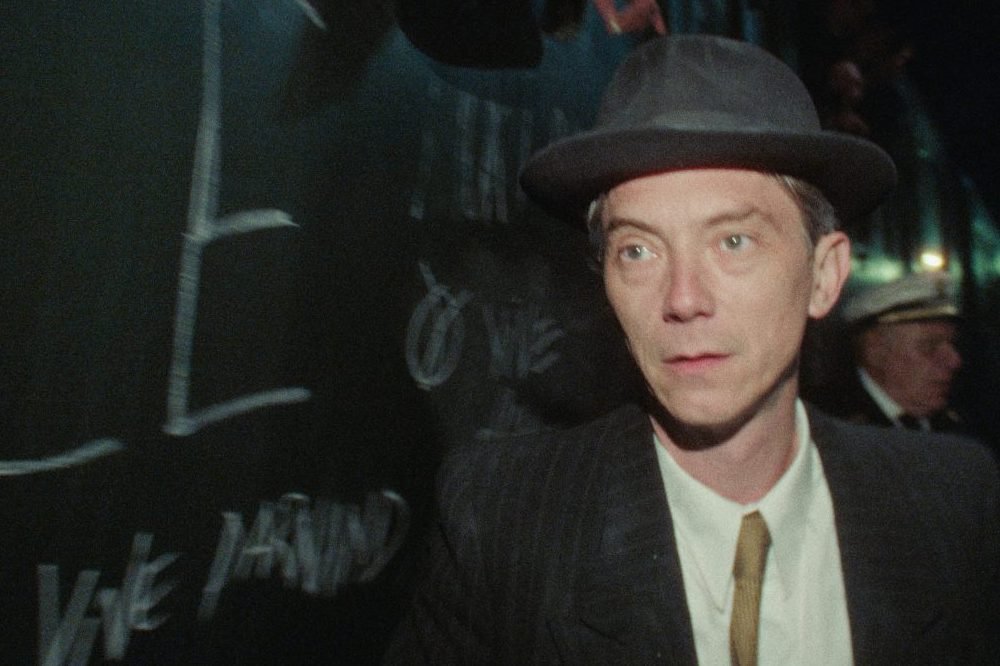
Dancing while others die, Henri Marre (an outstanding Swann Arlaud) is at a party, where as a new arrival to Vichy he is trying to insinuate himself into the inner circles of the bureaucracy supporting Pétain’s puppet government, established following the 1940 fall of France to the Germans. Henri gets drunk and ornery, and causes raised eyebrows with his gauche declarations of patriotism and his insistence on promoting his self-published book of Pétainist propaganda, titled Notre Salut (“Our Salvation”), to unimpressed revellers.
Already now, the experimental edge to Marre’s approach is making itself felt, with DP Olivier Boonjing’s grainy handheld cinematography becoming increasingly woozy and fragmented alongside Henri’s mental state, and with the lighting set-ups degenerating to resemble the off-the-cuff disposable-camera flash-photography: blurred, red-eyed, disheveled. Without altering the period-accurate costumes or locations, the anachronistic aesthetic co-opts the vintage vibe of a coked-up New York City disco as a visual byword for DGAF decadence. So it’s almost jarring to see a neatened-up Henri the next day, writing to his wife Paulette (a perfectly ambivalent Sandrine Blancke) to whom he refers cutesily as “my little lady” and to discover that he has a family — albeit one he regards at best as an accessory to his own social advancement, and at worst as an impediment to it. They have agreed to wait for him to establish himself so they can join him.
Henri may be a Pétainist believer, but he is primarily a careerist and a strange kind of egotist, almost always a little out of his depth, always expending enormous energy battling against the tidal currents of his own mediocrity. There’s a temptation to call such men too big for their boots, but Henri is too small for his, and Arlaud is so good at projecting that insufficiency, yet still being riveting to watch. And for all one can easily despise Henri for his ideological denseness, his ingratiating manner and his queasy deference to his social and professional superiors, one cannot fault his work ethic. When he gets a sniff of an opportunity, there is nothing he will not do to capitalize on it. Cue a mordantly absurd scene where his chance to land a position in the administration hinges on him successfully retrieving a precious package from a muddy field behind enemy lines, which turns out to be a damp and recalcitrant cat.
Having thus proved his usefulness — and that there’s no task too lowly for this factotum to unquestioningly carry out — Henri is duly hired and suddenly his fortunes are on the rise. Though he’s denied the promotion he believes he deserves and must suffer the indignity of working under Maux (Jean-Baptiste Marre) an acquaintance he quietly resents for his comparative lack of Pétainist zeal, he does distinguish himself enough with his assiduousness and efficiency to allow him to send for his family and to move from cramped lodgings into a spacious house. “We need reliable men like you,” harrumphs one official.
Now with Paulette elegant by his side, Henri’s social ascendancy begins in earnest. There are more soirées and social engagements, as well as montages and loosely choreographed dance sequences that are cleverly counterintuitive, soundtracked to ’80s synthpop and Opus’ “Live is Life” and even a version of the classic videogame earworm “Popcorn.” There are more occasions for Henri to enact petty revenges on the people he imagines slighted him on his way up. There are more of those flash-photography scenes and whole sequences that play in black-and-white, stitched into the fabric of the film with matter-of-fact unshowiness by editor Nicolas Rumpl.
What there pointedly are not, in this wartime film, are war scenes, or footage from the concentration camps or even a suggestion of much actual physical violence in the background. Marre’s focus on Henri’s rise, and subsequent fall when it finally becomes apparent even to him that he has hitched his wagon to the wrong star, is steady and unblinking, and for Henri, despite the discomfitingly frequent presence of visiting Nazi officers to the Vichy spa hotels that now serve as the various Ministries, the war itself is very far away.
Perhaps we could even imagine him, up till now, genuinely ignorant, and therefore somewhat innocent, of the Nazi regime’s worst excesses. Except that when he’s presented with a query about train carriages that the Germans have requisitioned, his fractional hesitation before signing off on the order betrays him. He knows what the implications of those calculations are, and though he will later cover for a colleague whose mercy extended to requisitioning extra straw to put in the transports that do not come equipped with chamber pots, nothing can excuse or forgive the culpability implied by that momentary pause.
But Marre’s aim with “A Man for His Time” is not to exonerate Henri, even though the impulse must have been there: he is based on Marre’s own great-grandfather (as is emphasized early on when Henri carefully spells out his surname to a new acquaintance) and much of the incident is lifted from the family’s trove of contemporary correspondence between the real Henri and Paulette. And though it can be genuinely wearying and not a little depressing to spend 148 minutes in the company of a man so deeply wrongheaded and in such maddening self-denial (even Paulette, complicit in her own way in her husband’s ambition will eventually insist that he stops calling her his little lady) it is certainly instructive and horribly relevant.
It’s been the subject of gallows-humor jokes for decades in France that everyone claims their grandfathers were in the Resistance, when the numbers do not even begin to bear out that possibility. And Marre, with his sturdy and disquieting movie, provides a corrective to that kind of historical myopia, using his own genealogy to cast a camera-flash of light onto one guy who could have been any of a million guys and to retroactively deny him the consolation — which many of us may one day reach for too — that he was just a cog in the vast churn of history. Even a cog can affect the workings of the machine if, with a great effort of will and principle, it chooses not to turn.
Leave a Reply