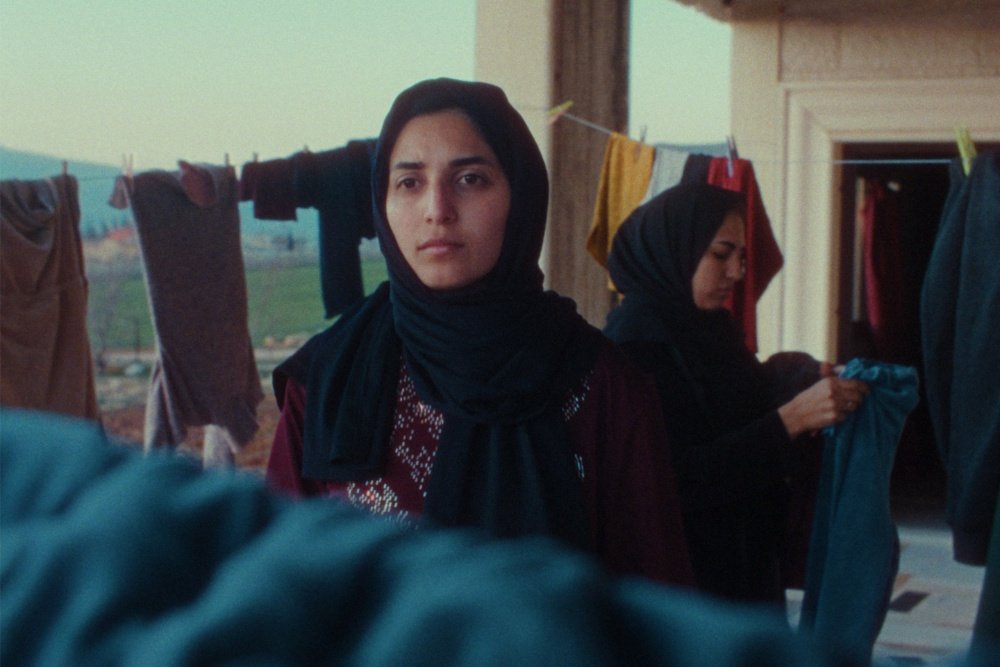
“Genre-defying” can be an overused term these days, but entries like Palestinian filmmaker Rakan Mayasi’s lyrical feature debut “Yesterday the Eye Didn’t Sleep” earns it, playing quietly and inventively by its own genre-free rules. A tone poem and an observational, fly-on-the-wall yarn more interested in the specificity of mood and atmosphere than story, the film takes viewers inside the traditions and patriarchal rituals of the Bedouin tribes in Lebanon’s Bekaa Valley. These pastoral people, also called “desert dwellers,” have been on the same soil for hundreds of years, going through the changes of settled life. (A different segment of the society was also the main subject of Elite Zexer’s 2016 award-winner “Sand Storm.”) But as Mayasi’s quietly attentive film articulates, their male-controlled customs still loom large.
Then again, patriarchy, however hidden, seems to still rule the day in other places too, even in more progressive corners of the world where women often pay a price or are asked to apologize for male wrongdoings. With that backdrop, Mayasi’s visual and narrative priorities, rejecting both judgment and moral superiority, render his film all the more powerful. He makes a clear choice to reflectively witness his characters’ choices and predicaments, despite the otherwise happenstance nature of the film — made without a traditional script, and with only first-time non-professional actors in the ensemble.
“Yesterday” starts off with the image and ear-splitting sound of a truck in flames. The fire comes with a backstory fed into the picture in small doses, through blink-and-you’ll-miss moments and throwaway exchanges between characters that come to define the film in its later moments, too. A young woman, possibly with a romantic entanglement her family doesn’t approve of, has gone missing — chances are she set the truck on fire and fled the pressures of her kinfolk. And it’s up to her cousin Yasser (Yasser Al Mawla) to find her in order to resurrect his family’s honor. Having been raised not too far from similarly-minded environs, this Turkish critic knows that keeping a pure and noble familial slate in patriarchy often means oppressing women. There could be no scenario in which Yasser’s pursuit of his cousin through reckless car rides and searches would end well.
Further troubles find Yasser soon enough, when he accidentally hits and kills a man from a neighboring Bedouin tribe. And it falls on the shoulders of his sisters, quiet Rim (Rim Al Mawla) and more vibrant Jawaher (Jawaher Al Mawla), to pay for his crime. Mayasi patiently follows the two sisters, especially hospital worker Rim, through their daily routines and nightly chatter. Both have their own romantic interests in secret. But little do they know that a different kind of fate awaits, one that would rob them of their autonomy.
Smartly, Mayasi doesn’t attempt to overexplain the Bedouin traditions — instead, he shows the events that follow at face value. We learn that forgiveness could only be granted to Yasser if Rim and Jawaher are sent to a certain Sheik’s home in the middle of the night as bridal offerings, and only if one of the sisters gets married with a bachelor of the tribe upon the Sheik’s decision. Despite the grotesqueness of the devastating situation, it’s surprising that the Sheik doesn’t come across as villainous as he could do. (Again, Mayasi isn’t in this to overtly spell out his judgment against these customs.) Eventually, Jawaher volunteers as the bride-to-be, selecting her groom after a deeply uncomfortable gathering with the tribesmen .
Considering his unwavering style that favors long takes, an ethereal handle on the passage of time and his lensing of landscapes and trees, it isn’t a surprise to learn that Mayasi has honed his skills alongside the likes of Béla Tarr and Abbas Kiarostami. There are aesthetic rewards for staying with this soulful yet slowly unfolding tale, even though it occasionally feels more like a collection of vignettes than a fluid whole. At times, you wish that Mayasi would give the viewer a little more narrative substance to nibble on to earn their attention.
But elsewhere, the film’s sporadic, accidental humor comes to its rescue — a scene involving a cow that clearly doesn’t want to be milked especially comes to mind. Also enlivening “Yesterday” is a wedding sequence of heart-pounding rhythms that puts Mayasi’s command of mood and choreography on display. While the joy of the wedding barely conceals an undercurrent of pain, that scene infuses the film with a jolt of energy, helping the viewer to exhale for the first time.
Somber and unapologetically experimental, “Yesterday” unleashes its most valuable surprise through its open-ended, otherworldly conclusion. In a statement, Mayasi says that his grandmother’s story of being pushed into an arranged marriage at 14 years of age never escaped him. With “Yesterday,” he turns that family history into a flawed yet powerful artistic statement, where injustice against women is a wounding vicious circle.
Leave a Reply