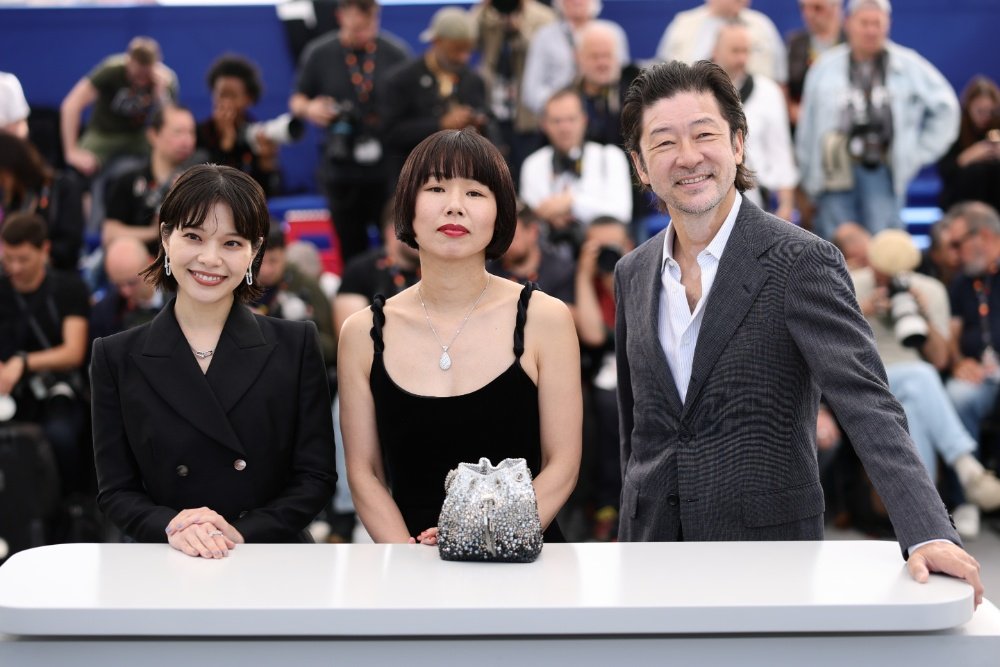
For Yukiko Sode, the challenge wasn’t pressure – it was pleasure. Adapting Mieko Kawakami’s introspective novel “All the Lovers in the Night” for the screen meant externalizing a protagonist’s inner world, a task the director describes not as burden but as sustained creative exploration.
“It was certainly a challenge to find a way to externalize the protagonist’s first-person introspection from the novel. But if anything, what stayed with me was the enjoyment of the process – continually exploring how to shape and articulate it cinematically,” Sode says.
The film premieres in Un Certain Regard at Cannes this month, arriving at a moment when Japan serves as the Marché du Film’s Country of Honor. For Sode, the timing carries dual significance.
“I am deeply honored that the film has been selected for Un Certain Regard in a year when Japanese cinema is in the spotlight. More than that, however, I value the opportunity for the film’s strength to be tested – how far it can reach across borders and cultures,” she says.
Kawakami’s novel centers on Fuyuko, a freelance proofreader whose solitary routine shifts after meeting Mitsutsuka, a physics teacher. The screen version stars Yukino Kishii opposite Tadanobu Asano, a pairing Sode pursued with specific intent.
“It was important that they feel like two people on the margins of the world – almost invisible, overlooked by everyone. As actors of immense talent whose profession is to be seen, I imagine this was no easy task, yet they responded beautifully. They carried a presence that felt as if they had been born into these roles,” the director says.
The film’s pacing reflects its protagonist’s experience – slow stretches punctuated by subtle transformation.
“As for the rhythm that runs through the film, it may divide opinion – whether one feels that nothing is happening, or that something is always unfolding. I see this not as a story about the two of them, Fuyuko and Mitsutsuka, but as a portrait of a woman’s everyday life after she falls in love. She isn’t thinking about romance twenty-four hours a day, so by giving more time to moments that don’t involve Mitsutsuka, I felt we could more clearly convey the subtle shifts in her daily life,” Sode says.
Building Fuyuko’s interior landscape on screen required tools beyond performance. Sode and her team leaned into cinematography, lighting, production design, and costume to express what dialogue couldn’t carry.
On adapting a novel with an established readership, Sode rejects the notion of special responsibility attached to Kawakami’s name specifically. The tension, she suggests, is inherent to any adaptation.
“I didn’t feel any particular pressure simply because it was a novel by Mieko Kawakami. Adapting an existing work always comes with a certain sense of tension, regardless of how well-known the original is. But as I continue writing, a screenwriter’s ego inevitably emerges. So I approach the process by holding both respect for the original and my own ego in balance, aiming to let them merge to the point where the boundary between what is drawn from the source and what is my own begins to dissolve,” she says.
The film occupies territory between romance and psychological study, a tonal balance Sode navigated by viewing romantic feeling as inseparable from broader human need.
“I see romantic feelings as something intertwined with other human desires – intimacy toward family and friends, attachment, the desire for recognition, self-expansion, and the urge to fill a sense of lack. For that reason, I found myself working hard to shape the film within the framework of a romance. It ultimately came together as a romance because of the actors’ remarkable performances. Thanks to them, I came to believe in those emotions myself,” the director says.
Asked to describe her thematic preoccupations as a filmmaker, Sode offers a succinct formulation.
“I’m interested in what is shaped by social norms, and in the distance between that and the individual,” she says.
That interest informs how Sode positions “All the Lovers in the Night” within Japan’s current international visibility. While narrative-driven films addressing social issues dominate contemporary Japanese cinema, her film pursues a different kind of relevance.
“In recent years, even in Japan, films that deal with social issues or contemporary topics, or that are driven by strong, plot-led narratives, have become mainstream. Such works certainly offer a way for audiences to understand present-day Japan, but I see this film as contemporary in a different sense. Living in a society saturated with information, how can we come to feel ‘there is something about you that only I can see,’ ‘a version of myself that only you can know,’ and ‘this very love – this one, here and now – is truly singular’? Even though our clothes, our dates, and the words we use to express love are all, in a way, quotations from social norms…Through a single relationship, the film explores this seesaw between the particular and the universal, and I hope that is something audiences outside Japan can also connect with,” Sode says.
Leave a Reply