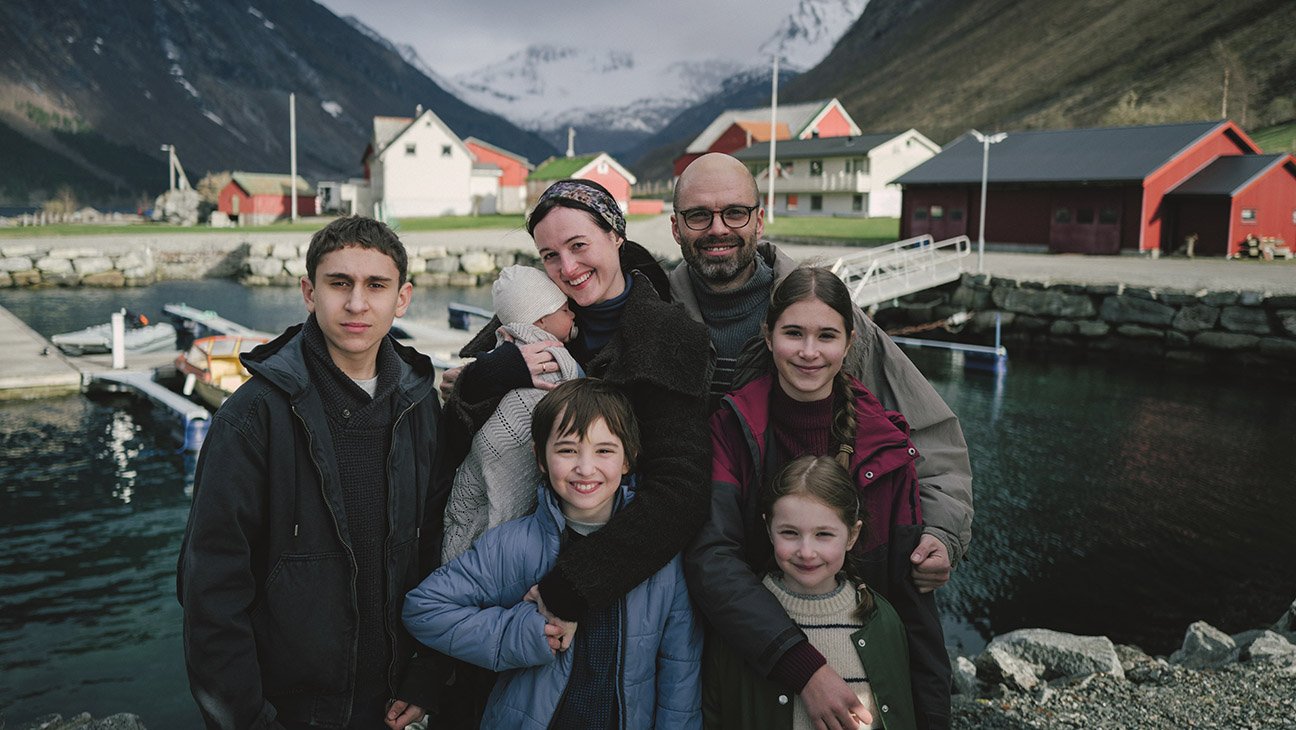
Cristian Mungiu’s films invariably deal with social, cultural and moral divisions, uneasy truths, ethical dilemmas and unjust compromises. In his latest, Fjord, the Romanian New Wave auteur brings his needling focus and unvarnished realism to a knotty drama of parenting and education, in which a suspicion of possible child abuse escalates into a full inquisition during a head-spinning rush to judgement. It’s also a nuanced reflection on otherness, and how anyone failing to conform to the values of a community invites distrust.
The community in this case are the residents of a picturesque port town on the isolated West coast of Norway, nestled among snow-capped mountains. The locals are all welcoming smiles and warm handshakes when the devoutly religious Gheorghiu family relocates there from Bucarest — including Romanian Mihai (Sebastian Stan) his Norwegian wife Lisbet (Renate Reinsve) and their five children, the oldest of them teenage Elia (Vanessa Ceban). Lisbet was born in the village and the move there was prompted by her mother’s offer to help with the kids.
Fjord
The Bottom Line
Compellingly squirm-inducing, if far from the director’s best.
Venue: Cannes Film Festival (Competition)
Cast: Sebastian Stan, Renate Reinsve, Lisa Carlehed, Ellen Dorrit Petersen, Lisa and warn Loven Kongsli, Henrikke Lund-Olsen, Vanessa Ceban, Christian Rubeck, Markus Scarth Tonseth
Director-screenwriter: Cristian Mungiu
2 hours 26 minutes
They seem to acclimate quickly. Both parents find employment, the children settle in at school, and they become friendly with their neighbors — headmaster Mats (Markus Scarth Tonseth), his attorney wife Mia (Lisa Carlehed) and their moody, rebellious daughter Noora (Henrikke Lund-Olsen). For impulsive reasons not made entirely clear, Noora ditches her best friend at school and adopts Elia, which leads to some aggressive moves on the wrestling mat in gym class.
At their new home on a small farm, the children are expected to help with chores and housework, plus put in hours of daily Bible study. The fact that they are not allowed phones or internet or modern music or dancing is brought up later as evidence that Mihai and Lisbet are unfit parents. Instead of regular kid entertainment, they learn hymns from their father or listen to his preachy pep talks about fairness and punishment.
The latter becomes a factor when Elia and one of her brothers get into a scuffle and almost scald the baby. As a result, they are forbidden to go to Noora’s birthday party. But Noora encourages them to sneak out with her at night, taking them for a spin on her family’s boat and giving them a taste of what youthful freedom feels like.
All this is Mungiu’s sly misdirection in setting up the hardline conservative Christians as bad guys, depriving their kids of any joy. But it’s when the sanctimonious, so-called progressive Norwegians start passing judgement on the Gheorghius’ parenting methods that the villains of the piece are revealed.
At times this borders on parody, for instance when a teacher recounts an incident in a gender studies class for 7-year-olds. One classmate self-identifies as a lesbian, prompting Elia’s younger sister to inform her that her sexuality is a sin and a ticket straight to Hell.
The real trouble starts when a gym teacher notices a bruise on Elia’s neck and feels duty-bound to report it to Principal Mats as well as counsellor Frida (Lisa Loven Kongsli), who keeps a vigilant eye on the students both in the playground and on the school bus that she drives. Mats advises them just to monitor the situation, but the two women are intransigent that protocol must be followed and Child Services contacted.
They question Elia and her brother about physical discipline at home, and after a leading question or two, the siblings confess that they get an occasional smack on the butt when they step out of line. That represents a red flag to the school staffers, who go back and forth about the difference between a smack and a slap.
Before they even know what’s happening, Mihai is taken to the police station for questioning while Lisbet is grilled at home by the quietly officious Gunda (Ellen Dorrit Petersen) and another woman from Child Services, who inform her that the children will be removed from her and her husband’s custody for the duration of the investigation. That includes the infant, who is still being breastfed and will need to be examined for possible shaken baby syndrome.
What’s most astonishing about the drama is the speed with which the children are placed with foster families despite no tangible evidence, let alone proof, of abuse beyond the light disciplinary measures that the scrupulously honest Lisbet and Mihai freely admit.
Legal counsel advises them that they will be separated from their children for weeks, possibly months, while dates for both civil and criminal trials are pending. It’s around this point that any half-sensible audience member will be canceling their Norwegian Cruise Line vacation.
The Gheorghius’ attorney (Maria Bock) quits at the first sign of bristling frustration from Mihai, but Lisbet convinces Mia to represent them. The red tape required even for a supervised visit with their eldest children is maddening, as is the insistence that the bonding process of the younger kids with their foster parents must not be interrupted. That alone indicates that their guilt has already been decided, and the children are not expected to be released back into their parents’ care. Or at least not for long.
There are parallels here with Danish director Thomas Vinterberg’s superb The Hunt, in which Mads Mikkelsen played a divorced former teacher whose life is nearly destroyed by an accusation of child sexual abuse built on an impulsive lie. That 2012 film trafficked in a more heightened vein of suspense, whereas Mungiu’s approach tends to be dryer, at times to a fault. But the Romanian director has a knack for tying a knot in the viewer’s stomach and then mercilessly tightening it until what we are left with is speechless outrage.
Fjord doesn’t come close to the prolonged anxiety attack of Mungiu’s best film, 4 Months, 3 Weeks and 2 Days, the abortion drama that won the Palme d’Or at Cannes in 2007, and nor do its somewhat clinical courtroom scenes measure up to, say, the volatile town hall meeting in 2022’s terrific slow-burn small-town drama R.M.N. The new film does, however, provide the satisfaction of a punchable face in the smug, annoyingly handsome prosecuting attorney Jacobsen (Christian Rubeck).
Jacobsen is one of several characters who are effectively putting the Gheorghius’ beliefs on trial, dismissing Mihai’s Romanian cultural background as irrelevant. A quick smack on the ass is probably the least severe form of punishment given to errant kids growing up under the Ceaușescu Communist regime.
What the Norwegians seem to be saying with passive-aggressive firmness is: “Your beliefs do not align with ours, so therefore, you are not to be trusted.” These are townsfolk who shrug off the almost daily threat of avalanches engulfing the village but clutch their pearls in horror over unfortunate children deprived of their screen time.
As has often been the case with Mungiu, the real strength of his work is its restraint, a quality echoed to perfection by his gifted leads. There are no histrionics here, no bellowing rage. Reinsve’s Lisbet is shellshocked and reeling for much of the film but gives the character a depth of compassion that speaks volumes about her love for her family and the certainty that she would never harm them.
But the most attention-grabbing performance comes from Stan, an actor whose considerable range is too rarely acknowledged, working here in a mix of English and his mother tongue, Romanian.
Almost unrecognizable with thick geek glasses, a beard and a bald dome — shame about that skull stubble in a couple scenes though; that’s not how male pattern baldness works — Stan never tries to disguise the fact that Mihai is an arrogant, self-righteous man, simmering with bottled-up anger while being careful to keep that valve closed. Where the actor really shines, though, is in showing that despite Mihai’s rigidly old-fashioned views, he is a decent man, who, like his wife, is completely devoted to their children.
Mungiu has pulled off what might be considered by most arthouse audiences to be almost a subversive act in this age of rightward drift and intolerance — just by making the conservative Christians unimpeachable compared to the insufferably holier-than-thou finger-pointing liberals.
Leave a Reply