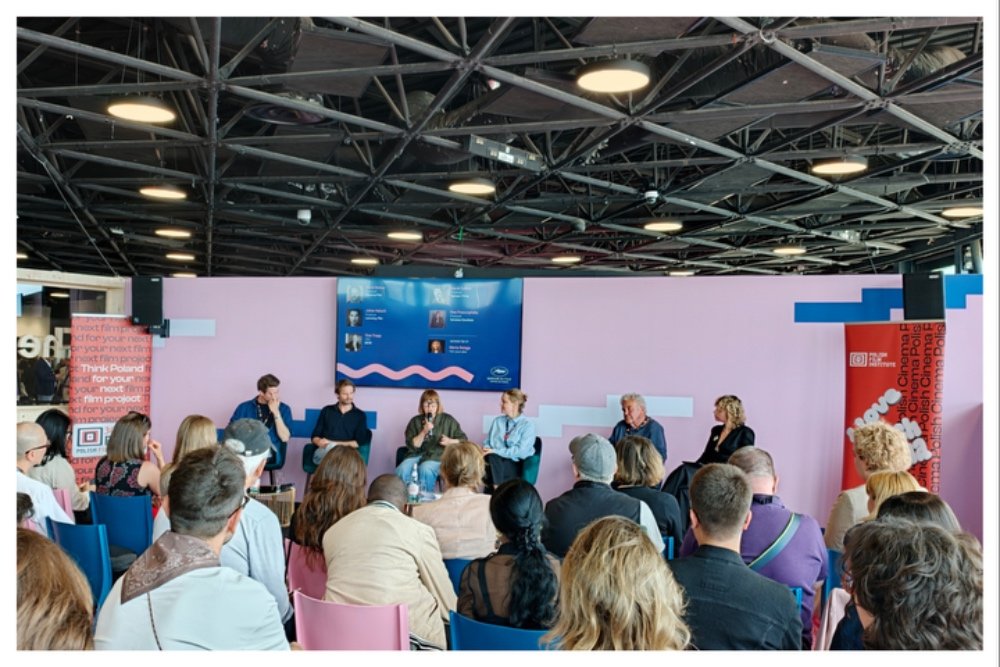
International co-productions are improving, argued “Fatherland” producer Ewa Puszczyńska of Extreme Films at Cannes.
“I don’t think we make the so-called ‘Euro pudding’ anymore. It has to be a project that everyone loves, and there has to be an artistic reason for making it together,” she said.
“Money is one thing, but there’s always a producer who started the project and is responsible for the artistic vision. In moments of dispute, this person has the final say. I think that – and I hope – that we are becoming increasingly clever in production, and I’m really happy when I see how good young producers are.”
Speaking during a “How to Develop Stories with Co-Production Potential” panel, presented by the Polish Film Institute, David Collins (Samson Films) said: “When you’re new to film production, you’ll often get excited by the possibility of getting a little bit of money here and there, but there’s a risk that, instead of making a film, you will be filming a deal.”
He added: “You can lose the vision of the film in your search for financing, and then, well, it’s a ‘pudding’. You’ve lost the soul of the film, or maybe you never knew what that soul was and that reflects on you as a producer. It’s easy to be seduced by the possibility of money in other countries, but sometimes it can hurt the project on a creative basis.”
Still, co-production and international cooperation are what “define us as Europeans,” noted Tina Trapp, CEO of EAVE.
“It’s important culturally and economically. There’ve been many studies by the European Audiovisual Observatory, and co-productions have around three times the number of admissions of national films,” she said. “We’re all here for the love for film and culture, but it’s also an economic driver. According to one study, the film industry employs and creates ten times more jobs than the car industry. Even films that perform well at the big box office generate revenue for the countries, and co-production maximizes that.”
Networks are crucial when looking for new collaborators.
“It’s important to find someone you trust to work with, and that’s difficult if you only have a five-minute meeting at a market. At EAVE, we create a safe space and bring together a carefully curated group of producers to collaborate. We are proud that actually 75% of people who have met at EAVE end up working together.”
Producer David Bohun (Panama Films) has also benefitted from this, he admitted: “That’s where we really start building our international collaborations, and they’re essential for us when working in a new territory. It’s about having the same vision and enthusiasm for the project, and sharing the same values of cooperation. We are lucky there are so many programs out there, and we need to keep them alive and ensure their budgets are not cut. For us, for emerging production companies, they are the most important asset.”
Reflecting on their experiences, the panelists were adamant. You have to always ask yourself: Why am I making this?
“Or: ‘Am I the best person to make this?’ There’s a phrase from a poem by Yeats: ‘In dreams begin responsibilities.’ As a producer, I take responsibility for somebody else’s dream,” noted Collins.
Sometimes, that translates to a bit of tough love.
“It’s my job to challenge that person and, if I’m the lead producer, find a way of articulating their vision to my co-producer. The most important thing is to find a co-producer who shares your vision, and to allow them to join the adventure on their own terms. I love finance plans – I should be in therapy – and I’m good at playing three-dimensional Monopoly with other people’s money. But that’s not as important as sharing a vision.”
These days, more and more often, producers end up collaborating with new territories. But the rules stay the same.
“We contributed a composer and a designer to it, but the fundamental thing was that this was a film that needed to be made. Everybody wanted to support it. You can only do that with a project that you feel you can contribute to. In this case, it was a certain chess move that no one else was able to make at that moment,” said Collins, recalling making the Canadian-Irish co-production filmed in Egypt.
“Everyone’s talking about trust and transparency, but sometimes things can go wrong. We had a Swiss-Irish-Austrian co-production shooting in Ireland, Nepal, Vienna, and Switzerland. When we were trying to move everyone to Nepal, the war happened, and we had to find a way to get everyone out of there. I had a conversation with a private jet leasing company, and it cost $450,000 to get our crew over to Kathmandu. Because it was war, we weren’t covered by insurance. As a producer, taking responsibility is important, but it’s also a test of character. It’s only when the chips are down that you really find out who you’re dealing with.”
International collab can feel like a marriage.
“It is [like marriage] because you’re responsible for a certain amount of budget, and you have to ensure your partner is also responsible. And keeps their promises!,” said Bohun, with Julian Haisch (Lemming Films) adding: “You can’t be too close. I think transparency is really the keyword here. If you detect a problem or a potential conflict, you need to speak up early on. We are always saying: If we can’t have a fun dinner with our potential co-producers, we probably shouldn’t work on the project together.”
He said, “I work for a company with a large network. We can always fall back on it, but we still go to all the markets and read everything we can. You have to make sure you share the same values.”
Haisch also opened up about the making of Brazil’s award-nominated hit “The Secret Agent.”
“The task was to make post-production work within three European countries, also knowing that some of the key positions were still Brazilian. We had very little butter to spread on that piece of toast, so to speak. We had long Zoom calls with the German and the French co-producers, where we just juggled ideas around. You can be very creative if you read the regulations a couple of times.”
“Everybody should see that producers can be creative as well. There’s great creativity in how we structure the projects and make them happen. We are creators,” Puszczyńska summed up, drawing applause from the audience. “We have our own histories and cultures, and combining them makes us stronger. Sometimes we forget that film can influence not only how we see each other but also how the rest of the world sees us as Europeans.”
Puszczyńska recommended starting collaborations early on. “We shouldn’t contact each other only when we need money or when we have a gap in financing. We should be looking for partners as early as possible, even at the development stage. Then, we can go through the process together and gain additional value from other people’s points of view. That has always been my experience.
“We cry together, shout together and make phone calls together. We fight for every single penny, but there’s trust and strength. That’s what we should be looking for.”
Despite new initiatives to work towards a better industry and protect producers’ mental health – “If they break down, the whole process will fall apart,” said Trapp – Puszczyńska had some advice for young producers.
“In difficult times, always tell yourself: ‘I’m not saving anybody’s life.’ It’s not the ER, so there’s always a solution if you sit down and think. Don’t have nervous breakdowns.”
Leave a Reply