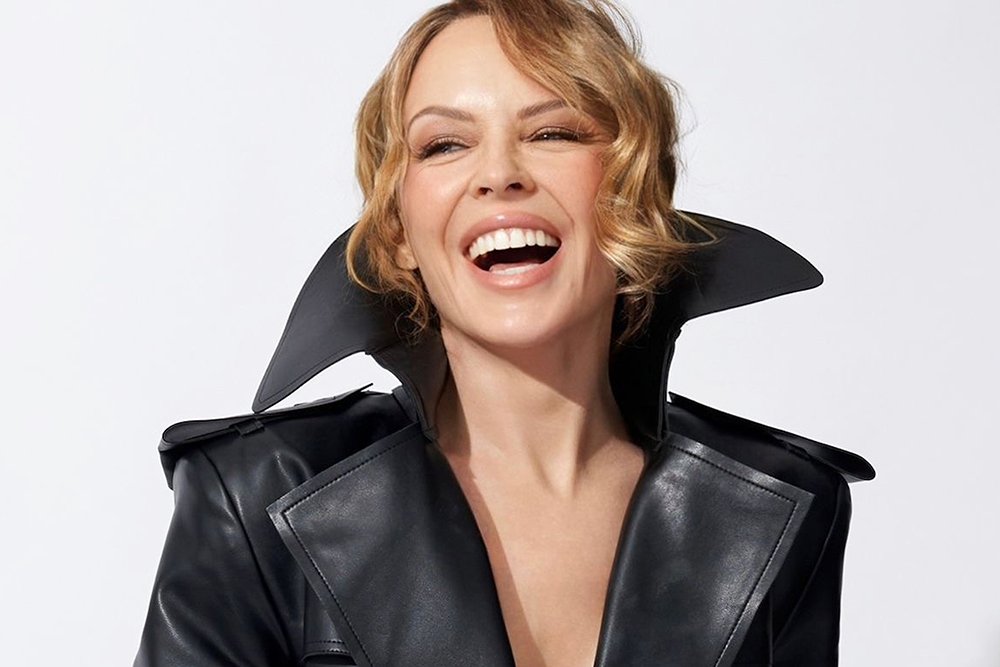
Kylie Minogue cannot be summed up easily. A three-decade career with era-defining tracks. An unmistakable aura that makes it feel like you know her. And a knack for constant reinvention that defies expectations, from “I Should Be So Lucky” to “Padam Padam.”
So “Kylie,” out on Netflix Wednesday, does not try to do so. Instead, the new John Battsek docuseries (the producer behind “Beckham,” “Still: A Michael J Fox. Movie” and “Three Identical Strangers”) explores what such a life has been like for Minogue, with the Australian singer being remarkably open about the grief, scrutiny and resilience she has experienced along the way. Alongside contributions from sister Dannii Minogue, record producer Pete Waterman and the musician Nick Cave, Kylie shows the world some of her personal archive, including archive photography by her longtime friend Katerina Jebb.
Speaking to Variety at Netflix’s London headquarters ahead of the docuseries’ release, Minogue talks about the experience of opening up emotionally on camera and why “Kylie” is a midpoint career reflection rather than a retrospection. She also discussed many of the topics that come up over the three episodes, including relationships with “Neighbours” co-star Jason Donovan and the late INXS frontman Michael Hutchence and the press scrutiny she received early in her career: “Thankfully, I gave myself a chance.”
Why was now the time to make this documentary?
I wish I had the neat answer for that, because it’s the question. I have had numerous requests to make a documentary, and I was a bit tempted, but I just felt like it wasn’t the time. [Producer] John Battsek from Venturelands reached out in 2018 — a long time ago — and I met him maybe in 2020 or 2021. It was a number of years before I agreed to him. I guess I let the idea simmer and percolate. I think after “Padam” and “Tension,” it felt like another wave, another juggernaut moment in my life and career.
Michael [Harte, the director] wasn’t 100% attached to it then, but I know the idea was there, so… team moment! If not now, when? I guess within myself I felt like there’s enough in the past and enough in the future, so it didn’t feel like, “Oh, this is looking back at my life,” and full stop. This is an interesting moment, as someone my age, a woman my age, me in this industry. I didn’t know what story he was going to tell, I just trusted Michael.
So you left him to work out the scope and then he would come to you and say, “We want to talk about this“?
Yeah, and I like to know stuff, so it was really trustful. We had our initial interview, but things were not going in our favor. I was still a little bit guarded. And as he relaxed and I relaxed, [we] just ended up [saying], “Put the paper away, let’s just have a conversation.”
And so a year and a half went by, that process. I was on tour, he’d check in, we’d arrange another interview. Until I saw the documentary in his edit suite, the anxiety leading up to this, I was like, “Oh my God, three hours, what if I hate it?” I know it’s going to contain stuff that might be difficult for me. Also celebratory. Also “What the hell did I say in those interviews? I don’t remember!” So, yeah, it was…
How did you feel after you watched it?
By the time I got to the end of act three, I felt overwhelmed. But what he’s done in the final edit and the way he’s used one of my songs to top and tail the series and because I got over the finish line, I leapt out of my seat! I think he got his phone out in record time, because I was the crazed person in the edit suite. I felt panicked and electrified it at the same time.

Kylie Minogue in “Kylie.”
Courtesy of Netflix
The documentary has such great use of archive, and we see you going through your personal collection. Was there a moment that surprised or affected you more than you thought it was going to?
There’s definitely a couple of points in the doc. I’ve only seen it three times — once with [Harte], once with my family and once with my team. So I still haven’t absorbed everything.
Before one of our interviews, my radar was on for just, “Keep an eye out if you see something, remember to put it aside.” I was just like, “Oh, there’s song lyrics.” My filing system is not great, but there’s a bit of slight organization. I looked at the top few ones, and I just went, “I’m not going to look at any more. This could be a good conduit for us to start a conversation on that. I know there’s stuff in here, I don’t know what.” So I think we had some really good moments that fell from the sky.
And what I’m realizing now is… It’s not out in the wild yet, so I don’t really know what the general reaction is going to be, but I’m starting to talk about it from a distance. It’s not a WIP [work in progress] anymore. It’s about to happen. I realize now that I can talk about things I’m talking about in the documentary with a bit of distance and not get as upset, but I know when I was talking with Michael, I’m really trying to remember how I felt in the moment.
We’re chatting without cameras and stuff, [but] you’re still aware there’s a camera on you, and everything just gets a little bit more tense and a little bit more heightened. I guess I gave myself permission to go there and feel safe enough. I really knew they weren’t there to exploit me, and that’s a big deal, because you’ve seen some of the stuff that I’ve navigated [in the doc]. So very often my default is I’m an open, people person, but I’ve just been burnt.
Were there some moments in the film where you realize how surreal it must have been back then?
There were some illuminating moments for me from the contributors. To see my sister… she did some hard work in that documentary to talk about those really difficult times again, and what was going through her mind at the time, like that’s really quite difficult to watch.
You got [producer] Pete Waterman with his version of events, and it’s pretty close to mine. Nick Cave just being profound and epic and dreamy all the same time, and Jason Donovan giving footage that I hadn’t seen. [The docuseries] was hard to make, and it’s hard to talk about, because it’s still so rich. It’s very dense.
I think the one thing that comes through the documentary for me is your belief in not being put into a box, but also your sheer determination. In Episode 1, when you were 19, the media were writing very scathing and absurd things about you (including referring to her as the “Singing Budgie”). You navigated that period with a sense of determination.
Seeing that in the documentary, it’s something that I can’t explain. I don’t know. I’m mystified as well. I go, “How did you turn up? How did you do that TV show when in your head, every voice around is going, ‘[She can’t] do it’… but you got out there and you sang a song.”
I’ve tried to figure it out these last few days. And it kind of ties into not wanting to be defined, that we’re all works in progress, we’re all in motion. And the notion, or the feedback, or the attitude that I couldn’t do it, I’m like, “But it might be possible.” It’s like “Dumb and Dumber.” He’s in love with the girl. He’s like, “What are the chances?” She goes, “One in a million.” He goes, “So there is a chance!”
Don’t shut me down! I’m self-aware enough to know that I wasn’t the person … they were expecting me to be someone else. So give me a chance! But thankfully, I gave myself a chance. I will thank myself for that.
Kylie Minogue in “Kylie.”
Is there any part of a documentary that you’re particularly proud of, or stands out for you in any certain way?
Probably the tenacity, for one thing. I’m proud as a family that we have navigated all of this. I’m proud of my parents for being amazing parents, and I’m proud of my audience for sticking with me. When some people were not open-minded, they were. Again, I’m not quite sure how that happened. Maybe [if] the start of my career was as a 40 year old, it would be different, but my career started at 17-18-19, so you have kind of grown up with me. I’ve sort of managed to stay on my path, you know?
I think that comes through when, in the second episode, we see you doing something unconventional: performing poetry on stage with Nick Cave. This moment feels like you are testing yourself a little bit to see what you can’t do.
Absolutely. Going for that audition for “Neighbours.” Leaving “Neighbours.” Going to [music label] Deconstruction. I mean, who wasn’t going indie in the ’90s? That’s what I was listening to, that’s what I was wearing, that’s where I was going.
What did you think of Jason Donovan’s reflections on that time?
So heartfelt and moving. “Love hurts, mate.” That is the quote, and he’s not wrong. It does sometimes, so I appreciated his honesty so much. And hilarious. And F-bombs. He’s so Jason Donovan. I can see just him being him.
I think all the contributors are very natural, and that’s a praise to Michael [Harte] and the team, and that they felt they could talk from the heart. And I’m realizing now, I talk a lot about all the firsts with Michael [Hutchence], but [not] how many firsts I had with Jason as well. We stumbled into fame together. We were rocking up to “Neighbours” every day. Then we were dating, then we were navigating mayhem. Mayhem! So props to Jason.
Michael Hutchence and Kylie Minogue.
One thing that really left an impression on me was how Michael Hutchence left such an impression on you (Hutchence and Kylie dated from 1989 to 1991, and he died in 1997). It feels as if he left an impact on all that you did next, what he taught you and how you reflect on life.
It’s hard to define him, because he was so many things. First, he was like an adult, and I don’t think I felt [that at] the time, but I was 21, 22. He was such a sincere, amazing person, which the world knows, because the world fell in love with him. I think I say it as well as I can in the documentary … [his] presence and feeling like he’s in the room and like, “Keep it together!”
Obviously, my memories are really pure and I’ll always have those, but it is within the movement of memory. If it was Jason, I could say, “Hey, come on, let’s go get a drink, let’s have a catch-up,” and [Michael] left us many years ago, so he’s just kind of around. So aside from it being truthfully an incredible moment in time for me, I think because of his departure, it just lives in its own little cosmos. It just lives as its own thing. And I just let it be lovely.
As a final question, what do you think you’ve learnt about yourself from this experience?
I could get into all sorts of strife. Here we go again! What happens is in my mind, and it’s a quiet determination. It’s a quiet sense of achievement.
I talk about not being boxed in, and I still don’t think I’m that definable after a three-hour documentary. And I’m happy with that.
This interview has been condensed for length and clarity.
Leave a Reply