Within 48 hours of this year’s Cannes Film Festival launch, two Formula One drivers were revving up the Palais carpet.
Carlos Sainz and Charles Leclerc — once teammates at Ferrari, now just gridmates following the Spaniard’s move to Williams — had photographers in a frenzy as they appeared with their respective partners at festival galas. They had scored an invite to the fest through being global ambassadors at L’Oréal, but the truth is that Cannes, as its position as the world’s leading hub for international cinema slips, is desperate for a slice of the F1 pie.
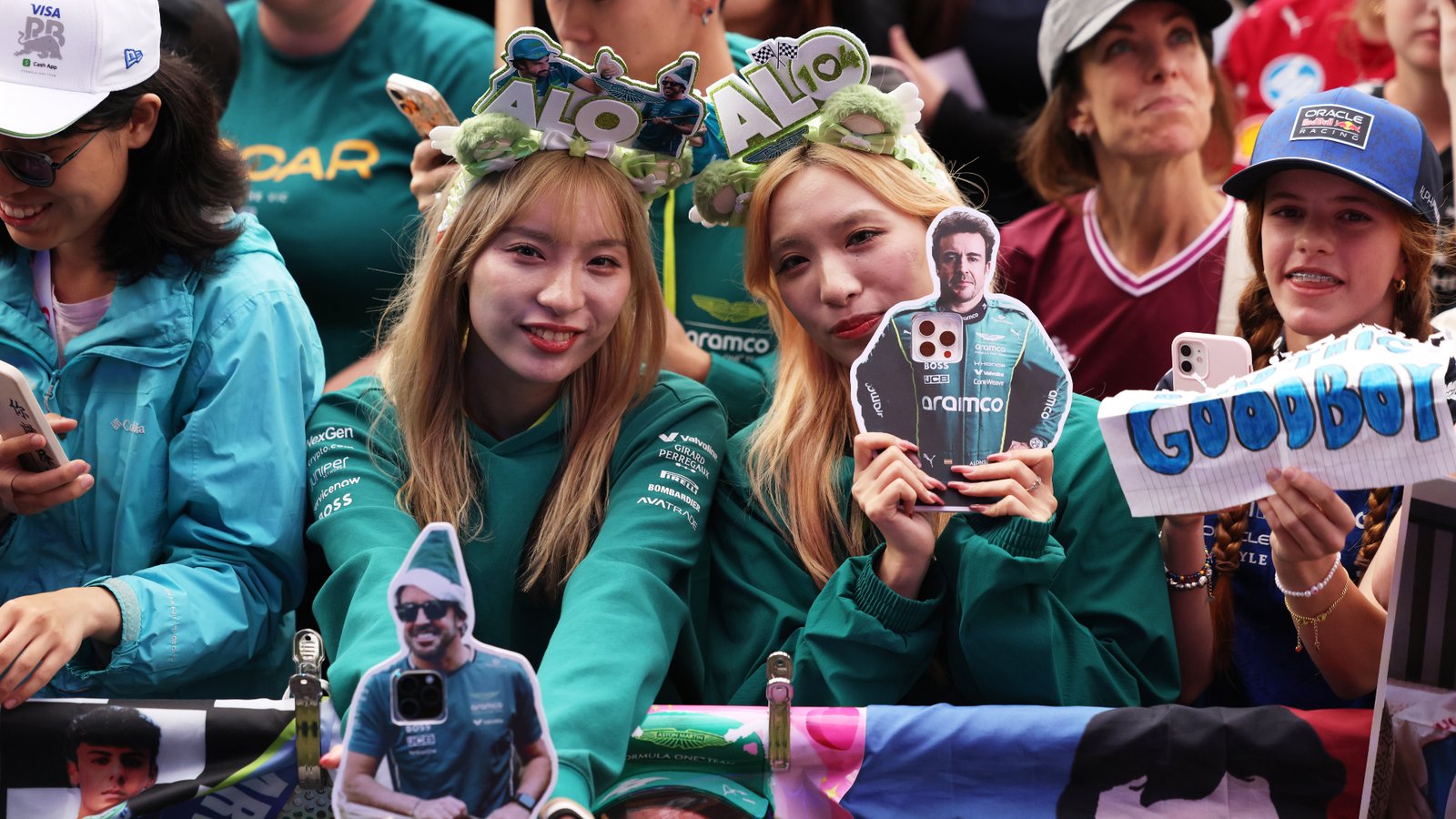
Since Drive to Survive resurrected the sport in 2018, the fan base has grown by over 68 percent globally. “The F1 river has truly burst its banks,” says Rob Bloom, chief marketing officer at Aston Martin, the fastest-growing team on the grid. “It’s everywhere.”
The rapidity of F1’s growth cannot be overstated. Bloom’s declaration is backed up by the stats: In 2025, 1.83 billion people watched F1, per Nielsen, up 6.8 percent from 2024. Over 43 percent of fans are now under the age of 35, with female representation rising to 42 percent, and at Aston Martin Aramco Formula One Team, fronted by drivers Lance Stroll and Fernando Alonso, they’re tallying a 30 to 40 percent year-on-year growth.

F1 driver Charles Leclerc and wife Alexandra at the 2026 Cannes Film Festival.
Courtesy of Getty
But it’s no longer on-track performance that determines the success of an F1 team. What sets Aston Martin apart is its discovery of the power of fan engagement, commercial partnerships and — as Brad Pitt and the producers on the $630 billion box office hit F1: The Movie recognized — the Hollywood-ization of F1.
“For years, Hollywood has honed its recipe, a recipe built on key ingredients,” begins Aston Martin’s executive creative director Stu Peddie. There’s the star power — in this case, the 22 best drivers in the world — he says, and the gripping story. The sport has cinema’s immersive world-building: It takes us to 24 races around the globe every year, from Mexico City to Singapore, Monaco to Melbourne. It also, continues Peddie, has the platform potential and the ability to create an entire ecosystem of creative assets and experiences around a race or team. “If you think about Hollywood,” says Peddie, “it thrives because there are multiple storylines. Formula One is the same.”
It’s no secret that F1 is now as Hollywood as it’s ever been. At May 3’s Miami Grand Prix alone, among some of the high-profile names to have appeared trackside are Jimmy Fallon, Chase Infiniti, Patrick Dempsey, Chance the Rapper, Jamie Foxx, Colin Farrell, DJ Khaled and Lupita Nyong’o. “Every Grand Prix now feels like a major cultural event — almost like a Super Bowl weekend,” notes Jefferson Slack, managing director for commercial at Aston Martin.
“It attracts actors, musicians, athletes and global brands who want to be part of that atmosphere. Some are genuine fans of the sport, while others recognize that F1 has become one of the biggest global platforms for audiences, hospitality and brand exposure. We’ve also seen it work the other way, too,” he continues, “with drivers increasingly appearing in culturally relevant spaces such as film premieres, fashion events and things like the Met Gala.”
Despite what some might think, Sainz and Leclerc’s Cannes call-ins made perfect sense. It reflects, Slack says, how F1 has solidified its place at the intersection of sport, entertainment and popular culture.
With such a wealth of star power at their fingertips, the commercial and marketing branch of Aston Martin understood immediately what could be gained by investment in brand partnerships, fan activations and targeted audience outreach. Now, Hollywood is no longer just an influence on F1 — it’s part of the framework. “We have deliberately positioned ourselves as less like a traditional racing team and more like a modern entertainment and luxury lifestyle franchise,” Slack tells THR.
Some great examples of this include merchandise collaborations with The Rolling Stones and Disney’s Toy Story ahead of the franchise’s fifth installment releasing this summer. Aston Martin was the first team on the grid to boast an official skin care partner, Elemis, and its extension beyond motorsport into the broader cultural and luxury ecosystem has landed team-ups with Swiss watch empire Breitling, sports juggernaut Puma and energy drink company Celsius. “Take our South Beach pop-up at the Miami Grand Prix,” says Bloom. “It was about creating opportunities for people to engage with our team and sport in different ways, creating experiences that leaned into fans’ other interests, from Pilates to HIIT classes with the team. Or the Celsius run club in Miami,” he adds. “That activation wasn’t about people setting personal bests in a 5K. It was about community: bringing 2,000 people together for a shared experience, united by a shared interest around Formula One.”
(L-R) Jefferson Slack, Rob Bloom, Stu Peddie
Courtesy of Aston Martin
It’s a method Hollywood has had no choice but to latch onto. Take The Devil Wears Prada 2, which has accrued a cool $440 million global box office tally so far, no doubt bolstered by the film’s collabs with the likes of Diet Coke, Starbucks, Samsung Galaxy, Lancôme, TreSemmé, Havaianas, Grey Goose, Google, Mercedes-Benz, Tiffany & Co. and Dior. Barbie and Wicked followed a similar blueprint, which helped unearth the lucrative effects of dialing into your female audience.
“With [F1’s] growth has come an entirely new demographic of fan — particularly in the U.S. — with a younger, female audience. Formula One is so much richer for that,” says Bloom. At Aston Martin, they’ve made role models out of driver ambassador and head of F1 Academy Jessica Hawkins, as well as F1 Academy driver Mathilda Paatz.
Says Peddie: “If we look ahead five years, what we really want is for younger female fans entering the sport to see Aston Martin Aramco as the team they naturally gravitate toward. At the same time, we’ll absolutely continue serving long-standing traditional fans, too. Ultimately, we want everyone to feel like there’s a place for them in this sport.”
And so exists yet another commonality between Hollywood and F1: The urgency of inclusion. F1, once considered an exclusive boys’ club, is undergoing something of a transformation regarding its access and outreach, with teams increasingly aware of the need for gender parity off-track. At Aramco’s livery takeover at the 2025 US Grand Prix, Aston Martin called the campaign The Science Inside and covered the car in aerodynamic equations and engineering formulas. “Rather than solely focusing on the car’s visual identity, we wanted to build a meaningful program designed to help inspire the next generation into careers in STEM and motorsport,” says Bloom.
If F1 is the all-encompassing world of film and TV, its drivers are the A-list stars, its technical squads the talented production crews, and, instead of a billion-dollar tentpole release once a year, it’s a momentous, narratively rich, and shockingly dramatic event every other weekend. There are the franchise spinoffs, the merch drops, the celebrity cameos, the brand deals and — most importantly — an ever-expanding crowd at the box office. And the teams? They’re all for it. Adds Bloom: “The Hollywood-ization of the sport has huge power to continue to inspire this generation.”
Leave a Reply