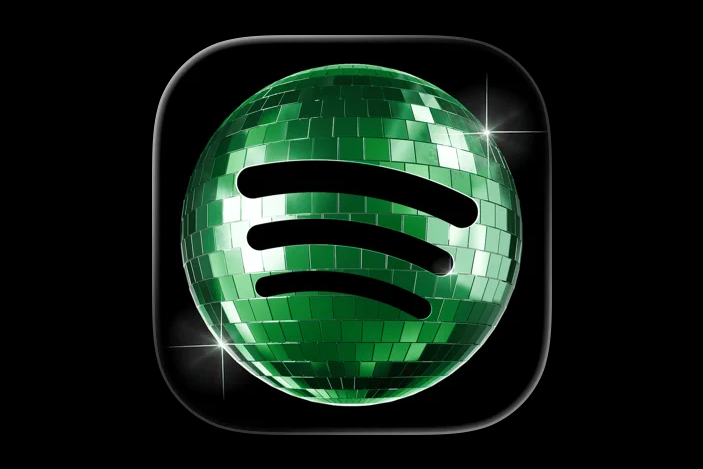
Spotify users who updated their mobile app this week saw something new and unexpected: a new icon on their phones that’s a shimmering green 3D disco ball.
Spotify has been coy about what the new icon means, responding from its official main account on X to a post about the new logo: “isn’t she lovely? 💚” At first glance on a small screen, the mirrorball may not be obvious: It kind of looks like the Spotify logo has been wrapped in cellophane.
A Spotify rep confirmed to Variety that the disco ball is for the audio streamer’s celebration of the 20th anniversary of its founding. Presumably the Spotify disco-ball icon is temporary, but the company spokesman wouldn’t confirm that.
As part of congratulating itself on its first 20 years, the streamer on Tuesday launched “Spotify 20: Your Party of the Year(s).” It’s a mobile-only in-app experience that provides look back at an individual user’s music listening history — including the total number of unique songs you’ve listened to, the first-ever song you played, and your all-time most-streamed artist.
The “Party of the Year(s)” also features a custom playlist of your top 120 most-played tracks, complete with play counts. Both premium subscribers and free users have access to the nostalgia-fueled lookback. As with its annual Spotify Wrapped marketing campaign, each data story comes with a custom share card you can post to social media.
And, as part of the 20th anniversary celebration, Spotify revealed for the first time the most-streamed artists, songs, albums, podcasts and audiobooks in its history.
The No. 1 most-streamed artist to date on Spotify is Taylor Swift, while Bad Bunny’s “Un Verano Sin Ti” is the most streamed album of all time. The Weeknd’s “Blinding Lights” was the most streamed individual song, and “The Joe Rogan Experience” was the most listened-to podcast. Finally, Sarah J. Maas’ “A Court of Thorns and Roses” was the most streamed audiobook.
For the record, while it has been 20 years since Daniel Ek and Martin Lorentzon co-founded Spotify in Sweden in 2006, the service did not launch in the U.S. until July 2011.
Leave a Reply