“Gabin” is far from the first film — nonfiction or otherwise — to make a longterm investment in a child protagonist, training a camera on them over years as adulthood gradually approaches. Maxence Voiseux‘s film has obvious precedents in such documentary projects as Michael Apted’s landmark “7 Up” series and Robert David Cochrane’s “Boys of Summer,” as well as, of course, Richard Linklater’s narrative slow-burner “Boyhood.” Somehow, though, the concept feels miraculous every time. There’s something illuminating and ineffably moving about watching someone grow up before your eyes in quasi-timelapse fashion, and especially so in “Gabin,” which packs ten years of one rural village childhood into less than two hours — a remarkably fleet, fluent feat of observation and editing that still conveys its subject’s anxious, ongoing fear that his life might stall before it gets to start.
The unsteady home life, learning difficulties and insecurely shifting ambitions of a young boy in France’s neglected northern Artois region may seem to many like a niche cinematic concern, but “Gabin” (one of two documentaries in this year’s Directors’ Fortnight program at Cannes) is sufficiently engrossing, humane and universal to travel well beyond its own small, perceptively captured world. The docfest circuit will obviously be the primary track for Voiseux’s film — all the more impressive for being his first feature — following its Croisette bow, but specialist nonfiction distributors and streamers would be well-advised to investigate a film with as much crossover audience appeal as the arthouse breakthroughs of Nicolas Philibert or Sébastien Lifshitz.
Though it functions as a completely freestanding work, “Gabin” is in fact an offshoot of Voiseux’s 2016 midlength film “The Heirs,” which first established the director’s interest in the working-class Jourdel family, and centered primarily on veteran working-class cattle dealer André and the three adult sons feeding into his family business. One of those sons, butcher Dominique, had three boys of his own — the youngest of whom, then eight-year-old Gabin, was a background presence in the shorter film.
Filmed from that point over the course of a decade, “Gabin,” needless to say, places the child front and center. His brothers do not appear on camera; nor do any extended family members beyond Dominique and Patricia, Gabin’s adoring and equally adored mother, who makes a hard living herself as a cattle farmer. Gabin’s drastically opposing relationships with his parents — who each practice very different kinds of care — give the film its spine and tension, but the boy is just as often, and just as compellingly, at war with himself as he tussles over time with the possibilities and limitations of his rural environment, what he wants out of life, and where he wants it.
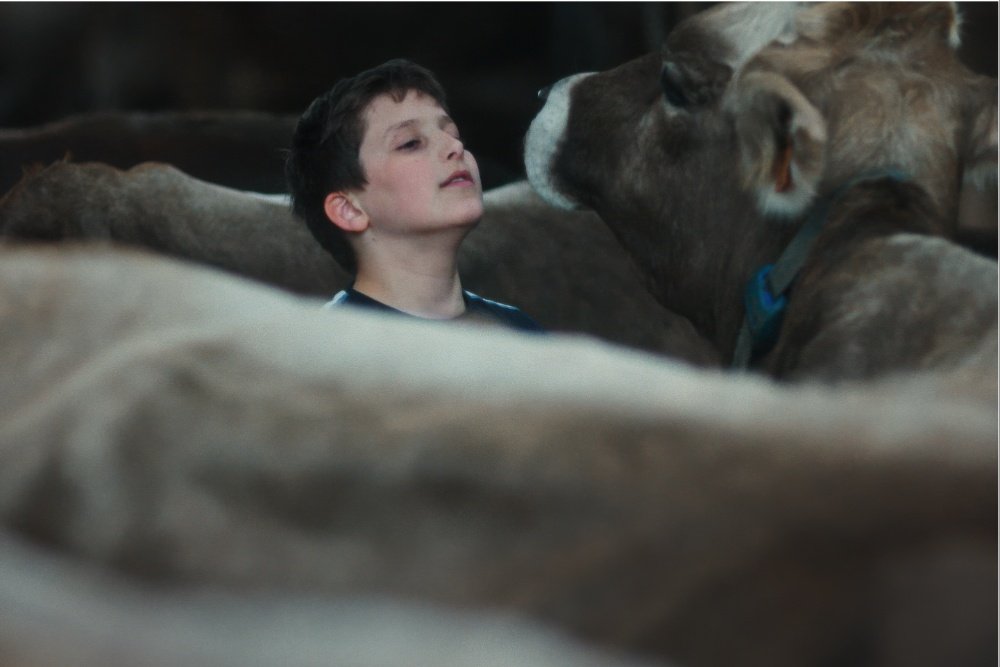
That Stephanie rears cows while Dominique slaughters them is a symbolic binary that defines much of the conflict here, given that Gabin is, from an early age, a child who loves animals more readily than he does other people. “I want to work with animals, but living animals,” he says early on in proceedings, aged eight, as the camera observes the boy tightly embracing various nonplussed cows on Stephanie’s farm. Later, he strokes Patricia’s hair as they drive home, noting admiringly that “it’s as soft as the skin of a cow”; for him, his mother’s livelihood and parenthood are inextricably linked, while his hostility to his father’s occupation drives an early, ever-widening emotional wedge between them. The film’s opening shot, in fact, finds Dominique peering fondly but bemusedly at Gabin at the kitchen table: “I’m trying to see who you look like,” he explains, and as time passes, his son never quite becomes a mirror to him.
At school, Gabin appears to find few friends beyond one loyal girl, Lilou, who acts as a sounding-board for him through to adulthood. Other boys, he says, “are fine and that, but there’s stuff I don’t understand, and things I say that they don’t understand.” His social abilities improve over time, but he consistently seems most at peace in the company of animals — from various farmyard beasts to his own scrawny kitten — and the ever-patient Patricia, who doesn’t always understand him either, but is content not to.
Gabin’s failing grades at school, eventually, are diagnosed as the result of a working memory deficit; a kindly tutor, Catherine, also functions as a kind of therapist, trusted with insecurities he won’t necessarily divulge to his parents. All the while, his dreams for the future skitter between helping his mother run her farm, breeding sheepdogs or, perhaps, exploring life beyond the overcast confines of Artois. Voiseux, who himself has family roots in the region, shoots Gabin’s environment with care and empathy, but also an air of restless repetition, in a tight Academy ratio that almost seems to press in on our protagonist as he moves through adolescence. A spare, horn-forward score chimes in with his frequent melancholy, though Gabin, and “Gabin,” can break into bliss and escape: In his late teens, a shepherding apprenticeship in the mountains proves positively oxygenating, conveyed in soaring, verdant wide shots.
For most of the doc, however, the camera’s presence is at once scarcely felt and impossibly close, capturing all manner of minute domestic details and personal, facially-written crises without ever letting us feel that Voiseux’s subjects are playing to his lens. Like many of the best documentarians, Voiseux sheds light on lives we wouldn’t otherwise see, but doesn’t pin them down for academic scrutiny. We can sense what changes and realizations have occurred in the film’s temporal jumps and ellipses, and can leave Gabin, on the brink of adulthood and formative travel, with his own story left to tell, on his own time.
Leave a Reply