Four years ago, Cannes’ Directors’ Fortnight premiered Chilean actress Manuela Martelli‘s superb directorial debut “Chile ’76,” which tracked with sinister precision the stirring of a complacently bourgeois housewife’s political conscience during the repressive Pinochet regime. Her follow-up, “The Meltdown,” now plays in the Un Certain Regard sidebar, but while the filmmaking is just as elegant and the storyline similarly observes sociopolitical upheaval acting on an individual psychology, the result is somewhat less resonant. Perhaps because here, it’s the far more slippery and elusive notion of the nation’s collective silence in the aftermath of its Pinochet trauma that is under the microscope. And perhaps because the subject is a child.
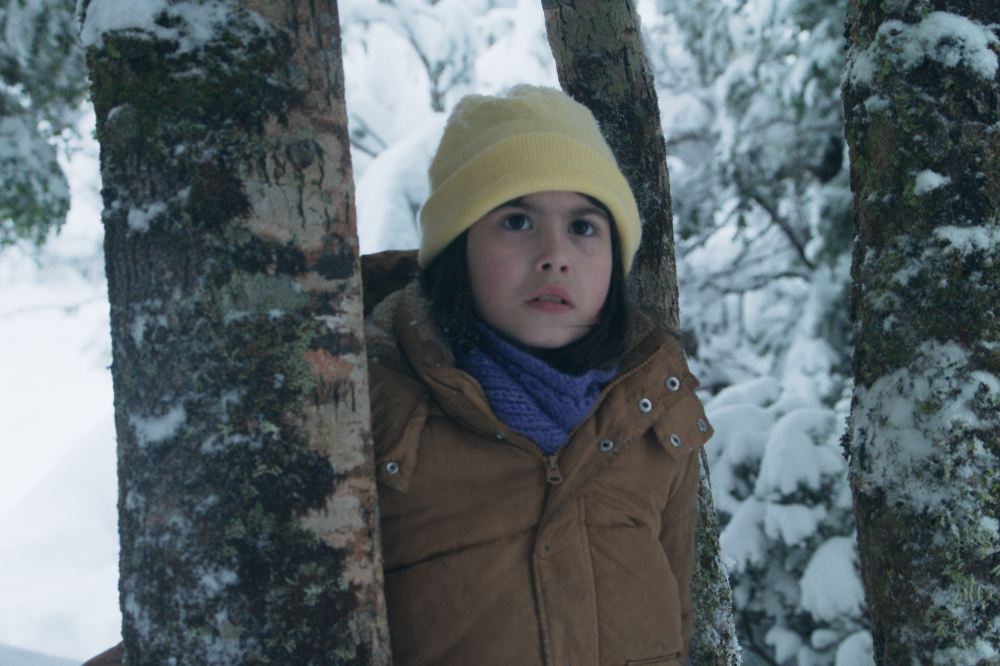
That child is Ines (excellent newcomer Maya O’Rourke) through whose dark, enormous, watchful eyes we observe a drama of disappearance play out that neatly echoes the stories of forced disappearances under the recently ended dictatorship. It is 1992, two years since Pinochet was replaced as President of Chile, but six years before his overdue arrest for human rights crimes, a period during which he continued to serve as the head of the military. So the nation, after the euphoria of the historic “No” vote that finally dislodged him from ultimate power, is experiencing a strange kind of political limbo. Ostensibly, the country is moving forward into a progressive future, but inwardly it is unable to meaningfully reckon with his legacy of terror.
For nine-year-old Ines, these realities are both very far away and very proximate. One way that the country is choosing to signal its new start to the world is through the metaphorically bizarre but logistically impressive feat of transporting of a 60-ton iceberg from the Antarctic to the 1992 Expo in Seville, Spain – crackly TV footage of which opens the movie. Inez’ parents are involved in this endeavor, which means that she is staying for an extended period in the ski lodge facility in the mountains that is owned and run by her grandmother. Ines, precocious and inquisitive but deprived of company her own age, has the run of the facility and has taken to sleeping in the cabins of the guests she befriends, or of the largely Indigenous hotel staff, who put up with this lovable nuisance with kindly forbearance. Ines also has a secret weapon: she is quite fluent in English and so can often help out the receptionists and the housekeepers when communicating with foreign visitors.
Her language skills also aid her in befriending Hanna (Maia Rae Domagala), a 15-year-old German skiing prodigy who has come to Chile to train with her coach, Alexander (Jakub Gierszal). Hanna’s teammates — all male — bully her incessantly, and Alexander pays her a little bit too much attention. So perhaps that’s why she takes so quickly to an easy friendship with little Ines, despite their difference in age, and the fact that Hanna is into teenagery things like rock music, alcohol and the flirtations of Ines’ cousin (Lautaro Cantillana).
The relationship between the two girls, delivered in halting English, is rather lovely, with Ines a little dazzled by the older girl’s seeming worldliness and Hanna showing big-sisterly fondness for Ines, and making her, along with her diary, the repository of her secrets. But one of the secrets that Ines will learn, through lowered eyelids as she pretends to sleep in Hanna’s bedroom late one night, will take on a darker aspect when Hanna goes missing. A search party is launched, and Hanna’s frantic mother (a superb Saskia Rosendahl) arrives, becoming as much a surrogate mother to pocket-translator Ines as Hanna was a sister. So now, suddenly, Ines is faced with a decision about whose secret to keep,.
The parallels between Ines’ dilemma and that of a nation being asked to lick its wounds in silence in the name of moving on from past miseries, are present but elusive, like much here, from the light that scurries away from Benjamín Echazarreta’s muted camera, to the moments of sweetness that punctuate Mariá Portugal’s largely ominous score. So while this story is, in its way, a tragedy, it’s the anti-dramatic tragedy of absence, of a smart little girl learning without ever having been taught the cruel and wrongheaded lesson that tribal loyalty and self-preservation are instincts that should override your conscience when it comes to speaking the truth. As with any absence, or any negative space, it’s a tricky thing to make compelling, and when you couple it to narrative style so restrained as to be withholding, rather too much of the import of this well-crafted and well-performed film falls into the hole at its heart. “The Meltdown” is another fine showcase for Martelli’s poise and promise as a director, but nine-tenths of it remain underwater.
Leave a Reply