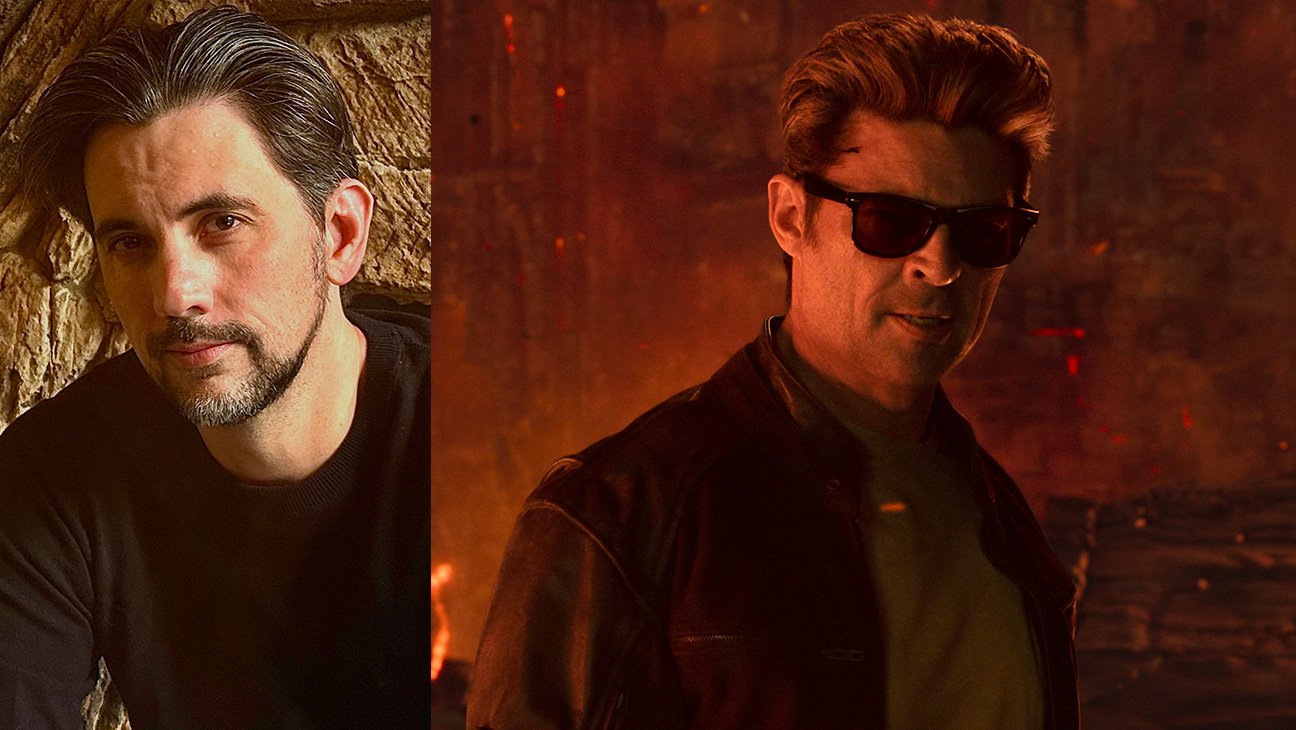
[This story contains spoilers for Mortal Kombat II.]
Mortal Kombat II is a victory for screenwriter Jeremy Slater in a way that goes beyond the franchise-best opening weekend of $40 million.
For the last two decades, the Kansas native has mostly been working in the trenches of IP-based storytelling, and he’s experienced every imaginable high and low that has come with the town’s decision to double-down on prebranded movies and TV series. Ironically, it was his acclaimed original spec script, Man of Tomorrow, that opened the door to the world of established properties.
The 2012 Black List selection — a 1940s-set superhero noir about an FBI agent who’s caught in the middle of a Chicagoland duel between Superman and Batman-like figures — opened the door to Slater’s six-month stretch on Fantastic Four (2015). While the maligned final cut does not resemble his script, he remains proud of the version he submitted to Fox. From there, he’d go on to work on recognizable titles including Death Note, Godzilla x Kong: The New Empire, Coyote vs. Acme, as well as series adaptations of The Exorcist, The Umbrella Academy and Moon Knight.
Most of these experiences featured a parade of writers, voices and cooks to where the writing credits are as lengthy as a signed petition. But that all changed on the Simon McQuoid-directed Mortal Kombat II. From Slater’s stand-out pitch at the writers’ roundtable, pre-green light, to the new ending he wrote during post-production, he was the sole screenwriter for the entire enterprise, a rarity on franchise projects in this day and age, unless a writer-director is in the driver’s seat.
Slater chalks it up to his time in television, along with the increased wisdom and decreased ego that come with age, for this fortunate turn of events.
“In the beginning of my career, I’d fight notes and reactions from my collaborators. But over the last ten years, my experiences in TV have helped me learn that collaboration is the name of the game, and it really has fundamentally changed my writing,” Slater tells The Hollywood Reporter. “I was able to get on the same wavelength very early with [the Mortal Kombat II brain trust]. We were all trying to make the exact same movie, and when that happens, it’s much easier for the writer to stay creatively involved. So fixing that mindset [that it’s less about me and more about the collaboration] is something I was not capable of doing in my Fantastic Four days nearly 15 years ago.”
As for the new ending Slater wrote during Mortal Kombat II’s post-production, Earthrealm’s surviving champions reunite and agree to head off to the Netherrealm so that they can rescue and revive their friends who died during the tournament against their Outworld foes. This coda was filmed during the movie’s week of planned reshoots.
“When we were looking at the initial cuts, we were missing the final check-in with all of our characters. It happened as a wordless montage, and that wasn’t sending people out of the theater with the feeling that we particularly wanted. So that’s why I wrote the new ending,” Slater recalls. “It teases where the series could go in a future movie. We know we killed some pretty big names along the way, but death is never final in this universe. So we wanted people to walk out of the theater with that glimmer of hope that they’ll maybe see some of their all-time faves again.”
Among the deaths was Lewis Tan’s Cole Young, the original protagonist of the 2021 movie. Cole faced heavy criticism at the time — not because of Tan’s performance, but for the reboot’s choice to invent a new lead rather than using one of the many beloved characters from the Mortal Kombat video games. So Slater, with respect to gameplay, de-emphasized Cole in favor of two new protagonists, Kitana (Adeline Rudolph) and Johnny Cage (Karl Urban).
“One of my approaches to this was saying, ‘Look, the joy of playing Mortal Kombat is every time you put a quarter in the machine, you select a different character for a wildly different experience,’” Slater shares. “I wasn’t interested in continuing the storyline of Cole Young from the first movie. It’s not necessarily admitting that mistakes were made. But we did say, ‘Let’s look at what the first movie did right and double down on those areas. Let’s also look at the areas where that movie failed to connect so we can steer clear and pivot in other directions.”
The ballad of Cole Young may not be entirely over yet, as Slater stresses multiple times in the following Q&A that some of the deceased characters will return in a potential Mortal Kombat III.
“We are not green-lit for a third movie yet. When the initial test screening numbers came back last year and the studio saw how fans were responding to II, I think they realized that there’s a potential here for this to be an ongoing franchise,” Slater shares. “So they commissioned me to start working on a script for III, and I’m finishing a second draft right now. I’m very, very happy with it. In the same way that we took lessons from the first one and tried to make II a much better movie, we’re now taking the lessons from II.”
Once he completes his latest draft of Mortal Kombat III, Slater will turn his attention to his upcoming feature directorial debut, Summoner. He’s been trying to sit in the director’s chair for many years now, and it nearly happened a few years ago on an unproduced Insidious spinoff called Thread.
“I wrote a movie called Summoner that just got the green light. It’s at one of the majors, and they might want to make announcements. But it’s bounced around for a while, and I’ve found the perfect home for it with creative partners that I’m really, really excited about,” Slater says. “So we’re casting at the moment, and I’m hoping to shoot it in August. It’s the scariest thing I’ve ever written, and it’s a very, very fun horror movie.”
Below, during a conversation with THR, Slater also discusses how the first notable figure he met in Hollywood was a screenwriter named James Gunn before touching on their DCU and Coyote vs. Acme collaborations. Then he addresses his exit from the MCU’s Moon Knight series.
***
What was your way onto this sequel? Did you pitch? Or were you offered it given your extensive history with franchise storytelling?
I was part of a roundtable that New Line brought in to just blue-sky possible storylines for a Mortal Kombat II. It was in the very early days when they still weren’t a hundred percent sure if they were going to make a sequel or not. But I always try to approach roundtables with a pitch in mind. Even if they don’t like it, I just want to have something to contribute.
I basically pitched them what I thought the storyline would be, and I also pitched them a tonal recalibration from the first film in trying to make this movie more fun and more satisfying. I wanted to embrace the humor and the absurdity and the imagination that makes Mortal Kombat special as a franchise. If we did that the right way, then I thought we could make this a really satisfying ’90s blockbuster that you don’t necessarily see so much anymore at the movie theater.
So that was my pitch for the roundtable, and after we were done, they were like, “Would you like to write it? ” And I was like, “Great, now I’m the guy who actually has to figure out all the stuff that I was just cavalierly throwing out as someone else’s problem to deal with.” (Laughs.) But of course, I said yes immediately because I grew up loving these games and these characters.

Ludi Lin as Liu Kang, Mehcad Brooks as Jackson ‘Jax’ Briggs, Jessica McNamee as Sonya Blade, and Karl Urban as Johnny Cage in Mortal Kombat II.
Courtesy Warner Bros. Pictures
In terms of preexisting marching orders, did they basically say, “We want a tournament with these specific new characters”?
It wasn’t even that. There were two promises at the end of the first movie: a tournament is coming, and Johnny Cage is going to be one of the combatants. But beyond that, we had a blank slate. One of my approaches to this was saying, “Look, the joy of playing Mortal Kombat is every time you put a quarter in the machine, you select a different character for a wildly different experience.” So I wasn’t interested in continuing the storyline of Cole Young from the first movie. I was like, “Let’s have some brand new protagonists come in here.” And that became Johnny Cage and Kitana.
For Johnny, we needed a movie star [in Karl Urban] and a POV character to ground the insanity of this world for the audience. Kitana [Adeline Rudolph] then became the other very natural protagonist just because of her relationship to Shao Kahn and what she loses in the opening moments of the movie. Everything that Shao Kahn takes from her gives her a really potent and emotional revenge arc throughout the course of that movie. So those two characters really became our bedrock, and while we tried to give everyone else in the movie little fun moments along the way, it was really about servicing Johnny and Kitana’s twin journeys.
Adeline Rudolph as Kitana in Mortal Kombat II.
Warner Bros. Pictures
(Spoiler Warning.) By centering the movie on beloved game characters like Kitana and Johnny, Lewis Tan’s Cole Young, who was the lead of the first movie, didn’t last long. I think some viewers will consider his demise an admission that the decision to launch this new series of films around an original character — and not one of the many colorful, existing characters – was a misstep. Is that how you see it?
My blanket response for all the characters that I unfortunately had to kill off in this movie is that I really do love them and the actors who brought them to life. One of my prerequisites for saying yes to the job was making sure that I could bring Josh Lawson back to life as Kano, because he was, by far, my favorite element in the first movie. I thought he really understood the assignment and nailed the tone of what these movies could and should be.
As much as it hurts to say goodbye to some of these characters, the great thing about Mortal Kombat as a franchise is that death is never final, as we see in this movie. We have big plans for some of the [deceased] characters and some of their actors if we are lucky enough to do a Moral Kombat III, IV, V or however long we can take this. The goal would certainly be to use what happens to some of these characters in this movie as a jumping-off point to tell larger stories and maybe do some course corrections.
Everyone involved in the first movie would be very candid that there were a lot of challenges along the way. They had to prove their existence. They had to prove that a hard R-rated martial arts movie in 2021 could still attract a new audience; they also had something to prove to the existing Moral Kombat fan base. Overall, they had a lot of limitations and probably a lot of interference that we didn’t have to deal with on the sequel.
So it’s not necessarily admitting that mistakes were made. I wasn’t a part of the first movie, and I would never want to denigrate their hard work. They were all doing their absolute best to deliver for the fans under really tough circumstances. But we did say, “Let’s look at what the first movie did right and double down on those areas. Let’s also look at the areas where that movie failed to connect so we can steer clear and pivot in other directions.”
Lewis Tan as Cole Young in Mortal Kombat II.
Warner Bros. Pictures
(Spoiler Warning.) So much of the previous film was about Hanzo Hasashi’s (Hiroyuki Sanada) bloodline continuing on, and in his parting words to Cole, he literally said, “Take care of my bloodline.” Was there ever a moment where someone informed Hanzo of Cole’s death and that Cole’s daughter/Hanzo’s bloodline would still be looked after?
We had some scripted scenes like that at different points, and I believe we might’ve shot some of them. Ultimately, I’m not involved in the editing process. I’m not necessarily privy to why certain scenes are cut or certain decisions are made, but every editing decision was probably made in service of streamlining the narrative and making sure that we never lost momentum. That would be my guess.
One of my big mission statements early on is that the worst thing a Mortal Kombat movie can be is boring. A movie like this should always be all gas, no breaks. My first draft was 140 pages, the version I turned in was probably 120 and the version we shot was probably 95. We didn’t have an unlimited budget to shoot endless amounts of footage and then discover the movie in the editing process. We had to make a lot of tough calls along the way in terms of chopping things down and really focusing on where we were going to spend our resources. It was about making the best possible movie so the audience could have the best possible experience.
So a lot of those more mournful scenes of people grappling with the deaths of other characters are probably the moments that got cut along the way. They were interrupting the pacing at the exact moment where we were building towards a climax. We wanted the audience to be on the edge of their seats, not bummed out. But I will again say that some of those deaths and some of those losses, if we’re lucky enough to do a third movie, will be addressed and explored going forward.
The first movie had this story point in which characters had to unlock their arcanas. I kept wondering if Johnny would have to discover his, but you chose to leave him powerless for the most part. Would that have undercut the point of his arc — that heroism is not predicated on being gifted at birth?
I think so. There’s a few answers to the question. The first is that the concept of arcana is something that was introduced in the last movie. It’s not a part of the Mortal Kombat mythology and lore. It’s something that the fans didn’t necessarily respond very positively to, and it became our midi-chlorians to some extent. So I made a conscious decision very early on that I was not going to contradict anything in the first movie, but I was also never going to say the word arcana out loud in this movie. We were just going to move right past that.
The other element is that Johnny, canonically, is a character who doesn’t have flashy superpowers. He’s the one guy who doesn’t teleport or throw fireballs. He does have a little bit of a green glow around him when he does his shadow kicks or uppercuts, and at one point in the movie, we do reference that green glow. So you could argue that he did discover his power set along the way, but his powers just aren’t as flashy as everyone else. That’s why we didn’t want to shine a huge spotlight on what Johnny’s crazy power is going to be because then we would have had to invent a power that didn’t come from the video games.
Also, what makes Johnny fun is that he doesn’t belong in this world with literal gods, cyborgs, ninjas and ice warriors. He’s just a guy with an ego and a big mouth. So giving him some crazy Spider-Man powers at the last minute would have undercut his journey and taken away a little bit of what makes the character unique in this world.
(Spoiler Warning.) The new Earthrealm champions assemble at the end to recover their dead friends in the Netherrealm. Was this a late addition to the movie based on test audience reactions? Or was it more that you guys figured out the general direction of the third film during the release delay from October 2025 to May 2026?
It was a little bit of everything. We always had a week of additional photography scheduled. We just didn’t quite know what we were going to shoot during that week. But it was always scheduled in the budget that we were going to go back to Australia at some point to pick up a couple additional scenes.
When we were looking at the initial cuts, we loved the final battle and everything leading up to the ending, but we all walked away feeling like the ending was a little bit too abrupt. We were missing the final check-in with all of our characters. It happened as a wordless montage, and that wasn’t sending people out of the theater with the feeling that we particularly wanted. So that’s why I wrote the new ending.
It gives you a little bit more fun with all of the main characters, and it teases where the series could go in a future movie. It also provides a glimmer of hope. We know we killed some pretty big names along the way. Some of you guys might have just lost your favorite characters, but once again, death is never final in this universe. So we wanted people to walk out of the theater with that glimmer of hope that they’ll maybe see some of their all-time faves again.
Martyn Ford as Shao Kahn and Ludi Lin as Liu Kang in Mortal Kombat II.
Courtesy Warner Bros. Pictures
You’ve been talking about a third film as if it’s not official yet. But you’re already writing the script in case you receive the green light?
Yeah, we are not green-lit for a third movie yet. When the initial test screening numbers came back last year and the studio saw how fans were responding to II, I think they realized that there’s a potential here for this to be an ongoing franchise. So they commissioned me to start working on a script for III, and I’m finishing a second draft right now. I’m very, very happy with it. In the same way that we took lessons from the first one and tried to make II a much better movie, we’re now taking the lessons from II. We’re taking some of the fan reactions from early screenings to make III even bigger and even more satisfying. We want to continue to raise the bar for ourselves along the way.
You received sole writing credit on Mortal Kombat II, which is a very rare feat on franchise films. As you’ve experienced firsthand, many of them have a revolving door of writers. Here today, gone today.
(Laughs.) Yes.
How did you pull it off in this particular case?
Well, my approach to writing has changed fundamentally over the last ten years or so. In the beginning of my career, I spent a lot of time trying to swim upstream. I’d fight notes and reactions from my collaborators. I’d say, “No, my version of the movie is the correct version. Everyone pay attention to me.” A lot of young egotistical writers enter the business with that mindset of, Here I am, Hollywood, who wants to cut me a blank check to bring my genius to life?
But over the last ten years, my experiences in TV have helped me learn that collaboration is the name of the game, and it really has fundamentally changed my writing. It’s not to the extent where I’ve become a yes-man, but I now know that my job is to make my collaborators happy. My job is to write a script that will get the president of the studio to say, “Yes, this is the movie I’m going to make.” My job is to write a script that will get the actors to say, “This is a role I want to play.” My job is not to be this fount of genius where everyone should just be in awe of my words. It’s to figure out the movie that my director wants to shoot, that my studio president wants to green-light and that my actors want to sign onto. Then I have to figure out how to write something that is creatively fulfilling and satisfying for me, while also satisfying all of these different people who are potentially looking to make a different movie in their minds.
So I got lucky with Mortal Kombat II. I was able to get on the same wavelength very early with Simon McQuoid, [producer] Todd Garner and [New Line exec] Dave Neustadter. We were able to form a creative brain trust where we were all rowing in the same direction. We were all trying to make the exact same movie, and when that happens, it’s much easier for the writer to stay creatively involved. It happens when you’re willing to pivot and say, “You know what? I really love this scene, but it’s not working for my collaborators, so I have to be okay with saying goodbye to it. I have to come up with a new scene that I’ll love just as much — but one that also works for them.”
So fixing that mindset in my own writing and in my own professional life is something I was not capable of doing in my Fantastic Four days nearly 15 years ago. It really is a discipline that you have to develop as a writer along the way.
How privy were you to the drama on the Fantastic Four (2015) set?
Not at all. I worked really extensively with Josh Trank, and I had a great time doing it. I was really creatively fulfilled and excited. I thought I wrote an awesome script, and then I got the call that you almost always get on these big blockbuster movies: “Hey, we’re going to bring in some fresh eyes.” Then the next time you see the movie is when you’re sitting down at the screening three years later.
So I wasn’t privy to whatever drama happened on set. I wasn’t even really privy to the fact that my entire script had been thrown out. It wasn’t until I was sitting there in that first audience and realizing, Oh no, something happened here. There was nothing in there that remotely resembled what I had set out to do.
But there was a good two-year period there where I was walking around very confident. I was like, “You guys, just wait for Fantastic Four. We’re the next Christopher Nolan. We’ve got the next [Dark Knight] trilogy on the way.” You always go in with the highest of hopes and the best of aspirations. But sometimes the projects don’t turn out the way that you dreamed about or envisioned. When you’re a writer and you’re playing in other people’s sandboxes, it’s really out of your control. You don’t really have any bearing on the quality of the finished product. You just hope that your collaborators all want to make the same movie you wanted to make.
I’m looking at a Moon Knight poster on your wall. When you were head writer on that show, Marvel was still applying their moviemaking philosophy to television. That meant that things were mostly executive/producer-driven. Then they eventually pivoted to a more traditional showrunner system. Did you get caught up in that original methodology that they brought over from their movies?
Yes, but I certainly don’t want to say anything bad or negative about Marvel or my time there. They took a chance on me, and they let me assemble a really great writers’ room. I was really, really proud of the work that we did. The end result was I left the project over creative disagreements with the director. The two of us simply had very different visions on what the show should be about. Ultimately, he won that creative battle, so I stepped away. He then brought in his own team of writers to create a show that was his vision and the story that he wanted to tell.
It certainly was not a traditional showrunner experience where the writer is the boss. That was not remotely my experience at the time, but I can’t speak to what the process is like now. I know a lot of writers who have gone through the development process at Marvel and have had great times. It’s just that the pairing of writer and director is always really, really tricky. When it works — like I think it did on Mortal Kombat II with Simon McQuoid — it is magical and wonderful. But when it doesn’t work, it’s probably really frustrating for everyone involved.
Coyote vs. Acme is another project of yours that’s had an eventful journey to the screen. Did you meet James Gunn on that project en route to the DCU writers room?
No, James was the first famous person I ever met in Hollywood 20 years ago. We shared the same agent who said to him, “Hey, you should grab dinner with this young writer who has no idea what he’s doing. Maybe give him some advice.” I was a kid from [Emporia] Kansas. It was the first time I’d ever eaten sushi in my life. I didn’t know how chopsticks worked, and James was thoroughly entertained by how stupid and uncultured I was. So we struck up a friendship, and I’ve now known James for probably 20 years at this point.
When he sold the idea of Coyote vs. Acme to Warner Bros., he suggested me as the writer and brought me on board. I had a great time writing the project for him, and then it sat on a shelf for ten years until it was rescued by [screenwriter] Sammy Birch and [director] Dave Green. They are both tremendous talents. Sammy rewrote the entire script, and she did such an awesome job that I didn’t even try to arbitrate for credit. I was just like, “No, this is clearly her movie. She should have full credit on this.” So I don’t have any skin in the game with Coyote vs. Acme. It’s not really my baby.
But I was definitely brokenhearted on their behalf when the movie got canceled [during post]. I do know how hard it is to make things. Every single person on set works 14- to 16-hour days, and you’re giving up a big portion of your life. For me, the implicit promise in moviemaking is: Yeah, I’m going to miss chunks of my kids’ lives and time with my wife at home. But at the end of the day, I’m going to have this thing that I can show them and say, ‘Here’s what I was working on. Here’s what we brought into the world.’
So taking that away from people was a really dangerous precedent, and I’m just overjoyed for Dave and Sammy and everyone else involved that they’re going to get their time in the sun. They’re soon going to have a chance to share what they created with the fans. So I may not have skin in the game, but I will be there on opening day to buy a ticket with everyone else.
He’s pumped the brakes a little bit on the initial “Gods and Monsters” DCU slate he and co-CEO Peter Safran announced in January 2023. But do you still see a lot of what you guys brainstormed taking shape?
Oh, absolutely. James Gunn has always had a very clear vision for what he wants his universe to be and what kind of stories he wants to tell. Our job is to just toss ideas his way. He’ll grab the ones that seem relevant or helpful, and then he will ignore the ones that don’t because he has a story that he’s telling. As a fan, I have loved the first couple chapters of that story. I know some of the stuff that’s happening next, and while it’s insanely exciting, I’ve also been sworn to secrecy on everything related to DC. All I can say is that I’m a huge fan of James and Peter, both as human beings and as creative individuals. And if they ever need my help with anything — whether it’s looking at a project or writing scenes or writing scripts or just bouncing ideas — the answer is always yes for those guys. I will always drop everything and come running if they need help. I just think the world of them.
Is part of you a wee bit disappointed that he beat you to the punch on a movie called Man of Tomorrow?
(Laughs.) I cannot remotely be mad about that. I wrote a spec called Man of Tomorrow probably 14 years ago at this point, and even though it never got made, it absolutely changed the course of my career and life. But I stole that title from a Superman comic, Whatever Happened to the Man of Tomorrow? So it’s James’s title — I’m the one who stole it. He’s just reclaiming it. I have no doubt that whatever James is cooking up right now is going to be awesome. That guy just doesn’t miss.
I wonder if Spider-Noir covers some of what you were going for with your superhero noir.
Probably, but I don’t know anything about Spider-Noir other than the [1930s era]. The log line for my Man of Tomorrow script was basically: Batman versus Superman, but it’s The Untouchables in 1940s Chicago. It weaved a gangster story in with some superhero trappings. Man of Tomorrow came about because I got my start in low-budget horror, and this was during the torture porn era of Hollywood where everything was a terrible Saw ripoff. So the only opportunities that were coming my way were horrible movies that I didn’t want to write and no one wanted to see. I knew that I was hanging on to this career by my fingernails, and if I didn’t do something dramatic, I was just going to fall by the roadside.
So I passed on everything, and I spent six months working on Man of Tomorrow. It was a big, R-rated period drama action movie with multiple overlapping timelines. It was just the most ambitious thing I could imagine at the time, and that’s really what broke me out of that low-budget horror box. It put me in the running for jobs like Fantastic Four. So even though it never got made, it is absolutely the script that changed my life and my career in a thousand different ways. If I hadn’t written that script, I know for a fact we would not be sitting here talking right now. I would, once again, be working at a Walmart somewhere.
You referenced midi-chlorians earlier, and I’ve also been staring at the Star Wars museum behind you all conversation. (Slater’s office has what appear to be life-size models of R2-D2 and C-3PO, among other things.) Has anyone from Lucasfilm seen this room of yours?
Oh, I have had some Lucasfilm meetings where I have nerded out to an embarrassing degree. Star Wars has always been my white whale. It’s always been the one thing that I’ve been chasing above all else, but I also don’t want to take a job unless I can deliver. I can’t think of anything more depressing and terrifying than getting your shot at Star Wars and then dropping the ball. So we’ve certainly had discussions in the past, but we’ve never found the right project. Maybe it’ll happen someday, maybe it won’t. But besides James and Peter, Star Wars will always be the other phone call that makes me drop whatever else I’m doing to run in that direction. It’s pretty foundational to the DNA of my life and my instincts as a storyteller. Most of it can be traced back to the dual pillars of Jaws and Star Wars.
As far as other projects, if you had a green-light power for a day, how would you wield it?
I would’ve used it on something I’m already doing. I’m finally getting my chance behind the camera to direct something. I wrote a movie called Summoner that just got the green light. I don’t think I can say where yet. It’s one of the majors, and they might want to make announcements. But it’s bounced around for a while, and I’ve found the perfect home for it with creative partners that I’m really, really excited about. So we’re casting at the moment, and I’m hoping to shoot it in August. It’s the scariest thing I’ve ever written, and it’s a very, very fun horror movie. I’ve been dreaming about this day for my entire life, and now it’s right around the corner. So once I finish Mortal Kombat III, the goal is to really dive into Summoner.
***
Mortal Kombat II is now in movie theaters.
Leave a Reply