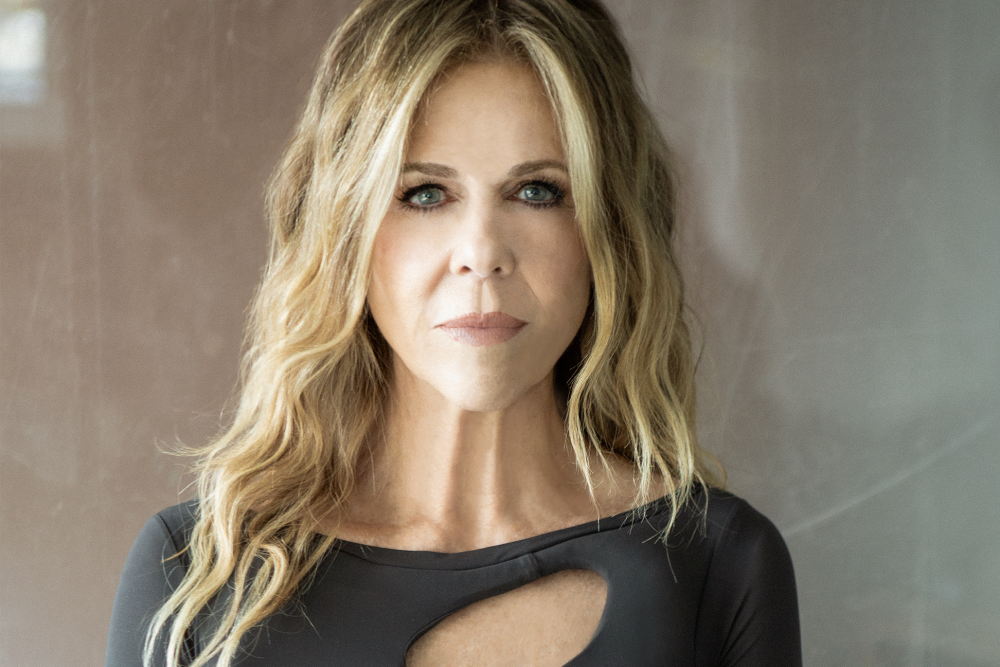
Rita Wilson is hardly the first Hollywood actress who’s complained of a dearth of interesting parts for women, or to have met that by realizing that she might have to proactively create challenging roles for herself. What sets her further apart is that she’s taken to creating these parts in song. And yes, as a producer of film and TV, too, but for the moment, her focus is on the work she’s creating as a singer-songwriter, with her sixth album just out. The title is, not at all incidentally, gender-specific: “Sound of a Woman.”
Sitting down with Variety at a cafe in Brentwood, Wilson touched on her acting career — going all the way back to her 1972 debut in a guest bit on “The Brady Bunch” — but the focus was primarily on what she’s been up to since 2012, when she released her first album, “AM/FM.”
“Sound of a Woman,” which she worked on in Nashville with famed producer Dave Cobb, ais her most focused release yet, running through a veritable checklist of topics that are of interest to women who have a lot of life experience behind them, and more still ahead: changing physicality (“Whose Body Is This”), learning to see one’s mother as an actual human being and not just eternal caretaker (“Your Mother”), the unnecessary guilt that women especially tend to take on (“Jury of One”), growing in parallel to a partner (“Marriage”), the not-so-autobiographical subject of divorce (“Better for Him”) and, in “Spare Keys (Coming Home to Me),” a belated process of real self-discovery.
Of that latter song, Wilson says, “I think as women, we do a lot in our lives that is around other people. You are trying to be there for so many different people in your life. And sometimes you get burned; sometimes it works out great. But I liked this idea of coming home to yourself, to this person that’s always been you, and that is nobody else is defining you in that moment. It’s almost like you’re moving into a new place, but the new place that you’re moving into is who you are. The line that I really liked is, ‘I was knocking on the windows from the outside looking in / At a part of me I couldn’t reach saying, “Where have you been?”‘
Self-curiosity can come to the fore more than ever in one’s sixties, but she is hesitant to overemphasize the self part. “Curiosity is one of the best things anybody could have<‘ she says — “not just about yourself, but about other people, about the world, about how things work. Let’s keep finding out more. Keep digging.” She puts the truth to that by — unlike most Hollywood stars in interview situations — asking almost as many questions of her interlocutor as she is made to answer. That said, the following interview has been edited for length, clarity and emphasis on parts of the conversation where we did turn it back on her.
You have an upcoming tour where you are playing at City Wineries across the country. There is just one problem with that: L.A. does not have a City Winery.
You know what? L.A. is is woefully sad when it comes to certain kinds of music venues. I wish there were more places like [famed New York clubs] Cafe Wha or Bottom Line. Fortunately, the Troubadour exists, but more places like that. Are you from L.A.? Do you remember when the Troubadour had tables and chairs? I have a fantasy that, if I’m gonna do the Troubadour, I want to do it like it was back in the ‘70s, with the tables and the lamps.
Certain music lends itself to that. Then it’s more about listening. There’s a song on the new album called “This Song,” and I wrote it because I’ve done all of those small clubs where people are eating and talking, and I was always like, wow, people aren’t really listening at this place. But then I’d look around and I’d always find one person to singn to that was listening, just listening, and I was so thankful for them. So I wanted to write a song for that person.
You grew up a music fan in L.A., so you probably have a rich history for venues.
I went to Hollywood High. I was just going to ask you if you remember the Hollywood Teen-Age Fair and all that stuff. Do you remember that, at the Palladium? … What was your first concert? … Mine was Led Zeppelin at the Forum. It was when I was in high school, so it had to have been like ’73, I’m pretty sure.
Did you ever go to the Universal Amphitheater? I worked there, so I saw everything. Everybody came through there, all my idols, like Joni, Carole King, Jackson Browne, Crosby Stills and Nash, Loggins and Messina, Elton. Even Steve Martin — they did comedy back then too, a little bit. Then they put a roof on it because people were complaining about the noise, and I’m like, really? Now it’s the Harry Potter ride, which always bothers me. It does.
We knew you went to Hollywood High because we just did a story on the museum they have at the high school about their illustrious alumni, which has a small display about you. They have Alan Hale’s skipper’s cap, Carol Burnett’s TV cap… they need an artifact from you.
Oh my, I would love to do that. Let me know who to call. I hope they have a picture of me as a cheerleader. That’s where I got… let’s call it discovered, on my first day of school, by this photographer, and his name was Albert Watson, and it ended up being for Harper’s Bazaar magazine. From that I got signed by an agency and that’s how I got into the business. But then being a cheerleader got me into “The Brady Bunch,” because a girlfriend of mine was auditioning, and the role was for a cheerleader but she was not one, so she said, “Can you teach me?” So I taught her a cheer, but she wasn’t a natural. I went with her to the audition and they asked me if I wanted to read, too. I didn’t get the part she was up for, and she didn’t either, but I got the part of the girl who had to be the good cheerleader who won the tournament. So Hollywood High, thank you for that.
Maybe I should ask them to dig out of the archive a copy of my report card where I failed typing. The only thing I ever failed was typing, and still like, if you see my iPhone, it says, “Sent from my iPhone. God help me.”
It sounds like you have positive high school memories.
Because Hollywood High had such a big class, we would have our graduation ceremonies at the Hollywood Bowl. I graduated in 1974. I had never been on the Hollywood Bowl stage since then. I still really want to perform there; that’s a bucket list. But 50 years later, to the year, after graduation — 50 years and a couple of months — I was invited by Brandi Carlile to be part of the Joni Jam [in October 2024], and I got to sing along and harmonize. If somebody had said to me when I was in high school, “In 50 years, you’re gonna be on this stage singing with one of your idols, Joni Mitchell,” I’d be like, “What are you talking about?” And also, “Why is it taking 50 years?” But that was a moment that I still can’t believe happened.
You had a late entrance into the music business. You have mentioned that Bruce Springsteen helped turn your head around about whether that was possible. What was it he said to you?
Oh, it was huge. I’ve asked him if I can say this quote, and he’s OK with it. He was talking about his writing process, and about how long it would take him to write songs early on — that he would just keep going back and refining and refining. Finally I asked him, “Bruce, what makes me think that I can start writing now, when you’ve been doing it all your life?” And he said, “Because, Rita, creativity is time-independent.” And that was like like Christmas morning. It was the concept that there is not a clock, and nobody is saying you missed your window, and it was supposed to happen at 28-and-a-half years old or whatever period it’s supposed to happen in. It really was about: this creative impulse exists inside you, and if you’re getting your creative impulse at this age, then this is what you should be doing.
In art in general, if you look at a painting or read a book or a poem or see a film that’s been directed by women over the age of 50, you would never know it, because you would just be judging the work based on the work that you’re seeing, if you didn’t know anything about who made the art. With our business, though, we’re front and forward. You’re a singer, you’re out there, or you’re an actor, you’re out there — they’re looking at you; your age is everywhere. And there was no example for it, for me to say that I could or should be doing this; “look, so-and-so has done it [at this age] so you can do it too.” There were examples in other artforms, but not in in music. And so for Bruce to say that to me was really opening up that portal into the possibility of what could exist.
One thing that seems like it is probably the reverse for you of how music careers usually work is: Normally people become fans of a singer-songwriter, then they get to know them a little better through interviews. Whereas with you, before you started doing music, a lot of people out there had already long since decided, through seeing your interviews, that they liked you as a person. So maybe that could be seen as an advantage in terms of people relating to the music, or at least wanting to. But you might see people’s foreknowledge of you as a person differently.
I don’t know. This was another helpful piece of advice from Bruce and Patti (Scialfa) because they’re incredibly generous people and they’re artists. But I was doing one of my first shows, and I called them up and I’m like, “I don’t know what I’m supposed to do. People don’t know that I do music. They’ll come and see me, but what is it that I’m supposed to be doing or saying or talking about?” And they said, “Be yourself — tell them what your journey is and how you got there, and let them understand that you’re still you.” Because if I’m trying to present some different persona of who I am, that’s gonna be confusing.
Part of the arc of this new album is about these different identities that we have throughout our lives as women, and it’s less about shedding those identities and more about bringing them along with you and who you are today. So you’re not saying, “I’m not that person anymore.” You’re saying, “That was me, and that’s part of who I am now,” but it’s also embracing who you are now. I just think I’m not trying to be anybody else. I’m not gonna be up there in a corset and high heels, running around. I mean, it’s super fun to do all that stuff, but nobody has to be threatened about me taking over any of that. I just try to do me.
Let’s talk more about the new album. It was produced by Dave Cobb, but as the title says, it’s very much an album themed to women, so it would make sense that your primary co-writer is a woman. Why did you bond so well with Amy Wadge as a songwriting collaborator?
Amy Wadge is incredible. She’s very well known for many, many hits and Grammys; she wrote “Thinking Out Loud” with Ed Sheeran, among things that put her on the map. She’s just an extremely soulful woman. We had been friends but hadn’t written together yet, and we were having lunch one day, talking about the challenges that women go through. I don’t know how it came up, but somebody said, “Yeah, that’s the sound of a woman.” I’m like: what a great song title. Let’s write that song. Let’s write that. That was the first song that we wrote, and it evolved into very consistent writing sessions exploring these different phases and identities of a woman’s life experiences, and the relationship we have to the world around us, to our own bodies, to our internal selves. Whenever we wrote, it was always, “OK, what do we need to explore? What do we need to say?” Because you’re writing about being single, about having children, about having a long-term marriage, about finding your own voice, about shaping yourself as an artist, all of the roadblocks that you encounter, and still choosing to just keep going.
I’ve always written from a very honest and personal point of view. But this is a little bit different because it is closer to my own experience. You know this because you interview so many people, but I’m in a very public job and I’m a very private person, so it felt a little bit scary to be exploring these topics that are gonna be out there to be looked at and dissected. But at a certain point, that’s what you really want to be doing anyway, so you’ve gotta kind of be brave about it.
In writing specifically about women, you didn’t worry that that would seem exclusionary to men listeners, did you?
Not intentionally exclusionary. There are probably a lot of people who hear the word “woman” and they’re like: “No.” But I didn’t feel like that. I had a really cool experience with a guy in London. I had just come from the studio last summer, and I had the roughs and I was on a 45-minute drive and I had to give some notes back to the studio. So I was like, OK, well, I’ll take advantage of this time and listen to the music. The driver was a proper, younger guy, and very quiet. The album finished and he said, “Is that you?” And I was like, yeah. He goes, “Well, you’ve made me quite weepy.” And I said, “I’ve made you quite weepy? Why?” And he said, “Well, it’s like everything I’ve heard about my mother, my sisters, my girlfriends, and I’ve just never heard it put that way before.” And it really opened up for me this idea that you’re writing from your own experience, but then you realize every man in your life has women in his life. It was really about opening up this conversation, not just with women, but also with men. Like, let’s talk about it, you know?
With Dave Cobb, I got to know him over the course of making the album. He told me that he was basically raised by his mom. She was an interior designer, and so he would go with her and put the wallpaper up. He aknew how to paint, he knew how to build things, hammer things, drywall… and he would carry around those fabric books and the wallpaper books and all of that. So he has a real comfort level with women that I thought was really great. He loves to laugh, and we had a freaking great time. His studio is that gorgeous RCA Nashville studio where Dolly Parton recorded “Jolene” and “I Will Always Love You.”
Some songs are universal across gender, but in listening to this album, you do think, yeah, a man is not likley to write something like “Whose Body Is This.”
Yeah. I think men have their own opinions about their bodies and what they look like and what they do and what they’re meant to do and what society says that they’re supposed to do. The experience of looking at your body in the mirror when you’re 20 and then when you’re 40, and then when you’re over 40, can be different experiences that probably everybody would have a version of.
But in this case, the first verse is about childbirth — carrying a baby, birthing a baby, nursing a baby, and the extraordinary ability of what a woman’s body can do. I remember feeling so empowered when I gave birth, like, “I cannot believe that my body just did this.” That was very exciting. And then the second verse is about, after I had breast cancer and a bilateral mastectomy, looking at myself in the mirror. I remember distinctly looking at myself the night before the operation and saying goodbye to that. And then looking at your body after you get those bandages off and thinking, “OK, well, this is new.”
And at the same time, feeling enormous gratitude for what your body actually can do to heal and keep you alive. There are the things we do, and then even the things that we don’t do, where our body is still working, like, “No, I got you. I’m still here, making it work for you.” Yhat was really an unexpected emotion from that experience — along with all the other ones of, you know, fear and terror and loss and all of that. There’s a line in there that says, “This body of mind kept me breathing through the night. When I was out of strength, it helped me to survive.” It’s there for you, kind of going, “I am here. I’ve got the engine going. You rest. I got you.” There’s something really beautiful about that.
But women have such an odd relationship to their bodies anyway. There’s so much messaging that comes to us from when we’re little girls to teenagers and all throughout our lives about what we’re supposed to look like and what these standards are. And I have a lot of admiration for the younger generation, because they in many ways shun a lot of that stuff. They’re able to just be super self-accepting of their bodies, whatever shape, condition they’re in. And you know, I look back on pictures of me when I was in probably the best shape of my life and still thought it wasn’t enough. And where does that come from, if it’s not from messaging in our media?
There’s that Nora Ephron quote. Do you mind if I look it up?… “Oh, how I regret not having worn a bikini for the entire year I was 26. If anyone young is reading this, go, right this minute, put on a bikini and don’t take it off until you’re 34.” Now, you know, in Europe, women wear bikinis all the time. It doesn’t matter what age you are. They are tanning. They haven’t gotten this SPF memo. And they are wearing those bikinis in all shapes and sizes. It’s very liberating.
Another song that is so distinctively from a woman’s point of view is “Your Mother,” and not just because of the word “mother,” but because it’s about how women are often seen as just that after they have children, whether it’s by the kids or by society. There are maybe less incidents of men saying, “Well, now that I’m a father, that’s the only way people think of me.”
Yeah, that’s exactly right. The song came about from a conversation Amy and I were having. My mom had passed away and her mom, who since has passed away, was struggling with some health issues. So we were thinking about our own moms, but we were also wondering if our kids really knew who we were. Because the first time they meet you, you’re their mother. It’s not like you’re an individual that had this life before them. That part of it was really interesting to me because now that my kids are all out of the house, I have become much more unfiltered at this point in my life than I ever have been before. I really think that I was very much part of my mom’s generation, which was being polite and being the person that is following the rules. I’m still a rule follower. I didn’t ever have a rebellion phase. But I want to be a rebel now. Like, let’s just do it now.
But when my mom passed away, even though she was my best friend, I would have this recurring thought of questions I wanted to ask her. Like, today I thought of one. When I was growing up in my childhood, my mom had a poster that hung on the wall in the kitchen, and it was the Desiderata. Do you remember that, like a long poem? “Go placidly amidst the noise in the haste, and remember what peace there may be in silence.” And then it goes on from there. I thought, Why did mom have that? This Greek lady from the old country — what resonated with her about that, that she felt, “I need to have that hanging in my kitchen so I can look at it every day”? I would like to ask her that question. I can’t now. So it was really about, what are the questions you want to ask your mom while she’s still alive? You know you’re gonna have those questions; try to get the answers while somebody is still alive.
There are still things like certain recipes that I wish that I had written down of hers. My mom was a very, very, very private person. But she was very funny and she loved music and she would do this thing… If there was a Greek song on, she’d be translating it for me. There wasn’t always a direct translation the way she was translating it, but she was trying to translate literally from the Greek. But along those same lines, she was really good even about pop music — about pointing out to me that songs had other meanings, that they weren’t just what you thought they meant. And also, that there was something beyond melody, because when you’re a kid, you’re singing along sometimes and you’re just digging the melody. She was instrumental in making sure I was listening to what the lyrics were.
It has been 14 years now since your first album, which was a collection of covers of your influences, and then a decade since the first album where you wrote the material. How do you feel you’ve grown into your role as a singer-songwriter?
Everything has been an incredible experience in that I didn’t know there would be this journey — the overused “journey” — of starting something in music and taking it to a place that led me to a deeper look at what it is that I want to say. For me it’s always been about, what are the songs that help me say that? Whether I was writing them or not. But every person that I’ve written with… this’ll make me teary… [She pauses for a tearful moment.] Sorry… Every person that I’ve written with, every person that has played with me, every person who has listened or who’s shown up at a show, every person that I’ve worked with is part of this music and part of my life. There’s such an act of faith that goes along with that. You just have this vision, like Michelangelo, who sees the angel in the marble and carves until he sets him free.
I knew that I wanted to do this. I didn’t know how I was gonna do it, and I didn’t know the path that it would take me on. But I found a real community in Nashville, and I felt incredibly welcomed there, which gave me the courage to keep going back there and keep writing and writing and writing. It felt like I was in some kind of graduate program, having never been to college. It was just like: Oh my God, I have really got to get better and better and better. But I knew that if I were consistent enough, and that if I were diligent enough, that I would not get worse.
And I think what made me teary before is that I couldn’t be here talking to you if it weren’t for all of those experiences, all those writing rooms, all those producers, all those demos, all those musicians. Everybody is part of that, really.
You have had a lot of pockets of support, to get to the place where a Brandi Carlile is inviting you to take a place on Joni’s stage.
I love “Returning to Myself.” I am in awe of Brandi in so many ways. Like, talk about seeing the angel in the marble: She’s got multiple multiple statues going on. She’s doing Trevi Fountain.
What other music are you enjoying?
So many different things right now. I’m listening to Raye, Olivia Dean, Sombr. I’m listening to a girl I found randomly called Sofia Isella. I didn’t know who she was, but the New York Times just did a big piece on her. I still read the physical paper, and there she is; she’s young and she does this kind of grungy rap that’s very feminist in nature that’s amazing. I love Taylor Swift as a songwriter. I love Bon Iver’s album “Sable, Fable”; that really moves me.
Do you see a lot of shows?
This weekend I’m seeing Lily Allen; I am very intrigued by what she is doing. Also Rosalia; I haven’t seen her show yet, but I like that idea that there is sort of this cohesive narrative that’s being shared. … The day before that, I’ll be seeing my son’s project, Something Out West, at Stagecoach. [That band’s co-founder, Chet Hanks, is one of four children she shares with husband Tom Hanks.] If you haven’t heard them, they’re really good. It’s not straight country, but it’s definitely in the country world.
Genres confuse me. It’s hard to not overly stereotype people. I love Teddy Swims, too, whatever genre he is. Do you remember growing up with AM radio and FM radio that played everything, so you were exposed to so much? All the different genres, all played on one station. And then you’d go to… Do you remember Wallichs Music City, at Sunset and Vine? Oh God. It was just a great place to go listen to music. [She pulls up a vintage photo of the record stores, which closed in 1978, on her phone.] A just massive place, bigger than Tower. Just rows and rows of vinyl, and and you would pick out the album cover, then you would go to the glass booths in the middle and they would bring the vinyl to you and you would listen with headphones in a booth. That was like how I got exposed to everything. It was so exciting, with everybody in one place on headphones, listening to music…
Everyone knows about your music and acting, and you’re producing too. Does it work out fine, balancing those three things?
I love working. I’ve become much more selective as an actor, only because I have found it so challenging to find roles that aren’t just warm, kind, nurturing mother, wife, sister, daughter, friend. If you’re gonna give me something like a mother, wife, sister, daughter, friend, she better be batshit crazy or something that is gonna make her interesting. Thank God for Lena Dunham, because she’s always giving me something fun to do.
You don’t want to always be playing to type, even if, maybe especially if, the type is “likeable.”
And it’s partly how our business is writing roles for women. That’s why you miss people like Nora Ephron. Nora Ephron used to say that the lines that they would give women in movies were things like, “When are you coming home? I just want you to be home.” She was always sitting at home waiting for the man to come back from the adventure that he was on.
I’ll give you one more Nora Ephron. When I turned 50, she toasted me and said, “I am here to tell you that great things happen after the age of 50. I did not direct my first movie until I was 50.” And if you look at what she did from that movie till when she passed away, 21 years later, the amount of output and epic impression that she made on our business, that all happened when she was over 50 years old. That was another one of those moments that empowered me to say, “OK, maybe there’s room for me here.”
You tackle some tougher subjects on the album, but you end it on a very upbeat note with “A Circle of Friends.”
I wrote that with Jessie Jo Dillon and Dave Cobb during the sessions. That was an homage to the power of friendship and power of girlfriends, and the times when you need exactly that kind of a friend coming over and saying, “Get up, get dressed. We’re going out. Nope, nope. Not taking no for an answer. We’re just gonna go.” And you don’t really want to go, then you’re out there and you’re like, “I’m so glad we did this.” It’s about friendship, but I feel like anytime you’re around music, whether it’s dancing or singing or performing or writing, it’s impossible to be in a bad mood. Just the sheer endorphins of being out somewhere listening to music is gonna put you in a good mood.
Rita Wilson’s 2026 tour dates:
June 11 – City Winery, Boston
June 13 — City Winery, New York City
June 14 — City Winery, Pittsburgh
June 15 — City Winery, Philadelphia
June 19 — City Winery, Chicago
June 22 — City Winery, Nashville
June 23 — City Winery, St. Louis
Leave a Reply