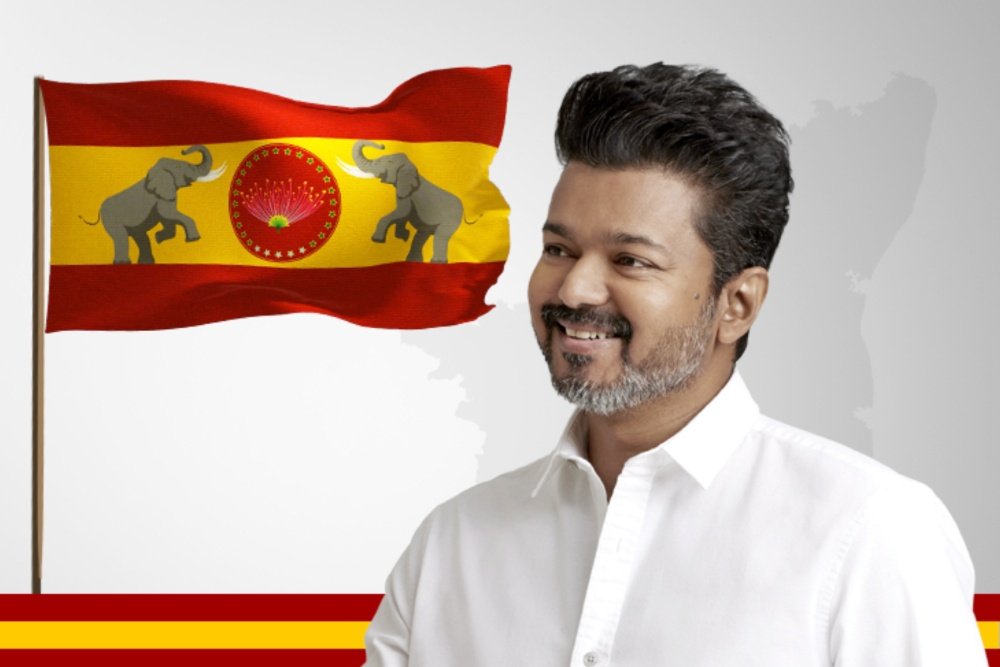
Joseph Vijay Chandrasekhar – the 51-year-old Tamil cinema superstar known to fans worldwide as Vijay, or simply as “Thalapathy” (Commander) – has delivered the most seismic electoral debut in Tamil Nadu‘s modern history.
His Tamilaga Vettri Kazhagam won 108 seats in Monday’s Assembly election count to emerge as the southern Indian state’s single largest party. On Tuesday, Vijay wrote to Governor Rajendra Vishwanath Arlekar staking formal claim to form the government – ending a 59-year lock on power shared exclusively between the Dravida Munnetra Kazhagam and the All India Anna Dravida Munnetra Kazhagam.
With the DMK securing 59 seats and the AIADMK 47, Vijay’s party outpolled both Dravidian giants on its very first attempt at the ballot box, claiming approximately 35% of the popular vote. TVK fell 10 seats short of the 118 required for an outright majority in the 234-member Assembly, producing a hung house and sending coalition arithmetic into immediate motion. The arithmetic suggests that TVK may not need an elaborate coalition. Support from a handful of smaller parties could be enough to push it past the 118-seat mark.
The results come after April 23 polling across all 234 constituencies recorded a turnout of 85.1% — the highest ever for a Tamil Nadu assembly election. Vijay himself contested from two seats and won both: Perambur in North Chennai by a margin of over 38,000 votes, and Tiruchirappalli East by 27,216 votes. Under Indian law, he will be required to vacate one of the two constituencies within a stipulated period.
The victory caps a journey that began in the Tamil film industry decades before anyone imagined it might end in the Chief Minister’s office. Born to film director S.A. Chandrasekhar and playback singer Shoba Chandrasekhar, Vijay made his debut as a child actor in “Vetri” in 1984, taking his first lead role in “Naalaiya Theerpu” in 1992 at the age of 18. His breakthrough came with the hits “Coimbatore Mappillai” and “Poove Unakkaga” in 1996, and he went on to evolve from the romantic hero of films such as “Kadhalukku Mariyadhai” – which won him the Tamil Nadu State Film Award for best actor – into an action star with the blockbuster “Thirumalai” in 2003.
Over more than 30 years as a lead, Vijay amassed 69 feature credits and commanded fees that placed him among Indian cinema’s highest earners, with several titles registering among the all-time box office benchmarks of Tamil film. Titles including “Ghilli” (2004), “Thuppakki” (2012), “Kaththi” (2014), “Mersal” (2017), “Bigil” (2019), “Master” (2021) and “Leo” (2023) cemented his standing as a dominant commercial force in Tamil cinema. Early in 2024, he formally stepped away from acting and unveiled TVK, pivoting entirely to politics after decades at the top of the industry.
The move placed Vijay at the apex of a long tradition of Tamil screen icons converting mass popularity into political authority. M.G. Ramachandran, who founded the AIADMK and swept to power in 1977, remains the most prominent precedent for an actor-CM, but J. Jayalalithaa and M. Karunanidhi represent equally significant strands of the same cultural phenomenon. Jayalalithaa appeared in 140 films across Tamil, Telugu and Kannada cinema between 1961 and 1980 before entering politics through the AIADMK and going on to serve as Chief Minister six times. Karunanidhi, though better known as a politician, having first made his name as a screenwriter for Tamil cinema, was MGR’s collaborator within the DMK before the two became the defining political rivals of their era. Karunanidhi served as Chief Minister five times. The tradition Vijay now inherits is one in which the screen and the Assembly chamber have long been closely linked in Tamil public life; his own filmography had long signalled the direction of travel – “Sarkar” (2018), in which his character mounts a political campaign after exposing ballot fraud, read in retrospect as less fiction than rehearsal.
Among the election’s most striking results was the defeat of Chief Minister M.K. Stalin – Karunanidhi’s son – who lost his Kolathur stronghold. Stalin’s son, Deputy Chief Minister Udhayanidhi Stalin – himself an actor-turned-politician who appeared in several Tamil films before following his father into the DMK – survived his own contest.
The election campaign played out against a dramatic and contested backdrop involving “Jana Nayagan,” the H. Vinoth-directed film produced by KVN Productions designated as Vijay’s cinematic farewell. Originally scheduled for a Jan. 9 release timed to the Pongal holiday window, the film became ensnared in a prolonged certification battle with the Central Board of Film Certification. Certification was abruptly withdrawn in the days immediately before the planned release – despite the board having already issued a U/A 16+ rating — after a last-minute objection from a board member raised concerns about the film’s depiction of the Armed Forces, its potential to inflame communal sentiment, and what was described as more than 50 politically charged lines of dialogue. A High Court single judge first ordered the certificate to be released immediately, but a division bench overturned that ruling on appeal. KVN Productions dropped its legal fight in February 2026, submitting instead to a fresh appraisal by a nine-member CBFC revising committee. The board then sent the film to the Election Commission for assessment of whether its political content could sway voters ahead of the polls.
During the campaign, Vijay alleged the delays were not procedural but punitive. The film’s troubles deepened further when its HD version surfaced on illegal websites on April 9, with clips including the introduction scene, title credits and climax spreading rapidly across social media. Fingers were initially pointed at the CBFC, a charge the board firmly denied. In a statement, the CBFC clarified that the film’s digital print had been returned to the producers in Mumbai on March 17 with full acknowledgement, and that access to the content remained password-protected through a secure Key Delivery Message system held solely by KVN Productions. Tamil Nadu police arrested six individuals in connection with the leak and removed over 300 links.
The leak, however, significantly amplified public attention and visibility for Vijay and TVK, potentially strengthening his political positioning by portraying him as a target of powerful interests ahead of the elections. The film, a remake of the 2023 Telugu production “Bhagavanth Kesari,” has still not received a confirmed release date.
Vijay announced TVK in February 2024, immediately staking out an ambitious strategy of contesting all 234 seats independently, without alliance partners. The party’s organizational model converted Vijay’s 85,000 fan clubs across Tamil Nadu wholesale into political cadres, giving TVK one of the most extensive grassroots networks of any debut contestant in Indian state history.
TVK’s first major political conference at Vikravandi in October 2024 drew a reported 800,000 attendees. The party’s manifesto centered on women-centric welfare pledges including monthly financial assistance, free cooking gas cylinders, free government bus travel and dedicated women’s safety teams. The campaign was not without turbulence. A crowd crush at a Karur rally in September 2025 killed at least 41 people and injured 80 others, triggering litigation and a Central Bureau of Investigation inquiry.
For Tamil Nadu, the election result represents a structural rupture with the political order that has governed it since 1967. Whether Vijay secures enough support to form a government – and on what terms – is expected to become clear within days.
Leave a Reply