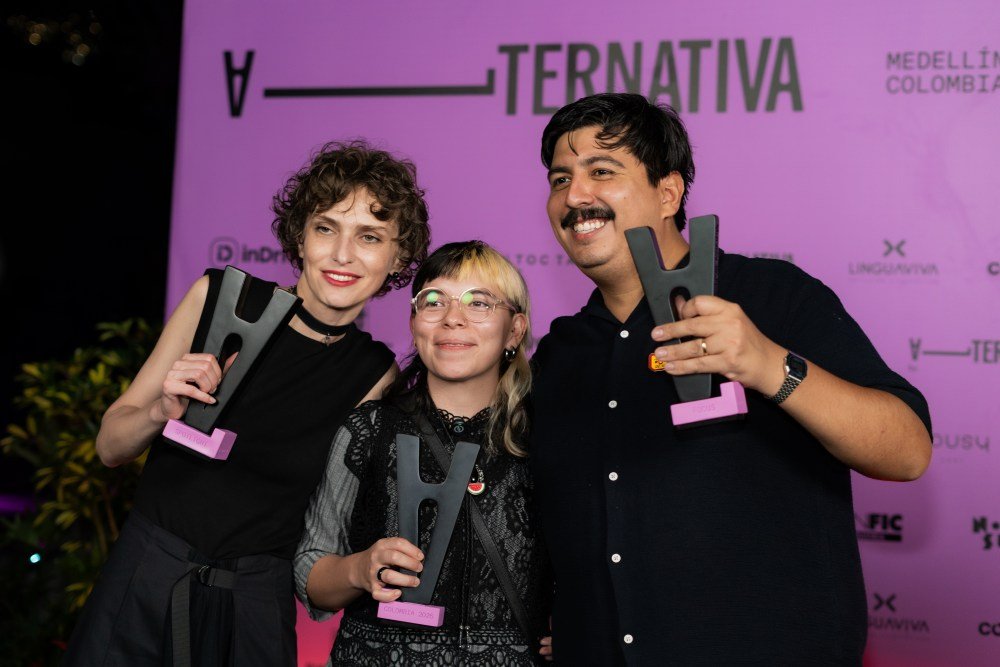
The 3rd Alternativa Film Festival wrapped April 30 in Medellín, Colombia with generous cash prizes doled out to five feature films and two shorts. These were selected from 15 feature-length films and 15 shorts hailing from Latin America and Asia.
Liza Surganova, head of the itinerant film festival founded by tech company inDrive, announced that Africa would be the next focus region for the 4th edition, leaving specifics for a later date.
At the multi-media closing ceremony held at the stunning Medellín Botanical Garden, Surganova said: “The winners each reflect the mission of the Alternativa as we continue championing underrepresented filmmakers whose work actively drives meaningful social change.”
Peru’s “Runa Simi,” the crowd-pleasing debut feature documentary of Augusto Zegarra, took home the Focus Award, which recognizes films that offer insights into the complexities of the current Alternativa Focus Region, in this case, Latin America.
The five categories for feature films included a $20,000 cash prize per category while the two winning shorts received $10,000 each.
Said the jury led by Colombian actress-activist-producer Natalia Reyes: “It’s a film that deeply moved us, leaving a lasting impact through its sweet and tender portrayal of a protagonist struggling to preserve his identity, an identity that is inseparable from language.”
A tearful Zegarra had his protagonist Fernando Valencia, a radio host who took on the task of dubbing “The Lion King” into the Indigenous language of Quechua, on video phone as he accepted the honor, one of several collected that began with Tribeca’s Albert Maysles Award.
Georgia’s Ketevan Vashagashvili snagged the Spotlight Award which focuses on pics that raise awareness on overlooked social issues. Her documentary, “9-Month Contract,” follows a homeless woman who becomes a surrogate mother five times in order to support her young daughter, fighting health issues, stigma and red tape along the way.
Said Thailand’s Ratchapoom Boonbunchachoke whose absurdist comedy “A Useful Ghost” received the award for first and second features, Future Voice: “It took me 26 hours to get here but even if I hadn’t won this award, it was still worth it,” expressing what many festival attendees felt, some who had traveled from as far afield as Kazakhstan, Georgia, Malaysia and Indonesia.
The Alter Award, which celebrates films that inspire action for change, went to “Cutting Through Rocks” by Sara Khaki and Mohammadreza Eyni from Iran, who could not attend the festival. The jury commended it “for its powerful portrayal of freedom and its unflinching reminder of the inequalities that continue to shape the lives of millions of women.”
“Lost Land” by Akio Fujimoto, a Japan-France-Malaysia-Germany co-production, scored the Nativa Award, which recognizes works that delve into national or cultural identity.
As the jury pointed out, the story of a pair of Rohingya siblings’ game of hide and seek “becomes a powerful metaphor for resilience and survival in a world where human life is often treated as expendable.” Malaysian producer Elise Shick bounded up on stage, apologizing for her bare feet as she had been dancing with a friend and misplaced her shoes, echoing the buoyant, festive atmosphere of the event, which culminated in salsa dancing, naturally.
An honorable mention went to Pamela Andrea Martínez Barrera’s docu “Present in the Big Events” which the jury commended for its “moving blend of archival memories and chatty, funny hangout footage that illustrates how the enormous forces of geopolitical change can impact us on the most intimate of levels.”
Alternativa Then, Now and Up Next
In an interview with Variety, Surganova, who’s been with Alternativa since its launch, traced the growth of the fledgling event, from its launch in Kazakhstan to its second edition in Yogyakarta, Indonesia and now in Colombia. Among the novelties in this edition, which lured close to 11,000 in both festival and industry events, were outdoor screenings, out of competition screenings and an extension to the capital of Bogotá which will showcase some nine Alternativa participants.
About Indonesia, Surganova reflected that they didn’t have the luxury of time to build the industry connections they fostered in Colombia, citing the invaluable help of Colombian promotional entity Proimagenes and the local production team led by Natalia Agudelo Campillo’s MadLove.
“That is something really valuable that will stay with us even when the festival goes somewhere else,” she noted. “It makes such a big difference when you come to a region, to a country, and you show them that you respect them, that you want to be part of their ecosystem, that you are here, that you are not extracting resources, but you are rather coming to their region and bringing some international expertise and most importantly, connections.”
In a press conference Surganova held alongside inDrive CEO Anser Tomsky prior to the closing ceremony, she stressed that the festival would take place where inDrive was present.
“We go to the countries where they need their brand to be supported but also to be associated with the social mission of the company,” she said, which Tomsky stressed was overall about effecting social justice and change.
But lofty ideals need a pragmatic application, in this case, distribution. However impactful their messages are, these films won’t make an impression if not widely seen. Alternativa is addressing the issue by creating a distribution arm that has already been in talks with platforms, TV channels, in-flight systems and other ancillary distribution modes.
“Our distribution team is already going to Cannes in a couple of weeks to start talking to some potential partners but we’ll be launching it in full scale in a few months.”
Industry Days
The industry section held April 28-30 focused on three themes: impact, distribution and connecting with the global south.
These included talks led by Chile’s Santiago Film Fest (Sanfic) and Mexico’s Guadalajara Film Festival, but those touching on distribution were the most popular, underscoring its heightened relevance today when windows have collapsed, theatrical exhibition remains anemic in most territories and filmmakers find it ever more challenging to reach their target audiences.
In the panel titled Distribution Across Global Majority, the panelists agreed that sometimes regional festivals would make a better fit for one’s film. “People make the mistake of bypassing regional festivals for A-list festivals,” said Katalina Tobón, BAM head of content. “They may not always be right for your film,” concurred critic-Berlinale selection committee member Jessica Kiang, who noted the enormous wealth of options out there.
The panel labeled A Guide to Collaborating with Streaming Platforms across the Global South drew the biggest audience, with panelists from Mubi, Retina Latina and Chilean TVOD platform, Pijama. A note of caution from Retina Latina’s Ricardo Pacheco: The streaming market is concentrated in large platforms that offer access to only 20% of the movies produced worldwide. They simply are unable to buy and screen all the films made across the world.
The 3rd Alternativa Film Fest ran over April 21–30.
ALTERNATIVA WINNERS:
Focus Award: “Runa Simi,” Augusto Zegarra, Peru
Spotlight Award: “9-Month Contract,” Ketevan Vashagashvili, Georgia
Future Voice Award: “A Useful Ghost,” Ratchapoom Boonbunchachoke, Thailand, Singapore, Germany, France
Alter Award: “Cutting Through Rocks,” Sara Khaki; Mohammadreza Eyni,
Iran, U.S., Netherlands, Qatar, Chile, Canada
Nativa Award: “Lost Land,” Akio Fujimoto, Japan, France, Malaysia, Germany
Honorable Mention: “Present in the Big Events,” Pamela Andrea Martinez Barrera, Panama, Venezuela, U.S.
SHORT FILMS
“Blue Heart,” Samuel Suffren, Haiti, France
“Casa Chica,” Lau Charles, Mexico
Leave a Reply