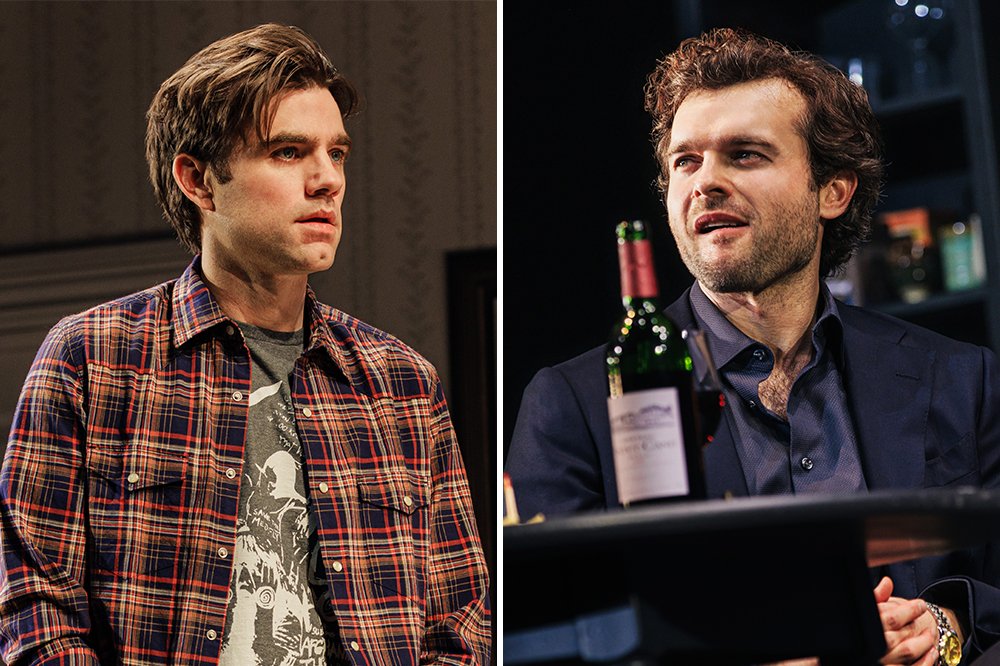
A few months before Alden Ehrenreich and Patrick Ball made their Broadway debuts in the hilarious dark comedy “Becky Shaw,” the two men met at a swanky Golden Globes party in Los Angeles.
Ehrenreich recalls his first impression of his future scene partner: “Not really a fan,” he cracks from the orchestra of the Hayes Theater, where the actors will be back on stage in just a few hours.
“Asshole,” Ball fires back.
They’ve clearly found an easy rapport since “Becky Shaw” opened earlier this month. Playwright Gina Gionfriddo’s relationship misadventure follows the fallout of a disastrous blind date: Max (Ehrenreich) gets set up with the titular Becky (Madeline Brewer) by his childhood friend Suzanna (Lauren Patten) and her husband, Andrew (Ball).
Part of the fun for them is playing men who are unlikable in different ways. Ehrenreich describes Max as a “boastful kind of guy” that “other people would call a dick.” Ball calls Andrew the “nice guy that sneaks up on you.”
Both of the Broadway novices are proudly bearing souvenirs of other passion projects. Ball, one of the breakout stars of HBO’s medical drama “The Pitt,” is sporting a bunch of beaded bracelets with phrases like “transmascs for Langdon” and “get help Robby,” a nod to the homemade jewelry worn by his character, Dr. Langdon. Ehrenreich, best known for “Solo: A Star Wars Story” and “Weapons,” is donning a brown barn jacket emblazoned with the logo for Huron Station Playhouse, a 120-year-old trolley station that he’s transforming into a theater space in L.A.
On a recent afternoon, the pair arrived early at the theater to talk about adapting to life on Broadway, ignoring reviews, and the famous faces who have come to see “Becky Shaw.”
This is both of your Broadway debuts. How are you adjusting to the schedule?
Ehrenreich: It’s been a million different things at once. It’s very thrilling and moving. I’m the least experienced of the bunch, so learning how to navigate the schedule, personal maintenance and emotional and psychological hygiene is very different. You live the whole show every night, which is different than when you’re shooting something and it’s parsed out.
Ball: It feels like coming home to me. I spent the last 15 years doing theater. I’ve been lucky to take a brief foray into television with “The Pitt.” My life has changed a lot over the past two years. Now to be back in a theater with an audience, this feels normal. This feels like what I know how to do. I don’t really know how to do red carpets.
How did “Becky Shaw” land on your radars?
Ehrenreich: I had been looking for the right play for, like, 10 years. I was talking to a producer about plays we could mount together in New York, and this was the first one she sent me. I started reading it, and I was loving it. Then she sent me an email and said, “Actually, forget this one. The rights are unavailable.” The rights were unavailable because of this production. I had talked to [director] Trip [Cullman] about a play a couple of years ago and had been interested in working with him.
Ball: I got a call last fall from my then-agent, who was like, “Hey, there’s this play called ‘Becky Shaw.’ It had an Off Broadway run in 2009 that was a real moment in the New York theater scene. Give it a read. Let me know what you think.” I spent a week reading the play and was immediately struck with how smart it was in the conversation around gender roles and attachment and codependency and overt-versus-covert aggression. I got on a Zoom call with Trip and Gina, and I remember talking about what was interesting to me: the idea of Andrew being this insidious, nice guy who rubs your back and claims to be “not like the other guys,” and then turns out to be more Machiavellian than the guy that comes in the door with arms swinging. We got into this whole conversation, and then at the end of the Zoom call, I remember saying, “And I also think it’s funny! I don’t know if that’s coming across in this call, but I think this is a very funny play!”

Ball and Patten play a married couple in “Becky Shaw.”
Did any real-life people shape the interpretation of your characters?
Ball: For sure. I definitely have an Andrew in my life that grinds my gears. I was very excited to get into that… the nice guy that sneaks up on you.
Ehrenreich: I can’t think of a specific person; that’s not been the way I’ve been thinking about it. But there is a kind of role I’ve always wanted to play, which are super verbally dexterous, funny people that other people would call dicks. I remember seeing Chris Pine do “Fat Pig” when I was in high school, and his character is very much that. Dennis in “This Is Our Youth” or Ricky Roman in “Glengarry, Glen Ross” feel like that. I’ve always wanted to play that kind of role because it’s a little bit of who I was when I was 16. Maybe not that bad, but in that world… This felt like the first opportunity I’ve ever had to do that professionally.
What were your first impressions of each other?
Ehrenreich: I’m not really a fan.
Ball: Asshole.
Ehrenreich: There’s so much that’s new about this for me. So getting to meet Patrick and his girlfriend at a party, and just the fact that he’s such a lovely guy, I was like, “OK, good.” There are scenarios you can get into with two guys in a show that would be different.
Ball: I remember my girlfriend Elysia [Roorbach] tapped me on the shoulder and was like, “Dude, I think that’s Alden.” I turn around, and Alden is posted up on the bar looking like a movie star. I go over and just completely dork out. I’m like, “Dude, we are about to be in the trenches and go through a whole fucking journey together.” It’s really cool when you get the chance to meet somebody before you go into this sort of micro reality we create here.
Ehrenreich: It was very grounding and helpful for me.
Did your preparation process differ for theater compared to film or television?
Ehrenreich: It did for me. I talked to Jesse Tyler Ferguson before I came here, and he was telling me I should be off-book before we started. That was really helpful. At this point in life, my memory is pretty good. When I do a movie, I do it a lot closer to when we shoot it. I’m a big proponent of being memorized on movies, which —
Ball: Which apparently is not a given, which is crazy to me!
Ehrenreich: It’s pretty awful. Not to go down too far down the road, but I’ve had experiences of being on sets where there’s a ton of money [involved] and everybody’s got to do their job for this take because a thing has to blow up in the background… And then people, especially people who are very established, come in and don’t know their lines, which is, you know, the basic unit of your job. There’s an ethos of “Well, I don’t [memorize] because then I keep it fresh.” There’s people for whom, I guess, that works. But I’ve watched people not doing that, where it meant the whole crew gets home later and producers are spending more. Especially when it’s someone who’s a big name, the fact that no one feels comfortable being like, “Hey, you need to know your lines.” I was like that when I was, like, a teenager… Anyway, tangent. Knowing your lines is good.
I just hired a new assistant, and the first task we had to do together was her helping me memorize my lines. She’s in college; she just met me, and I’m sitting with her all day and saying [lines from the play] like, “What the fuck is wrong with you? Are you having your period?” I’d be like, “So this is an odd energy for us to start with here.” But she was really great. It was helpful.
Ball: We would have guest stars on “The Pitt” who would be like, “Man, it’s so amazing. You guys know all your lines.” I’m like, “What are you talking about? Of course, I know my lines…”
Ehrenreich: Well, that’s because you come from theater.
Ball: With theater, I don’t prepare the same way for everything. I did “Hamlet” in L.A. after Season 1 of “The Pitt.” It was such a big lift and scary thing. “Can I do this?” I locked myself in my apartment for two months and got off book for “Hamlet” before the first day of rehearsal so I could come into it with confidence. For this, I left the plate pretty clean. This is a relationship play, and I didn’t want to preempt any assumptions about the characters until I met the actors playing them and could read that energy off of them. I spent a lot of time just finding that cling impulse that is a base drive of Andrew.
Ehrenreich: What do you mean, cling? Like, clinging to her?
Ball: Like, somebody that has lived with scarcity. Somebody who has lived with feeling like if they were to have a boundary, they wouldn’t be lovable; that they have to give all of themselves all the time, or they won’t be enough. Finding that base drive and energetic center was something I spent some time working on.
Do you have a favorite line another character says in the show?
Ehrenreich: I do. When Becky says, “My family doesn’t speak to me.” And you say, “I’m sure they’re the problem, not you.” That’s such a beautifully constructed thing on Gina’s part. It’s so encapsulating of the way someone is. On its face, the show is this razor-sharp, funny, explosive comedy. But the roots are so deep; the “why” of why people are doing what they’re doing.
Ball: In real life, I probably identify closer to Max’s view on the world than Andrew’s view on the world. My favorite line, the encapsulating moment for Max, for me, is that plot of land speech, which is phenomenal. I don’t think I can quote the thing on its face.
Ehrenreich: “Unless you’re Gandhi or Jesus, you have a limited sphere of responsibility. You have a plot of land, and the definition of a moral life is tending that plot of land.” It’s such a gift when a writer is like, “Here’s how he sees the world, moves through it and justifies his behavior toward everybody.” It reminds me, weirdly, of the end of “Oklahoma” where Curly killed the guy, and everybody just rallies around him. There’s a family-first, regional thing about that I really understood.
Ball: Coming from a Southern family — that’s very much a Southern mentality, right? — Your responsibility is to your nuclear family. There’s a clarity and responsibility in that, which encapsulates Max really well. It also rings true to my lived experience.
Ehrenreich with Brewer, the titular Becky Shaw
Do either of you read reviews?
Ball: I went on one of the roundups that gives the icons of thumbs up, thumbs down. I saw a bunch of thumbs up, and that’s as far as I went. I was like, “OK, we’re gonna be employed.”
Ehrenreich: No. With film, months later when it’s all said and done, I don’t actually think it’s a good thing to do… but at least it’s a little safer. I cannot imagine doing that in a play. Even if stuff is good, reading a review and having to do it and not having whatever adjectives they described you in your head… I think it would be so destructive.
Patrick, your recent comments about the liberation of paying off your student loans have gotten a ton of traction online. Were you surprised to see how much it resonated with people?
Ball: It was wild. I talked about how landing “The Pitt” allowed me to pay off my student loans and how heavy it was to be 35 years old and be $80,000 in debt and have been working exclusively in theater all my life, working for $800 or $900 a week. And knowing I might die with those loans and feeling the effect of financial insecurity on my personal and romantic relationships, on my ability to look into my future and believe in what I see. And how profound it was to pay off those student loans and feel like I was going to be safe. Like I was going to OK for the first time. I had no idea that little pull-quote was going to go as far as it did. But I’m really glad that it did because this sense of financial burden from student loans is something that is carried by many, many people in this country, many of whom have it much worse than I did. I think the system is broken, and the fact that this has been able to start a conversation around that is awesome.
Has it allowed you more freedom in terms of the projects you take on?
Ball: Yeah, it put me in a position to make $750 a week on “Hamlet” and not worry about it. I’m going to be able to pay my rent. Having something like “The Pitt,” which hopefully will continue to be part of my life for a long time, is really empowering. It means I don’t have to make artistic decisions based off of financial need. I can make it off of my creative curiosity, and I can do projects that I believe in.
Ehrenreich: That’s great you’re talking about it. I grew up romanticizing the movies of the ’70s or the Actor Studio days. As you get older, you realize how much you’re totally kneecapped from living that wild, experimental, creative, artistic life. People can’t do that if they can’t afford to live. And if they can’t, then you get people making less interesting things.
Ball: I got a lot of great advice from Noah Wyle of, like, “Save your money. Stay cheap. Keep your overhead low. Don’t end up in a situation where your cost of living gets inflated, so even though you’re making 30 times more, you’re now spending 30 times more, and you still feel just as poor.” I’m back in the same apartment I was living in before “The Pitt” came along. I’m in Brooklyn with the same roommate.
How do you wind down after a performance?
Ehrenreich: I’m finding it very difficult. There are different techniques; I’ll do yoga stuff that tries to slow the adrenaline. And have a drink.
Ball: You come off stage, and you’re going a mile a minute. Your nervous system is lit up. It can take a while to come down. I could probably do better at making the time to meditate and slow down. But I come out and I’m like, “I gotta go see Elysia. I gotta hear about her day. I gotta check in.” And then I have to figure out, “What are we waking up tomorrow morning and doing?” Right now, the hamster wheel just keeps going.
How do you like to spend your days off?
Ehrenreich: I’m reading a bunch of plays because Huron Station, the theater I bought in L.A., is opening very soon. And then just trying to decompress, spend time alone and catch up with my friends and family and partner.
Ball: I have not had a day off for about a calendar year. Doing nothing is what I aspire to do. I love sitting in Fort Greene Park. It’s my favorite place in the world. I can’t wait to just go sit under a tree and listen to the wind.
Do you hope to do more Broadway?
Ehrenreich: Absolutely. If I can find roles and plays like this, I would love to. In college, all my favorite actors were people who began in theater, that whole ’70s generation, Ellen Burstyn being one of them, who was here the other day, which was very meaningful.
Ball: I got a long list of things I want to do. I would love to come back to Broadway and do one of the great American classics. That’s pretty much exclusively what I did before going to grad school at Yale. I would love to do a play on the West End. I’ve never been to London, and so I would love an excuse to go, if you know anybody hiring.
You mentioned Ellen Burstyn. Have other celebrities come to see the show? Do you like to know when famous people are sitting in the audience?
Ehrenreich: I don’t like to know if they’re here before the show starts. Patti LuPone came the other day.
Did you spot her mid-show, or did someone tell you after?
Ball: Her presence rippled through the seats and upstairs.
Ehrenreich: She came on stage and finished the play.
Ball: Julianna Margulies came, which was very cool.
Ehrenreich: I did not know that.
Ball: My girlfriend has come five times, so that’s cool. Her best friend from high school came the other day. It was her second ever play. We also took her to “Stranger Things,” so it was a big change of pace.
Ehrenreich: I have a family member who I’m navigating right now, making sure they don’t come because they’re very, very, very religious, but they really want to come. They would have a really hard time with the play. Religious, like, has never seen movies or anything like this.
Ball: That’s my family.
Ehrenreich: I’m like, “You’re not gonna enjoy this.” They want to come and be supportive. I think it would confirm every feeling that they had that —
Ball: Your life has gone awry?
Ehrenreich: That Satan is running the show.
Leave a Reply