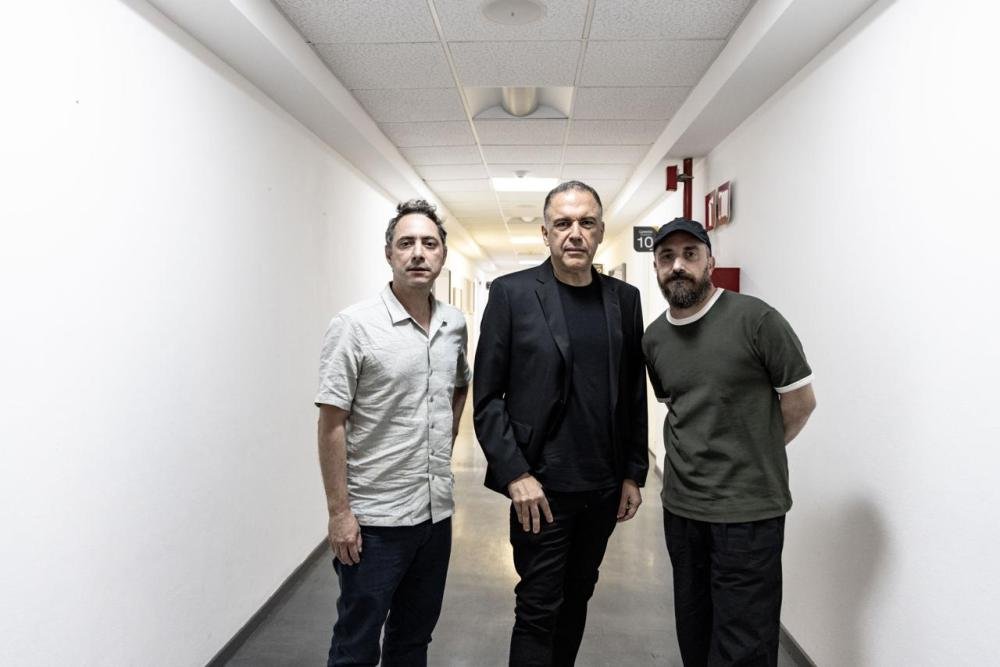
It was one of the most anticipated events of the 41st Guadalajara Film Festival (FICG) where Chile is the country guest of honor.
On April 19, director Pablo Larraín and his producing partner brother Juan de Dios Larraín, founding partners behind Chile’s most successful production company, Fabula, sat down with Netflix’s Francisco Ramos, VP of Latin American Content, to discuss how their company has grown into the international player that it is now, with offices in Santiago, Mexico City, Los Angeles, Madrid and perhaps Bogota, Colombia, in the not so distant future.
Throughout the conversation, they reflected on how Chilean and Latin American cinema has grown from a small, resource-limited industry into a globally visible creative force.
Ramos asked a question in many people’s minds, how a country so remote and relatively small could have such a strong creative output. “We’ve got you here, Maite Alberdi, Sebastián Lelio —but beyond that, there are so many other filmmakers who’ve emerged over the past 30 years. And it’s really interesting to ask why. Why are there so many compelling voices coming out of Chile?
He went on: “It makes you wonder about the kind of environment that fosters that level of talent. Because it’s not just directors—there are producers, cinematographers, designers, writers… all these roles branching out and feeding into each other, forming that ecosystem you need for an industry to really grow and thrive.”
The question stumped them, but only to some extent. Pointing to Chile’s rich culture of painters, poets, writers and more recently, its growing cinematic sensibility, Juan de Dios said: “I do think the visual side – the graphic sensibility—plays a big role. Chile is almost like an island: on one side you’ve got the Andes, on the other the Pacific, and then the desert up north. It’s a pretty isolated place. Growing up there, any time you wanted to do something or go somewhere, it usually meant getting on a plane. We grew up in a much more remote environment, and I think that creates this urge to go out into the world, to be seen, to be validated abroad. That pushes you, it shapes you, gives you an extra drive.”
“But honestly, that’s just a theory – I’m not even sure I fully believe it myself,” he added, drawing laughs from the audience.
Pablo, whose body of work has expanded from local stories of resistance like “No” to his English-language trilogy of three iconic women, Diana Spencer, Jackie Kennedy and Maria Callas, concurred: “I think it’s amazing that we can be so diverse while being such a small country, and at the same time so hard to define. I don’t know if there’s a clear explanation for it. We’re also very close to it – we’ve been immersed in this world for so many years and we’re part of it ourselves.”
He cited Chile’s revered documentarian Raúl Ruiz, who described it as “a country that resists classification, where categories don’t quite stick.” “And within that, there’s also a lot of internal tension – we challenge each other, there’s a kind of constant self-scrutiny, a restlessness.”
Juan de Dios Larraín also pointed that it was precisely the size of Chile’s market that has forced them and their peers to look outward in order to make their films.
“Co-production isn’t just helpful—it’s essential to Chilean cinema. There’s really no other way to do it. You can’t finance a film purely through the Chilean market; the numbers just don’t add up. So from early on, going out and seeking funding became a fundamental part of the process – it’s built into the system”
“In a way, that limitation forces growth. It pushes you to adapt, collaborate and think beyond your own borders from the very beginning,” he noted.
Pablo Larraín added: “We’ve produced a lot of films – close to 50 – with different directors. And looking at both the most successful ones and the ones that didn’t quite work, I keep coming back to the same idea: the key is supporting the director.” Fabula has backed the likes of Lelio who won Chile’s first International Feature Oscar for his transgender drama “A Fantastic Woman” and Alberdi, twice nominated for her documentaries.
Juan de Dios also pointed to another key factor that has contributed to the company’s growth, television, with advertising still a strong pillar of support.
He said: “The first 10 or 15 years, we were a very independent production company, with a strong editorial identity, working with directors from all over and driven by very auteur-led ideas. Then we gradually shifted into something more collective – almost like treating filmmaking as a shared sport, if you will. At the same time, there was this push to access larger budgets, which led to our first production with Lelio.”
“Around that same time, television also entered the picture as a major force. And that combination created a kind of perfect storm for us as a production company. It pushed us to evolve, to expand from being a relatively small outfit operating in just a couple of countries into something more structured – more “corporate,” for lack of a better word. If it weren’t for television, the company probably wouldn’t have grown the way it did. And in a way, the Oscar gave us a kind of legitimacy or identity that helped us take that next step at exactly the moment when the opportunity was there.”
The Guadalajara Film Festival (FICG) runs over April 17-25.
Leave a Reply