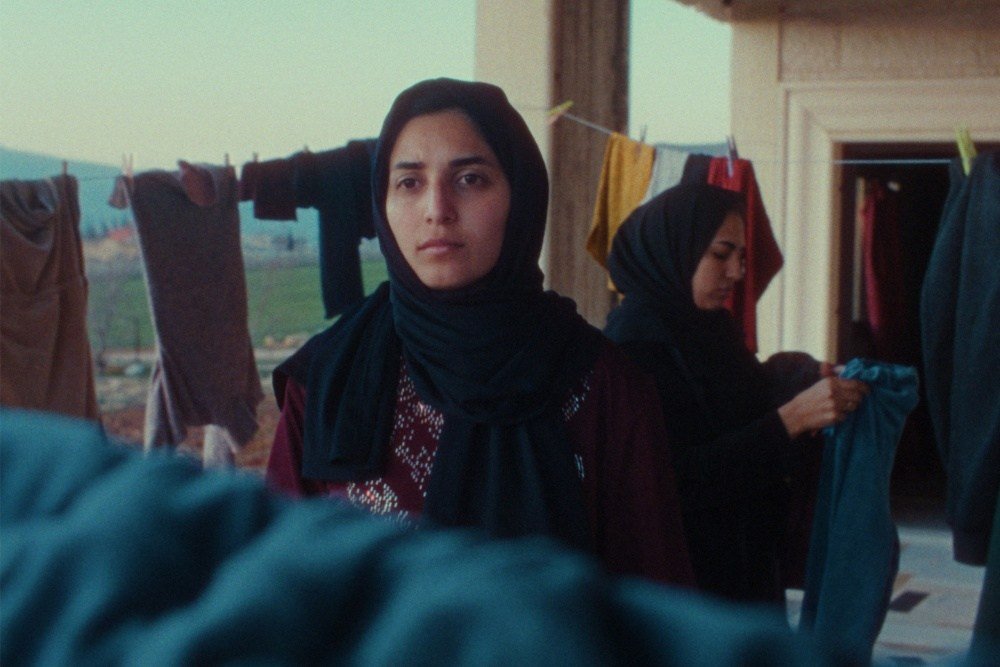
Iconoclastic Palestinian filmmaker Rakan Mayasi’s debut feature “Yesterday the Eye Didn’t Sleep” made a splash in this year’s Un Certain Regard in Cannes with its powerful, poetic treatment of a Bedouin community in Lebanon’s Bekaa Valley. This week it plays in a competition slot at the El Gouna Film Festival, where Variety spoke to the director.
Inspired by Mayasi’s grandmother, it’s a story of two women who become pawns in a tribal blood feud, played out in a visionary style that owes much to Mayasi’s mentor Abbas Kiarostami, yet has its own rhythm and sensorial, at times almost feverish, point of view. Following its Cannes premiere the film has been warmly received at other festivals, and will be screening at Montpellier’s CineMed followed immediately by the Rome Film Festival, in their Best First Feature section. International sales are being handled by Salaud Morisset.
The film has several exceptional set pieces: it opens with a car in flames, in the middle there’s a stunningly hallucinatory wedding sequence, and it ends with an evocative longshot that plays with visual space. When you and your cinematographer Pôl Seif were conceiving the film, did you have these already in mind?
Some of it was already set and ready in our minds. Some of it, no. For example, for sure the fire, it was there since the beginning. I’m interested in metaphors and how to translate that visually, so with Pôl we had the idea that we zoom in so you feel that the car is getting closer to you and the fire is spreading. We were trying to translate what the metaphor could possibly look like. Whereas the end was rewritten, by the two of us, because it’s a very visual scene. So we blocked it again three days before the shoot ended, and we rewrote it entirely.
The wedding scene has been singled out by many critics for its visual beauty and the emotional shift it conveys.
In that scene I allowed myself to get out of the narrative, so to speak, to change the rhythm and play with a kind of psychedelic approach. It’s never really stated that this was the actual wedding, and when the one sister, Jawahir, is revealed as a bride, it is very theatrical. The idea was kind of like zooming into her subconscious, into her imagination of a celebration. It allowed me to play around. For example, the whole scene was improvised. I never met any of these dancers before. We made a call for the biggest number of people to join, and we were very lucky because a lot of people came and they were very, very energetic. My job was to just have a microphone and make them more energetic.
The scene also allows the community to be seen in a more three-dimensional light.
The idea was to juxtapose two emotions and then make the audience feel guilty afterwards. I want to enjoy watching this pleasing, psychedelically shot dance sequence, but then afterwards I will ask myself, what the fuck did I just watch and why did I enjoy that? This was the idea.
Is that something that you enjoy in film in general? Do you like that idea of sort of thinking, what the fuck did I just watch?
Yes! My next film will be entirely like this.
Speaking of things that are unexpected, we’re used to a particular kind of Lebanese cinema that deals primarily with the Civil War and subsequent crises. Yet you’ve chosen something completely different. You’ve gone into the Bekaa Valley and focused on a community that probably hasn’t been seen before in a feature film.
I don’t like formulaic films. I don’t like the way we are seen outside, with every film having to talk about the Civil War, or the post-Civil War. I want to go to communities that have not been on film before, mainly because there’s much more depth in plots and characters and life there.
This is why I wanted to work with non-professional actors. I could have gotten actors and put them in there in this context, but I prefer not to because this fragile authenticity has to be kept. Also, don’t forget that I’m Palestinian. I lived in Lebanon 20 years, and though I don’t have Lebanese nationality, I also feel Lebanese somehow because I became a filmmaker in Lebanon. But I don’t like the mainstream, so to speak. I like to dig in and see much more into life, basically.
Is your next project also set in Lebanon?
Half of it happens in Gaza. It was supposed to be my first feature, but it’s a dark comedy, so I had to stop it when the Israeli genocide began in Palestine. Now I’m returning to it a bit slowly; it’s an absurdist, deadpan dark comedy, very different from “Yesterday the Eye Didn’t Sleep.” It’s more staged, in a more controlled environment. And it’s about life and death. and the bureaucracy of life, basically. It’s called “The Passport” and I’m in late development/early pre-production. May Odeh, who’s associate producer on “Yesterday the Eye Didn’t Sleep,” is producing that film.
What’s next for “Yesterday the Eye Didn’t Sleep”?
After Cannes, it was selected in 50 festivals, which is fantastic, and it’s doing quite well at the festival circuit. I’m doing a tour of eight festivals in October, including Rome, the Viennale, Valladolid and in Bucharest, Cristian Mungiu’s Cannes Reprise. It will also be in Geneva in early November.
Leave a Reply