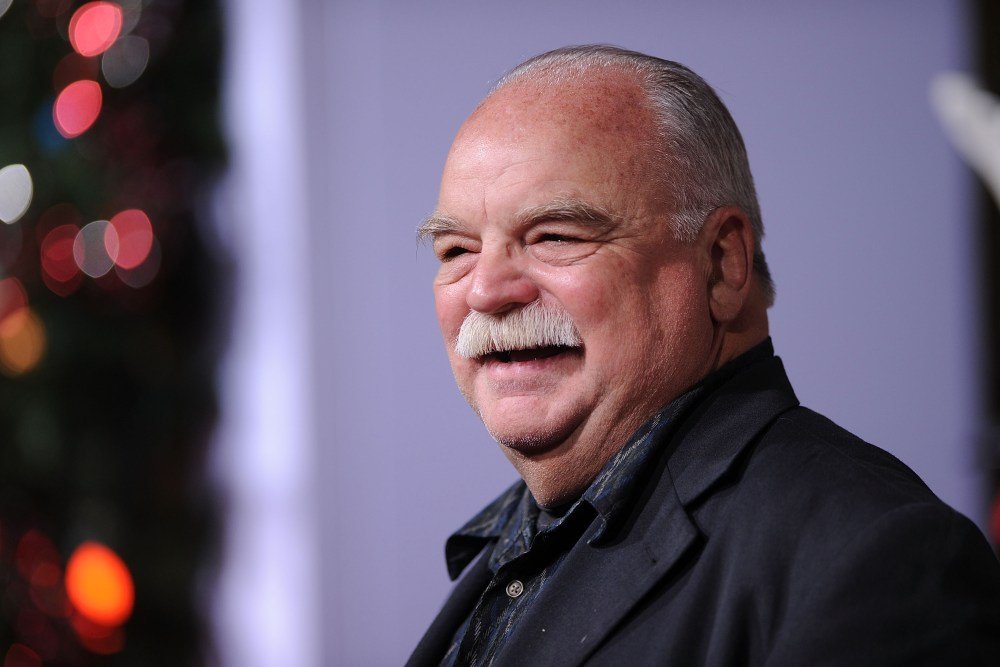
The first time I met Richard Riehle, I was making one of the first things I’d ever made. It was a Funny or Die video, and my friend Tanner Thomason and I were trying to figure out how to get an actual actor to be in it. Someone suggested Richard. “Just offer it to him. I bet he’ll be down.” So we wrote him a nice letter, offered him the enormous sum of $250, and a week later we were working with a legend.
I remember arriving on set that morning and finding Richard already there, sitting by himself, reading the newspaper and drinking a root beer. He’d beaten the crew there. He didn’t need anything, didn’t seem particularly concerned that he was an actor with hundreds of credits doing a little internet video for two guys who had never really made anything before. He was just happy to be there.
That was about 13 years ago. I spent a lot of the next 13 years trying to find reasons to work with him again. If I wrote something with a part Richard could play, I offered it to him. Sometimes I probably wrote the part because I wanted an excuse to hear his stories. We ended up acting in several other projects together, too, and over the years we became friends.
He was also, without question, one of the best actors I’ve ever worked with. I know that might sound like the sort of thing people say when someone dies, but I mean it. Richard was astonishingly good. He could make a line funny just by deciding not to make it funny. He could steal a scene without seeming to do much of anything. And every once in a while he’d remind you that underneath the familiar face and the wonderful mustache was an actor with a range most people never got to see.
Years ago, we were doing a table read for a movie called “Fear, Inc.” We’d cast Richard as the funny neighbor. The actor who was supposed to read the villain couldn’t make it that night, so Richard offered to fill in. No big deal. Just reading a few extra lines. Then he started doing the role, which he had literally worked on at home. He knew the lines of a role he wasn’t even going to play for the table read. The sweet, funny neighbor we’d all been laughing at was suddenly terrifying. I remember looking around the room and seeing jaws drop. People were genuinely stunned. It was like we’d all forgotten, for a moment, who we were sitting across from.
Richard had more than 400 acting credits, which is an almost ridiculous number until you understand the man. More than anything, he just loved being on set. Student films, tiny independent movies, major blockbusters, network sitcoms. I honestly don’t think he cared all that much about the difference. If he could hang out on set instead of in his trailer, that’s where you’d find him. And if you worked with him once, you had a friend. Invite him to a screening a year later, some random improv show, or a backyard barbecue, and if he was free, he’d show up.
A couple of years ago, we were in Dallas shooting a movie called Tonic. One night over beers, Richard told me how excited he was to have been asked to reunite with his old “Office Space” pal, Stephen Root, on an episode of “Barry.” We got to talking about his career, and he said something I’ve thought about a lot since. Richard suspected that taking so many small independent projects over the years had probably hurt his chances of getting certain television or studio jobs. Maybe people saw the sheer volume of credits and made assumptions. Maybe he’d have been better off being more selective. But he wasn’t going to change anything.
He wanted to act. As much as he could, for as long as he could. If saying yes to some tiny movie meant missing out on a bigger one, well, that was fine with him. He’d rather spend his Tuesday on a set somewhere, even a tiny set, than sit around waiting for a more prestigious phone call. I loved that about him. I think a lot of us could learn something from it.
Richard lived in the same Los Feliz spot for years. He liked being able to walk around Hillhurst and Vermont, to get out and be part of the neighborhood. He drove a Honda Civic that was something like 25 years old. Why get a new car? This one worked. It got him to set and back. That was Richard.
And he had that mustache. I’m actually wearing a mustache today partially because of Richard Riehle. Six years ago, I grew one for a movie we made together called “Faith Based.” I wasn’t sure I was going to keep it. Richard told me I should. He said growing his own mustache was one of the best decisions he’d ever made. It fit his face, he explained, and gave him something distinctive. Coming from a man whose mustache belongs in the same conversation as Sam Elliott’s and Burt Reynolds’, I took that advice pretty seriously. I haven’t shaved it since. I suppose that’s a pretty small thing to carry forward from a friendship, but I like knowing that a little piece of Richard will be looking back at me in the mirror every morning.
When I think about Richard now, I don’t really think about his filmography, impressive as it is. I think about that first morning. The newspaper and the root beer. A man who’d already been in more movies than I could count, sitting patiently on the set of a $250 internet video in Canoga Park, ready to give it everything he had for a comedy sketch.
He gave that little project just as much as he would have given a studio movie. I don’t think it ever occurred to him to do otherwise. Richard just loved being an actor.
Luke Barnett is an actor, writer, and filmmaker whose credits include AMC’s “Dark Winds,” Apple TV+’s “For All Mankind” and Peacock’s “The Burbs.” His recent filmmaking work includes the viral short “The Crossing Over Express,” currently being developed as a feature, and the Fangoria-produced “Goodbye, Monster,” which just premiered at Fantastic Fest. He has also worked on nearly a dozen projects with the late Richard Riehle, though not nearly enough.
Leave a Reply