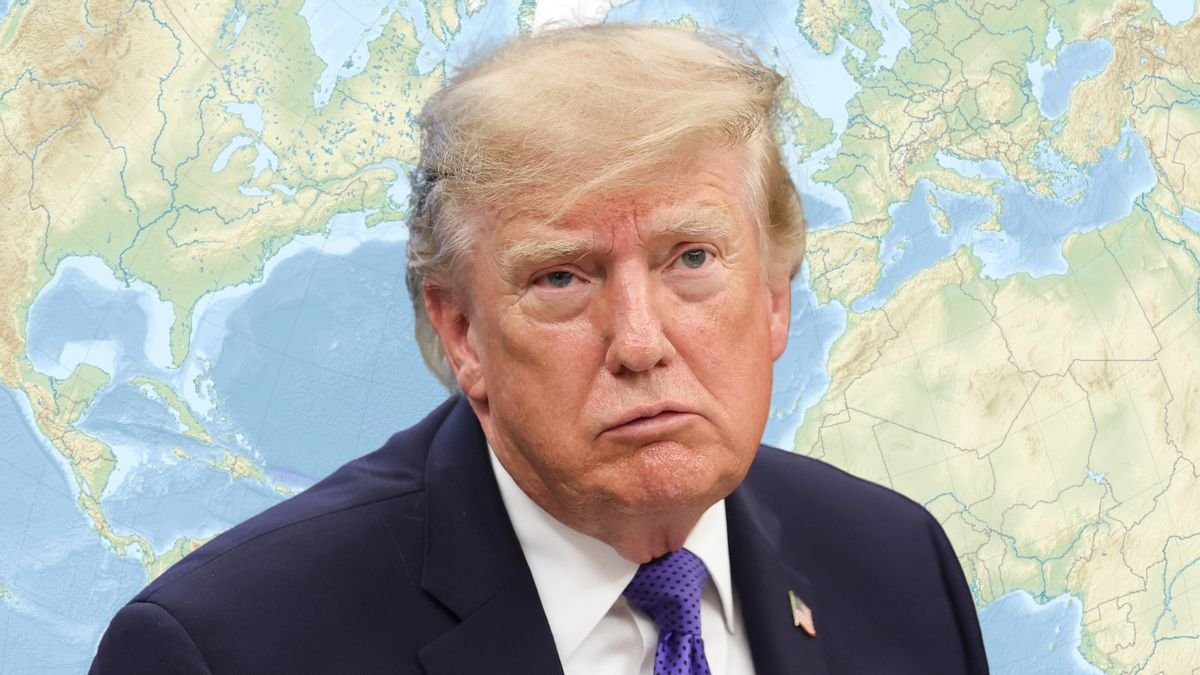
- During the first half of his second term, U.S. President Donald Trump ordered the federal government to rename the Gulf of Mexico to the Gulf of America, Denali to Mount McKinley and Lake Ontario to Lake America. In October, he suggested he might rename a river or ocean as well. Trump’s renaming crusade has led to discussion about what authority he has in the matter.
- The U.S. federal government maintains a list of the official names of geographic features across the world. The Board on Geographic Names, which is under the control of the Department of the Interior, is in charge of maintaining and updating the list.
- The board is made up of representatives from six cabinet agencies, the Postal Service, CIA, Library of Congress and Government Publishing Office. It has different subcommittees dedicated to the names of domestic landmarks and foreign landmarks.
- Its goal is standardization and clarity, meaning board members do not decide the names of landmarks themselves. Instead, it relies on naming and renaming suggestions from anyone, and discourages renaming landmarks unless absolutely necessary.
- Since the Board on Geographic Names is under the control of the Interior Department and is therefore part of the executive branch, it did rename the features in the official government database as mandated by Trump’s executive orders.
- However, the board only controls how the U.S. federal government refers to landmarks in official documents. Whether or not the general public and other countries choose to use the names is their prerogative.
At an Oct. 10 rally in Clarksville, Tennessee, U.S. President Donald Trump told a crowd of supporters he was thinking of renaming an ocean.
“I was thinking of either the Atlantic or the Pacific,” Trump said, naming two of the three oceans that border the U.S. “We call it ‘Trump Ocean’ or, or ‘Ocean of the Americas,’ something like that.”
Renaming large, prominent geographic features with centuries-old names has been a theme of the second Trump administration. Just after retaking office in January 2025, Trump signed an executive order mandating that the Gulf of Mexico be renamed the “Gulf of America” and Denali, the highest mountain in North America, be re-renamed Mount McKinley. (The mountain was first dubbed Mount McKinley in 1897 and recognized by the federal government by that name in 1917. In 2015, the federal government switched to using Denali, the name used by Alaska Natives). In August 2026, he added another feature to the list by ordering Lake Ontario, which the U.S. shares with Canada, be renamed to “Lake America.”
Given that Trump is now talking about renaming oceans and rivers, it’s worth revisiting exactly what authority he has here. Put simply, can a president rename an ocean?
The answer is complex. In some sense, yes, a president can rename an ocean. In a different sense, no, a president cannot.
Surveying the land
Boiled down to the simplest level, a country has two resources at its disposal: the land it claims and the people who live there. Having deep knowledge of those two kinds of resources allows leaders to make better decisions, so countries have a vested interest in taking stock of both their population and their territory.
For people, this is relatively easy — the decennial census, taken once every 10 years since 1790.
For land, this is much harder, which is why high-quality maps are a relatively recent technological advancement.
In the early days of the U.S., when the fastest way to travel was by horseback or foot, surveying land required sending a team of men out into the wilderness with a compass and some string to measure distances and record every geographic feature in sight, while avoiding bears and other dangers. Creating an accurate map of even a small area was a tribulation, and in a country as big as the U.S., surveying the entire nation was an afterthought.
In the mid-1800s, two key things happened to kick-start the standardization of place names: A large number of settlers began moving west, and then the railroads quickly followed suit. Surveyors and cartographers began producing maps for the areas — but with inconsistent and sometimes contradictory names, according to National Geographic.
Suddenly, having an accurate map of the entire country with standardized names made a lot more sense. In 1890, President Benjamin Harrison signed an executive order establishing the Board on Geographic Names to sort it all out. The board was reorganized a few times in the following decades, but after World War II, it was placed under the control of the Department of the Interior, where it remains to this day.
According to the board’s website, its members include representatives from six executive departments (Agriculture, Commerce, Defense, Homeland Security, Interior and State), the Postal Service, the CIA, the Library of Congress and the Government Publishing Office. Members, who serve two-year terms, are divided into committees dedicated domestic names, foreign names, names on Antarctica and the names of undersea features. The Associated Press reported that the board handling domestic names meets at least once a month.
The board’s goal is standardization and clarity, not commemoration. It accepts proposals for new names for unnamed features and for renaming existing features from anyone, according to its website, meaning that the board does not name the landmarks itself. Furthermore, it “discourages name changes unless there is a compelling reason.” As a result, the name changes ordered by Trump contradict the board’s advice — there seem to be no compelling reasons for renaming the large bodies of water other than because he wanted to.
But because the board is part of the Interior Department and therefore a part of the executive branch, executive orders do apply to it. So, on the official map of the U.S. maintained by the federal government, the Gulf of Mexico is called the Gulf of America, Denali is called Mount McKinley and Lake Ontario is called Lake America.
The board also places some restrictions on the names of geographic features. Names containing derogatory language are prohibited, for instance (Snopes previously covered a Biden-era effort to rename places whose names contained a slur for Native American women.) Additionally, features may not be named after a person who is alive or has been dead for less than five years. Trump’s suggestion of “Trump Ocean” probably won’t fly, for that reason.
Similarly, the committee on foreign names has no power to rename landmarks outside the boundaries of the U.S. — according to a board member who spoke to National Geographic, it attempts to accurately transliterate foreign place names in the Roman alphabet.
All of this belies a larger point, however. Trump does have the authority to compel the board on Geographic Names to change the federal names of landmarks. Whether or not people choose to use those names is an entirely different question.
Leave a Reply