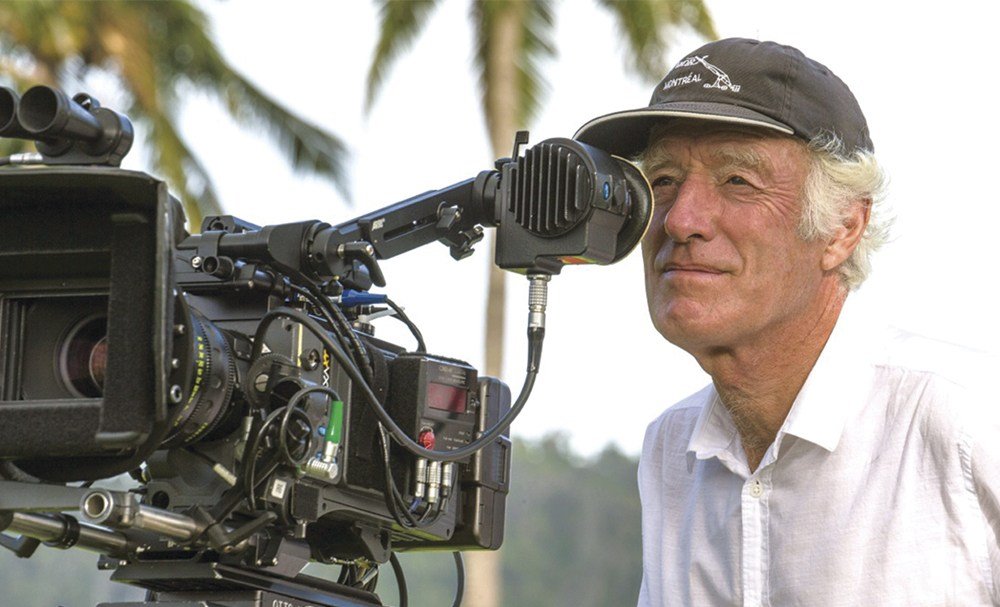
Walking through Turin with his wife and creative partner James Ellis Deakins, Roger Deakins found himself thinking about Giorgio de Chirico. The Italian painter, one of his favorites, had drawn inspiration from the city’s vast squares, long arcades and unusual arrangements of light and shadow. Deakins was noticing the relationship for himself.
It’s characteristic of a man who has spent much of his life looking at the world, yet remains somewhat at a loss to explain precisely how he sees it.
“Somebody asked the other day, what is a cinematographer? I mean, I still can’t answer that,” he says.
It’s an uncommon admission from someone whose images have helped define contemporary cinema, from “No Country for Old Men” to “Blade Runner 2049” and “1917.” But for Deakins, the work is too dependent on the circumstances of a story, and the people telling it, to be reduced to any one method.
“It’s your emotional reaction to things that’s important,” he says. Technical considerations can be discussed, but the decisions that shape an image ultimately arise from something inexplicable.
Perhaps his relationship with looking began as something more personal. As a young man, Deakins, born in the southern English resort of Torquay, discovered that the camera offered a kind of confidence, a way of approaching a world in which he hadn’t always felt comfortable.
“I was kind of hiding behind the camera to a certain degree,” he recalls. “I had confidence because there was something between me and reality.”
He could scarcely have imagined where that camera would take him. Only in retrospect has he come to appreciate the significance of experiences whose importance wasn’t apparent at the time.
“If you don’t experience things, then what have you got to contribute?”
It’s a conviction he shares with Ellis Deakins, his wife and essential collaborator on every project since they met on Michael Apted’s “Thunderheart.” For her, experience gives a filmmaker more than a collection of visual references. It provides different ways of understanding the people and specifics of a story.
“If you’re going to tell a story, having had many different experiences gives you many different points of view,” she says. “You’re able to actually add more to the story.”
Deakins worries that cinema can become too inward-looking, with filmmakers drawing inspiration primarily from other films.
“I rarely, if ever, do that,” he says of referencing earlier movies. “You bring all the things that you experienced in your life to something.”
Their Team Deakins podcast often explores the myriad routes people have taken into filmmaking. There is no repeatable path, just as there is no formula for a good image. James encourages the aspiring to experiment, examine their photographs and footage, and ask themselves why something works or doesn’t. It’s how they develop an eye, or what Roger calls a personal sensibility.
Deakins, however, is less inclined to analyze his own.
When asked about the relationship of shapes and forms in his still photography, he struggles to explain what draws him to a composition. He tends to see the whole image, he says, rather than its individual elements.
Ellis Deakins is more definite. Looking at his photographs, she notices how shapes intersect and contrast.
“You may not be aware of it, but you are interconnecting shapes,” she tells him. “But I know it’s instinctual.”
The distinction between conscious intention and instinct becomes more intriguing when we discuss Andrew Dominik’s “The Assassination of Jesse James by the Coward Robert Ford.” Much of the film contrasts light and dark, yet the scene depicting Robert Ford’s murder takes place in a bar housed in a tent, surrounded by snow, its interior swathed in flat, even light. The violence, and Casey Affleck’s Robert Ford, seem jarringly exposed.
Was the contrast deliberate?
Deakins considers the question. The appearance arose partly from the circumstances of the set: the tent, the snow outside, the whiteness of the surroundings. Whether the scene had been staged there for its visual effect or because of its historical circumstances, he cannot entirely say.
But there were choices to be made. They could have introduced stronger shadows, allowing the light to fall on only part of the tent. Instead, they chose to preserve the evenness of the illumination.
“I think it was a very conscious decision to have almost a sort of documentary feel about it, as opposed to the rest of the film.”
He thinks the scene is stronger for it.
How much is planned varies from one director to the next. With Sam Mendes on “Jarhead,” he worked largely handheld, responding to actors as they performed. With Joel and Ethan Coen, the process was often meticulously planned. Different ways, he suggests, of reaching the same place.
The common concern is what matters in the scene, and where the audience should be as that part of the story unfolds. For James, that requires entering someone else’s imagination. She recalls her early work as a script supervisor, when understanding what a director wanted meant learning to see through another person’s eyes.
It is a reminder that, however personal Deakins’ instincts may be, the images are not made in isolation. His way of seeing must always attempt to meet the director’s vision, the actors’ performances and the needs of the film.
Harrison Ford once described what it feels like to work with Deakins. Discussing “Blade Runner 2049” alongside Ryan Gosling, Ford observed that Deakins’ approach to lighting proceeds from the story, leaving an actor feeling supported.
It’s a quality Deakins himself describes as the product of collaboration. He particularly misses the intimacy of operating a camera with a director standing beside him, rather than watching from a monitor elsewhere.
After a take, the director might turn and ask, “How was that for you?”
“Then there was that sense of trust,” he remembers. He misses, he says, that “intense collaboration and trust.”
He and Ellis Deakins are careful to distinguish digital technology from the working habits it can encourage. They have always embraced whatever technology best serves the storytelling, and have a long and fruitful history of shooting digitally. But Roger remembers the particular discipline of working on low-budget film productions, when stock and time were precious and rolling the camera was consequential.
“You kind of had to figure out what was the essence of the scene and what was the shot that was going to give you that.”
Finding the essence of a scene does not always mean moving closer or showing more. Ellis Deakins points out that holding back from an actor can itself create a feeling, leaving the audience uneasy because they want a closer view.
Deakins recalls admiring Andrei Tarkovsky’s long takes. “They would hold shots, and the shot would become something else. It would be saying something else.”
He finds another kind of patience in his still photography, where a single image can hold the viewer’s attention indefinitely. And he has spent a lifetime fishing. A couple of days before our conversation, he had been out in his boat off the Devon coast catching mackerel. Enough for supper, anyway.
“You never know what might happen,” he says, “and you’ve got to sort of change your approach constantly to adapt to the sort of tide and the weather and the way the fish are running.”
He acknowledges the parallels with filmmaking, without wanting to make too much of them. Both involve waiting, observation and a willingness to respond to the world as it is rather than impose a fixed plan.
At View Conference in Turin, I later spot the partners attending a number of technical talks themselves. For all their insistence that filmmaking depends on instinct and experience rather than formulas, they remain curious about what others are making and discovering. There is something fitting about seeing Deakins, whose work is so often studied and dissected by others, sitting among the audience, still looking and listening.
During our conversation, he had recalled a remark by the photographer Raymond Depardon: if he knew how to take a good photograph, every photograph he took would be good.
I had also mentioned “Moby-Dick,” the novel Deakins chose to take to the island on a recent episode of “Desert Island Discs.” Did he identify more with Ishmael, the observer, or Captain Ahab, the obsessive pursuer?
“I’m definitely Ahab,” he replied.
“Isn’t Ahab the captain?” Ellis Deakins asked.
“Yeah, he goes down with a whale.”
“A crazy captain,” she said.
“Searching for something he doesn’t really understand, fighting something he doesn’t really understand,” Deakins replied.
“I’ve always felt an affinity with Ahab for sure.”
Leave a Reply