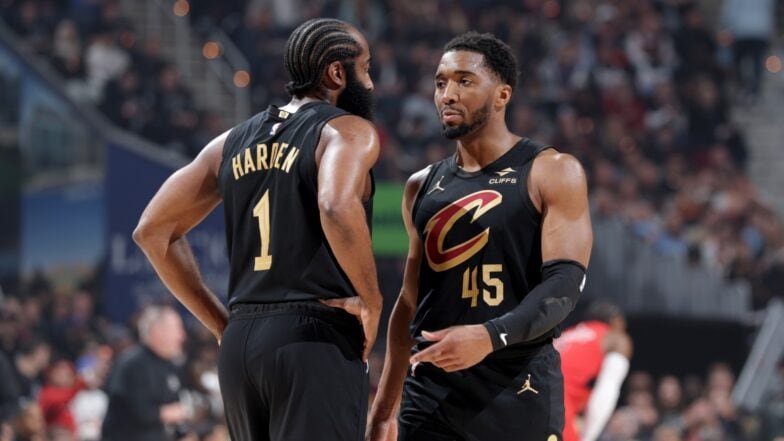
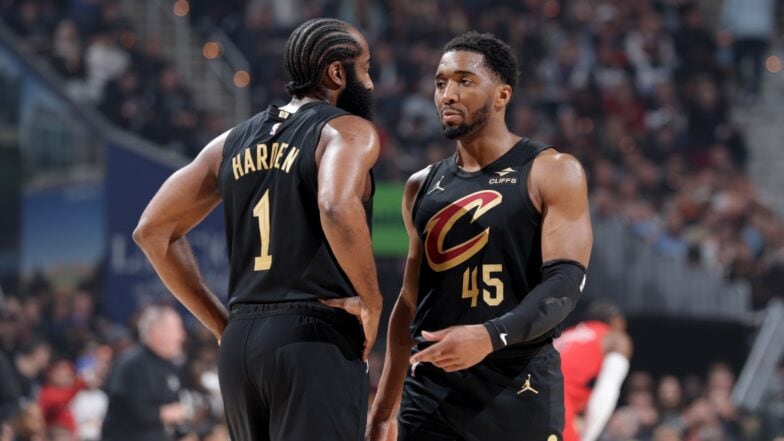
Donovan Mitchell looks to reach the Conference Finals for the first time in his career against Detroit.
Every Sunday, he’d watch his mother, and his grandmother, prepare the coconut. He’d watch how precisely, how intensely, they’d shave each piece with a grater for arroz con gandules, rice and pigeon peas, the Panamanian version, one of his grandmother’s best dishes. A nod to their heritage. His grandmother never wrote down the recipe; never needed to.
When Donovan Mitchell, then a young boy, would wake, he sensed the commotion in the kitchen. The chopping, the blending; he saw how no detail was left unattended. There were no short cuts, either. His grandmother could have bought frozen coconut milk, but instead she insisted on buying a fresh coconut each time, cracking it open and saving the water, then manually grating inside the coconut. She’d place the shavings into a blender, mix and drain it, using her hands to squeeze out all the milk, and then place that in the rice. Watching the blade hit the coconut, again and again, Donovan saw that one could not have sweetness without work — a lesson learned.
And now, years later, approaching 30 at the peak of his NBA career, he still thinks about his late grandmother. “She had it rough. She came from Panama,” Mitchell says. “She raised a family of three by herself … No one believed in her.”
She came to the States on her own, full of hope. Raising her family on her own in Brooklyn, she worked long hours as a nurse to move her family to a better neighborhood in Dobbs Ferry, New York. “One obstacle after another,” says Nicole Mitchell, Mitchell’s mother. “My mom’s mindset was just, ‘I have something to conquer. This is just not it. This is good, but this is not it.’” Grandma pushed herself to finish her undergraduate degree with high honors and even earn a master’s at Fordham University with high honors.
Nicole pauses. I have something to conquer. This is good, but this is not it. The words sound familiar. “It’s so interesting,” Nicole says, “because that’s Don’s mindset.”
Mitchell has enjoyed a successful NBA career by conventional standards. At 29, he’s been a seven-time All-Star and made All-NBA First Team for the first time in 2025. He is one of the league’s handful of superstars. And yet, there is still something missing. Something that all-time greats are undoubtedly judged for at the end of their careers: a championship.
Mitchell has never made it past the second round, both with the Cavs and with the Utah Jazz, where he played from 2017-22. He is fighting to make it out of the first round, entering a Game 7 against the Toronto Raptors on Sunday. The absence of a deep playoff run — let alone a title — motivates him, and reminds him of D.O.N., his slogan, Determination Over Negativity. “As great and as much as I have done in the league, I still think there’s a narrative of like, oh, you know, I haven’t made it out — well, it’s not a narrative, it’s a fact — I haven’t made it out of the second round, right? And there is, you know, is he good enough? Is he this or that? Determination Over Negativity still applies to this day.”
“Still trying to fight, still trying to find a way,” he continues, “and not letting the noise dictate my every day.”
He spends more hours on the court, in the weight room, in the film room, than even his coaches expect. He remembers those childhood Sundays. The coconut. His grandmother.
Her drive is his drive.
“I think that’s where it comes from,” Mitchell says.
Mitchell arrives about 30 minutes early to morning shootaround in Utah for the first of a back-to-back against the Jazz in late March. And he is one of the last to leave, still launching jumpshots long after most of his teammates prepare to exit the arena.
Maybe a part of him needs to stay on this court. Not just to shoot, but to remember. Remember who he was, back when he was here, navigating his first five years in the league after being drafted No. 13 overall out of Louisville. And although he has been back to Salt Lake City many times since being traded to the Cavs in September 2022, it is still a strange yet comforting feeling, coming back to the same place as a different person. A more mature, more seasoned veteran.
“This is still kind of special, coming back,” Mitchell says on this March morning. “It’s been a few years, but when you enter this building and see this court, it brings back memories.” Even more meaningful, his fianceé, singer Coco Jones, made the trip. He showed her around the day before. Being here reminded him of how far he has come. “To see me grow up, you know what I mean?” Mitchell says. “To see how much I’ve changed — in a good way.”
“I was kind of shook by it,” he says. How quickly time passes. He is far from the innocent rookie who called his mother the first day in Utah, stunned: “Ma! There’s not a piece of garbage on the street!” (New York felt like a different universe). He is far from the young player who saw some random Jazz fans online posting about having a BBQ pool party. Mitchell just showed up without security.
And he is certainly far from the child he used to be, the one that his grandmother called “Papi Chulo.” The one who would jump on top of her coffee table and dance, using her pots and pans and a wooden stick to drum as loud as he could. Mitchell still drums to this day, but basketball stole his heart, despite being the son of a former Minor League Baseball player, Donovan Sr., who worked in various roles with the Mets. Even though Donovan didn’t end up pursuing baseball, as a young boy he had superstitions, as many baseball players do. He was so sure that if he played well with certain socks, he’d have to wear that same sock — no matter how stinky or dirty — because he was sure it would make him successful.
The more he reflects, the more his mind turns back to the present. To winning. Mitchell led the Jazz to five-straight playoff appearances, including dropping 45 in Game 1 of the 2021 Western Conference semifinals. “To remember, like, man, certain moments you know you’re hitting shots, you’re getting stops, the arena’s loud,” Mitchell says. “Just knowing what the city felt like while we were contending and doing our thing.”
He wants to feel that feeling again – badly. And perhaps no one understands that desire, or has witnessed his growth more closely, than Johnnie Bryant, Cavs associate head coach, who has been with Mitchell since his rookie year with the Jazz. Back when Mitchell wasn’t as confident, sometimes wondering: Am I good enough? “I [didn’t] really know who I was,” Mitchell says. The two would work out early in the morning and late into the night, as Mitchell built his confidence, rep after rep, learning to trust his enoughness — to trust his work.
He trusts that work even more today as he chases that elusive championship. “I know what I put into this game,” Mitchell says. “I’m not seeing the results pay out, right? Even though I haven’t been to the finals or the conference finals, I know who I am as a player. I know what I can be, and at some point in time, my time is going to be there.”
Bryant has seen Mitchell’s work ethic first-hand. “His drive is his superpower,” Bryant says. “His attention to detail. His ability to push himself outside of his comfort zone. … He’s always asking questions, always trying to figure out ways to get better.” Part of that process, Bryant says, is making himself even more uncomfortable. To attain something he never has had before, Mitchell has to do things differently than he ever has before.
“He was successful right away, right? Individual success,” Bryant says. “Human nature is like, ‘OK, well, I’ve done this, therefore, I should be able to accomplish X, Y, and Z next.’ And it doesn’t work that way. Winning is hard. Winning is hard in this league …
“Last year, we had the best record in the league and didn’t guarantee that we’re gonna be in the conference finals [The Cavs fell to the Pacers in Game 5 of the Conference Semifinals] So, you look at the best players who have played this game, some of them have never reached the Finals, right? That’s the ultimate challenge to understand, like you have to continue to work, you have to continue to improve.”
But other things have to come together, too. Luck. Health. Four other starters and a deep bench. “It’s not always you,” Bryant continues. “There’s certain moments where it’s like, ‘Hey Donovan, you know what, I know you can go score 70 points in an NBA game, but we may need you to score 10 tonight and get 15 assists. Are you OK doing that?’
“At the end of the day, winning may look differently,” Bryant says. “Everybody says they want to win, but a lot of people want to win on their own terms, right? And I’m not saying Donovan is one of those guys that want to on his own terms — meaning it has to go through him. I think he’s had enough individual success in his career to where it’s like, he knows he needs help.” He’s welcomed that support, namely with the addition of James Harden at this year’s trade deadline. “We’re in a position now with the team that we have to make a run,” Bryant says.
Mitchell’s teammates praise his positivity, his selflessness. The way he stands in his customary spot in the corner of the locker room, encouraging rather than berating teammates, at halftime, as he did during a game earlier this year, when the Cavs struggled to score in the second quarter, telling teammates they needed to pick things up. It rallied everyone in a positive way. That is the kind of leadership he hopes to bring to the postseason.
As Mitchell heads to the loading dock, to hop on the team bus to go back to the team hotel, he can see snow-capped mountains in the distance. His old life, and the life he lives now. The regular season is winding down and the playoffs are near. He has been trying to strike the right balance between the present and the future, asking himself: “How do I find the way to push the guys around me?” Mitchell says. “How do I find a way to inspire, to lead? But to also be better myself?”
There is a brightness among Cavs players — an optimism that was not as palpable earlier in the season, when Cleveland struggled with injuries and dropping supposedly easy games. “Don’s always kept the belief in us,” backup center Thomas Bryant says.
There is a cohesion, a playfulness, to the group, too. Mitchell and guard Sam Merrill are always trying to beat head coach Kenny Atkinson to the facility. “They’re basketball geeks,” Atkinson says of the duo. “Desperate for improvement.”
The rest of the team shares that same mentality. “All of our heads are in the right place,” big man Evan Mobley says. Adding Harden has helped ease some pressure on Mitchell. “To have two superstars where you can alternate like that is huge,” Atkinson says, regarding the minutes the two of them share. “Don, he’s so comfortable in this rotation right now. Where he comes in, comes out. He doesn’t really have to force anything. James helps with that… It’s just a serenity. A balance to them playing together.”
“It’s helped Donovan and I think it’s helped our team,” Atkinson says. “We’re more calm and poised.”
Mitchell has always been a vocal leader, but has made it a point to be even more so this year. “For most of my time in Cleveland, I’m one of the oldest, so it’s like being able to be a Rudy [Gobert], be a Joe [Ingles], be a Ricky [Rubio], be a Mike [Conley], right?” Mitchell says, reflecting on the leaders he had learned from during his Jazz tenure. “I found myself, especially my first two years here in Cleveland, saying things that they said to me … Just being able to use what I’ve gained from my teammates here in Utah and [say] ‘Hey, this is what I see we can be better, not just on the court, right, just in life — as a human.’”
He often reaches out to teammates and reminds them why he values their contributions. Last summer, Jaylon Tyson, a second-year guard, remembers his phone buzzing at 8 a.m. It was a text message from Mitchell. Although it was summertime, a sour feeling lingered from the series loss to the Pacers.
“Yo, I believe in you,” Mitchell wrote. “You’re gonna get opportunities here.” Mitchell told him about the ways that Tyson can help the team, and how he could maximize his potential. It shocked Tyson — the expressed belief Mitchell has in him. Tyson is averaging career highs in points, rebounds and assists this season. True to Bryant’s advice, Mitchell has been empowering him — and others. “I’m going to set a screen for you. Go be aggressive,” Mitchell often says to Tyson.
“As a superstar, you’re not setting those screens for nobody,” Tyson says. But Mitchell is a different kind of superstar; one who is still evolving and still figuring out how he can bring the best out of everybody. “He doesn’t take his teammates for granted,” guard Dennis Schröder says. “That’s really special.”
Mitchell is also willing to look within, often taking responsibility for shortcomings. He’s far more likely to call out cursing himself in timeouts. “Almost every game he’s saying something about what he needs to do better,” Merrill says. “Any time he’s trying to get after the whole team he always turns to himself. It’s like, ‘Dude. You’re the face of the franchise. It’s OK to just yell at us occasionally,’ but that’s just the kind of person he is.”
After the gutting playoff elimination loss to the Pacers, the Cavs weren’t planning on speaking with media the following day. But Mitchell came up to the Cavs PR staff and was adamant that each player show up. He did, too, sending the message: no one is above this. “I think that’s pretty unique, looking at himself first, looking in the mirror first, and see what he can do better,” Schröder says.
It wasn’t easy. Mitchell heard the noise around him: Donovan can’t even get out of the second round. But it is his ability to look at loss — look at failure — and walk toward it rather than retreat. To ask himself: “What could I have done better?”
“Losing is the best teacher,” Bryant says. Like other playoff losses, Mitchell wouldn’t let it deter him. “He takes it very hard,” Nicole says. “He goes into a little funk and then he snaps out of it,” Nicole says. “Like, OK, it’s time to prepare. … He bounced back and went to work.”
He spent hours each day with Murphy Grant, his long-time trainer and assistant athletic trainer with the Cavs, pushing himself to exhaustion. Day after day, they’d do drills that simulate game situations, putting the kind of load on Mitchell’s body that he’ll take each night in trying to break free from a defender for a shot. He’ll do eight single arm shoulder presses with a 50-pound dumbbell, while standing on one leg, then run a suicide, for four sets. “His dedication to work is like no one that I’ve ever been around,” Murphy says. “There’s times [where I say], ‘Everyone is doing this.’ And he said early on, when we first got together: ‘I’m not like everyone.’”
His teammates can sense that even in film sessions. “He notices every single detail,” says center Jarrett Allen. “He says, I should’ve done this, that’s my bad.”
That was something his mother taught him growing up. No matter how big-time he got, when he finally went from under-the-radar prospect to receiving dozens of college offers, Nicole always told him: “Always remain humble because life will humble you if you don’t humble yourself.” And in case Mitchell didn’t get the message, she’d add: “There are no jerks in this house.”
Forward Larry Nance Jr. remembers a film session when Mitchell failed to close out on a defensive possession. “He stopped the film and said, “Fellas, that’s unacceptable for me,’” Nance Jr. says. “And, you know, for the rest of us, we see him hold himself accountable…who are we? It speaks to his hunger. His drive.”
But that drive is manifesting in new ways — heeding Bryant’s words: At the end of the day, winning may look differently.
A few days before the Utah road trip, the Cavs faced the Heat. Guard Max Strus was hot, draining eight threes and scoring 22 of his season-high 29 points in the first half. Mitchell, who had an off night, scoring just six points on 1-of-10-shooting, had the biggest smile on his face when he came into the locker room, finding Strus.
“It’s your day! Let’s feed you! You got the hot hand!” Mitchell said, beaming. “I’m good! I’ll figure it out.”
Strus smiles. “Four years ago,” Strus says, “Donovan would have tried to do anything he could to get at least 20 points, but I think he’s fully understanding and has accepted that he needs to do whatever it takes to win. And he wants to win at the highest level and he’s trying to understand how that works, and how he can be better.”
“We appreciate that from him,” Strus says. “He doesn’t have to do it by himself. He knows we have a full team.”
***
Mirin Fader is a senior writer for The Athletic, writing long-form features, primarily on the NBA. Mirin is also the New York Times best-selling author of GIANNIS: The Improbable Rise of an NBA Champion and DREAM: The Life and Legacy of Hakeem Olajuwon. She has told compelling human-interest features on some of our most complex, most dominant heroes from the NBA, NFL, WNBA and NCAA, most recently at The Ringer. Her work has been featured in the Best American Sports Writing books. She lives in Los Angeles. Follow Mirin on X @MirinFader
Leave a Reply