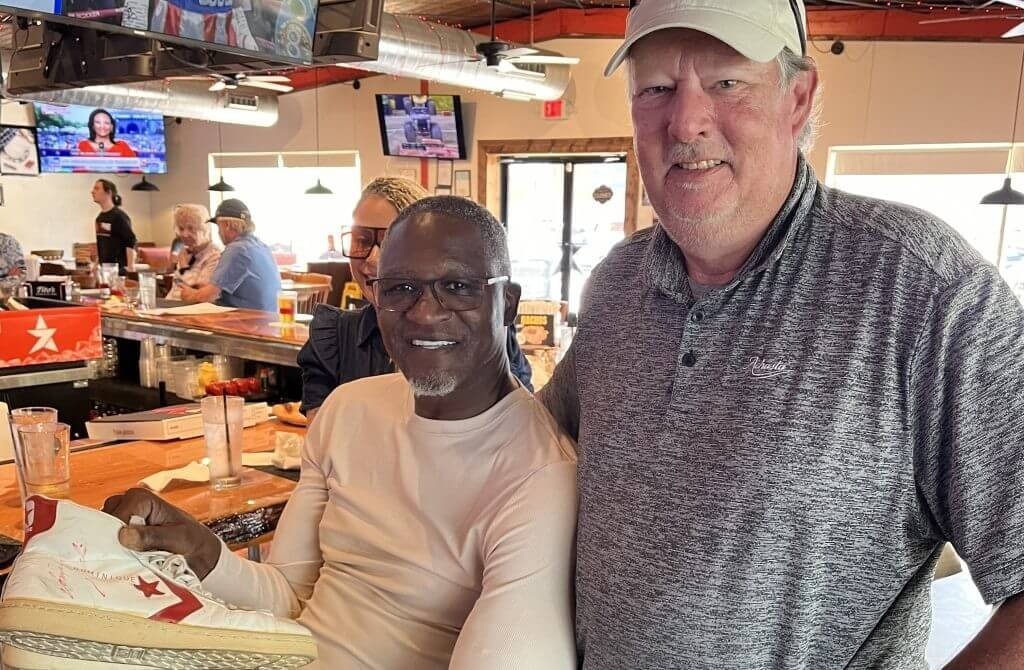
On Sunday, Dominique Wilkins and Steve Alexander reconnected 42 years after sharing a moment over shoes.
Editor’s Note: Read more NBA coverage from The Athletic here. The views on this page do not necessarily reflect the views of the NBA or its teams.
***
This past Sunday, Dominique Wilkins was enjoying a late afternoon meal at 7Pie Pizzeria & Bar in Dahlonega, Georgia, about 65 miles from Atlanta. He noticed a man walking toward him. Wilkins didn’t recognize the man, but it isn’t uncommon for him to be approached by strangers. He’s used to fans asking for an autograph or a selfie, even though his playing days have long been over as a 15-year player, a Hall of Famer with two dunk contest titles and a scoring crown.
The man had indeed been a fan — but for much longer than the 66-year-old Wilkins initially realized. The two actually crossed paths decades ago.
“I had been waiting 40-something years to tell Dominique this story,” said Steve Alexander, the man who walked up to Wilkins.
Alexander, who lived about two miles away, received a text message from a friend at 7Pie. “At 7 pie and I think Dominique just sat down across the bar.” Alexander immediately grabbed a pair of faded white and red Converse sneakers and put it in his trunk and set off for 7Pie. These were no ordinary retro sneakers; the pair had belonged to Wilkins in 1984. He signed them that year for Alexander, who was then just a 16-year-old hoop-head who dedicated a wall of his room to posters of Wilkins.
Now, four decades later, Alexander finally had the chance to reconnect with his hero and ask if there was any chance he might remember the exchange.
“Hey Dominique,” Alexander said to Wilkins and his wife, Jedidia. “Are y’all in the middle of business or do you have time for a story?”
“I love stories,” Wilkins said, smiling. “What you got?”
“Hold on a second. I’ve got props.” Alexander walked out and went to his car. Wilkins was puzzled.
“Props?” Wilkins said, wondering: What could he possibly be bringing?
In came Alexander, clutching the worn pair of sneakers. Wilkins recognized them immediately, breaking into a giant smile. Those shoes. Those courts. Those battles. It all comes flooding back. He is so moved that he doesn’t have the words. “That was a long time ago,” Wilkins said later, reflecting on the encounter. He couldn’t believe that this kind of interaction could happen at all–let alone in a remote area like Dahlonega. “He brought so many memories back to me.”
Alexander began to tell Wilkins the tale: It was March 31, 1984. “I stole Dominique’s home phone number from my girlfriend’s father’s Rolodex,” Alexander said. Her father was a photographer who took photos of NBA players. He wrote down the number on a small sticky note and dialed — because, back then, you could just … call NBA stars.
“Hello?” Wilkins said.
“Hi. This is Steve. I’m the kid in Indiana who always tries to get your shoes when you’re here.” Each time the Hawks came to Indianapolis to play the Pacers, Steve would scream for Wilkins with his arms out, hoping to catch a glimpse and a pair.
“I’m on the other line with my mom,” Wilkins said. “Let me call you back in about 15 minutes.”
He actually called back. Steve knew this was his one shot. “Do you think you can give me your shoes after the next game? I’m going to be in Atlanta for the next game.”
“All right,” Wilkins said. “Meet me in the third-floor parking garage at the Omni Arena three hours before the game.”
Alexander laughed at the absurdity of it all — how this call would never happen in today’s world. Not the call, not the meet-up. Back then, everything was so loose, so fun. Wilkins was so cool to take a teenager seriously, and make plans with him. That era of falling in love with hoops — and falling in love with Nique’s dunks, a.k.a, the Human Highlight Film, soaring across his television every night — was a special time for him.
“My mom, bless her heart, dropped me off after we drove from Indiana to Atlanta,” Alexander said. “Tree Rollins walked in. Randy Wittman walked in. Doc Rivers. Like, the whole team. And then Dominique’s car showed up.”
The two finally met face to face. “Which ones do you want?” Wilkins asked him.
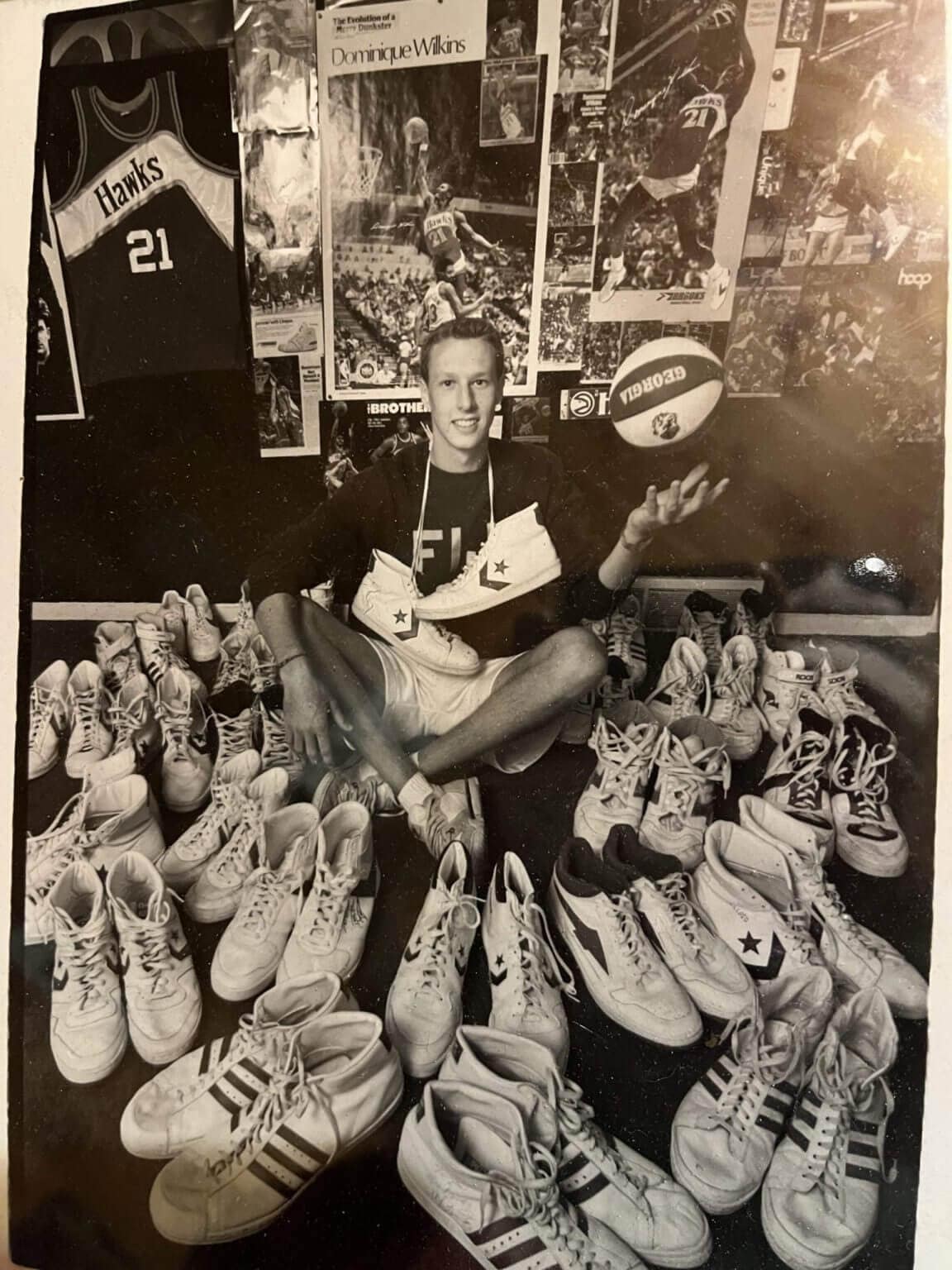
Alexander as a younger man with his massive collection of shoes. Photo courtesy of Steve Alexander
“He had a pair of Nylon Converse and a pair of leather All-Stars, with his name printed on the side,” Alexander said, recalling the scene. He could have squealed; there were few players that had their own shoes back then. But he tried to play it cool: “I want the leather ones, man.”
Wilkins signed a few other pieces of memorabilia for him, and the two agreed upon a spot for the sneakers after the game: behind the basket closest to the Hawks locker room. Sure enough, Wilkins made good on his promise. Wilkins came out with the sneakers in his hands and found Alexander, clearing a path for him to get through, as if he were Somebody. Wilkins signed one shoe in red ink.
It was the coolest feeling in the world. Alexander had bragging rights for life, or at least for that night. “I had an entourage, like a hundred kids following me through the underground (tunnel),” Alexander said. “My mom and I were a little scared that they were gonna jump us and take the shoes, but we made it into the car.”
Once they were in the clear, speeding away, Alexander raised his arms up, fist-pumping. I did it! He thought to himself. I pulled off the impossible! It was a joy he’d remember for the rest of his life — enough to drive to the pizza parlor and talk about it again all these years later.
“It shows you how much more important it is than just playing a game of basketball, and how you can touch someone’s life. That lasts a lifetime,” Wilkins said, reflecting on Sunday’s moment. “It just totally blew me away that this guy happened to live up in the mountains, and he had a pair of shoes that had been held onto for 40 years.”
And he wanted to do more than share his memories. Back at 7Pie, a question gnawed at Jedidia. “Why did you bring the shoes back? What was the reason?” Jedidia asked that day. “Do you want him to sign them again?”
Alexander knows the value of a good story. Alexander went on to cover the NBA as a senior editor at Rotoworld for more than 20 years, known in his columns as “Dr. A” like Dr. J. He is currently a fantasy hoops contributor for ESPN and SportsEthos. However, he didn’t want to just tell the story to Wilkins.
“I wanted to tell him the story,” Alexander said, “but I also wanted to know if he wanted them back.” He said to Wilkins: “I don’t know if you have any of them left, and I thought this is something that you may want to hold onto.”
Wilkins took a beat, floored by the kindness of this stranger. “Man, you held onto these for all these years,” Wilkins said. “I’m not taking them back!”
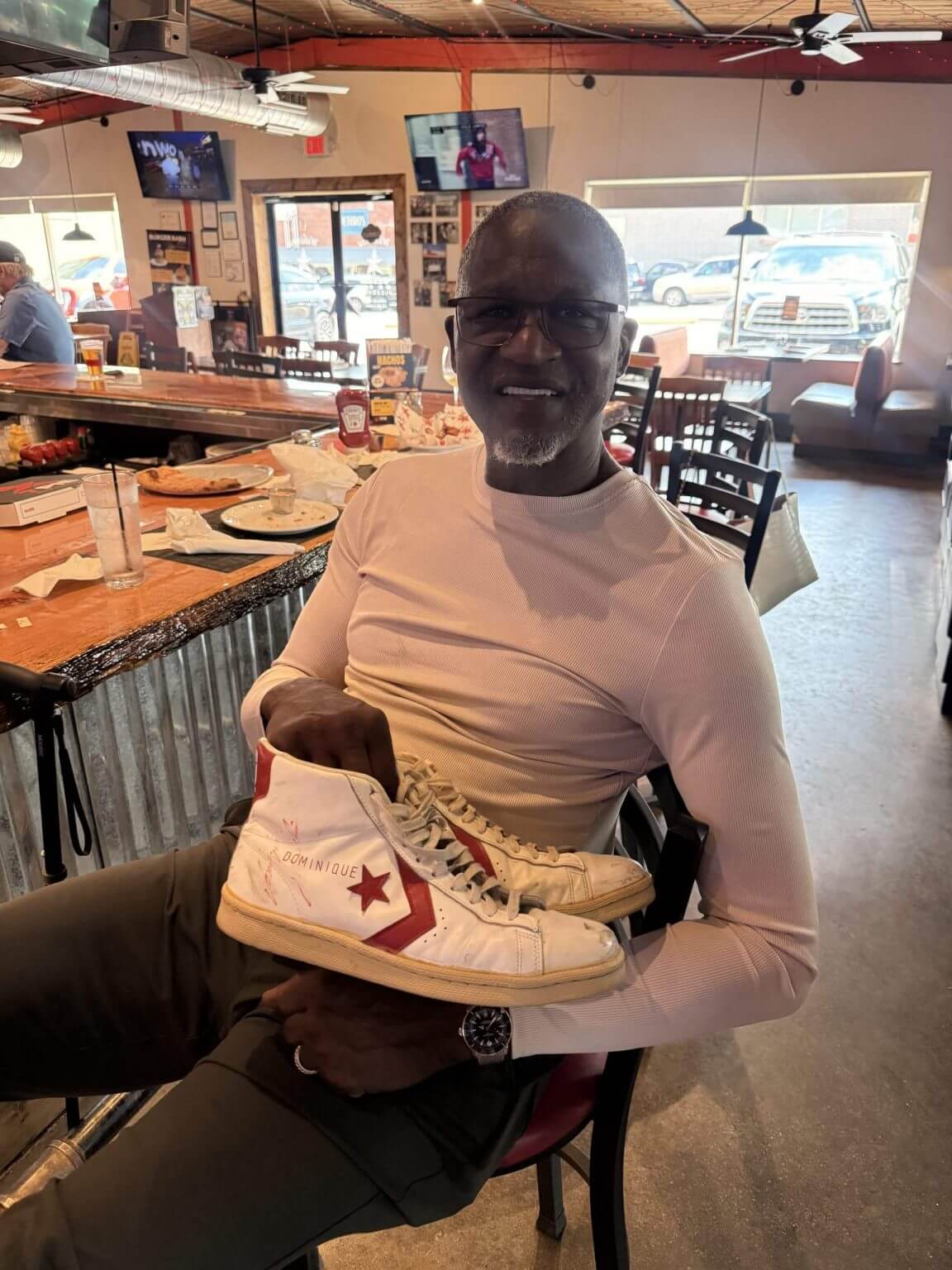
Wilkins shows off the kicks he was reunited with. Photo courtesy of Jedidia Wilkins
Wilkins signed the other sneaker. This time he used black ink to contrast the previous red signature.
“It was heartwarming,” Jedidia said. She shared the story to Instagram, and since, the post has gone viral. Alexander wanted to clarify how old he was and when the initial meeting happened, and the year that the meeting occurred, since he said a few of the initial stories about the encounter got those details incorrect.
Both men are still thinking about the purity of the exchange, and the difference between today and that ‘80s era of hoops. How you didn’t have to be wealthy — the son of someone who has courtside seats, for example — to get shoes from an NBA star, let alone get close enough to say hello. It is a much different world, one with security and red tape.An ecosystem in which players are wary to sign something like shoes or posters because someone can easily sell them for profit.
What matters, no matter the era, Wilkins said, is what you can give to another person, even if it is something as simple as a pair of shoes. “I believe in life that you treat people like you want to be treated,” said Wilkins, a member of the NBA’s 75th anniversary team. “I see so many people that use their status and means to look down on people. I never believe in doing that because we all do something to bring us some type of peace and love and satisfaction. At times, people put themselves above you to think that they’re better. And we’re not better.
“The thing is, it costs you nothing to be nice. It really don’t cost anything. At the end of the day, we’re supposed to be uplifting each other instead of tearing each other down, like I see so much in sports. We tend to forget the people that we idolized growing up, who gave us the reason to play.”
In a way, Alexander reminded him of the kind of legacy he wants to leave and the kind of person he wants to be.
“There’s stories like this that you hang onto,” Wilkins said, “that you remember.”
***
Mirin Fader is a senior writer for The Athletic, writing long-form features, primarily on the NBA. Mirin is also the New York Times best-selling author of GIANNIS: The Improbable Rise of an NBA Champion and DREAM: The Life and Legacy of Hakeem Olajuwon. She has told compelling human-interest features on some of our most complex, most dominant heroes from the NBA, NFL, WNBA and NCAA, most recently at The Ringer. Her work has been featured in the Best American Sports Writing books. She lives in Los Angeles.
Leave a Reply