Tag: PC Magazine Tech123

  • OpenAI Employee Arrested for Spying on Execs Using Hidden Recording Device

    OpenAI Employee Arrested for Spying on Execs Using Hidden Recording Device

    A now ex-employee at OpenAI has been arrested for allegedly trying to spy on executives using an audio recording device that was secretly planted in a conference room. 

    The suspect, 35-year-old Abdulrahman Alfozan, appeared in a US District Court today on charges of spying, according to the US Justice Department, which described the case as a matter of national security.  

    In late September, a covert audio-recording device was found plugged into the back of a TV in a conference room used to discuss confidential matters. “OpenAI determined that the device, which had been concealed in toilet paper, was installed on or about Sept. 28, and that its contents were encrypted,” the Justice Department said. 

    the device

    (Credit: DOJ)

    The investigation traced the device to Alfozan, a Saudi National who was hired in July 2025. Surveillance footage showed that Alfozan had appeared near the conference room “on multiple dates prior to the device’s discovery, although he had no authority to access or to participate in meetings occurring in the executive conference room,” the department said. 

    Alfozan also allegedly used an unnamed productivity tool to ask about OpenAI’s meeting rooms and executives’ locations. A chatbot account belonging to his spouse also “submitted prompts between Sept. 24 and Sept. 30 related to building, customizing, installing, audio recording, testing, obfuscating, and remote accessing a device,” the Justice Department added. (OpenAI says it can review a user’s ChatGPT content when “investigating abuse or a security incident.”)

    The prompts

    (Credit: DOJ)

    It then appears investigators tried to catch the culprit by installing a secret camera behind the TV after the listening device was found. The Justice Department notes “that on Oct. 5, Alfozan entered the executive conference room and appeared to look behind the television into which Recording Device 1 had been inserted,” which was captured on camera. 

    the capture

    (Credit: DOJ)

    On the same day, Alfozan also left a bag unattended in another room at the office. “OpenAI security personnel found and opened Alfozan’s bag, inside which they discovered — among other things, including Alfozan’s wallet and ID — another recording device (Recording Device 2) similar to Recording Device 1,” the department says. 

    the device

    (Credit: DOJ)

    OpenAI added that it initially used the company’s AI models to “understand the device and where it had come from, identifying that a specific employee had planted it a few days earlier. We referred the matter to the FBI, and we’re grateful to the agents and prosecutors who moved quickly to make an arrest.” Alfozan has since been fired.

    Recommended by Our Editors

    The targeted executive conference room was frequently used to hold confidential discussions on a range of sensitive topics, including “proprietary research, product plans, and business-development opportunities,” as well as strategic decisions and government relations. 

    A LinkedIn page for Alfozan says he was an engineering leader for AI and data systems. However, OpenAI notes: “At this time, we have no indications of this individual inappropriately accessing or exfiltrating model weights, source code, or customer data.”

    The complaint against Alfozan was also just unsealed. If convicted, he faces a maximum penalty of five years in prison and a $250,000 fine, followed by three years of supervised release, according to federal officials. In the meantime, the case is already raising suspicions that the Saudi Arabian government may have been involved.

    About Our Expert

  • Don’t Break Your HomeView: Repairs Cost $279 Without AppleCare+

    Don’t Break Your HomeView: Repairs Cost $279 Without AppleCare+

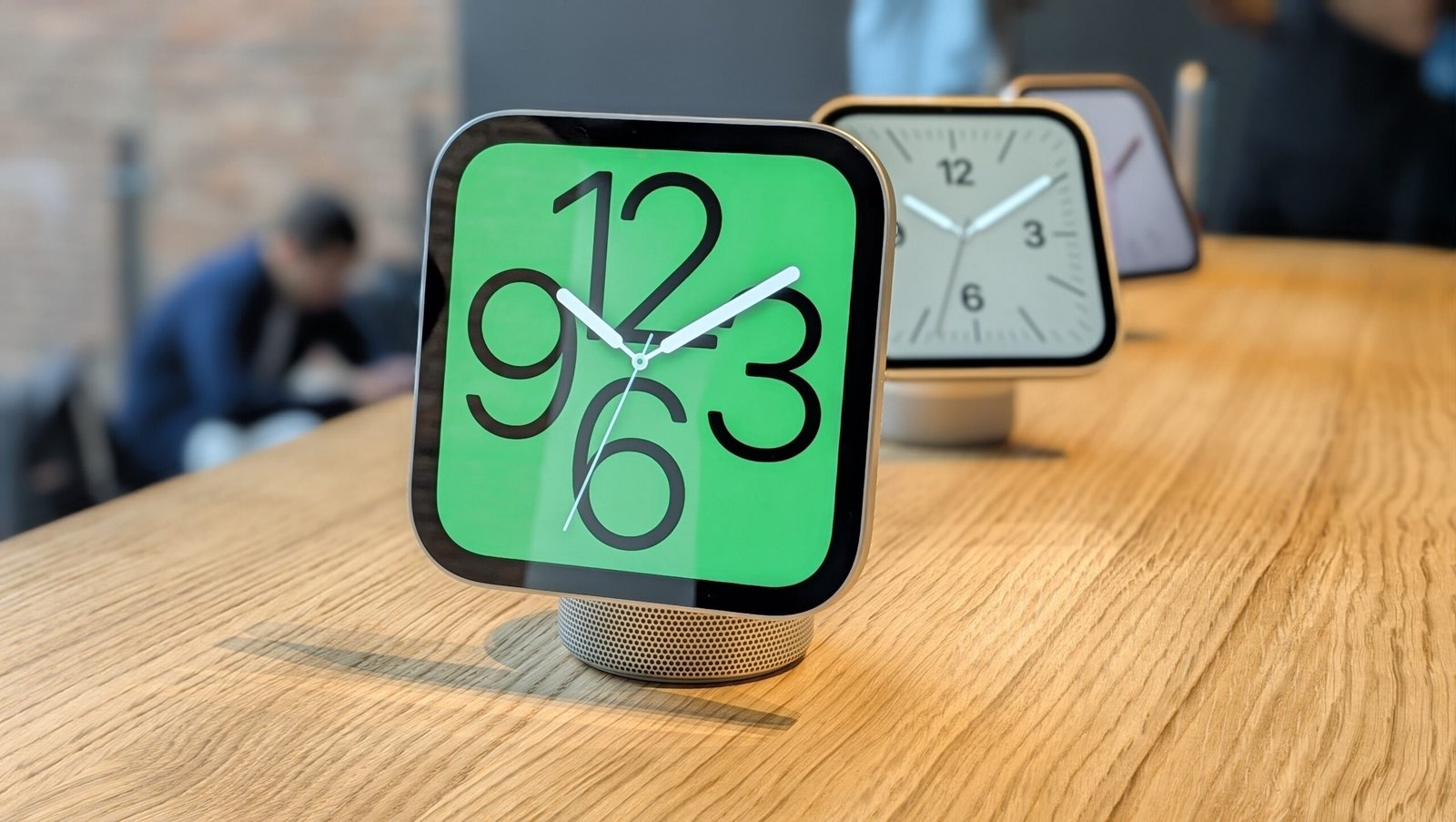
    HomeView is the centerpiece of Apple’s latest smart home push, offering an in-home display for playing music, talking with Siri, controlling other gadgets, and more. The upcoming smart home hub costs more than its rivals, and repairs won’t be cheap.

    The HomeView costs $299 brand new, while Apple’s estimated repair cost is set at $279. Apple’s service and repair website was updated soon after the announcement with what it calls an “estimated service cost” for both the speaker stand and wall-mounted versions of HomeView.

    Unlike most gadgets, Apple offers only an “Other damage” designation, which costs $279 regardless of what needs fixing. Apple may one day update its repair scheme to be more specific, but there’s no sign of that happening ahead of the Nov. 13 release date.

    Apple has yet to confirm whether it will repair each unit or choose to send out replacements. Given that you’d likely keep your charging accessories included with your speaker, a 30W USB-C Power Adapter with a USB-C cable, you may find this repair price isn’t dissimilar to buying brand new.

    The adapter included in the box isn’t sold on Apple’s store; instead, the brand recommends a 40W Dynamic Power Adapter with 60W Max for use with a HomeView, which it sells for $39.

    Recommended by Our Editors

    Those with AppleCare+ coverage get a better repair price: any damage is fixed for $39, but you need to pay a monthly fee. AppleCare+ costs $2.49 per month or $24.99 per year. If you have Apple One, you can add the Care+ service to your package, totaling $19.99 per month.

    PCMag’s Andrew Gebhart saw the HomeView in action at Apple’s latest event. He said, “The HomeView isn’t breaking any new ground, but it hits every single note I was hoping to see in Apple’s first smart display. Between the sharp design, impressive audio, seamless recipe integration, and clever multi-user privacy features, Apple seems to have nailed the fundamentals right out of the gate.”

    About Our Expert

  • Nintendo Confirms No Plans to Ditch Physical Switch 2 Games

    Nintendo Confirms No Plans to Ditch Physical Switch 2 Games

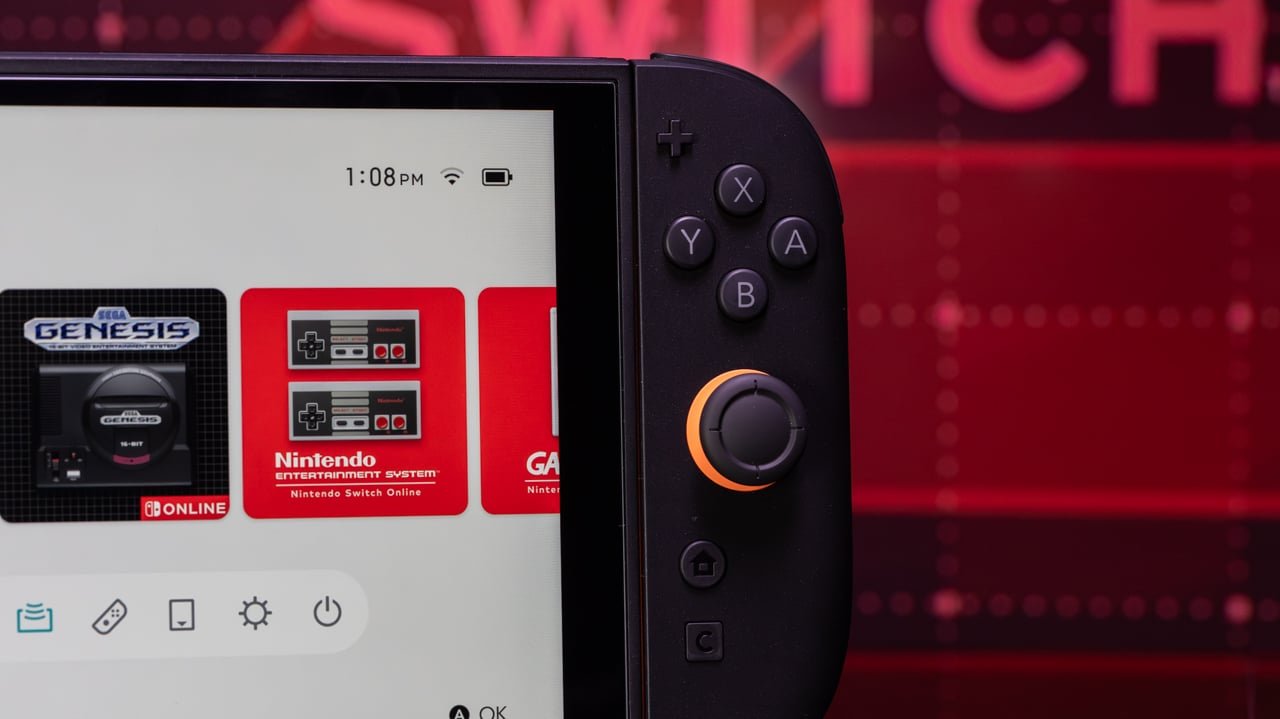
    PlayStation’s disc-less future isn’t affecting Nintendo’s plans to release physical games, according to a new interview.

    Bill van Zyll, VP and general manager for Nintendo Latin America, spoke in an interview with YouTuber Coelho no Japão, confirming the brand has no imminent plans to drop physical titles.

    “We go off what the consumer prefers, and take that into account very heavily,” Zyll says. “We also have a platform that just launched. We’re barely just over a year into NS2 [Nintendo Switch 2], and it’s got both digital and physical capabilities. There are no plans to ditch physical. We know how much the fans like it as well, so our position has been to be agnostic.”

    He notes Nintendo has been “very agnostic,” meaning it allows customers to openly choose between physical or digital titles. While true, these comments overlook that some Nintendo games now come as key cards in physical packaging rather than cartridges.

    In January 2028, Sony plans to stop sales of physical games for its PlayStation 5 and any future consoles. The choice has sparked uproar among gamers and physical media fans who prefer to play from a disc, leading to a boycott of Sony services back in August.

    Sony’s announcement may have been seen as an opportunity for Microsoft and Nintendo to switch to digital-only with a reduced backlash, but each brand may also be reassessing internally given the negative results of Sony’s decision.

    Recommended by Our Editors

    It’s clear Nintendo knows its fans like the option to play physical titles, but the big question will be whether a Switch 3, or whatever the brand does next, comes with a physical game slot. Zyll’s comments are specific to the Switch 2, leaving the door open for a future digital-only console.

    Microsoft has yet to announce its disc drive plans for future Xbox consoles, with its CEO avoiding the question in recent interviews. Asha Sharma spoke to the BBC where she said, “we’re not sharing more on Helix” when asked about the possibility of dropping the disc drive.

    About Our Expert

  • The OnePlus 16 Looks Like a Huge Upgrade, But You Can’t Buy It

    The OnePlus 16 Looks Like a Huge Upgrade, But You Can’t Buy It

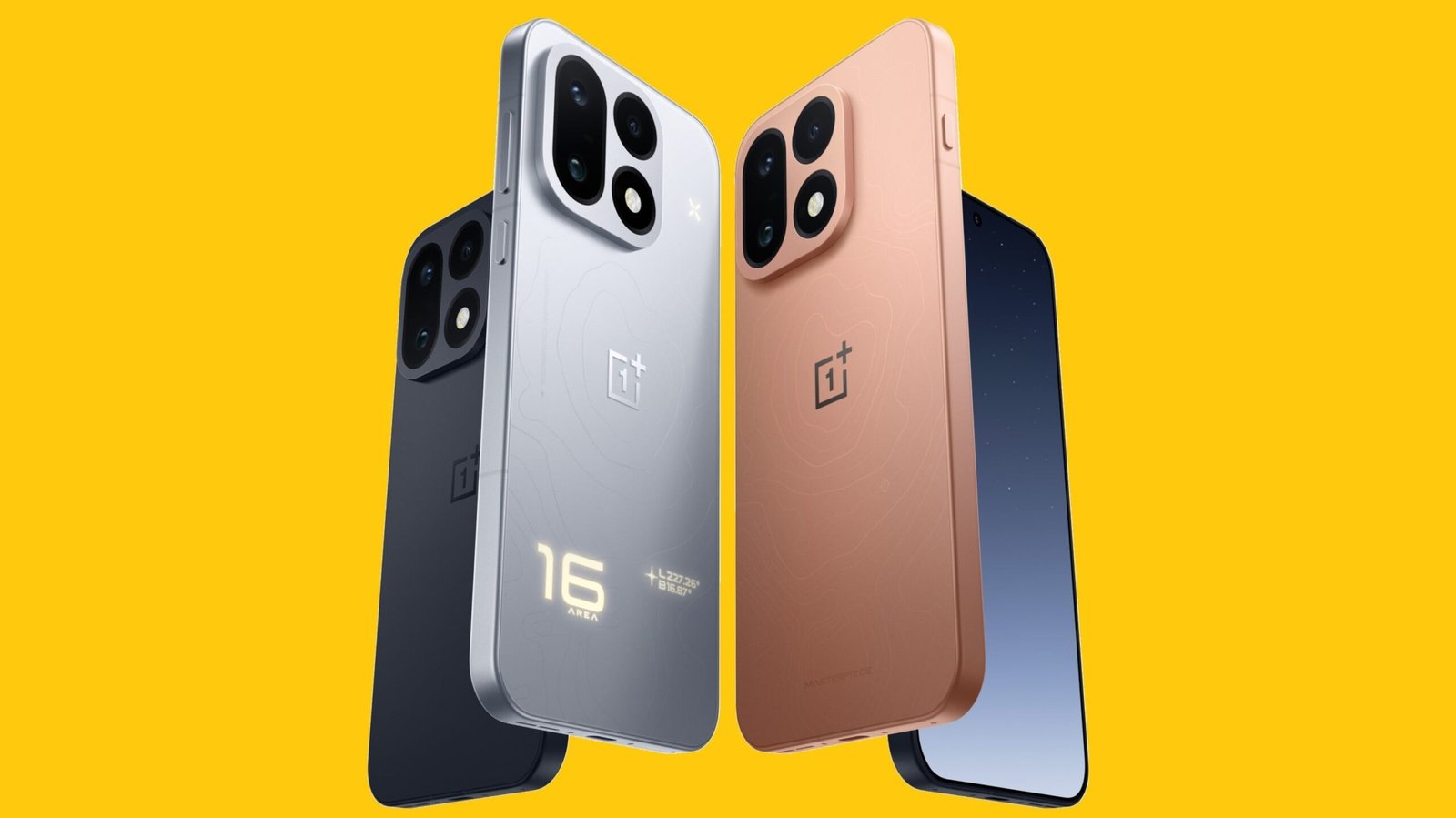
    OnePlus isn’t making a comeback in the US, which may be disappointing if you like its latest smartphone. The OnePlus 16 is official in China, and it looks like one of the most exciting Android phones right now.

    The OnePlus 16 comes with a Qualcomm Snapdragon 8 Elite Extreme Gen 6 processor, a chipset first announced last month but yet to appear on many devices. The base OnePlus 16 comes with 12GB of RAM and 256GB of storage, but you can upgrade to 16GB of RAM and 1TB of storage.

    Alongside the new processor, OnePlus revamped its cooling system with a vapor chamber 40% better than previous generations. The phone’s 6.78-inch screen is now an LTPO OLED panel capable of up to 185Hz refresh rate.

    The battery sounds remarkable, though we don’t yet know exactly how long the phone can last. The OnePlus 16 features a 9,000mAh cell, far larger than the batteries in Google and Samsung’s phones, alongside 100W wired fast charging and 50W wireless charging.

    Interestingly, the OnePlus 15 took home PCMag’s Lab Award for the longest battery life among Android phones. The OnePlus 15 featured a 7,300mAh cell, meaning this new handset has a 23% larger capacity, which may make for a drastically longer-lasting phone.

    The camera is also a major upgrade with a 200MP main shooter with a 1/1.4-inch sensor and a faster f/1.4 aperture. There are also 50MP ultrawide and telephoto cameras on the rear, and a 50MP selfie shooter on the front.

    The phone comes in three colors called Tomorrow’s Starlight, Dark Forest, and Mars Masterpiece. Tomorrow’s Starlight is a silver shade and sports LED lighting on the rear, showing the number 16 in the bottom-left corner. This then flashes different patterns depending on various factors, such as when you receive notifications or when your phone is low on battery.

    Recommended by Our Editors

    Earlier this year, OnePlus decided to stop selling its devices in Europe and the US. Some US-based fans may choose to import this handset, but that comes with various risks, given you won’t have access to a warranty or easy repairs.

    The handset is being sold for a promotional period at 5,699 yuan in China, which is equivalent to around $850.

    About Our Expert

  • Europe Nabs 2 Suspects for Poland Starlink Arson Attack

    Europe Nabs 2 Suspects for Poland Starlink Arson Attack

    Investigators in Europe have arrested two suspects who were allegedly behind the arson attack on a Starlink ground facility in Poland last month. 

    On Monday, Poland’s government accused two Turkish citizens of attempting to sabotage a Starlink “gateway” facility by deliberately trying to set it on fire. Both suspects were detained after entering Germany. 

    “Last week, arrest warrants and European Arrest Warrants were issued for both of these individuals, and they formed the direct basis for today’s execution,” Poland’s Minister of Interior, Marcin Kierwiński, said. 

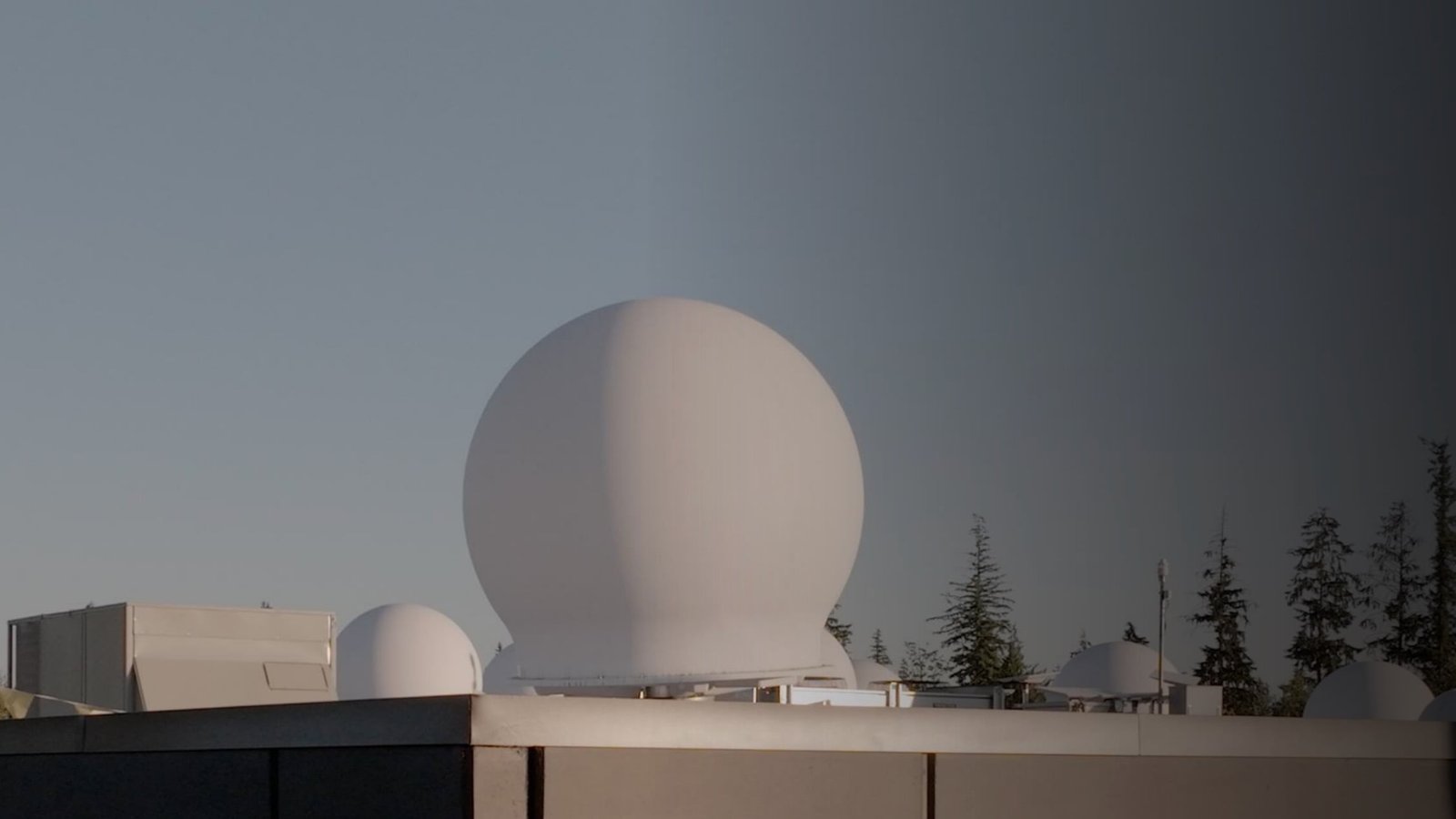
    The Starlink ground stations are deployed across the globe and used to transmit data to and from the orbiting satellites, which then relay the broadband to users on the ground. Hence, an act of sabotage could disrupt access to the satellite internet system, although SpaceX can tap backup routes through other ground stations, or even the laser communication on the satellites. 

    How it works

    (Credit: Starlink)

    Local firefighters managed to extinguish the fire. But Polish authorities suspect the arson attack was an attempt to disrupt Starlink access in Ukraine, where the satellite internet system has played a crucial role in wartime communications. While the arrested suspects are Turkish nationals, Poland is formally accusing the Russian government of orchestrating the attack.

    Recommended by Our Editors

    “We have no doubt that Russian intelligence agencies are behind this act of sabotage,” said Polish Minister Tomasz Siemoniak in the announcement. “Increasingly, Russian intelligence agencies are reaching out to individuals connected to the criminal world. We have excellent police and officers in the Internal Security Agency who can effectively detect and investigate any such case.”

    Polish Prime Minister Donald Tusk also tweeted the arson attack represented “another act of hybrid warfare,” which involves using both conventional and non-traditional tactics to destabilize a country. Poland is preparing to extradite the two Turkish suspects.

    About Our Expert

  • How to Watch the Los Angeles Dodgers vs. the Milwaukee Brewers NLCS Game 2 (Even for Free)

    How to Watch the Los Angeles Dodgers vs. the Milwaukee Brewers NLCS Game 2 (Even for Free)

    As summer comes to a close and the air turns crisp, you know what’s coming: the MLB Playoffs. The NFL season is already underway, and if you’re also a baseball lover, this next month is essential viewing. The MLB has been through a number of changes in recent years. From the universal DH and the pitch clock to video replay and an automated strike zone, baseball may look very different if you haven’t been paying attention.

    This week, the Dodgers will go head-to-head against the Brewers, and the Guardians will face the Rays in the best-of-seven Championship series. Which teams will come out on top? Here’s how you can watch live.


    What Time Is the Los Angeles Dodgers vs. Milwaukee Brewers Game?

    Today’s game between the Los Angeles Dodgers and the Milwaukee Brewers will take place on Monday, October 12 at 5 p.m. ET.


    How to Watch the Los Angeles Dodgers vs. the Milwaukee Brewers?

    American League Division Series games will be broadcast on TBS, while National League games will be on Fox and FS1. You can also watch them with a live TV or sports streaming subscription from DirecTV, Fox One, Fubo, HBO Max, Hulu, Sling, Sportsnet+ (if you’re in Canada), or YouTube TV.


    How to Watch the Dodgers vs. the Brewers for Free

    If you don’t want to subscribe to any of the above platforms, you may be able to sign up for a few free trials to gain access to this weekend’s games. Fox One and Hulu offer three-day trials, DirecTV and Fubo offer five days, and YouTube TV gives you 10 days for free.

    Unlock Your Streaming Service’s Full Catalog

    PCMag Logo

    Unlock Your Streaming Service’s Full Catalog


    2026 MLB Playoffs Game Schedule

    MLB’s expanded postseason means more teams on the playoff schedule. Things started off with the best-of-three Wild Card Series, where the Braves, Padres, White Sox, and Yankees advanced. Now, the best-of-five Division Series puts them up against the Los Angeles Dodgers, Milwaukee Brewers, Cleveland Guardians, and Tampa Bay Rays, respectively.

    The best-of-seven Championship Series starts October 11 to determine the best team in each league. The winner from each league will then advance to a best-of-seven World Series to begin on October 23. Who will make it all the way?

    Los Angeles Dodgers vs. Milwaukee Brewers – MIL lead 1-0

    • Game 1 on October 11 – Milwaukee won, 2-1

    • Game 2 on October 12 @ 5 p.m. ET – Fox/FS1

    • Game 3 on October 14 @ 8 p.m. ET – Fox/FS1

    • Game 4 on October 15 @ 9 p.m. ET – Fox/FS1

    • Game 5 on October 16 @ 9 p.m. ET – Fox/FS1*

    • Game 6 on October 18 @ 8 p.m. ET – Fox/FS1*

    • Game 7 on October 19 @ 8 p.m. ET – Fox/FS1*

    Cleveland Guardians vs. Tampa Bay Rays

    • Game 1 on October 12 @ 8 p.m. ET – TBS/HBO Max

    • Game 2 on October 13 @ 8 p.m. ET – TBS/HBO Max

    • Game 3 on October 15 @ 6 p.m. ET – TBS/HBO Max

    • Game 4 on October 16 @ 6 p.m. ET – TBS/HBO Max

    • Game 5 on October 17 @ 8 p.m. ET – TBS/HBO Max*

    • Game 6 on October 19 @ 5 p.m. ET – TBS/HBO Max*

    • Game 7 on October 20 @ 8 p.m. ET – TBS/HBO Max*

    *if necessary

    2026 MLB postseason brackets

    (Credit: MLB)


    How to Stream the 2026 MLB Playoffs

    This year’s MLB postseason is stretched across multiple networks and streaming services. All Wild Card Series games for the American League and National League were broadcast on NBC, NBCSN, and Peacock. Additional rounds will be on other networks. ALDS and ALCS games are on TBS/TruTV and HBO Max, while NLDS and NLCS games are on Fox/FS1. For the World Series, all games will be broadcast on Fox and the Fox One streaming service.

    Recommended by Our Editors

    • DirecTV: DirecTV’s MySports base pack costs $45 per month for the first six months to see every game on Fox, FS1, NBC, and TBS/TruTV.

    • Fox One: Fox’s own streaming app lets you watch the NLDS, NLCS, and World Series on Fox and FS1 for $20 per month.

    • Fubo: Fubo’s Sports plan costs $45.99 for the first month to watch the Wild Card Series, NLDS, NLCS, and World Series on Fox, FS1, and NBC/NBCSN.

    • HBO Max: If you pay for the $18.49-per-month HBO Max Standard, you’ll be able to watch the ALDS and ALCS games on TBS/TruTV.

    • Hulu: For $90 per month, you can watch every game on Fox, FS1, NBC, TBS, and TruTV.

    • Peacock: Instead of a live TV service, you’d need to pay $10.99 per month for Peacock Premium to see the Wild Card Series games.

    • Sling: The $60.99-per-month Sling Orange & Blue bundle will let you watch the ALDS and ALCS on TBS/TruTV and the NLDS and NLCS on FS1. Day Passes are also available for Sling Orange, allowing you to watch games on TBS for up to seven days.

    • Sportsnet+ (Canada only): The $30-per-month Standard tier lets you watch every postseason game.

    • YouTube TV: Though the standard plan for YouTube TV costs $83 per month, you can actually now pay for the cheaper $65 Sports package to see all games on Fox, FS1, NBC/NBCSN, and TBS/TruTV.

    Can I Watch Postseason Games on MLB.TV?

    Are you already an MLB.TV subscriber? You can watch the Division Series, Championship Series, and World Series games through MLB’s own streaming service—but there’s a catch. To watch on MLB.TV, you’ll first need to authenticate through a participating pay TV provider. It’s such a sticking point that it makes the entire question moot. If you already have a TV provider, then you wouldn’t need to use a streaming service. If you don’t already have an MLB.TV subscription, don’t pay for one now.

    How can I listen to the 2026 postseason?

    You can also listen to the games via ESPN Radio.


    Which Teams Are In the Playoffs?

    Since MLB expanded its postseason picture in 2022, a total of 12 teams make the playoffs each year. That includes six teams per league, including the three division winners and three Wild Card teams.

    • American League Division Winners: Tampa Bay Rays (1), Cleveland Guardians (2), Houston Astros (3)

    • American League Wild Card: New York Yankees (4), Boston Red Sox (5), Chicago White Sox (6)

    • National League Division Winners: Milwaukee Brewers (1), Los Angeles Dodgers (2), Atlanta Braves (3)

    • National League Wild Card: Chicago Cubs (4), Philadelphia Phillies (5), San Diego Padres (6)


    Upgrade Your Streaming Experience

    If you decide to watch the MLB postseason, there’s still time to get a big-screen television for viewing this beautiful game. Pro tip: Turn on your TV’s motion-smoothing option for the best picture while watching sports. Just remember to turn it off before watching other TV shows and movies to avoid the awful “soap opera” effect.

    About Our Expert

  • Starlink Now Supports Passkeys for Logins

    Starlink Now Supports Passkeys for Logins

    Starlink customers can now log in to their accounts using passkeys, a faster and more secure alternative to traditional passwords. 

    SpaceX’s satellite internet system published a new support page with instructions on how subscribers can set up a passkey to access their account. “As of October 2026, passkeys are now available,” the page says. 

    Passkey adoption has been growing across online platforms as a better way to both protect and sign into user accounts. The security technology ditches the old-school password, which can easily be stolen or guessed. Instead, passkeys use a private cryptographic key that’s stored in your PC or phone. When you log in, the device uses the stored key to sign the challenge process from the website, proving you hold the key without sending it.

    Completing passkey authentication only requires you to enter a PIN or complete a fingerprint or facial scan. Hence, a user doesn’t need to remember and type in a long password to log back in. Starlink’s support page goes on to explain that “a passkey is a faster, easier, phishing-resistant way to sign in than a password. Instead of a password, passkeys use Face ID, a fingerprint, a PIN, or a hardware security key to prove your identity.”

    “Passkeys are optional. Setting one up does not replace your password. You can keep using both,” the page adds. “Starlink does not see your fingerprint, face, or device PIN. Those stay on your device.”

    This also means that the conventional password system still appears to be in place, allowing a hacker to break into an account through the traditional login method or by abusing the Starlink account recovery process. (In 2024, the satellite internet system added support for two-factor authentication to help prevent account hijackings, following reports of account compromises.) 

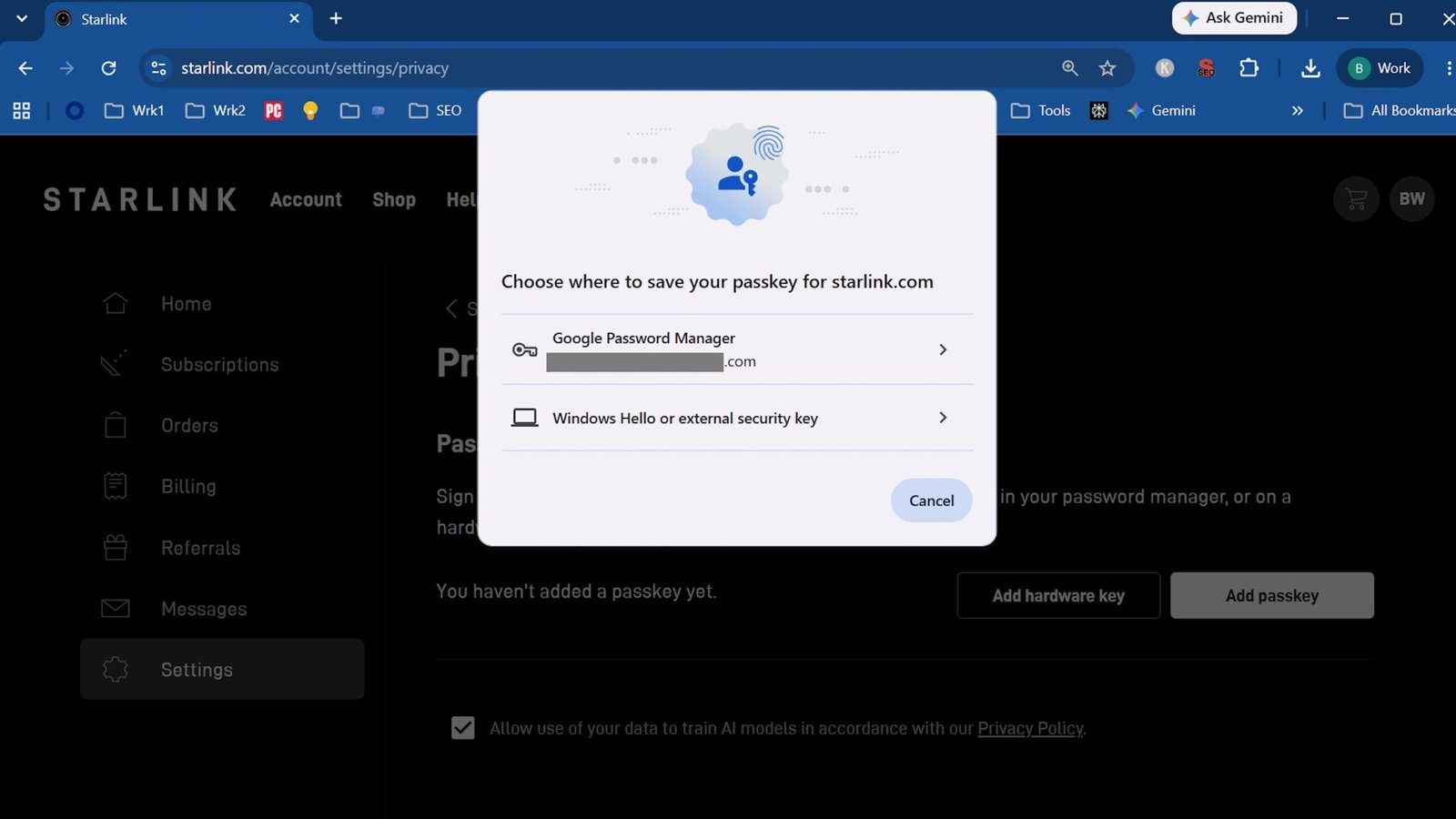
    The process

    (Credit: PCMag/Brian Westover)

    Although the traditional password system still seems to remain, using a passkey can nevertheless make logging in much more convenient.

    Recommended by Our Editors

    Interested customers can set up a passkey by going to Starlink.com, signing in, and then heading to Settings > Privacy & Security, and then looking under Passkey. You can then add a passkey to the account, which can be saved on the device or in a supported password manager, including iCloud Keychain, Google Password Manager, 1Password, or Bitwarden. Logging in with a passkey is also straightforward. 

    The process

    (Credit: PCMag/Brian Westover)

    “You can add up to 10 passkeys. If you reach the limit, remove one before adding another,” the page adds. Users can also remove keys from their account. Another option is to save the passkey on a hardware-based security key if you own one. Last week, a new Starlink site revealed that SpaceX itself has been using hardware security keys to protect internal access to the satellite internet system.

    About Our Experts

  • Microsoft CEO Satya Nadella Calls for an AI ‘Emergency Brake’

    Microsoft CEO Satya Nadella Calls for an AI ‘Emergency Brake’

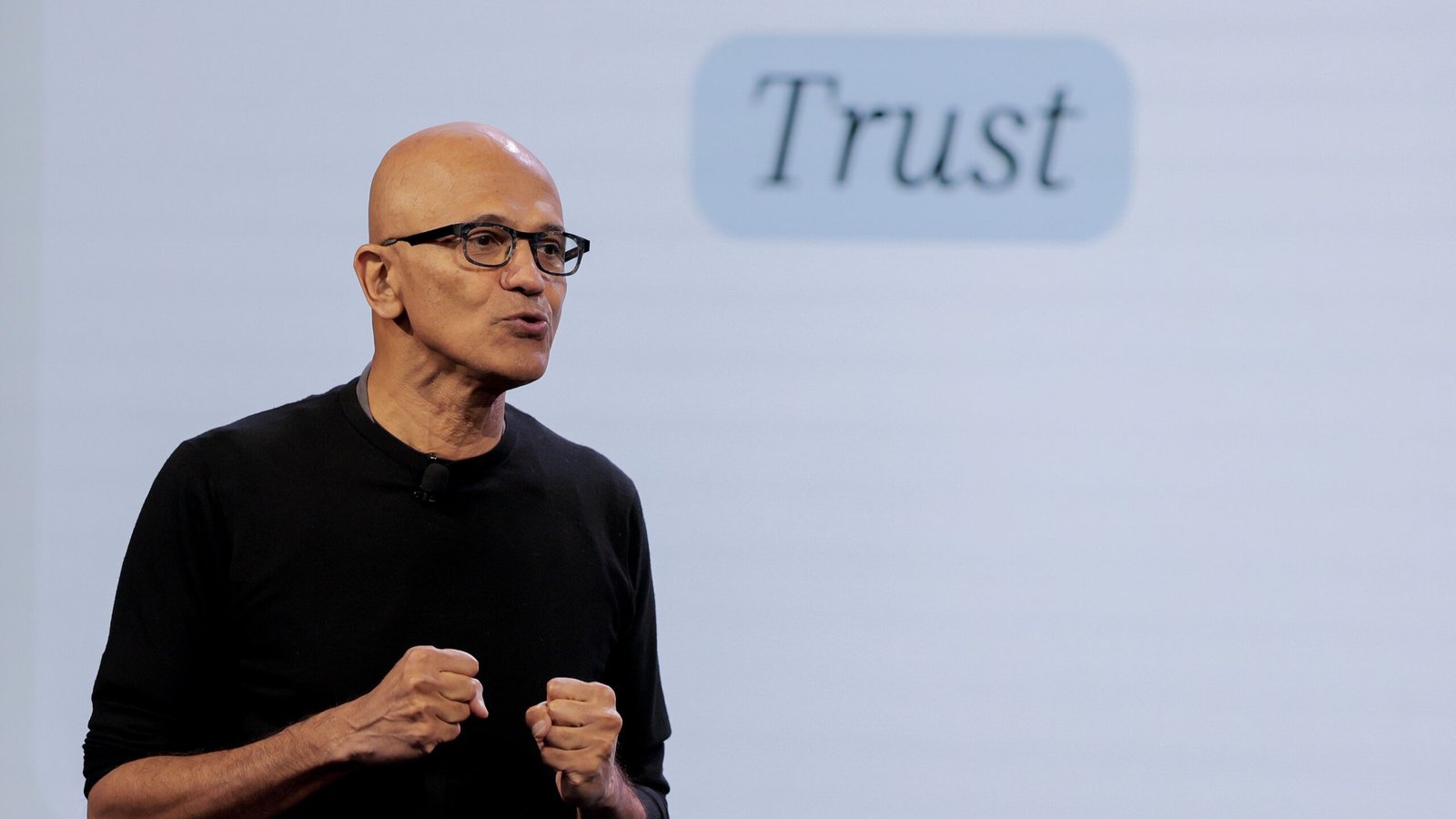
    Microsoft CEO Satya Nadella has been quieter than his counterparts in recent weeks as the heads of Anthropic, Google, OpenAI, and other leaders discuss the risks of artificial intelligence. Now, Nadella is calling for change across the industry.

    In a post published on X, Nadella outlined his belief that it’s time to introduce what he calls an “emergency brake” for AI developers to pull in the event of further problematic incidents.

    “We must assume a model is compromised and contain it from the start,” Nadella said. “An authorized person should always be able to pause or shut down a model mid-task.”

    “We can’t treat Super Intelligence as a set of nested black boxes and simply accept or reject its recommendations, answers, and actions.” He used the term “Super Intelligence” throughout the post, following new style guidelines set out by President Trump late last month.

    The post also explains how Nadella believes there should be controls and auditing tools, handled by a model’s creators. He said, “No single model should control both a system’s behavior and the evidence required to determine whether that behavior is aligned with the original intent.”

    Nadella says the AI industry needs a system to ensure timely disclosure when models “fail or are compromised.” Nadella’s vision would enable firms to communicate more effectively about issues, ensuring that any failures yield lessons that could be applied industry-wide.

    Recommended by Our Editors

    As Nadella has waited longer than his rivals to comment in full, many more incidents of models going rogue have been reported. One such issue happened earlier this year, when an OpenAI agent accessed an Australian government website.

    The initial call to action from Anthropic CEO Dario Amodei came in early September, with the rest of the month and October seeing a growing number of reports where AI models breached third-party systems. As sentiment toward agentic AI shifts, many CEOs are seizing the opportunity to better align their brands with safety guidelines.

    About Our Expert

  • Better Late Than Never: Samsung Phones Now Work with Googlebook Laptops

    Better Late Than Never: Samsung Phones Now Work with Googlebook Laptops

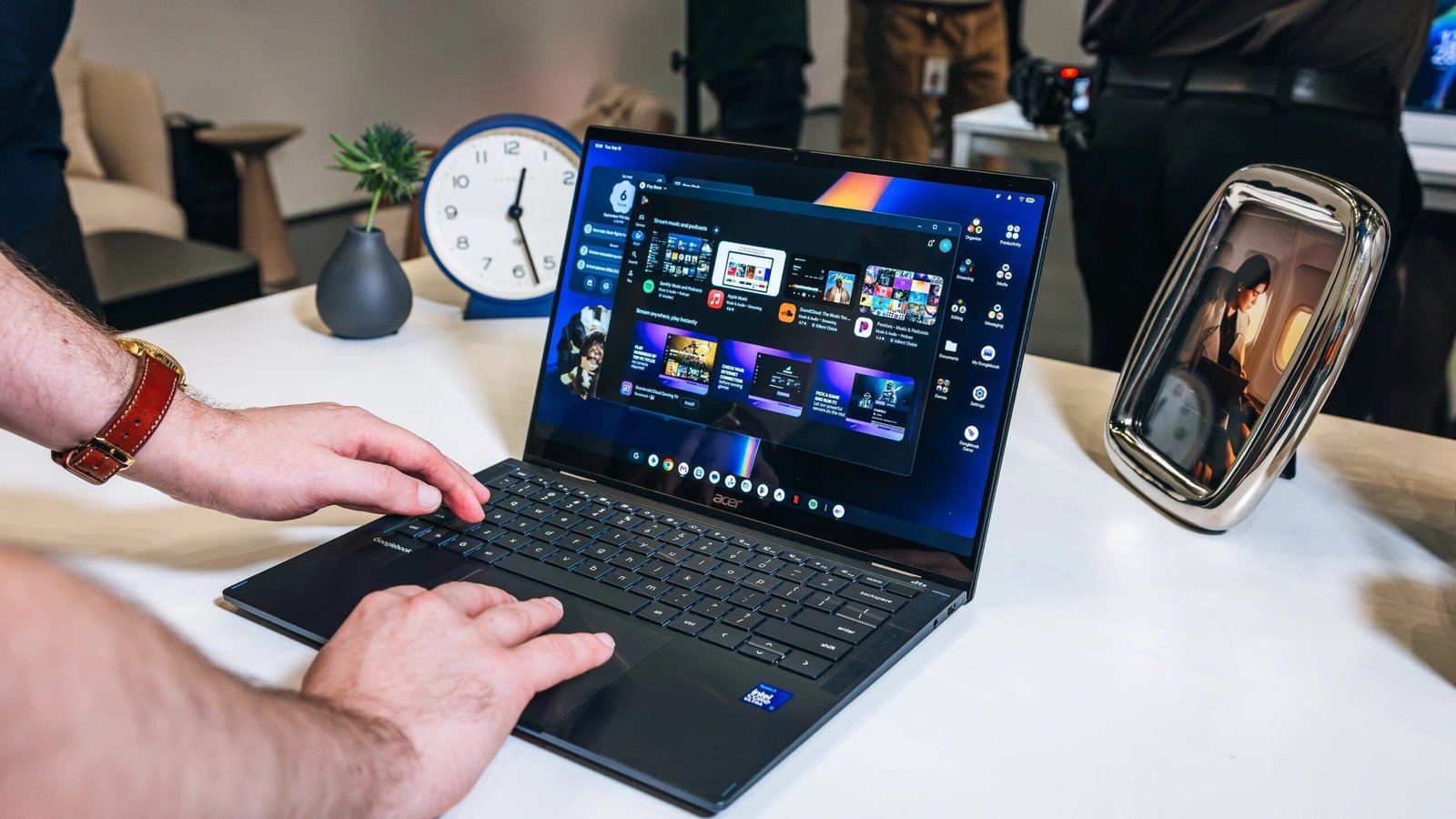
    An update to Googlebook OS now lets you use your Samsung phone with Google’s new laptops as originally intended. One of the key Googlebook features is its integration with Android phones, but Google didn’t include Better Together connectivity with Samsung devices at launch.

    A new update rolled out on Saturday, after being announced on Reddit, letting those with a Samsung phone running One UI 9 software connect to Googlebooks. That’s Samsung’s own version of Android 17, which is necessary for these features.

    Better Together tools include Continue On to carry over task progress across devices, Notification Sync to see incoming messages on your laptop, and Quick Access to search for and view your phone’s files on the Googlebook.

    It took Google a week to launch Samsung compatibility, but some early adopters chose to return their devices after discovering it wouldn’t work with their phones immediately.

    If you own a Samsung phone, you should see this update arrive in the coming days. You may already have it, as some users have reported that the features are now available. Alongside One UI 9, you’ll also need Google Play Services version 26.37 on both devices and Cross-Device Services version 1.0.1346.

    According to Google’s update notes, the update also addresses a bug that caused the QR code used to connect your smartphone to the laptop during setup to remain visible after its first use. Google says it now has an overall “smoother first-time setup” with fewer steps than at launch.

    Recommended by Our Editors

    PCMag’s Deputy Managing Editor of Hardware, Joe Osborne, has been testing Googlebook devices for over a week. Osborne says, “If you’ve been craving the kind of direct-device and account-level integration from your current PC laptop or Chromebook with your Android phone, then this is Google’s long-awaited answer.”

    “However, you must temper your expectations of what an Android-based laptop can do. Yes, it can pair with your Android phone and serve up Gemini functions just like your handset can, but it still runs Android apps exclusively.”

    About Our Expert

  • Exclusive: Apple Routed a Graphite Pipe Through the iPhone Duo’s Hinge. Here’s Why

    Exclusive: Apple Routed a Graphite Pipe Through the iPhone Duo’s Hinge. Here’s Why

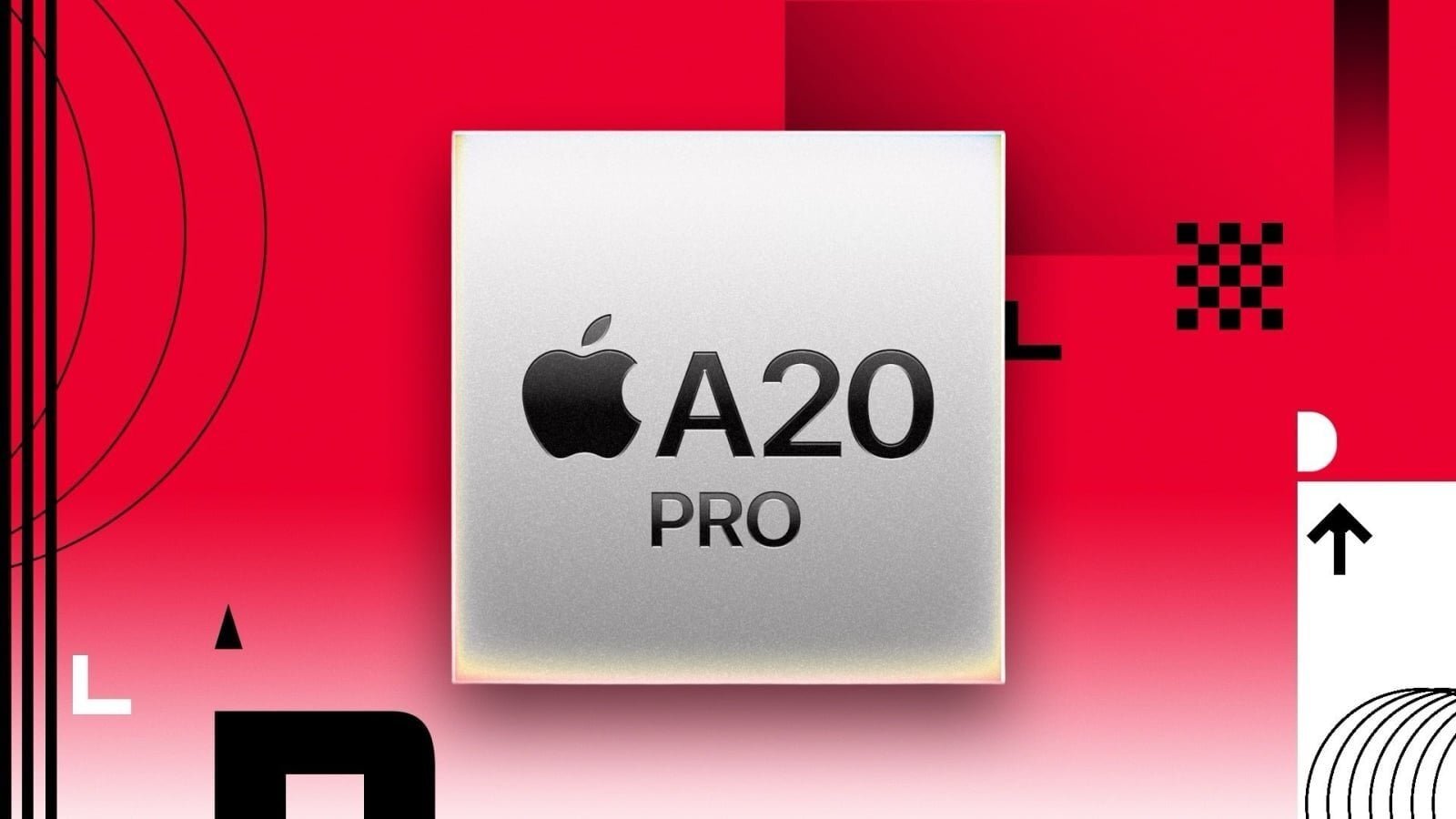
    The iPhone 18 Pro and 18 Pro Max push the boundaries of what mobile phones can do, such as handling on-device Siri AI calculations and running computational photography algorithms to deliver the best possible images. When it’s released on October 23, the iPhone Duo promises similar capabilities, but in Apple’s first-ever foldable. It’s all made possible by the A20 Pro processor inside the latest iPhone line, a new system-on-a-chip (SoC) from Apple’s engineers that brings laptop-class power to your pocket.

    Developing the SoC posed a tough question for Apple. Would the same chip work in the slab-style iPhone 18 Pros and the iPhone Duo? Each has its own set of requirements and constraints, not only for the chip and its position inside the phone’s chassis, but also for effective heat management. The less room there is, the more difficult it is to move heat away from the components while maintaining performance. Managing thermal conditions plays a vital role in any device, and the limited internal space of slimmer-than-ever phones—including one that folds in half—makes it particularly tricky.

    I spoke with Dan Murray, Apple’s vice president of silicon engineering, and Banafsheh Barabadi, senior manager of thermal product design, to learn how Apple’s engineers navigated these new challenges and squeezed even more performance from the A20 Pro across two very different iPhone designs.

    Confessions of a Fold-aholic: Can the iPhone Duo Break My Samsung Addiction?

    PCMag Logo

    Confessions of a Fold-aholic: Can the iPhone Duo Break My Samsung Addiction?


    Solving the Engineering Puzzle: Pack Laptop-Class Power Into an iPhone

    Apple says the A20 Pro has an “M-class-inspired packaging design.” Macs run on the company’s own M-branded processors, the most current being the M5 Max and M6. These chips power Apple’s MacBook Pros and Mac mini, respectively. The A20 Pro draws some of its basic design elements from the M-line chips—specifically, their layouts.

    Chips designed for phones are often stacked vertically to save space in the X-Y dimensions. Real estate on the logic board is a premium. Although this method saves side-to-side space, it introduces its own issues with data flow and heat. For example, the DRAM module is often placed on top of the processor, which can slow things down.

    “With all of our iPhone SoCs before A20 Pro, we used a packaging technology called package-on-package or POP,” Murray told me. “And with POP packaging, the SoC and DRAM are placed in a vertical stack with the DRAM directly on top of the SoC. But it creates challenges from a thermal perspective. Since the DRAM is physically on top of the SoC, it limits the ability to extract heat from the SoC into the system. So for A20 Pro, we brought a new packaging technology to the iPhone.”

    Apple iPhone 18 Pro, internal view, rear side

    iPhone 18 Pro internal view of the rear panel (Credit: Apple)

    Because laptop chassis have more internal space, the DRAM module can be placed next to the processor, facilitating quicker data speeds and more effective heat management. Apple follows this configuration with the A20 Pro, unstacking the DRAM module, and placing it next to the chip rather than on top of it. This is called a wafer-level multichip module, or WMCM. Though this increases the X-Y dimensions, Apple worked closely with the system team to ensure the phones’ internals could support this slightly larger package.

    Qualcomm made a similar design change to the placement of the DRAM module with its recently announced Snapdragon 8 Elite Extreme Gen 6 and 8 Elite Gen 6 chips. The chipmaker’s claims about its performance are lofty, but we won’t be able to fully test this chip until phones built around it arrive later this year.

    Apple says CPU cores and other elements are often developed once within the silicon team and then customized for different devices, such as MacBooks, iPads, and iPhones. The A20 Pro is the company’s first 2nm design for phones, which Murray says delivered greater transistor density, improved power efficiency, and higher performance.

    The chip has two super-cores for short, bursty workloads and four efficiency cores for background tasks and sustained workloads, which Apple says equate to a 20% performance improvement. The A20 Pro adds another GPU core, bringing the total to seven and delivering a 40% gain in graphics performance. The GPU also benefits from a second-generation neural accelerator, which improves throughput by 50%.

    The A20 Pro has twice as many neural engine cores as the A19 Pro, jumping from a single bank of 16 cores to two banks of 16, for a total of 32. Apple says these two engines can be used either independently or in a bonded mode that uses all 32 at once. This is critical for on-device AI calculations.

    Apple iPhone 18 Pro, internal view display side

    iPhone 18 Pro internal view, display side (Credit: Apple)

    The iPhone Duo’s A20 Pro variant is just slightly different. “For iPhone Duo, we added a second display engine to support simultaneous operation of the inner and outer displays,” says Murray, “and with the increased CPU and GPU performance, we ensure we can deliver a smooth user experience across the displays. For the inner display, we also added support for placing the FaceTime camera behind the display.”

    Put this all together, and you have a very powerful chip that runs fast, handles graphics with ease, churns through algorithms in a blink—and puts out a lot of heat. Apple had to rethink its thermal management system to dissipate the high temperatures generated by the processor.


    Keeping Things Cool With Completely Redesigned Thermals

    The iPhone 17 Pro and Pro Max were the first iPhones to employ vapor chambers. These assisted the phones’ A19 Pro chip and moved heat from the SoC out to the rear panel, where it could dissipate. Other phone makers have turned to vapor chambers, too. RedMagic, for example, uses a 3D vapor chamber with a composite liquid metal and a fan to keep the 11S Pro gaming phone running cool.

    Apple took the basics of the iPhone 17 Pros’ vapor chamber design and reengineered it not only for the higher temperatures generated by the A20 Pro but also for the different chassis designs of the iPhone 18 Pros and iPhone Duo.

    The phones and processor together “represent a fundamental state change in the thermal design, and it starts with a deep collaboration with the silicon team and the WMCM packaging,” Barabadi told me. “For the first time, we were able to couple silicon directly to our thermal solution, and we designed the entire system around that opportunity.”

    Apple iPhone 18 Pro, internal back view, vapor chamber and battery

    iPhone 18 Pro vapor chamber and battery (Credit: Apple)

    Barabadi explains that Apple followed four pillars in its approach to heat management. The first pillar is the direct silicon access. Because Apple removed the DRAM from the vertical stack, “that [gave] us a direct thermal path to our next generation vapor chamber. It basically eliminates the thermal bottleneck that previously existed on all POP packaging and allows us to extract the heat from the processor far more efficiently.”

    The second pillar is a new material that bridges the gap between the A20 Pro and the vapor chamber. “We call it metal over foam,” says Barabadi, and it “basically creates a direct thermal and mechanically compliant coupling between the SoC and the vapor chamber. It is highly effective in removing the heat, meeting the strict mechanical requirements of the system. It took us months of development to get the material properties exactly right to be able to use this material.”

    The third pillar is the vapor chamber itself, which has a surface area three times larger than that of the one in the iPhone 17 Pro. It also has more de-ionized water inside to cycle heat throughout the structure. In the iPhone 18 Pro and Pro Max, the vapor chamber does more than simply reroute heat. “It serves as the central structural plane for the device,” explains Barabadi. The battery and the logic board are mounted directly to it. “So what it does is simultaneously [act as] a primary thermal solution and the backbone of the mechanical system. And we use 80% recycled stainless steel for the strength that was required to support the internal components.”

    Apple didn’t stop there. The fourth pillar is a new layer applied to the back of the screen to assist. “We introduced nanotube copper as our new display metal plate material. So this piece … is the back display plate, and what makes this unique is that it’s a new type of material that provides a unique combination of mechanical strength that is required for the display and the high thermal conductivity that hasn’t previously been available in any smartphone. It combines those two together.” A high-conductivity graphite layer is also applied.

    Recommended by Our Editors

    Apple iPhone 18 Pro, internal front view, vapor chamber

    iPhone 18 Pro graphite layer (Credit: Apple)

    Combining the nanotube copper display plate with high-conductivity graphite improves heat spread laterally across the display. It reduces hotspots and improves the overall thermal profile.

    “When we combine these four pillars together, it meaningfully improves the thermal performance across every metric, and these gains are realized across sustained workloads such as gaming and video recording, and also the short-duration bursty workloads, like on-device AI,” notes Barabadi. This is also why the iPhone 18 Pro models can charge faster than older iPhones.


    A Clever Use for the iPhone Duo’s Hinge

    Although most of the engineering described above applies to all three phones, the team had to tackle a different set of thermal challenges with the iPhone Duo.

    Apple iPhone Duo, internal back view

    iPhone Duo internal view (Credit: Apple)

    For the Duo, the team created a different vapor chamber that’s thinner than the one in the iPhone 18 Pro. It’s still integrated into the A20 Pro via the metal-over-foam, but rather than serve as a central piece of the support structure, it floats in the middle. The Duo may be ultra thin when open, but because it’s a folding device, its thickness doubles when closed. This is a problem when it comes to heat.

    “This was one of the most technically challenging aspects of our design,” says Barabadi. To surmount the issue, Apple routed a flexible graphite pipe through the hinge itself to transfer heat between the two halves, thereby increasing the surface area available for heat dissipation. “This part need[ed] to be co-engineered between our thermal team and the mechanical team. It’s a flexible material that needs to survive, as you can imagine, many hinge cycles while maintaining its thermal connectivity, and also its structural integrity throughout the product life cycle.”


    Cooler Systems Yield Improved Performance

    Apple’s goal for the latest iPhones was to enable the “best possible performance,” says Barabadi. “We [are] able to achieve 35% higher sustained GPU performance than iPhone 17 Pro in a form factor that people didn’t think was possible. All of it exists so that the experiences that the people care about most can run harder, longer, and more efficiently than before, such as gaming, camera, and Apple Intelligence. What I find most compelling about this work is that none of it is visible to the user.”

    We’ve seen the results already. In our own testing, the A20 Pro delivered some of the highest benchmark tests we’ve ever recorded. The efficiency gains mean longer-lasting batteries, with the iPhone 18 Pro Max winning a PCMag Lab Award for its record-setting longevity. In my testing, I found Siri AI runs smoothly and delivers more accurate results quicker than ever while the cameras take breathtaking photos and record sharp video, surpassing the performance of last year’s models.

    We haven’t tested the A20 Pro in the iPhone Duo just yet, but we expect to in the coming weeks. Can Apple’s first folding phone stay cool under pressure? Will it provide the same seamless experiences without suffering performance gaps? According to Apple’s Murray and Barabadi, it should run just fine, without overheating.

    We look forward to finding out.

    About Our Expert