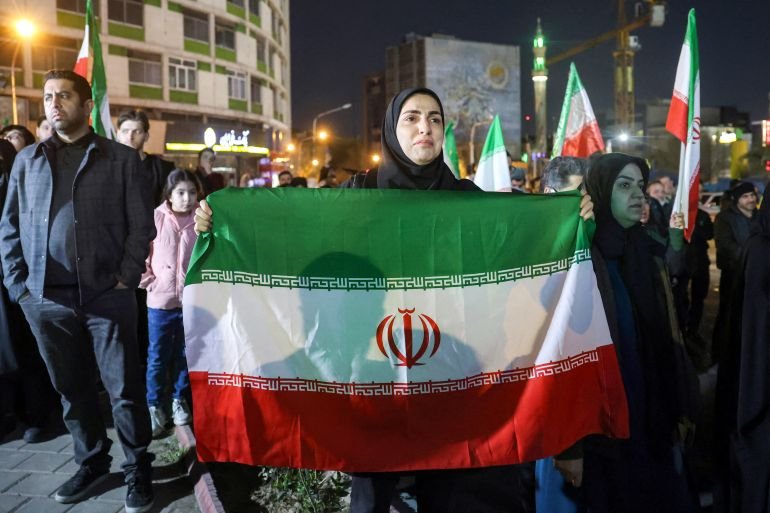
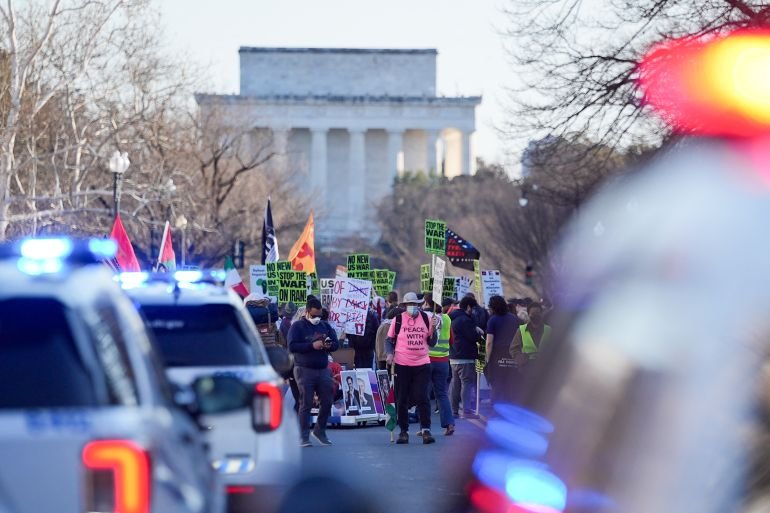
Spanish Prime Minister Pedro Sanchez has condemned US and Israeli strikes on Iran.
Published On 2 Mar 20262 Mar 2026
Share
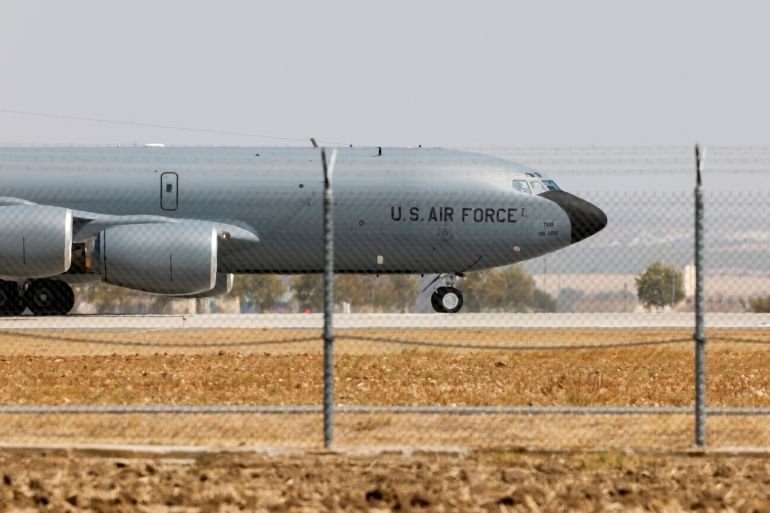
Spain says the United States is not using – and will not be using – joint military bases on its territory for operations against Iran, a mission condemned by Madrid.
“Based on all the information I have, the bases are not being used for this military operation,” Foreign Minister Jose Manuel Albares told Spanish public television on Monday.
Recommended Stories
list of 4 itemsend of list
Prime Minister Pedro Sanchez has condemned US and Israeli strikes on Iran that began on Saturday as an “unjustified” and “dangerous military intervention” outside the realm of international law, in another break from US policy.
“The Spanish government will not authorise the use of the bases for anything beyond the agreement or inconsistent with the United Nations,” Albares said, referring to the Rota naval base and the Moron airbase.
The US operates at the bases under a joint-use arrangement, but they remain under Spanish sovereignty.
Defence Minister Margarita Robles said the bases “will not provide support, except if, in a given case, it were necessary from a humanitarian perspective”.
Spain also condemned the retaliatory attacks by Iran on Gulf countries.
According to maps by flight-tracking website FlightRadar24 on Monday, 15 US aircraft have left bases in southern Spain since the US and Israel launched attacks on Iran. At least seven of the aircraft were shown on FlightRadar24 as having landed at Ramstein airbase in Germany.
The Spanish position is an outlier among the major European countries.
Britain had also initially refused to allow the use of its bases for an attack on Iran, but on Sunday, Prime Minister Keir Starmer authorised their use for “collective self-defence”, amid Iranian counterattacks targeting US assets across the Middle East and energy infrastructure in the Gulf region.
France and Germany, meanwhile, are prepared to do the same.
The three countries’ leaders were “appalled by the indiscriminate and disproportionate missile attacks launched by Iran against countries in the region, including those who were not involved in initial US and Israeli military operations”, read a joint statement on Sunday.
“We have agreed to work together with the US and allies in the region on this matter,” they stated.
The US secretary of state says he hopes Iranian people will overthrow the regime, as US military says six service members killed.
Published On 2 Mar 20262 Mar 2026
Share
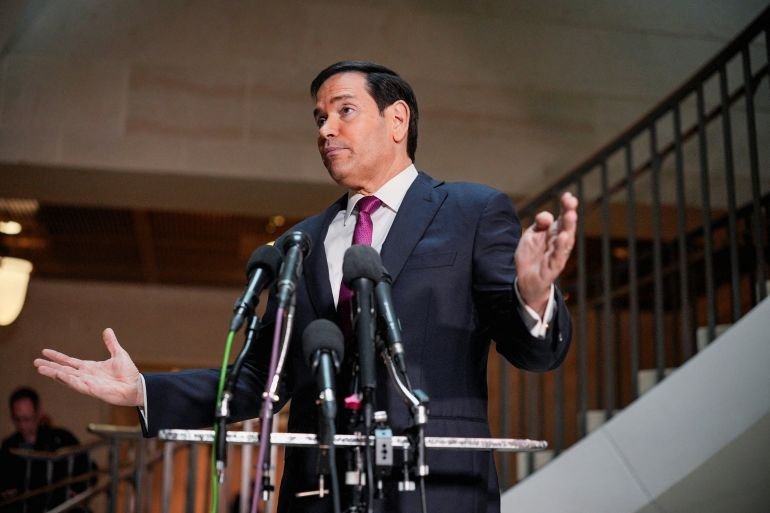
US Secretary of State Marco Rubio has suggested that a planned Israeli attack on Iran determined the timing of Washington’s assault on the government in Tehran.
The top diplomat told reporters on Monday that Washington was aware Israel was going to attack Iran, and that Tehran would retaliate against US interests in the region, so US forces struck pre-emptively.
Recommended Stories
list of 3 itemsend of list
“We knew that there was going to be an Israeli action,” Rubio said after a briefing with congressional leaders.
“We knew that that would precipitate an attack against American forces, and we knew that if we didn’t pre-emptively go after them before they launched those attacks, we would suffer higher casualties.”
The state secretary’s comments came minutes before the US military confirmed that its death toll from the conflict has risen to six, after two bodies were recovered from a regional facility struck by Iran.
Tehran retaliated against the joint US-Israeli attacks that killed its supreme leader, Ayatollah Ali Khamenei, several top officials and hundreds of civilians, with drone and missile launches across the region, including against US bases and assets in the Gulf.
Rubio argued on Monday that although the US and Israel jointly attacked first, Washington was acting to thwart an immediate threat because Israel was going to strike Iran on its own, anyway.
Israel is a close US ally and has received at least $21bn in military aid from Washington since 2023.
“There absolutely was an imminent threat,” Rubio said. “And the imminent threat was that we knew that if Iran was attacked – and we believed they would be attacked – that they would immediately come after us.”
The assertion highlights the Israeli role in bringing about the war with Iran, which Israeli Prime Minister Benjamin Netanyahu has been seeking for years.
On Sunday, Netanyahu said the attacks on Iran are happening with the assistance of his “friend”, US President Donald Trump.
“This coalition of forces allows us to do what I have yearned to do for 40 years,” the Israeli prime minister said in a video message.
Rubio told reporters on Monday that an attack on Iran had to happen because Tehran was amassing missiles and drones that it would have used to protect its nuclear programme and acquire a nuclear bomb.
Israel and the US launched the war less than 48 hours after a round of talks between American and Iranian officials over Tehran’s nuclear programme.
Rubio said the goal of the war is to destroy Iran’s missile and drone programmes, but stressed the US would welcome ending the governing system in Tehran.
“We would not be heartbroken, and we hope that the Iranian people can overthrow this government and establish a new future for that country. We would love for that to be possible,” he said.
Later on Monday, Washington urged US citizens across more than a dozen countries in the Middle East – including Gulf Cooperation Council nations, Lebanon, Syria, Egypt, Israel and the occupied Palestinian territories – to “depart now”.
The advisory reflects the growing turmoil and threats in the region.
The State Department “urges Americans to DEPART NOW from the countries below using available commercial transportation, due to serious safety risks”, US official Mora Namdar said on X.
Early on Monday, a suspected Iranian drone crashed into the runway at the United Kingdom’s RAF Akrotiri base in southern Cyprus. British and Cypriot officials said the damage was limited. There were no casualties.
Hours later, two drones headed for the base were “dealt with in a timely manner”, according to the Cypriot government.
Recommended Stories
list of 4 itemsend of list
The incidents came as Prime Minister Keir Starmer signalled on Sunday that the UK was prepared to support the United States in its confrontation with Iran – raising the prospect that it could be drawn deeper into a war it did not choose by its closest ally.
In a joint statement with the leaders of France and Germany, Starmer said the European group was ready to take “proportionate defensive action” to destroy threats “at their source”.
Later, in a televised address, he confirmed that Westminster approved a US request to use British bases for the “defensive purpose” of destroying Iranian missiles “at source in their storage depots, or the launches which are used to fire the missiles”.
But his agreement did little to placate US President Donald Trump, who said the decision came too late.
UK-based military analyst Sean Bell cautioned against reading too much into the Akrotiri incident.
“I understand the projectile that hit Cyprus was not armed, it hit a hangar [with] no casualties, and appears to have been fired from Lebanon,” he said, citing sources.
Al Jazeera was not able to independently verify the claim.
The broader context, he argued, is more consequential.
The US has taken the action “and everybody else is having to deal with the fallout”, he said.
Iran’s military strength lies in its extensive ballistic missile programme, he said, adding that while some have the range to threaten the UK, they do not extend far enough to strike the US.
“I don’t think [US] President Trump has yet made the legal case for attacking Iran, and … international law makes no discrimination between a nation carrying out the act of war and a nation supporting that act of war, so you’re both equally complicit,” he said.
Bell said that Washington likely reframed the issue, communicating to London that, whatever triggered the escalation, US forces were now effectively defending British personnel in the region.
That shift, he suggested, provided a legal basis to “not to attack Iran, but to protect our people”, allowing the UK to approve US operations from its bases under a “very, very clear set of instructions” tied strictly to national interest and defence.
UK officials ‘tying themselves in knots’
However, concerns of complicity had reportedly shaped earlier decisions, according to Tim Ripley, editor of the Defence Eye news service, who said the British government initially concluded that US and Israeli strikes on Iran did not meet the legal definition of self-defence under the United Nations Charter.
When Washington requested the use of bases such as RAF Fairford in Gloucestershire, UK, and Diego Garcia in the Indian Ocean, Starmer is understood to have consulted government lawyers, who advised against participation.
Up until Starmer’s televised address, in which he approved the US request, the UK had not considered the campaign a war of self-defence, said Ripley. While Washington’s legal reasoning has not changed, the war’s trajectory has.
Iranian retaliatory strikes – which have seen drones and missiles targeting Gulf states – have placed British expatriates and treaty partners under direct threat.
“The basis of our decision is the collective self-defence of longstanding friends and allies, and protecting British lives. This is in line with international law,” Starmer said.
According to Ripley, several Gulf governments, which maintain defence relationships with the UK, sought protection, allowing London to focus on protecting British personnel and partners rather than endorsing a broader campaign. However, with memories of the Iraq War hanging over Westminster, British ministers have stopped short of explicitly backing the US bombing campaign.
British officials are “tying themselves in knots” trying to describe a position that is neither fully participatory nor detached, he said.
US-UK: A strained relationship
Starmer on Monday told Parliament that the UK does not believe in “regime change from the skies” but supports the idea of defensive action.
But Ripley warned that any arrangement allowing US warplanes to operate from British air bases carries significant risks.
Iran’s missile systems are mobile and launchers mounted on trucks, he said. From RAF Fairford or Diego Garcia, US aircraft face flight times of seven to nine hours to reach Iranian airspace, necessitating patrol-based missions.
Once airborne, pilots may have only minutes to act. The idea that a US crew would pause mid-mission to seek fresh British legal approval is unrealistic, he said.
London must rely on Washington’s assurance that only agreed categories of “defensive” targets will be struck. If an opportunity arose to eliminate a senior Iranian commander in the same operational zone, the temptation could be strong. Yet such a strike might fall outside Britain’s stated defensive mandate. The aircraft would have departed from British soil, and any escalation could implicate the UK, Ripley said.
Bell highlighted another weakness: Britain has no domestic ballistic missile defence system.
If a ballistic missile were fired at London, he said, “We would not be able to shoot it down.”
Intercepting such weapons after launch is notoriously difficult, reinforcing the argument that the only reliable defence is to strike before launch.
The UK, therefore, occupies a grey zone: legally cautious, operationally exposed and strategically dependent on US decisions, it does not fully control.
Beyond the legal and military dilemmas, Starmer must also contend with a sceptical public.
A YouGov poll conducted on February 20 found that 58 percent of Britons oppose allowing the US to launch air strikes on Iran from UK bases, including 38 percent who strongly oppose.
Just 21 percent support such a move, underscoring limited domestic backing for deeper involvement.
Iran appeared determined to avenge the killing of Supreme Leader Ayatollah Ali Khamenei and other senior Iranian officials following the start of the US-Israeli assault on Saturday, as Tehran continued to strike back at Israel and United States military assets across the Gulf on Monday.
After Khamenei’s death was confirmed by Iranian state media on Sunday, the Islamic Revolutionary Guard Corps (IRGC) vowed revenge and launched what it called “the heaviest offensive operations in the history of the armed forces of the Islamic Republic against occupied lands [a reference to Israel] and the bases of American terrorists”.
Recommended Stories
list of 3 itemsend of list
Iran’s army chief, Amir Hatami, also pledged to continue defending the country, as the army claimed its fighter jets had bombed US bases across the Gulf region on Sunday.
This is not the first time Iran has targeted Israel and US military bases in the Gulf region in retaliatory strikes. Last June, during Iran’s 12-day war with Israel, Tehran launched a wave of ballistic missiles targeting Israel and the Al Udeid airbase in Qatar, which hosts US troops. Most of these missiles were intercepted and destroyed, and the strike on Al Udeid was pre-warned and largely seen as a face-saving exercise.
This year, defence analysts say Iran has revised its military strategy to a more aggressive one focused on the Islamic Republic’s survival.
The nation operates parallel armies, multiple intelligence services and layered command structures, all of which answer directly to the supreme leader, who serves as the commander in chief of all the armed forces.
The parallel armies comprise the Artesh – or Iran’s regular army, which is responsible for territorial defence, airspace and conventional warfare – and the IRGC, whose role goes beyond defence and includes protecting Iran’s political structure.
The IRGC also controls Iran’s airspace and drone arsenal, which has become the backbone of Iran’s deterrence strategy against attacks from Israel and the US.
Defence analysts told Al Jazeera that such a complex military structure is a deliberate strategy to safeguard the country from both external and internal threats, such as coups.
“Iran’s military strategy is derived from its political structure. Their political aim is to safeguard their own territorial integrity and stop foreign intervention targeted at overthrowing their rule,” a military specialist and former military official, who requested anonymity, told Al Jazeera.
(Al Jazeera)
How has Iran responded to strikes?
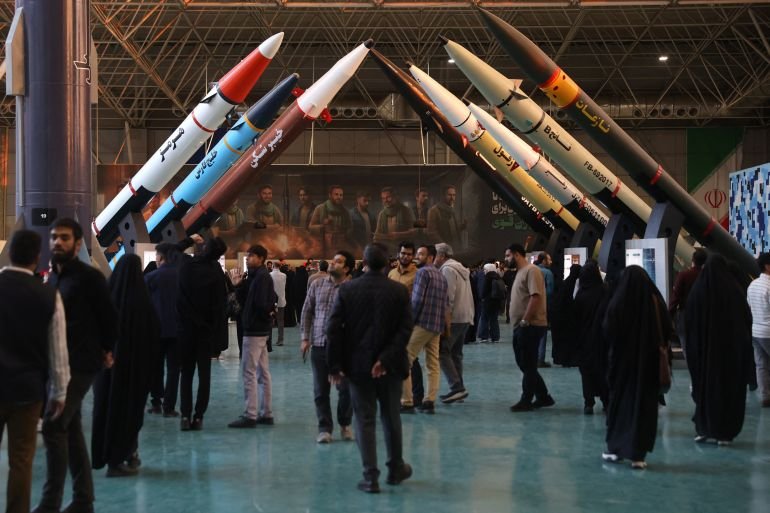
Following the US and Israel’s coordinated strikes on Iran on Saturday, Tehran has retaliated against Israel and US military bases across the Gulf region, using Shahed drones – Iranian unmanned combat aerial vehicles (UCAVs) – and high-speed ballistic missiles.
While Israel, the US and Gulf countries have intercepted most of these missiles, some have struck military assets and civilian infrastructure. Debris from those intercepted has also fallen on some civilian areas.
On Saturday, Iran fired 137 missiles and 209 drones across the United Arab Emirates (the UAE, where US military bases are present), its Ministry of Defence said, with fires and smoke reaching the Dubai landmarks of Palm Jumeirah and Burj Al Arab.
At Abu Dhabi’s airport, at least one person was killed and seven wounded during what the facility’s authority called an “incident”. Dubai’s airport, the world’s busiest for international traffic, and Kuwait’s airport were also hit.
At least nine people were also killed and more than 20 injured in Iran’s missile strike on the Israeli town of Beit Shemesh on Sunday.
(Al Jazeera)
What is Iran’s strategy here?
John Phillips, a British safety, security and risk adviser and a former military chief instructor, told Al Jazeera that Iran’s current military strategy is to survive intense Israeli‑US pressure, rebuild its core capabilities, and restore deterrence by calibrated asymmetric escalation through missiles, drones and proxies.
He said the military strategy firstly focuses on “asymmetric endurance, which is a case of hardening ‘missile cities’, dispersing command structures, and accepting initial damage in order to preserve a second‑strike capability rather than trying to prevent all strikes”. Missile cities are defensive infrastructure used by Iran to safeguard its ballistic and cruise missiles from any aerial attacks
Phillips explained that regional saturation and proxy warfare are also part of the strategy whereby Iran is using “large salvos of ballistic missiles and loitering munitions, alongside actions by Hezbollah and remaining partner militias across the Middle East, to stretch Israeli and US missile defences and impose costs region‑wide”.
Early on Monday, Hezbollah fired a barrage of rockets at northern Israel, to avenge the killing of Khamenei.
Phillips added that Iran has also threatened to close the Strait of Hormuz as part of its military strategy to raise the global economic stakes of the war and pressure Western and Gulf governments.
About 20-30 percent of global oil and gas supplies are shipped through the Strait of Hormuz. Instability in this important maritime route could rattle economic stability worldwide. So far, Iran has not officially closed the strait. But shipping data from Sunday showed that at least 150 tankers, including crude oil and liquified natural gas vessels, had dropped anchor in open Gulf waters beyond the strait.
(Al Jazeera)
How is this strategy different from last June?
In June last year, Iran and Israel, which was supported by the US, engaged in a 12-day war.
It erupted on June 13, 2025, when Israel launched air strikes on Iranian military and nuclear sites, killing key nuclear scientists and military commanders.
Iran retaliated with hundreds of ballistic missiles targeting Israeli cities. In the days that followed, Israel and Iran traded missiles as casualties mounted on both sides. While casualties were high in Iran, they were minimal in Israel. However, some missiles did breach Israel’s much-lauded Iron Dome.
The US entered the military clash on June 22 with bunker-buster strikes on Iran’s Natanz, Fordow and Isfahan nuclear facilities. Afterwards, US President Donald Trump claimed that Iran’s nuclear capabilities had been neutralised.
A fragile ceasefire was eventually brokered by the US on June 24, hours after Iran had fired missiles at the largest airbase hosting US troops in the Middle East – Al Udeid in Qatar.
Phillips said that since then, Tehran has shifted its military doctrine from a primarily defensive containment to an explicitly offensive asymmetric posture.
“The June 2025 war marked a major inflection from largely proxy‑based confrontation to direct, high‑intensity exchanges between Iran and Israel, with US involvement,” he said.
“Compared to June 2025, Iran today appears more structurally aggressive in doctrine where it is formally embracing earlier and more extensive use of regional missiles, drones, cyberattacks and energy coercion (when energy resources and infrastructure are targeted or cut off), but is operationally constrained by battle damage, sanctions and internal instability,” he added.
Phillips also noted that Iran has become more risk‑accepting and escalatory in nature since June last year.
“But its degraded capabilities and fear of triggering an outright regime‑ending campaign push it toward calibrated, episodic bursts of aggression rather than permanent high‑intensity warfare,” he said.
“Their immediate response is likely to be similar to that post the killing of [Qassem] Soleimani,” he said.
In January 2020, after Trump’s administration killed IRGC military commander Qassem Soleimani, along with six others in an air raid on Baghdad’s international airport in Iraq, Iran fired more than a dozen missiles at two Iraqi bases hosting US forces. There were no casualties.
Phillips added that Iran will likely resort to “excessive proxy attacks … for the period of mourning to avenge the killing of the ayatollah. There is highly likely to be another large-scale ICBM [intercontinental ballistic missile] attack on Israel to prove a point and to fight back.”
Is Iran’s current military strategy working?
Defence analysts say it is too early to tell whether the recalibrated strategy is working.
“Iran has a strong army, but there are currently no boots on the ground, and it is an aerial war. Iran is in a disadvantageous position with its air defence compared to the US and Israel. Tehran has increased its stockpile of aerial missiles, but only time will tell if it can hold its own,” the military expert and former official said.
Phillips compared Iran to a “wounded animal” and said that in narrow deterrence terms, Tehran’s military strategy is working to the extent that it has demonstrated it can still launch meaningful missile and drone attacks after the 2025 strikes. It has also forced Israel and the US into a “sustained, resource‑intensive defensive and offensive campaign rather than a clean, one‑off disarmament”, he added.
“However, Iran’s nuclear and missile infrastructure has been heavily damaged, its economy further weakened, and it lost Ayatollah Khamenei in the strike on Tehran, leaving the regime more vulnerable and internally strained, which indicates that its strategy has not prevented severe strategic setbacks,” he said.
How long can Iran hold out?
Even before the Israeli and US attacks on Iran on Saturday, Iranian officials had warned that any attack from Washington or Tel Aviv on Iran would be treated as the start of a wider war, not a contained operation.
After Khamenei’s killing, this stance by Iranian officials has continued.
“You have crossed our red line and must pay the price,” Iran’s parliamentary speaker, Mohammad Bagher Ghalibaf, said in a televised address, referring to the US and Israel.
“We will deliver such devastating blows that you yourselves will be driven to beg.”
While Iran, the US and Israel have traded air strikes since Saturday, it remains unclear how long the conflict will continue.
Phillips said that militarily, Iran can likely sustain “intermittent missile, drone, proxy, and cyber operations for years because these systems are relatively cheap and can be produced and deployed from dispersed, hardened facilities, even under sanctions”.
“Politically and economically, however, prolonged high‑intensity conflict that invites repeated large US‑Israeli strikes risks severe economic contraction, internal unrest, and further erosion of regime legitimacy,” he said.
“So Tehran has strong incentives to oscillate between escalation and tacit pauses rather than sustain continuous full‑scale war,” Phillips added.
How long can the US and Israel hold out?
US President Trump has repeatedly warned Iran against retaliation and threatened that the US could strike Iran “with a force that has never been seen before” in the face of retaliation. But he has also sent mixed messages about how long the war could continue.
Since early February, the US has amassed a vast array of military assets in the Middle East, amid escalating tensions with Iran.
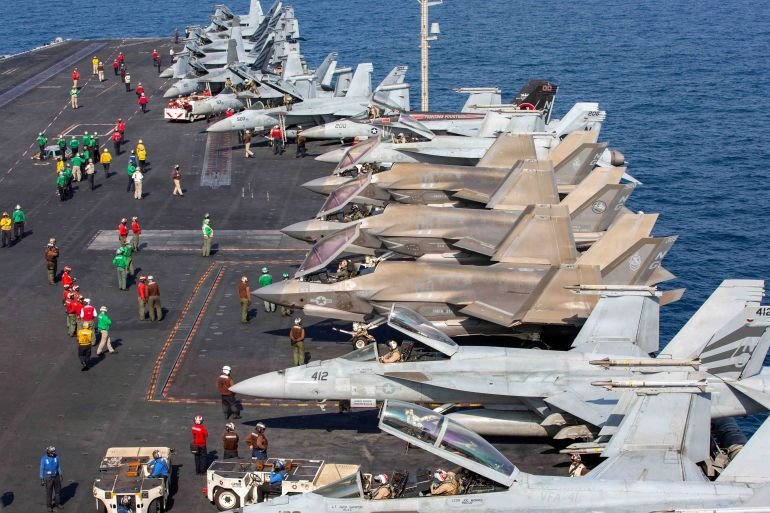
According to open-source intelligence analysts and military flight-tracking data, since early February, the US appears to have deployed more than 120 aircraft to the region – the largest surge in US airpower in the Middle East since the 2003 Iraq war.
The reported deployments include E-3 Sentry Airborne Warning and Control System (AWACS) aircraft, F-35 stealth strike fighters and F-22 air superiority jets, alongside F-15s and F-16s. Flight-tracking data shows many departing bases in the US and Europe, supported by cargo aircraft and aerial refuelling tankers, a sign of sustained operational planning rather than routine rotations.
But after attacking Iran, Trump has been unclear about how long the conflict could last.
On March 1, he told the New York Times that the war could last for four to five weeks. He told ABC News that after the killing of Khamenei, the US was not thinking of targeting anyone else. He also told The Atlantic magazine that Iran’s new leadership had agreed to talk to him, signalling a potential end to the ongoing conflict.
Christopher Featherstone, associate lecturer in the department of politics at the University of York, said that for the US and Israel, international condemnation and domestic opposition could be a limiting factor.
“The US can continue to deploy assets in the region, but any increase in attack would require a huge political effort and significant resources. Trump ran on being an ‘at home’ president, but is increasingly aggressive abroad. However, he is still wary of sustained foreign engagement,” Featherstone told Al Jazeera.
Phillips said that militarily, Israel retains qualitative superiority, an active missile‑defence network, and robust US security support, allowing it to sustain repeated air and missile campaigns and defensive operations for an extended period.
“Its main constraints are domestic resilience (civilian disruption, reserve mobilisation fatigue) and the cumulative diplomatic and economic costs of prolonged regional conflict, which suggest it can sustain a grinding campaign for years, in military terms, but will come under growing pressure – internal and external – to stabilise the situation well before that,” Phillips said, adding that support from European and United Kingdom defence contractors could also dictate, to a degree, how long Israel can sustain this conflict.
‘The US can sustain the current tempo of strikes, air and naval deployments, and missile‑defence support far longer than either regional actor in purely material terms, given its global force posture and industrial base,” he said.
“The binding constraint is domestic political will and strategic prioritisation,” he noted.
“The Iran-Israel theatre is testing Washington’s ability to align its National Defense Strategy with limited public appetite for another open‑ended Middle Eastern conflict,” Phillips said. “So the US is likely to aim for a contained, deterrence‑focused campaign rather than an indefinite high‑intensity war. Their catalyst for stopping will be the political will of allies and how much sway they can hold over the next supreme leader.”
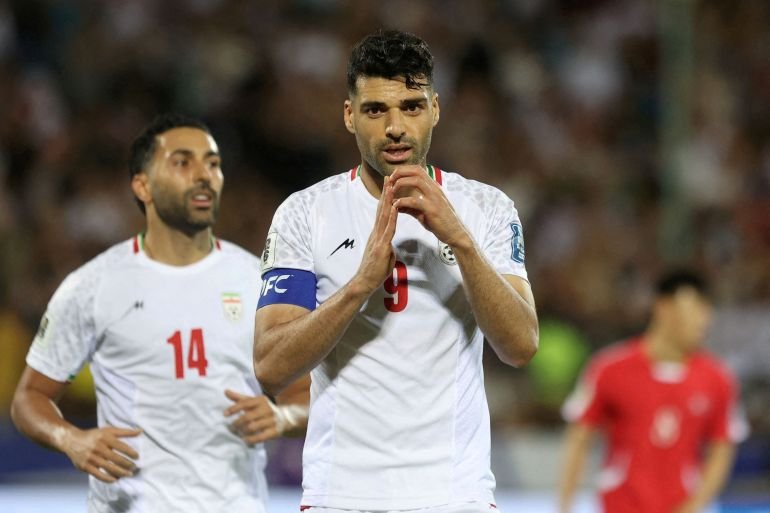
United States and Israeli attacks on Iran have cast doubt over the Iranian football team’s participation in the upcoming FIFA World Cup.
Iran has responded to the attacks, which began on Saturday, by striking Israeli and US military bases in the Middle East with missiles and drones.
Recommended Stories
list of 3 itemsend of list
As of Monday morning, at least 555 people had been killed across Iran and 10 in Israel. Three US soldiers had been killed in action while 38 people had been killed in other nations across the region.
The World Cup will be cohosted by Canada, Mexico and the US – where Iran is scheduled to play all its group games. But if there is no letup in the conflict, the tournament’s logistics and Iran’s role in it have come under question.
Here’s what we know so far:
When is the FIFA World Cup, and what’s Iran’s schedule in the tournament?
The World Cup will begin on June 11 in Mexico while Canada and the US will host their first match the following day. The final will be played on July 19 in East Rutherford, New Jersey, near New York.
Iran is in Group G of the tournament with Belgium, Egypt and New Zealand and is scheduled to play all of its games on the US West Coast.
Here’s Team Melli’s group-stage schedule:
June 15: Iran vs New Zealand at 9pm (05:00 GMT on June 16) at Los Angeles Stadium
June 21: Belgium vs Iran at 3pm (23:00 GMT) at Los Angeles Stadium
June 26: Egypt vs Iran at 11pm (07:00 GMT on June 27) at Seattle Stadium
Will Iran play in the FIFA World Cup?
While Iran has not officially pulled out of the tournament, a top Iranian football official has admitted the team’s participation has been thrown into question.
“What is certain is that after this attack, we cannot be expected to look forward to the World Cup with hope,” Mehdi Taj, president of the Football Federation of the Islamic Republic of Iran (FFIRI), told local sports portal Varzesh3 on Sunday.
“It’s not possible to say exactly, but there will certainly be a response,” Taj added when asked whether the FFIRI or the Iranian government would reconsider the country’s participation in the tournament.
“This will surely be studied by the country’s high-ranking sports officials, and there will be a decision on what’s going to happen.”
FIFA Secretary-General Mattias Grafstrom has said the world football governing body is monitoring the conflict and the situation emerging from it.
“I read the news [about Iran] this morning the same way you did,” Grafstrom said at the International Football Association Board’s annual general meeting in Wales on Saturday, according to a report by ESPN.
“We had a meeting today, and it is premature to comment in detail, but we will monitor developments around all issues around the world.”
With the tournament a little more than three months away, FIFA said it will “continue to communicate with the host governments”.
Will the Iranian team and fans be allowed in the US for the World Cup?
While Iran’s games are scheduled at venues on the US West Coast, which is home to a sizeable Iranian community, Team Melli’s fans hoping to travel to the tournament from Iran and support their team will find it difficult.
Iran was among the 12 countries that were included in US President Donald Trump’s travel ban imposed in June.
The ban was met with criticism from Iran, which called it “racist” and a sign of deep-rooted hostility towards Iranians and Muslims.
What happens if Iran does not participate in the World Cup?
There is no precedent for a team withdrawing from the FIFA World Cup, which is deemed the biggest sporting event in the world.
Teams that have been sanctioned and banned by global and regional football bodies have been excluded from the tournament with Russia’s ban the most recent.
Should Iran pull out of the tournament, it would likely be replaced by another nation to ensure the smooth operation of the tournament.
Because Iran is part of the Asian Football Confederation and qualified for one of the region’s berths for the World Cup, the replacement would likely come from Asia although organisers have not confirmed whether that would be the case.
Based on their position at the end of the qualifying process, the United Arab Emirates could be the nation next in line. However, if Iraq, who are aiming to qualify via an intercontinental playoff, fail to book a place, they could pip the UAE as Iran’s replacement.
What’s Iran’s record at the FIFA World Cup?
Iran are currently ranked 20th in the world and second in Asia.
They have appeared in the World Cup on seven occasions with consecutive appearances in the past three editions but have failed to move past the group stage.
A favourite tactic of war is to try to decapitate the enemy leadership. While such strategies might work in certain contexts, in the Middle East, they have proven to be a disastrous choice.
For sure, the assassination of an enemy leader might give a quick boost of popularity amid war. Certainly, United States President Donald Trump and Israeli Prime Minister Benjamin Netanyahu are basking in the limelight of their perceived “success” in assassinating Iranian Supreme Leader Ali Khamenei.
But killing an 86-year-old man who had already been planning his succession due to his ill health is not that much of a feat considering the overwhelming firepower that the US and Israel together possess. More importantly, eliminating him does not necessarily mean that what follows would be a leadership or a regime that would accommodate Israeli and US interests.
That is because leadership assassinations do not lead to peaceful outcomes in the Middle East. They can open the door for much more radical successors or for chaos that leads to violence and upheaval.
A brief glance at recent history shows that whenever Israel and the US have tried the idea of leadership “decapitation” in various conflicts in the region, the results have been disastrous. In the case of Iraq, its leader Saddam Hussein was captured by US forces and handed over to allied Iraqi forces who executed him. This ended a regime that was openly antagonistic to Israel, but it also opened the doors for pro-Iranian forces to take power.
As a result, in the following two decades, Iraq served as a launching pad for Iran’s regional proxy strategy, which saw it build a powerful network of nonstate actors that threatened US and Israeli interests.
The security vacuum created by the US invasion triggered various insurgencies, the most devastating of which was the rise of ISIL (ISIS), which swept through the Middle East, killing thousands of innocent people, including US citizens, and triggering a massive refugee wave towards US and Israeli allies in Europe.
Another case in point is Hamas. Since the early 2000s, Israel has repeatedly tried to assassinate its leaders. In 2004, it succeeded in killing its founder Sheikh Ahmed Yassin and then his successor Abdel Aziz Rantisi, who was considered a moderate. A few assassinations later, Yahya Sinwar was elected head of Hamas in Gaza and went on to plan the October 7, 2023, attack.
Hezbollah has a similar history. Its late leader Hassan Nasrallah, who successfully led the expansion of the group to a formidable nonstate power, ascended to its leadership after Israel assassinated his predecessor Abbas al-Musawi.
Two and half years of war and mass killing of leadership may now have devastated both armed groups, but Israel has failed to assassinate the idea behind them: resistance to occupation. The current lull in fighting may be the quiet before another storm.
In the Iranian case, it is highly unlikely that whoever replaces Khamenei would be as open to negotiations as he was. The statements by the Omani interlocutors during the talks in Muscat and Geneva pointed to major concessions on the nuclear issue that Iran under Khamenei was prepared to make. It is unlikely that his replacement would have the political space to follow suit.
If Israel and the US continue their campaign and really push for state collapse in Iran, what comes out of that ensuing chaos could be anyone’s guess. But if we are to go by recent experiences in Iraq and Libya, a security vacuum in Iran would have devastating consequences for US allies in the region and in Europe.
That raises the pertinent question of what Israel and the US stand to gain from their “decapitation” strategy in Iran.
For Netanyahu, the assassination of Khamenei is a major success. Facing crucial elections that could mean the possible end of his political life and maybe his imprisonment over four corruption charges, the short-term gain in popularity and votes is worth it. Israeli leaders do little thinking and planning on the mid- to long term and do not have to bear the consequences of military adventurism abroad. After all, Israeli society is very much in favour of it.
But for Trump, the gains are not as apparent. He gets to brag about killing an 86-year-old ailing leader of a faraway country to a public that has no appetite for war. At a time of a continuing cost-of-living crisis in the US, he is spending billions of taxpayer dollars to fight a war against a country that posed no imminent threat, a war that many Americans are increasingly identifying as “Israel’s war”.
Instead of projecting power, Trump risks showing weakness and being seen as a US president fooled into starting a costly war to ensure the political survival of the prime minister of a foreign country.
It is clear for now that the US president has drawn a line at putting US boots on the ground. At some point, he will have to end the bombardment campaign and pull US troops. He will leave behind a disaster that US allies in the region will have to bear the brunt of. US regional alliances are sure to suffer. Domestic audiences are sure to ask questions.
This will be yet another US military adventure in the region that will cost US taxpayers’ money, US soldiers’ lives and foreign policy clout and offer no return. The hope is that Washington may finally learn its lesson that assassinations and decapitation strategies don’t work.
The views expressed in this article are the author’s own and do not necessarily reflect Al Jazeera’s editorial stance.
Civilian deaths are growing as more attacks are reported in the capital and other parts of the country.
Published On 2 Mar 20262 Mar 2026
Share
At least 555 people have been killed in US-Israeli strikes across 131 counties in Iran, the Iranian Red Crescent Society says, amid another wave of intensive attacks and Iranian counterstrikes on Israel and US assets in the Middle East region.
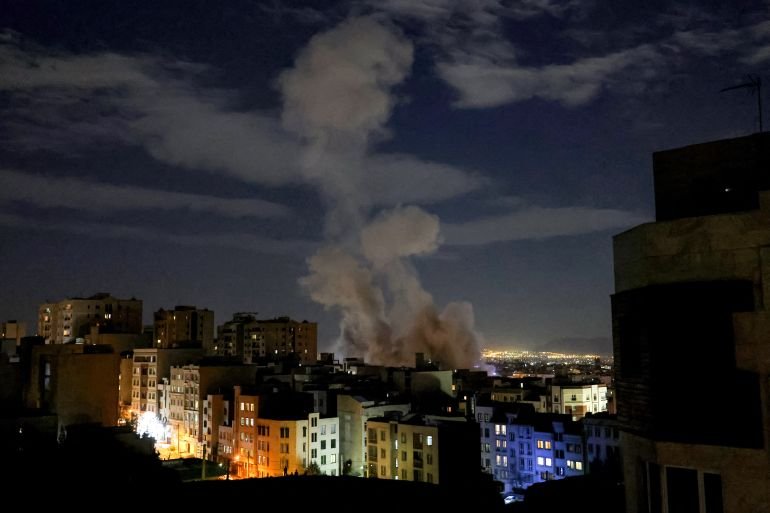
At least 35 people were killed on Monday morning in southern Iran’s Fars province, according to the Mehr news agency. The outlet also reported more than 20 people killed in an attack on Niloofar Square in Tehran.
Recommended Stories
list of 3 itemsend of list
The Fars news agency said at least two people were killed in the central city of Sanandaj as several residential buildings next to the city’s police station were destroyed. The Tasnim news agency said US and Israeli forces dropped six missiles on different parts of the city, including densely populated neighbourhoods.
Reza Najafi, Iran’s ambassador to the International Atomic Energy Agency (IAEA), the United Nations nuclear watchdog, told reporters that US-Israeli air strikes had targeted Iran’s Natanz nuclear enrichment site on Sunday.
“Their justification that Iran wants to develop nuclear weapons is simply a big lie,” Najafi said, describing the facility as “peaceful”.
Israel and the US have not issued any statements confirming strikes at the site, which the United States bombed during the 12-day war between Iran and Israel in June.
Al Jazeera’s Tohid Asadi, reporting from the Iranian capital, said the latest strikes were indicative.
“This shows the scope of the attacks on Iran, with raids targeting not just political centres and military headquarters,” he said. “We are witnessing damage to civilian buildings, with some of them fully demolished in some cases. And this is concerning because the civilian fatalities are growing.”
Videos verified by Al Jazeera also showed huge clouds of smoke billowing behind buildings near the international airport in the central Iranian city of Kermanshah.
Iranian authorities reported that the death toll from an Israeli attack on a girls’ school in Minab on Saturday rose to 180.
Hossein Kermanpour, the head of public relations at Iran’s Ministry of Health, added that the “same type” of missile was used to attack the Gandhi Hospital in Tehran on Sunday. The hospital was badly damaged, and patients were evacuated.
The Israeli military on Monday said Iran had launched more missiles and that air defences were operating to intercept the projectiles. It called on residents to take shelter and remain in protected spaces until informed.
Israeli police said nine people were killed after an Iranian missile attack on the central city of Beit Shemesh. Eleven people were reported missing as rescuers searched for survivors.
Iran continued with its retaliatory strikes on Qatar, Bahrain, Jordan, Oman, Kuwait, Saudi Arabia and the United Arab Emirates, with attacks reported on airports, residential buildings and hotels.
Countries in the Gulf have pledged to defend themselves against Iranian attacks, including by “responding to the aggression”.
Iranian Foreign Minister Abbas Araghchi stressed that Tehran was not seeking confrontation with its Gulf neighbours but aimed to attack US assets in the region.
A poll conducted in the hours after the United States and Israel launched a major military operation against Iran, sparking regional retaliation, shows dismal approval for the strikes from the US public.
The Reuters Ipsos poll was conducted beginning on Saturday and closing on Sunday, before the administration of President Donald Trump announced that the first US troops had been killed in the conflict. Only one in four respondents approved of the US-Israeli attacks.
Recommended Stories
list of 3 itemsend of list
The early findings could have a significant effect on how the Trump administration moves forward in the days ahead and on how lawmakers respond to the attacks, particularly as they look to a punishing midterm election season.
Trump on Sunday promised to continue what he described as a “righteous mission” until “all objectives are achieved”. Referencing the three US military members announced killed on Sunday, Trump said that “there will likely be more before it ends”.
After a US-Israeli strike killed Iranian Supreme Leader Ayatollah Ali Khamenei, Trump again framed Iran as an existential threat to the US, claiming that the country’s leaders “have waged war against civilization itself”.
The Reuters-Ipsos poll suggested that the US public does not share that view, with 43 percent of respondents saying they disapproved of the war and another 29 percent saying they were unsure.
Approval among Republicans was stronger, but not resounding, with 55 percent saying they approved of the strikes, 13 percent disapproving and 32 percent unsure.
Perhaps most significantly, about 42 percent of Republicans said they would be less likely to support the operation if it led to “US troops in the Middle East being killed or injured”.
About 74 percent of Democrats disapproved of the strike, with 7 percent approving and 19 percent unsure.
Midterms loom
The poll released on Sunday comes as Republican lawmakers have largely coalesced around Trump’s message on Iran, even as its contradiction to Trump’s campaign promises risks alienating his Make America Great Again (MAGA) base.
Trump had run on a pledge to cease “endless wars” and halt US interventionism abroad in an “America First” pivot.
While Trump has shown a unique ability to shape the views of his staunchest supporters in his likeness, some conservative commentators have warned that he is playing with fire.
“If this war is a swift, easy, and decisive victory, most of them will get over it,” Blake Neff, a former producer for late conservative activist Charlie Kirk, wrote on X on Saturday.
“But if the war is anything else, there will be a lot of anger.”
He added that “success can override bad explanations. So we must pray for success.”
Speaking to Al Jazeera, Doug Bandow, a senior fellow at the Cato Institute, a libertarian think tank, said the confirmation that US soldiers had been killed “brings home the cost of the war”.
“Americans, by a very large margin, don’t want to be tied up in an ongoing conflict in the Middle East,” he said during a television interview. “The fact that Americans have died suddenly shows this is not just a video game from the standpoint of America.”
Beyond the three US military personnel killed, at least 201 people have been killed in Iran, nine in Israel, two in Iraq, three in the United Arab Emirates and one in Kuwait.
Meanwhile, 45 percent of respondents to the Reuters-Ipsos poll, including 34 percent of Republicans and 44 percent of independents, said they would be less likely to support the campaign against Iran if gas or oil prices increased in the US.
The conflict has threatened arterial trade routes, with several companies suspending shipments in the area.
Democrats will also be keeping a close eye on public sentiment on the war, which will surely hang over the campaign season ahead of the midterm elections in November.
The party has made affordability a key issue, with incumbents and upstart challengers alike portraying Trump’s military adventurism, which has also included the US abduction of Venezuelan leader Nicolas Maduro, as out of touch with his messaging.
Elected Democrats, meanwhile, have given a range of responses to the US operation against Iran, with at least one Democratic senator praising Trump’s strikes. Others celebrated Khamenei’s killing, but remained more circumspect on Trump’s justification for the attacks, while several others were forthright in condemning the strikes.
Several Democrats on Sunday said the killing of US soldiers underscored the urgency of passing a war powers resolution, which would require approval from Congress before further military action is taken.
“I’m thinking of the brave American soldiers killed today,” Senator Chris Van Hollen, a proponent of the resolution, posted on X on Sunday. “They should still be with us.”
“Trump said he would keep us out of war. This is his war of choice.”
A vote on the resolution is expected early this week.
US Central Command (CENTCOM) said in a statement that five others have been ‘seriously wounded’ in the operation.
Published On 1 Mar 20261 Mar 2026
Share
The United States military has announced that three service members have been killed in its operation against Iran, the first US casualties in the continuing attacks on Iran.
The announcement on Sunday comes on the second day of strikes by the US and Israel that have killed the Iranian Supreme Leader Ayatollah Ali Khamenei and drawn retaliatory fire from Iran towards targets across the Middle East.
US Central Command (CENTCOM) confirmed in a statement that three US service members were killed and five others have been “seriously wounded” in the operation.
“Several others sustained minor shrapnel injuries and concussions — and are in the process of being returned to duty. Major combat operations continue and our response effort is ongoing,” it added.
“The situation is fluid, so out of respect for the families, we will withhold additional information, including the identities of our fallen warriors, until 24 hours after next of kin have been notified,” it added.
The United States and Israel continued to launch attacks across Iran on Sunday, the second day of a campaign that US President Donald Trump says is aimed at removing Iran’s government from power. Iran has responded to the assault with attacks targeting US assets across the Middle East, raising fears of a wider regional war.
Iran’s Revolutionary Guards reported on Sunday that they had targeted the USS Abraham Lincoln aircraft carrier with four ballistic missiles.
A US official told Al Jazeera that the Iranian attack did not cause any damage.
CENTCOM said on X that the aircraft carrier, “continues to launch aircraft in support of CENTCOM’s relentless campaign to defend the American people by eliminating threats from the Iranian regime.”
Reporting from Washington DC, Al Jazeera’s Alan Fisher, said that the deaths of US troops would “change a lot of things for the United States”.
“Donald Trump, of course, campaigned on the idea of being a president who wasn’t going to take the US into wars. He said that [former US Vice President] Kamala Harris, if she were elected, would start a fight with Iran that would lead to World War III,” Fisher said.
“There are many on the Democratic side who now want an emergency debate in Congress about this [the US operation in Iran] because they want to know what is the administration’s plans? Where does this go? How long is thing going to last?,” he said.
“And the big question of course, how many more service personnel will be put at risk,” he added.
Still, Trump told Fox News on Sunday that things were “moving quickly” during its operation on Iran following the killings of Iranian Supreme Leader Ali Khamenei and other members of the political top brass.
“I’m not worried about anything, and things are going well,” he said.
“Iran would have had a nuclear weapon within two weeks if it weren’t for our strikes against its nuclear facilities, and then this type of attack wouldn’t have been possible,” he added.
Iran has vowed retaliation for the killing of Khamenei and the ongoing US-Israeli attacks on the country, as Foreign Minister Abbas Argachi told Al Jazeera that there were no “limits to our self-defence”.
The United States-Israeli war on Iran is just one day old, and it is already clear it will have a profound impact on the Middle East and the Gulf in particular. The US-Israeli bombardment of Iran has killed a number of high-ranking officials as well as Supreme Leader Ali Khamenei. Tehran has responded by attacking not just Israel but also various countries in the region.
Saudi Arabia, Qatar, the United Arab Emirates, Bahrain, Kuwait and Oman were all struck by Iranian missiles or drones, even though none of these countries had launched attacks on Iran from their territory. Various sites across these states were targeted, including US military bases, airports, ports and even commercial areas.
If the conflict drags on, it could become a real turning point for the Gulf – one that reshapes how states think about security, alliances and even their long-term economic futures.
For years, Gulf stability has leaned on a familiar set of assumptions: The United States remained the dominant security guarantor; rivalry with Iran was managed, contained and kept below the threshold of full confrontation; and the Gulf Cooperation Council (GCC) – despite its disagreements – provided enough coordination to prevent regional politics from unravelling entirely. A sustained conflict involving the US, Israel and Iran would strain all of that at once. It would push Gulf capitals to revisit not only their defence planning but also the deeper logic of their regional strategy.
In recent years, Gulf diplomacy had already been shifting – carefully, quietly and with a strong preference for hedging rather than choosing sides. The Saudi-Iran thaw brokered by China in 2023, the UAE’s pragmatic channels with Tehran and Oman’s steady mediation role all point to the same idea: Stability requires dialogue, even when mistrust runs deep. Qatar has also kept doors open, betting on diplomacy and de-escalation as a way to reduce risk.
But a prolonged war would make that balancing act much harder to sustain. Pressure would rise from Washington to show clearer alignment. Domestic opinion would demand firmer answers about where national interests truly stand. Regional polarisation would intensify. In that kind of environment, strategic ambiguity stops looking like smart flexibility and starts looking like vulnerability because everyone wants you to pick a side.
The economic shockwaves could be just as significant. Any extended conflict tied to Iran immediately puts maritime chokepoints back at the centre of global attention, especially the Strait of Hormuz, one of the most sensitive arteries in the world economy. Even limited disruptions could trigger sharp energy price increases, higher insurance and shipping costs, and renewed investor anxiety.
Yes, higher oil prices could boost revenues in the short term, but sustained volatility carries a different cost. It could scare away long-term capital, complicate megaproject financing and raise borrowing costs at exactly the moment many Gulf states are trying to accelerate diversification.
There is also a longer-term strategic risk. Major consumers, especially in Asia, may decide that repeated instability is reason enough to speed up diversification away from Gulf energy resources. Over time, that would quietly reduce the region’s leverage, even if it remains a major energy supplier.
Inside the GCC, the war could either push states closer together or expose the cracks. The bloc has always moved between unity and rivalry, and a crisis doesn’t automatically produce cohesion. Different members have different threat perceptions and different comfort levels with risk. Oman and Qatar have typically valued mediation and communication channels with Tehran. Saudi Arabia and the UAE have leaned more heavily towards deterrence, even if both have recently invested in de-escalation. Kuwait tends to balance carefully and avoid hard positioning.
If the conflict escalates unpredictably, those differences could resurface and strain coordination. But the opposite outcome is also possible. The crisis could drive deeper cooperation on missile defence, intelligence sharing and maritime security. Which direction the GCC takes will depend less on outside pressure and more on whether member states see this as a moment to compete or a moment to close ranks.
Zooming out, a prolonged war would also accelerate larger geopolitical realignments. China and Russia would not remain passive. Beijing, deeply invested in Gulf energy flows and regional connectivity, may expand its diplomatic footprint and present itself as a stabilising intermediary. Moscow could exploit the turmoil to increase arms sales and leverage regional divisions.
Meanwhile, if US military engagement deepens but Washington’s political bandwidth narrows, Gulf states may find themselves in a complicated position – more dependent on American security support yet more cautious about relying on a single patron. That dynamic could produce a new pattern, something like conditional alignment, where Gulf capitals cooperate militarily with the US but widen their economic and diplomatic options to avoid overdependence.
The deepest change, though, may not be military or economic. It may be cultural, in strategic terms. The Gulf states have spent decades prioritising stability, modernisation and careful geopolitical manoeuvring. A sustained regional war could disrupt that model. It could force painful trade-offs between security imperatives and development ambitions, between diplomatic flexibility and alliance discipline, between the desire to avoid escalation and the reality of living next door to it.
That is why the Gulf now feels like it is standing at a crossroads. It could become the front line of a prolonged, great power-inflected confrontation – or it could leverage the diplomatic capital it has built to push for de-escalation while strengthening its defensive resilience. Either way, the outcome won’t just shape Gulf security thinking. It could influence the region’s entire political architecture for years – possibly decades – to come.
The views expressed in this article are the author’s own and do not necessarily reflect Al Jazeera’s editorial stance.