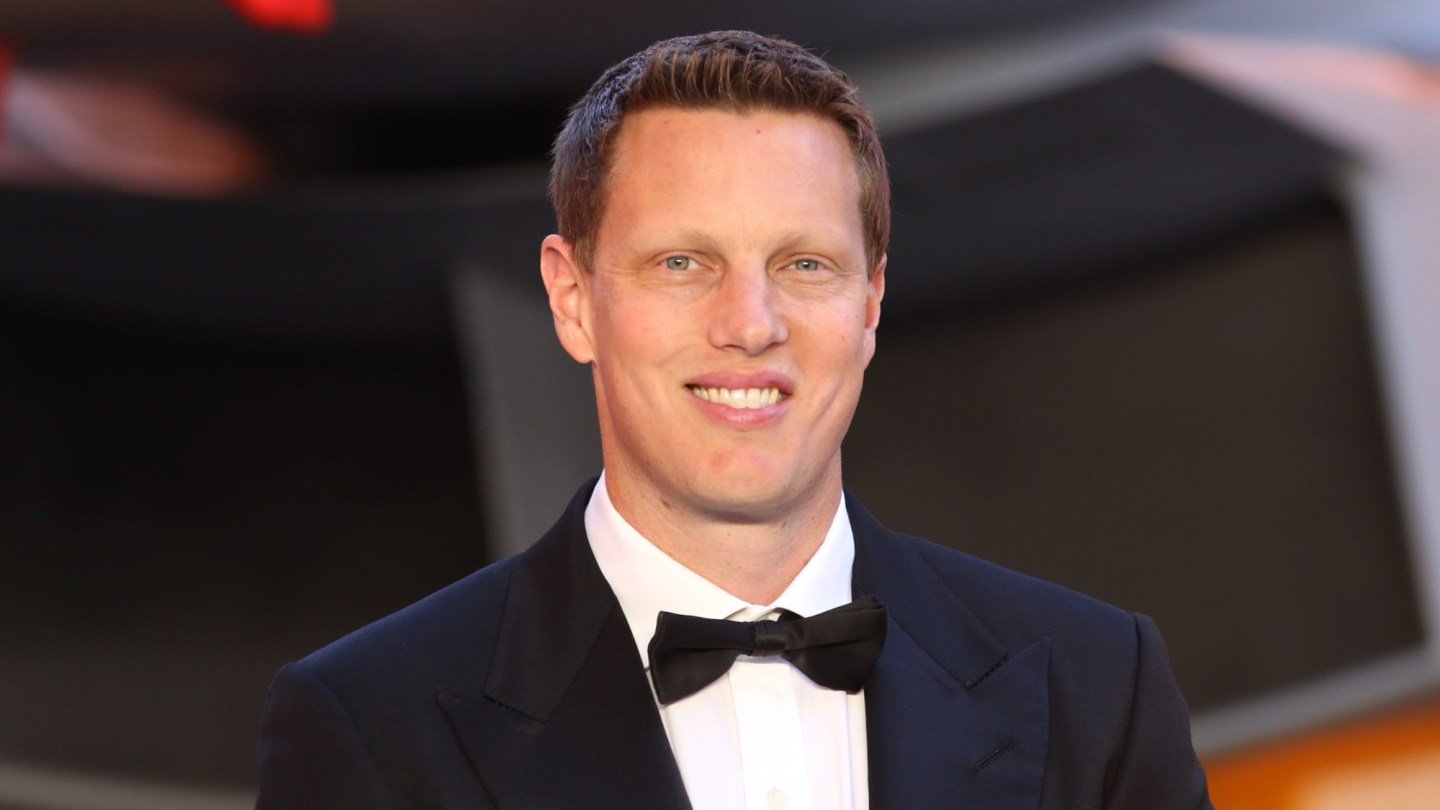
The couple reportedly welcomed a baby daughter in late July, according to reports. TMZ posted photos of the actress carrying a baby in New York after seeing Death of a Salesman on Sunday, which marked Abbott’s last performance.
Abbott played Biff Loman in the Broadway revival of Arthur Miller’s classic play opposite Nathan Lane and Laurie Metcalf; he earned his first Tony Award nomination for the role, and they attended the ceremony as a couple (see photo above).
Plaza, meanwhile, earned an Emmy nom for best supporting actress in a drama series for her role in The White Lotus in 2023. She also was the co-creator of Prime Videos animated series Kevin. Her other credits include Agatha All Along and Parks and Recreation.
News first surfaced in April that Plaza was pregnant with her first child. The couple have worked together previously, in the 2020 movie Black Bear as well as in the off-Broadway play Danny and the Deep Blue Sea.
She was previously married to writer-director Jeff Baena (Life After Beth), who died by suicide in January 2025.
Ingeborg and Adam are visionary hand surgeons who are bound by love, control and irresistible fixations. Ingeborg, for one, feels compelled to steal objects. Adam longs to become one.
But after an accident, their well-choreographed lives suddenly face a force that could upset the careful balance that has long defined their relationship: the enigmatic Gaia. With her arrival, unexpected desires start springing up.
With Objet a, her new mind-bending and visceral feature, Berlin-based visual artist and filmmaker Ann Oren (Piaffe) returns to Locarno. It is a stylized cinematic exploration of the fragile relationships between humans, as well as humans and nature. And it is likely to make you look and think at control, desire, intimacy, identity – and kleptomania – in a different way.
Objet a, world-premiering in the international competition of the 79th edition of the Locarno Film Festival on Tuesday, Aug. 11, stars Aenne Schwarz (All Is Well, Every You Every Me) as Ingeborg, Louis Hofmann (All the Light We Cannot See, The Forger, Dark) as Adam, and Simone Bucio (Piaffe, The Ivy) as Gaia. Georg Friedrich (Great Freedom) and Sofia Kokkali (Our Wildest Days) also feature.
“I’m interested in human desire and how it connects us to other species,” Oren says in a director’s note. “The human body is the starting point for my cinematic language: the more control we have over it, the more we separate ourselves from the natural world.”
Oren wrote the screenplay for Objet a with Geoffroy Grison. The cinematography is courtesy of Juan Sarmiento G. (The Voice of Hind Rajab, A Poet), with editing by Hansjörg Weißbrich (Rose, Late Shift). The film is produced by Schuldenberg Films in co-production with Tarantula, asterisk* and ERT. A theatrical release in Germany through Grandfilm is scheduled for the first quarter of 2027. Oscilloscope Laboratories has acquired the North American rights. Bendita Film Sales is handling international sales.
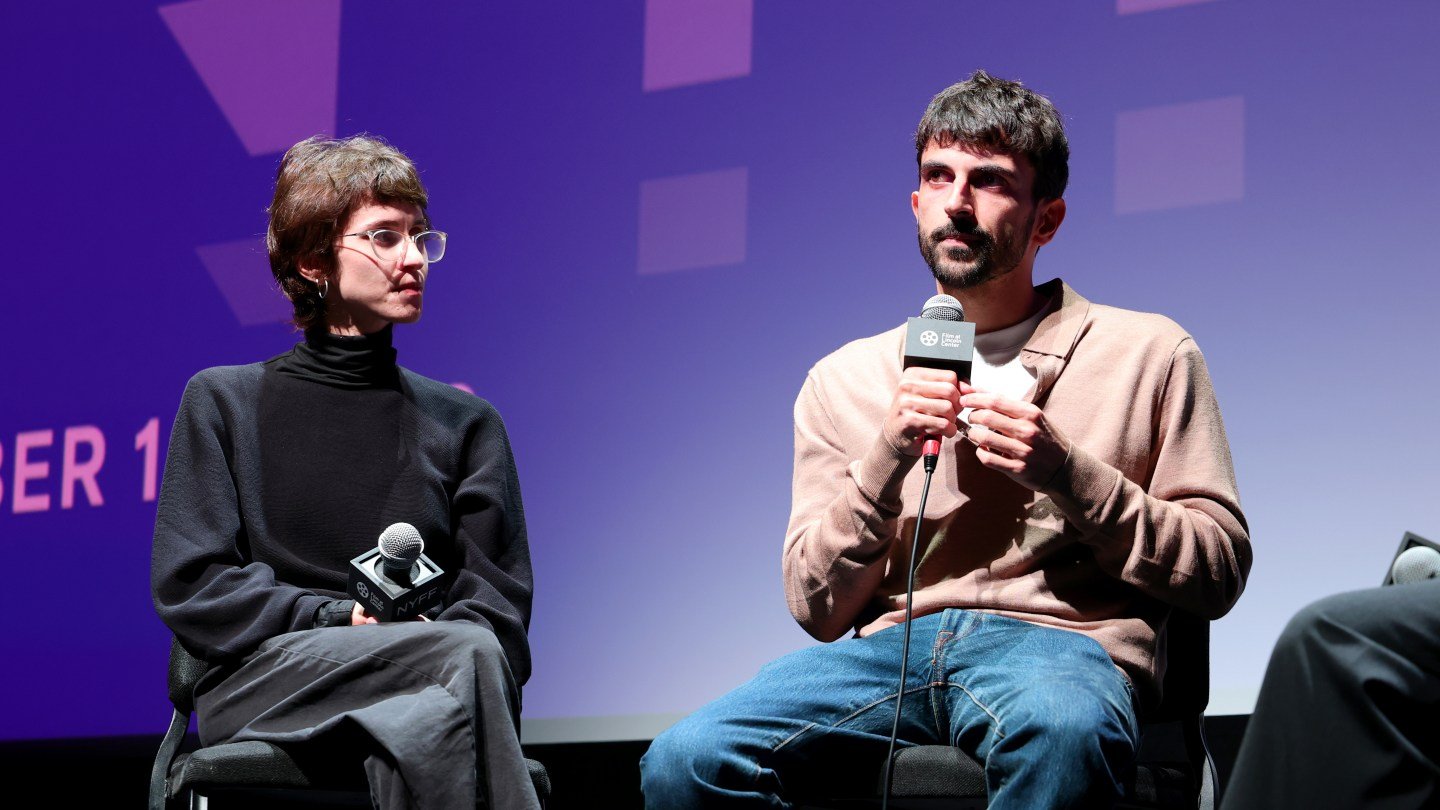
Ahead of the Locarno premiere of Objet a, Oren, Schwarz and Hofmann talked to THR about the serious and fun sides of the production, how they collaborated on its choreography and how timely its themes are if you look close enough.
Ann, what gave you the idea for this film and this story?
ANN OREN Several things, but what I was starting with was the sense of touch. I make very visceral films. My first feature film, Piaffe, dealt with the sense of sound. I start with the experience of the human body today in order to understand the human condition today. Here, I was thinking about the sense of touch today and what happens when we touch flat screens more than we touch our lover’s skin. A lot of experiences have flattened down to touching this plexiglass most of the day, so what is happening to our fingertips? I think they’re really deprived, and I was imagining zombie-like, hungry fingers – hungry to touch something. And then I had this idea of a couple that is living a very bubbled life and communicating emotionally through objects.
‘Objet a’
Courtesy of Juan Sarmiento G./Schuldenberg Films
I am curious, Aenne and Louis, how Ann pitched this project to you. To me as a viewer, Objet a sometimes felt a bit like a dance choreography that was very body-driven and that I could “feel” physically while watching.
AENNE SCHWARZ When I read the script, I felt a real longing to become part of this genuinely faraway world, which, at the same time, felt somehow familiar. What was very intense was when Ann talked us through the script. I remember when we all met, she had such a precise and full vision of what she wanted. And then, yes, it was a very physical experience. I experienced it like diving in, and at the same time, you had to hold the line and be very straight because they’re such delicate characters.
LOUIS HOFMANN I remember that in our first rehearsal, the term dance popped up quite a few times. The way we moved around one another was, I guess, testing out how near you could be to one another and what distance you could create. I remember that there were only a few moments where the characters would actually touch. But most of the time, it was about playing with the distance between them, creating tension, and playing with that tension.
SCHWARZ Yes. The gaze was part of the tension between us. You never lose each other. But sometimes, you are very far and sometimes much closer. It’s always a thin line holding us together.
HOFMANN And that longing for the touch is, I think, omnipresent, and that created the tension.
Interesting how you both describe this. Now it makes more sense to me why I sometimes felt that you two were almost moving like marionettes. Ann, are you happy if viewers get that sense?
OREN Absolutely, because this is exactly the type of work that I’m doing. I see working with actors as being about a very physical performance. There is also the psychology, but what I’m actually interested in is how the characters make decisions, not rationally, but rather through gut feeling. I look at human beings as the species that they are. In everyday life, it happens to everybody that we are compelled to do something, although we don’t really understand why. And I think it’s very exciting for a viewer to see that in a character and see that things are charged with this kind of tension.
In the psychoanalytic theory of Jacques Lacan, “objet a” is an unattainable object of desire. Aenne, Louis, were you familiar with this term, or did Ann go through some of this theory? Or was it not really that important to understand such concepts?
HOFMANN My girlfriend mentioned it to me. I wasn’t aware of it, but she was. And then during rehearsals, we touched on it a little bit. My character Adam has this desire of wanting to be a desired object for someone else. But then through his journey, he is also developing a sense of what he wants to be for himself. For me, that was a very beautiful journey to go on.
‘Objet a’ film still, courtesy of Juan Sarmiento G./Schuldenberg Films
AENNE I saw the title and remembered that a long time ago I studied literature, and Lacan was a topic in one seminar. I remember that I was very excited about it, and so I got a little bit into it. A close friend of mine is a Lacanian psychoanalyst. I felt I had a very intense meeting with this “objet a” myself during filming. The film became this object, in a way. I also wanted to touch it. I also wanted to have it, to own it, and it was also slipping away. So for me, it was a very personal experience with the theme.
HOFMANN You mentioned marionettes. I sometimes felt that the way I was being, or we were being directed, I felt so secure and so safe. In Ann’s world that she created, we just kind of obeyed her vision in a very beautiful way. I don’t mean that we had no say in it anymore, because it was quite the opposite. She was still welcoming all of our ideas.
Do you remember any examples?
HOFMANN When I tried to find the character, I very much went through voice. It was an impulse. I’d read somewhere that the soul of a character is placed in the voice, and I’ve never really gone through that, using the voice in particular to create the character. During rehearsals, I was reading Georg [Friedrich]’s part with Aenne, and I was mimicking, for fun, Georg’s [Austrian] accent and dialect. And then Ann was like: “Wait, I love this voice for you.” And I said: “Hang on, I can’t really have Georg’s voice when being in a film with Georg.” But I then took that placement of the voice, where his voice sits. That’s just an example of how playful we were with one another while being in that very safe and secure environment of Ann’s vision.
Ann Oren, courtesy of Björn Melhus
Courtesy of Björn Melhus
Ann, as a filmmaker, how do you think about colors? I noticed, or maybe I should say “felt,” colors quite a bit in Objet a…
OREN This is the bread and butter of my language. I don’t even have to sketch it out. It just comes to me. What would be the color palette of the film, and how does that support the mood that I would like to bring across? For this film, I wanted to reduce colors. Actually, we only have natural colors in the film until, slowly, green becomes the guest and the star color in the film. You have to work very hard to reduce color, actually, especially when you’re shooting outside, and then you slowly introduce it. So when you have a sequence in the end, it’s really ecstatic.
So we made sure in the production design and in the costumes that the range was from whites and beiges into the deep browns. The red color was used only in the bedroom … and [in another location] in the background. When I see Adam and Ingeborg within these natural colors, it really makes me think of them a little bit more like animals.
I felt the desire inside, or below the surface, of the couple without the characters having to talk about it. Is there a trick to tap into that to make us viewers sense this desire?
SCHWARZ With Ingeborg, what I thought was very exciting about her was that her fingertips and her eyes are her sensual organs. And I really tried to dive into these sensations. The crutch she [gets for one of her legs as the film unfolds] became part of my body. It was exciting for me to really open to the world that an object can become so strong. And with Gaia, she also has a sense she never had before, and she can’t control it. That is like an earthquake for her. She goes into a direction she never went before, and she can’t understand it.
She basically has things in order. She knows what she wants. She’s very sensitive and delicate, but also very clear in what the object has to do for her. And then this kind of melting starts when her body breaks. When her leg is broken, something breaks into pieces.
‘Objet a’ film still, courtesy of Juan Sarmiento G./Schuldenberg Films
HOFMANN I remember that the objects, the crutch, as well as a corset I use, had an immense effect – not only on us but on the whole team. There was a fascination with the beauty of how they were built, and maybe how we got attached to them. We treated them as extended parts of ourselves, and there was this fascination coming from the team as well.
I also remember us, as actors, acting differently when we had our objects with us. There was more to us, and it was also kind of between us. This film is about these two people who are symbiotic and living their life in a very symbiotic way, doing everything with one another – working together, living together, loving each other – and then there are these new elements popping up that are so disturbing at first, and so irritating, and so frightening. And then they slowly but surely start to go with those impulses, and they don’t really know where they’re coming from.
SCHWARZ One thing that was very special was that this was very playful, and also funny in a way. And that gave us also a lot of freedom. We were having fun. We were laughing.
HOFMANN At first, I wondered, “Is this going to become not body horror, but is it all going to be really dark, scary and just full of doom?” But I felt it was quite endearing, and so sweet, no matter how strange these desires might appear to other people. At the end of the day, they are very endearing, sweet desires. And I found the characters so endearing.
SCHWARZ Yes, there’s a tenderness.
Ann, can you share how you think of rituals as part of your storytelling?
OREN That has a lot to do with obsessions with control. You see that with both of them, especially with Adam’s character. He’s obsessed with controlling his body, developing his body, and then he wants his body to also get attention. But the more control we have over our bodies, the more we are disconnected from the natural world that we are a part of. And I think this is a very contemporary condition.
The need for rituals, historically, first of all, is that they are relaxing. It doesn’t have to be a religious ritual, but it can be about the things that you have to do in the morning or the things that you have to do before you leave the house. I think that the need for it also has to do with forgetting ourselves and connecting with something larger than ourselves. If in the beginning, the characters are connected to controlling their lives and to objects, towards the end, it opens up to a psychedelic experience that is like ecstasy. And ecstasy has always been a need for humankind. Today, there is a renaissance of psychedelics in the world because we’re so controlled – the need to forget ourselves, to have a moment of ego loss, and to connect to something larger than ourselves. I didn’t want to have a didactic experience for the audience, but rather lure them into something through passion.
Speaking of passion, Adam and Ingeborg really try to control that when we first meet them…
OREN I built the sexuality between the couple so that they were canceling parts of their bodies; they’re not including their genitals. It’s all about this exchange of the experience of touching and being touched, but in the most clinical way, which makes it absurd and interesting and a very particular choice for the two of them, which makes them suit each other very well. I think we live so bubbled today, and we’re trying to control everything, and it’s becoming about maximizing the length of your life, but you forget to live your life.
The film starts with thinking about the human condition, our bubbled life, and what, in a way, leads us to the disaster that we are in right now. We’re living in times of war, climate catastrophe and tech fascism, and it starts from that. So, the film is something very fantastical, and I have very particular characters. But it touches on living in the world right now, and I hope that it’s going to resonate and be absorbed this way. I like to work with ambiguity, so I don’t want a person to come out of the film and be able to describe it with one sentence. That would make it rather boring.
Writer-director Natalka Vorozhbyt (Bad Roads) decided to face the Demons to explore the roots of the war between Russia and Ukraine. Now, she is unleashing the Demons at the 79th edition of the Locarno Film Festival, where the film will world-premiere in the Filmmakers of the Present competition program on Aug. 13.
Here is how a synopsis describes the movie: “In the 1990s, Slavik, a homeless drifter from Russia with a blurred past who claims to be a writer, wanders into a remote village in central Ukraine. Nina, a strong and independent woman much older than Slavik, takes the stranger into her home. At first, their strange companionship resembles an unlikely love story. But as their relationship unfolds, love turns into betrayal, and the village begins to reveal its hidden rules — a place where witches may live next door, and the dead sometimes speak with the living.”
The creator of the film highlights that it unfolds on three interconnected levels. “The first is the relationship between a man and a woman within a traditional society,” Vorozhbyt explains in a director’s statement. “The second is socio-political, where this relationship becomes a metaphor for the relationship between Russia and Ukraine. The third is mystical, exploring the connection between the living, the dead, and the otherworld.”
In case you wonder: Nina seems to be the embodiment of post-Soviet Ukraine and the country’s independence. So, you’ll want to look out for any danger to her.
Ruslana Pysanka, Aleksey Mitin, Tatiana Stepanova, Ruslan Garmash and Mykola Ponomarenko feature in the cast. Demons was filmed by cinematographer Volodymyr Ivanov, with editing by Milenia Fiedler and Andriy Gulyanych. Celluloid Dreams is handling international sales.
THR can now exclusively premiere the trailer for Demons. Don’t expect any exorcizing of demons here! Instead, it is time for a drink and “fire in the belly.” You look confused! To change that, watch the trailer for Demons right here.
To be precise, Guadagnino came to Locarno, in Italian-speaking Switzerland, to discuss Ketticè, the sophomore feature of his former assistant, writer-director Giovanni Tortorici (Diciannove). The coming-of-age drama stars Salvatore Gallina, Rachele Testagrossa and Monica Bellucci. And yes, the movie’s list of producers includes Guadagnino.
Set in Palermo, Sicily in 2012, the era of media mogul-turned-politician Silvio Berlusconi, the movie revolves around Giulio, a listless and dissatisfied 16-year-old who drifts through his days without any enthusiasm for school and no real future prospects. But his encounter with Ketty, a more self-assured peer, offers him an escape from the monotony. The two form a close friendship, which a synopsis describes as “a shared refuge in their search for freedom, far from the judgmental gaze of the adult world.”
The film’s title refers to Ketty’s nickname in the Sicilian dialect. Bellucci plays Giulio’s mother in an aristocratic Sicilian family that leaves her feeling oppressed. The cinematography is by Camilla Cattabriga, with editing by Marco Costa. PiperPlay is handling international sales.
Guadagnino was asked by reporters about Italy’s rich cinematic history and if his decision to produce Tortorici’s movie was his way of keeping that tradition alive. “Most definitely,” he replied. “I think that we can agree that historically, Italian cinema, from the silent times until the ’70s, generated some of the most important personalities in the history of cinema, but also as an industry, had created a system that was the envy of many other countries. There were many different kind of films being made.”
‘Ketticè’
Courtesy of Locarno Film Festival
But then, something happened with “the advent of private TV and the Berlusconi empire,” Guadagnino offered. “It dried [up], and most of what was produced for cinema became TV. Genre was killed. A pretension on authorship became such that the great idea of cinema as authorship became basically people writing scripts and shooting their own scripts so that they could define themselves as authors.” In the end, “the movie industry shrunk and the perspective shrunk and the cinema of Italy became sterile and totally devoid of an idea of language and of an idea of life.”
That’s where Tortorici comes in. “So when you meet a personality like Giovanni, who, of course, is an Italian filmmaker working in Italy, but I like to think that he’s a filmmaker, period, when you meet someone that is a complete rarity in the landscape of Italian cinema, you must protect it,” Guadagnino concluded. “You must make sure that every stone is not left unturned in order to give him the means to express himself. For me, introducing films such as Giovanni’s movies is a way to … set up a pavement into the future.”
And he emphasized: “It’s about the mindset. The mindset means how you do your stuff, what stories you want to tell, how you understand reality, how you interpret reality. How you run away from falseness is intoxicating for all its truth, all its incredible, vivid reality.”
As a producer, Guadagnino shared that he likes to watch a movie and experience it like anyone else in a movie theater. His audience take on Ketticè: “As an audience member, I feel the movie really speaks in a very universal way.”
‘Ketticè’
Courtesy of Locarno Film Festival
Tortorici said his film explores how institutions, such as school, family and the state, fail kids. “I think the guilty ones are the adults,” he told reporters. “I think they just live in a cultural context of the ultra-capitalist contest and a mediatic world.”
Does Tortorici have any vision for his cinematic future after two autobiographically inspired films? “In my next movie, I’m going to explore something that is very far from me,” he offered. “Shooting this movie, I met a lot of people in Palermo, even coming from difficult neighborhoods with difficult life experiences. I find in these stories the possibility to continuing to explore this struggle of young people with authorities.”
Continued Tortorici: “I think the big problem of society is the structure of, for example, the family. I think family is the structure that [creates] the next repressed person. So I would very much like to explore these different experiences in all parts of society, family in particular.”
The author, who wrote the novels that the show is based upon, took to Instagram Friday to weigh into online debate about the casting of the characters Troy Barrett and Harris Drover in the upcoming season. It was announced Friday that Charlie Gillespie was cast as Troy, a professional hockey player who is traded to the Ottawa Centaurs in Reid’s source material, while Justice Smith was cast as Harris, the team’s social media manager.
“Thinking about all the people last summer who told me the casting for Ilya and Shane was wrong and bad…” she wrote on an Instagram story.
Some fans online were criticizing the decision to cast a “skinny” actor to play the character of Harris, who was described as chubbier than the hockey players of the book.
Harris and Troy’s budding relationship drives Reid’s novel Role Model, the fifth installment of her Game Changers series, which Heated Rivalry the series is based on. “Rachel Reid has given us two beautifully layered characters in Harris and Troy who you can’t help but root for,” showrunner Jacob Tierney and executive producer Brendan Brady said in a release about the casting.
“From the start of the casting process, we knew we were looking for actors who could create something truly special together and bring that same depth and heart to the screen. Justice and Charlie do exactly that,” the statement continued. “They immediately connected with the vulnerability and resilience at the core of these characters, bringing an instinctive understanding of who Harris and Troy are.”
Ottawa is expected to be the season two home for main character Ilya Rozanov, played by Connor Storrie, who moves to the low-ranking Canadian team. The Russian hockey player made the decision to move to the team in the finale of the show’s first season to be closer to Heated Rivalry’s other main character and his now-boyfriend, Shane Hollander, played by Hudson Williams.
Tierney serves as writer, director and executive producer on the series. Brady and Jayme Alter Wilson serve as executive producers, alongside Lori Fischburg and Liane Cunje as producers. Reid serves as a consulting producer. Mike Goldbach joins season two as co-writer alongside Tierney.
Ever since the official trailer dropped for the Callum Turner–Monica Barbaro rom-com One Night Only, quickly racking up millions of views on its way to its nearly 40 million total, internet commentators have had a lot ofquestions about the film’s central premise in which premarital sex is illegal apart from one 12-hour period a year.
How is this law enforced? Are people breaking the law? How did this legislation pass? What counts as “sex” under this new mandate? Are marriage (and divorce) rates skyrocketing? What about affairs?
Rest assured: Some of those questions are answered in the movie, and explanations are starting to trickle out online for those unconcerned about spoilers. Beyond that, One Night Only writer, Travis Braun, who saw his screenplay top the 2024 Black List, has answers, but they’re not all in the Will Gluck-directed Universal movie now in theaters.
“I set out to write a movie about the circus that is modern dating, and I thought how fun if we could set that all in one night, and I have answers to those questions, and some of them are in the movie,” Braun told The Hollywood Reporter at the One Night Only premiere earlier this week in New York.
Braun said he definitely thought about the specific rules of the film’s alternate reality, framed as three years on from the no-sex act being passed, but didn’t want to get too deep into the politics of the world of the movie.
“There’s a big mythology that I’ve built out and then as you develop a movie you start to pare down and you go: What does an audience really care about, and what are they showing up to see? For me the answer is always a love story, romance,” he told THR. “I hope they can come in and we’ll show them how this world functions, and then they can just enjoy the movie and have fun. The whole focus of this was love story and romance first, and the world-building obviously has to make sense and has to be there, but ultimately we weren’t interested in getting into the politics of it. We wanted to tell a story about these two incredible people trying to find love on this crazy night.”
Producer Jacqueline Monetta, who brought Braun’s script to Gluck, said they didn’t want moviegoers to have all of the answers.
“I had a million questions. I was like, ‘What does this mean? What does this world look like? How do people communicate? What’s different?’ And that’s I think what’s so smart about it,” she said of One Night Only‘s “big idea, high-concept” premise. “We don’t answer every question in the movie, purposefully, because we want those questions to be had on the car ride home. We want people to keep talking about it and really think about what would this mean for our world, what does it mean for our world now. But I think Will and I were really specific on what questions we wanted to answer.”
In a recent Reddit AMA, Gluck also detailed how he and his team approached the world building of the movie while not wanting it to be all about the mandate and offered prospective moviegoers hints for where to find the answers to their questions.
“We spent a lot of time talking about the rules of the world, and if you’ve seen the movie, or when you see the movie, you’ll see that the rules of the world and the world building are all in the background,” he said. “It’s on TVs, signage, in thrown-away lines, because we didn’t want to give the world short shrift, but we didn’t want the movie to be about that. It’s another way I want people to see this. If they see it more than once, they’ll pick up so many more rules of the world in the background. A lot of the questions that I’ve been getting after people have seen the movie are actually answered in the movie, which is by design because I want people maybe not to know them. So, yes, it was a tricky tightrope to have them there, but not for the movie to be about it.”
Turner meanwhile echoes Braun’s advice for curious prospective moviegoers: “Go see the film!”
“You’ll realize pretty quickly what the realm is that you’re working within and it’s a comedy,” Turner says of what inquisitive filmgoers will find. “There are no great political undertones, I don’t think. This is just a place where you can escape for an hour and a half, two hours and enjoy and laugh your head off.”
One Night Only is now in theaters.
Callum Turner and Monica Barbaro at the One Night Only premiere on Monday.
If you purchase an independently reviewed product or service through a link on our website, The Hollywood Reporter may receive an affiliate commission.
One of the greatest artists of all time is adding another honor to her legacy, as Barbie unveils an official Whitney Houston doll, available to buy online now.
The Whitney Houston Barbie Signature Doll captures the singer’s memorable look from her “I Wanna Dance with Somebody (Who Loves Me)” music video, complete with a purple tank dress, iridescent heels and colorful beaded drop earrings. The singer’s big hair is an instant nod to the 80s era (the song was released in 1987), as is her purple and gold eye makeup. The collectible doll comes with a black microphone and mic stand.
Mattel
OFFICIAL COLLECTIBLE
Whitney Houston Official Barbie Doll
The Whitney Houston Barbie is an officially-licensed release from Mattel and the late singer’s estate. The doll comes in a collectible window pane display box, with images of the singer and her signature in the background. The MSRP is $60.
Mattel says it worked closely with Pat Houston, the singer’s sister-in-law, throughout the creative process, adding that she helped to “shape the doll’s design” and gave “thoughtful details” into what the finished Barbie doll should look like (Pat Houston is married to Whitney’s brother Gary, and she is the executor of The Estate of Whitney E. Houston, and president of the Whitney E. Houston Legacy Foundation).
In a press release, Pat Houston thanked Mattel “for making one of Whitney’s dreams come true,” adding that “we celebrate more than the release of a doll, we celebrate the enduring legacy of an icon.”
“The new Whitney Houston Barbie honors a woman whose voice, grace, beauty, and spirit inspired generations around the world,” she says. “May this doll remind every child and every collector that dreams have no limits, excellence leaves a lasting imprint, and true greatness never goes out of style.”
Amazon
GET THE ALBUM
Whitney (Vinyl Edition)
It’s been more than four decades since Houston burst onto the music scene with her self-titled album in 1985. “I Wanna Dance With Somebody,” meantime, was taken from her 1987 album, Whitney, and quickly became one of the singer’s signature anthems. The music video was also an instant hit on MTV and BET. The song went on to win the Grammy Award for Best Pop Vocal Performance, and its legacy has continued to this day, with “I Wanna Dance With Somebody” topping Billboard’s list of the 500 Best Pop Songs of All Time, among other accolades.
“I Wanna Dance With Somebody” was also the name of the well-received 2022 Houston biopic, which starred Naomi Ackie as the music legend.
Amazon
WATCH THE FILM
Whitney Houston: I Wanna Dance with Somebody (Blu-ray)
The film is streaming free on Prime Video, though you can also rent it or purchase the movie on Blu-ray (the Blu-ray disc includes a digital code that you can redeem for a download of the film online).
The Whitney Houston Barbie doll was officially unveiled on August 8 at the 5th Legacy of Love Gala, an annual charity event hosted by the Whitney E. Houston Legacy Foundation in Atlanta. The doll is sure to be an instant collectible for Houston fans and pop culture fans alike. You can find it on sale online through Amazon and Walmart.
Houston’s Barbie doll comes on the heels of other musician Barbie releases, including a Miley Cyrus edition and a Kylie Minogue doll, both of which were released this year. Other musicians who have been honored with a Barbie doll in the past include Diana Ross, Tina Turner and Elton John.
Real history, fiction and AI blend together for a look at a former radical far-left underground armed organization in Portugal in the new film from auteur Edgar Pêra (Telepathic Letters, Manual of Evasion LX94), Asphalt Guerrilla (Guerrilha no Asfalto). The movie marks the Portuguese writer-director’s return to the Locarno Film Festival in Switzerland, where it will world premiere in the Out of Competition program during its 79th edition on Monday, Aug. 10.
The militant group that the film revisits is the FP-25, short for Forças Populares 25 de Abril, or Popular Forces 25th of April, which was active between 1980 and 1987. It carried out dozens of bombings, shootings and bank robberies. The film is based on the eponymous book by Manuel Ricardo de Sousa, a member who ended up being lynched by a mob in the aftermath of a bank robbery.
But there is also a meta level to the movie. “It’s also about trying to make a film that ought to be shot in a guerrilla mode, with no compromises with the system,” notes the Locarno website.
A synopsis teases the mind-bending quality of the movie by describing it as “a fictional film rooted in reality about a utopian time in Portuguese democracy.” And it continues: “Set in the early ’80s, it begins with a quiet student who becomes involved in a radical organization and ends up being shot and lynched by the mob in the aftermath of a bank robbery. Throughout the film, we witness the sometimes comical, sometimes tragic problems of these ‘asphalt guerrillas’ fighting against the system; at the same time, the director of the film quits the organization in order to fight to make films in a guerrilla mode.”
‘Asphalt Guerrilla,’ courtesy of Bando à Parte
Pêra wrote the screenplay with Rodrigo Areias, and the voices of Pêra and Albano Jerónimo feature in Asphalt Guerrilla. Jorge Quintela is the cinematographer, while João Mora is the editor. The cast features Miguel Moreira, Maria Leite, Ivo Arroja, Jerónimo, Bernardo Santo Tirso and Luke Eberl.
Pêra talked to THR about Asphalt Guerrilla, what inspired it and what it says about his latest take on the use of AI in filmmaking.
“There are many films in this film,” Pêra highlights. “The very beginning was this book, which I read in the ’90s and basically shows a very amateurish group of guerrilla men or terrorists, depending on your point of view, but it gradually transforms into a film about my own guerrilla [film] scene, mainly because my friend and producer Rodrigo Areias made me do it.”
Indeed, Pêra started making an underground name for himself in the mid-1980s with his avant-garde style as a “neuro-punk” filmmaker associated with DIY counterculture and the Portuguese music scene.
“I would never pitch a film about me, including an autobiography, but I really understood that Rodrigo proposed it,” he tells THR. “I told him that I wanted the film to be about the future, not about the past, not about the ’80s and the problems we had back then in Portugal, but about this society and the state of cinema.”
If you are watching the film and can’t quite tell which parts are real and which ones are fictional, Pêra won’t mind. “This fusion, or blur, of fiction and reality is something that I like, but it’s also something that I must fight against,” he explains. “So the film is also a mirror of what’s happening, where you sometimes don’t really know what’s real.”
‘Asphalt Guerrilla,’ courtesy of Bando à Parte
Does he really feel like a film guerilla? “Actually, when I was in my 30s, there was this producer who called me the Sniper,” Pêra tells THR. “I think he said that with respect. I think I have that respect from other filmmakers of my country because I never tried to do anything that was not myself.”
As the filmmaker did in his 2024 Locarno film Telepathic Letters (Cartas Telepáticas), Asphalt Guerrilla uses AI images. “I always try to leave some clues for what is AI-made,” he highlights. “But there are moments where, to show the danger of AI, you have to behave like a dangerous AI, which is why this film has moments [referencing] what worries me most, news becoming fabricated. And actually, the worst part is that AI also gets the most fun part of creating, such as [people] asking AI to write prompts.” Concludes Pêra: “So I try to fight all of that and create my own prompts and create my own algorithm. If you leave things to the YouTube algorithm, you know what you get.”
Added the auteur: “You have to make at least a playlist so that you’re not invaded by this ultra commercial thing. That’s my fight inside of AI to create some images that are original in the way that they are recombinations of things that already exist. That’s what every artist does.”
How does that fit into Pêra’s early neuro-punk days? “I was always interested in the effects of cinema on the minds of people and how the mind works,” he tells THR. “Neuro-punk was meant to say that we have to fight things with ideas, not with violence. So, cameras are weapons. Make films, not violence.”
‘Asphalt Guerrilla,’ courtesy of Bando à Parte
The auteur didn’t necessarily know how timely his film would feel in a time full of wars, a rise in political and other radicalism and, of course, AI when he first started conceiving it. “I think it’s not a coincidence. It’s a synchronicity,” he offers. “But even when we think times are okay, we have lots of things that worry us. Now, we are in the worst of times, as they say. But even in the best of times, there’s still exploitation, people dying and all that. So yes, I think it’s a timely moment to go to the roots of the problems and not only focus on radicalism. I think radicalism is a symptom; it’s not the problem.”
He sees the underlying issue this way: “Radicalism is a symptom of the decay of our system. I’m not an expert, but I feel that it’s not the radicalist we have to fight because that means [we are] becoming another radical. So that’s a trap. Instead, let’s talk about what makes our planet worse.”
Pêra is working on another movie, which will keep speaking out about worries he has. It’s called The Spiral of Fear, and it’s about “big tech and what media says about the masters and all that.”
In At Night, British filmmaker and artist Beatrice Gibson’s first feature-length film, the nightly sights and sounds of Paris interweave with the stories and conversations of six women – from hopes, dreams and sexual desires to worries about the future.
Rhythm and mood are key elements that make the experimental and “autofictional” movie, which world-premieres on Saturday, Aug. 8, in the Filmmakers of the Present competition program of the 79th edition of the Locarno Film Festival, a special kind of cinematic ride. Just ask Locarno’s artistic director, Giona A. Nazzaro. In a chat with THR, he described the movie as “this nocturnal, ambient film where you can almost hear music that makes you think of Brian Eno. If At Night were a record, it could be music for lonely people at night.”
Written and directed by Gibson, At Night features cinematography by her long-time collaborator Ben Rivers and editing by Liyo Gong. But the music doesn’t come courtesy of Brian Eno. No, it is the creation of Elvin Brandhi.
If you don’t follow experimental music, here are some basics to know about her. Elvin Brandhi is the pseudonym of Freya Edmondes, an improvising voice and sound artist who was born in Wales, but has become a citizen of the world. Her music features unusual beats created from field recordings, her own voice, tape, vinyl and instruments. She is also part of all sorts of music collaborations, including father/daughter “noise-improv berserkers” Yeah You, Pollution Opera with Nadah El Shazly, the duo Avril Spleen with Joseph Jadam, the band PFL with Peter Kutin and Lukas König, and the project Bahk with Daniel Blumberg.
At Night, which features an array of Gibson’s non-professional actor friends and influences as they discuss and explore such topics as sexuality, money, motherhood and mental health, is the musical artist’s first-ever feature film soundtrack. And it seems fitting that she collaborated with Gibson on this film that press notes call “a love letter to friendships, relationships, and the quiet yet poignant stories women share together but rarely to an audience.”
Brandhi took time out of her busy schedule to talk to THR about the creation of the soundtrack for At Night, her other music work and whether we may be able to hear more from her on future cinematic journeys.
The artist confirms that the work on At Night marks a new step for her. “It’s the first time I’ve done a soundtrack for a feature film,” she tells THR. “I did a couple of short films with friends, and I make my own music video-type thing. So I consider myself more of an audiovisual artist. I think in both realms, but this was obviously very different. I’ve worked with Daniel Blumberg a little bit, hanging out with him a lot in the process of The Brutalist and then the Anne Lee film, [The Testament of Ann Lee]. I was doing quite a lot of vocal stuff, also with [avant-garde improvisational vocalists] Phil Minton and Maggie Nicols. And Daniel has been creating this nice bridge between the experimental scene in London and Hollywood cinema.”
‘At Night,’ courtesy of Night Films
Courtesy of Night Films Ltd.
So, this must be a good time for Brandhi to get her first feature film soundtrack under her belt, you may wonder. “It was probably helpful for me to get involved in the experience of how to make a soundtrack,” she confirms, but notes that it required a different focus from her usual work. “It was quite a unique experience, and I had to adjust a little bit how I think about composing. A lot of my music is quite in your face and trying to be as present as possible. But with a soundtrack, you have to almost make it sneak in from the sides, or be somehow invisible, coming out of the background.”
Given that Brandhi works a lot with field recordings, how did the Paris setting of At Night play to her passions? “What was really nice about this film was that the metro is such a big center of the narrative, and that’s already quite a noisy place,” she tells THR. “It has a lot of the kind of frequencies and ambient noise and things that I might feel like field recording and be inspired by anyway. So it was this perfect entry point for coming into that film world.”
Gibson and Brandhi have all sorts of connections but made their acquaintance by coincidence. “I met Beatrice for the first time at [the experimental music festival] Borealis [in Bergen, Norway], but only very briefly,” the music artist recalls. “We were in the same taxi going somewhere, and I was playing, and she was screening something. I think she knew of my music, and then a common friend, Leonardo Ruvolo, from Alcamo in Sicily, put us in contact because I also did his residency, and she’s living in Palermo [in Sicily] now, so there were various coincidences.”
And the women quickly got along. “When we started working together, we became very good friends immediately,” Brandhi shares. “And working on At Night was a very intimate and special process.”
But what was this process like, and how early did Brandhi start crafting music for the film? “Beatrice wanted to have as much sound as possible before even starting to shoot. So I did get sent a first draft of the script, but that did get changed as the film went through different shifts,” she recalls. “We spent a week going through ideas before any shoot. I sent her some drafts of things that might work. And she had one reference of a song that she really liked, which was actually from a collaboration I have that is called Insin [with Palestinian producer/MC Bashar Suleiman]. The track is called ‘Kidney Spears,’ which is a little bit more dreamy. I’m also singing in that. So I tried to send her other things within that kind of dynamic.”
When Gibson started shooting in Paris, Brandhi also came to the French capital. “I was taking some recordings when they were going into the metro,” the musician tells THR. “And there was originally even a scene of me performing in Paris in the film.”
‘At Night,’ courtesy of Night Films
Courtesy of Night Films Ltd.
All in all, the soundtrack came together in an ongoing collaboration. “There were some core themes that we developed, and then little bits that needed a very specific kind of mood or dynamic,” she says. The collaboration also included editor Liyo Gong. “She is really amazing,” says Brandhi. “She’s also a DJ, so she has a very strong sense of the musicality in film and in how she edits.”
Crystabel Riley also contributed, drum sounds, to the soundtrack. “I asked her if she would contribute some drumming that I could weave into different parts of it,” Brandhi recalls. “She was actually involved in the film, doing some of the makeup, because she’s a makeup artist as well as a musician.”
Fans of the artist’s work may get to hear more from her in feature movies in the future. “I definitely would like to,” Brandhi tells THR. “I would be really up for it; it was really interesting entering the story and composing from a different perspective.” She adds: “I saw her playing live for the first time last year, and I was just so blown away because she’s such an incredible performer, and her stage energy is so engaging. There’s this warmth and tension as well. It feels very urgent. I was just watching her and felt the state of mind of the women in the film echoing in her performance.”
Concludes Brandhi: “It was really special for me and Bea that she was part of it.”
The creative mentions that she has also worked with video herself, and being involved with At Night inspired her to return to more of it. “In the lockdown, I did a lot more filming and editing stuff, so I feel that this soundtrack world is also a nice potential way to get back into the editing of my own film material,” she shares.
Not that Brandhi doesn’t have all sorts of music stuff in the works. Including an album with Berlin-based Kenyan musician KMRU under their name A|||oy, which will be released on KMRU’s label offnot. “He is associated a bit more with ambient music. But we have so much in common and are both fans of each other’s music, even though it might seem like we have quite contrasting dynamics,” she tells THR. “There’s a strong similarity in the way we work with field recordings and sounds, textures and spaces.” Concludes Brandhi: “We’ve been collaborating for three years now, and we have an album coming out that we made between a couple of residencies, one at [Swedish electroacoustic music and sound art center] EMS in Stockholm, and then one in [Max Richter and his partner Yulia Mahr’s] Richter Mahr studio in Oxfordshire. We just listened to the test pressing, and it was really exciting. We’re both singing, and it’s completely different from both of our works.”
The coming-of-age drama is the sophomore feature of former Guadagnino assistant Giovanni Tortorici (Diciannove), who wrote and directed it, and stars Salvatore Gallina and Rachele Testagrossa.
Set in Palermo, Sicily, in 2012, the era of media mogul-turned-populist politician Silvio Berlusconi, the movie revolves around Giulio, a listless and dissatisfied 16-year-old who drifts through his days without any enthusiasm for school and no real future prospects. “His encounter with Ketty, a more self-assured peer, offers him an escape from the monotony,” reads a synopsis. “The two form an exclusive friendship, a shared refuge in their search for freedom, far from the judgmental gaze of the adult world.”
With cinematography by Camilla Cattabriga and editing by Marco Costa, the film has been boarded by PiperPlay to handle international sales.
The film’s title refers to Ketty’s nickname in the Sicilian dialect. Bellucci plays Giulio’s mother in an aristocratic Sicilian family that leaves her feeling oppressed.
During a press conference with the three stars and Tortorici, Bellucci shared about her character: “It was interesting to play a different role because this wife and mother tells us about the frustration behind the entire perfection of society. … She is the victim of a social role [she must play]. So she tries to counterbalance this frustration by eating up snacks. There [is a] scene where she’s sleeping in front of the TV, and she has plenty of snacks.”
The star also addressed how body and voice are key to her role. “This is a woman who forgot about her femininity. She doesn’t take care of herself,” Bellucci explained. “And when she talks, she yells.”
That keeps the relationship with her son on the edge throughout much of the movie. “She creates this constant tension with her son,” Bellucci offered. “There is a mutual humiliation that [shows] a true impossibility of exchange between generations. You see a generation of adults who can no longer understand the youth. And we are talking about 2012. Imagine how it is now!”
Tortorici was asked about a scene in which a girl expresses admiration for former Italian fascist dictator Benito Mussolini. “I remember I had a girlfriend who would say such things,” the writer-director explained. “So I think this would represent a youth culture, which is a bit absurd. I mean, the girl I knew was refined and educated, and then she would admire Mussolini. It’s a reference to my own biography, but I think it was very symptomatic and significant, and it was representing that age of Berlusconi.”
Bellucci lauded the director and the young stars of Ketticè who were discovery via an extensive street casting process. “It’s been a wonderful experience being on this set,” she shared. “Giovanni Tortorici is a young director who knows exactly what he wants, and he’s very self-confident, determined, and he made a very personal and really unique film. … This film confirms his talent as an auteur. And these two teenagers are fantastic. They’re awesome. They are so natural and so spontaneous.”