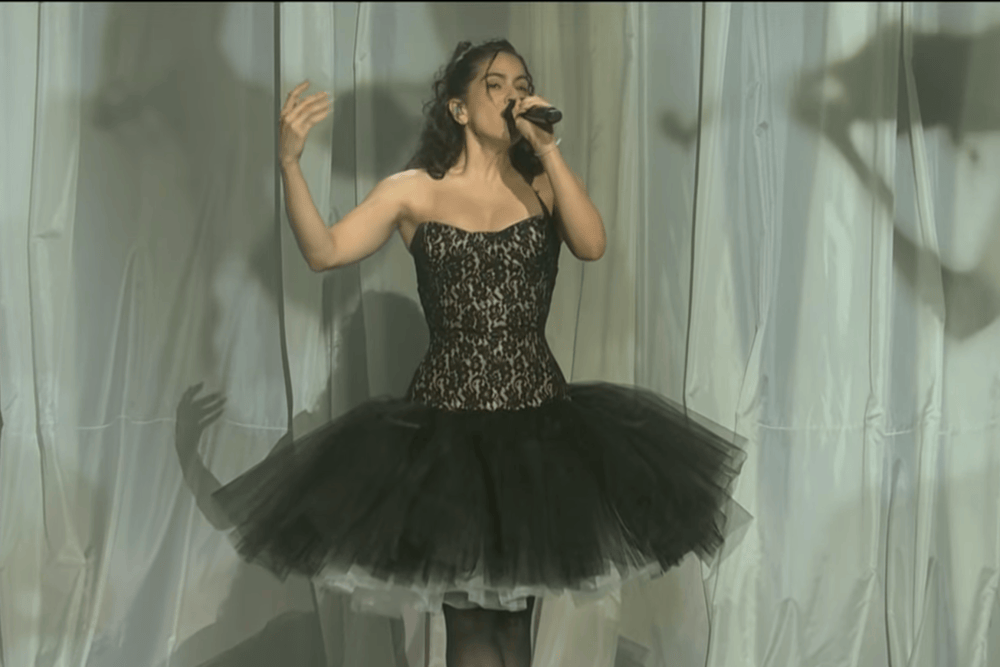
Sabrina Carpenter leaned into a “Thelma & Louise” theme with her weekend-two Coachella appearance Friday by featuring Geena Davis reading the mid-show monologue as an older “Aunt Sabrina,” succeeding last weekend’s guest Susan Sarandon.
The monologue was half the length of Sarandon’s uncomfortably overlong version last weekend, lending credence to rumors that Sarandon had been asked to stretch and improvise due to a technical delay.
Her appearance was doubly a surprise as it came amid hurricane-force rumors that Madonna will be joining Carpenter during the show, which led many to wonder if she would perform the monologue instead of Sarandon, only to find that she was being saved for an actual musical appearance later in the show.
Sitting in one of the 1950s cars that are a theme of Carpenter’s set, amid a makeshift drive-in theater lot in the middle of the field, Davis read through a monologue that preceded largely along the lines of last weekend’s script. However, the young drive-in carhop, played by her former “Girl Meets World” TV costar Corey Fogelmanis, arrived after three and a half minutes instead of seven to help her settle up her tab.
Even though the monologue hit many of the same beats as last week’s, it was paraphrased throughout. Sarandon opened with: “What a moron I was. Running around like nobody’s going to judge you, just bippity boppity boo. When of course, everybody’s judging you.” Davis’ opening: “What a moron. I was running around like that carefree, all hippity, skippity…”
The many trims that cut the speech in half included losing somewhat audience-confusing references to a fictional sister, Laurie, who Sarandon-as-Sabrina said “was always really uncomfortable whenever I was the center of attention. Sometimes she would just ignore what I was doing or other times she would shit on me. And probably she’s putting down my career right now…” Also dropped was the whole wistful/inspirational final part of the monologue, in which Sarandon had spoken of “that little voice (where) you say, fuck it, I can do this. I can do whatever I put my mind to… Why do people stop saying that to themselves when they become 12 years old?”
Later in the set, Will Ferrell was succeeded in his comedic role as an electrician by Terry Crews, playing the same part, but with different dialogue, and without the failed attempt to light a cigarette.
Of course, Madonna ultimately provided the mother of all cameos with a medley/duet of her hits… and extended astrology talk that threatened to erase the memory of any filibustering that might have gone on during Sarandon’s speech the previous week.
Sabrina Carpenter leaned into a “Thelma & Louise” theme with her weekend-two Coachella appearance Friday by featuring Geena Davis reading the mid-show monologue as an older “Aunt Sabrina,” succeeding last weekend’s guest Susan Sarandon.
The monologue was half the length of Sarandon’s uncomfortably overlong version last weekend, lending credence to rumors that Sarandon had been asked to stretch and improvise due to a technical delay.
Her appearance was doubly a surprise as it came amid hurricane-force rumors that Madonna will be joining Carpenter during the show, which led many to wonder if she would perform the monologue instead of Sarandon, only to find that she was being saved for an actual musical appearance later in the show.
Sitting in one of the 1950s cars that are a theme of Carpenter’s set, amid a makeshift drive-in theater lot in the middle of the field, Davis read through a monologue that preceded largely along the lines of last weekend’s script. However, the young drive-in carhop, played by her former “Girl Meets World” TV costar Corey Fogelmanis, arrived after three and a half minutes instead of seven to help her settle up her tab.
Even though the monologue hit many of the same beats as last week’s, it was paraphrased throughout. Sarandon opened with: “What a moron I was. Running around like nobody’s going to judge you, just bippity boppity boo. When of course, everybody’s judging you.” Davis’ opening: “What a moron. I was running around like that carefree, all hippity, skippity…”
The many trims that cut the speech in half included losing somewhat audience-confusing references to a fictional sister, Laurie, who Sarandon-as-Sabrina said “was always really uncomfortable whenever I was the center of attention. Sometimes she would just ignore what I was doing or other times she would shit on me. And probably she’s putting down my career right now…” Also dropped was the whole wistful/inspirational final part of the monologue, in which Sarandon had spoken of “that little voice (where) you say, fuck it, I can do this. I can do whatever I put my mind to… Why do people stop saying that to themselves when they become 12 years old?”
Later in the set, Will Ferrell was succeeded in his comedic role as an electrician by Terry Crews, playing the same part, but with different dialogue, and without the failed attempt to light a cigarette.
Of course, Madonna ultimately provided the mother of all cameos with a medley/duet of her hits… and extended astrology talk that threatened to erase the memory of any filibustering that might have gone on during Sarandon’s speech the previous week.
Sabrina Carpenter leaned into a “Thelma & Louise” theme with her weekend-two Coachella appearance Friday by featuring Geena Davis reading the mid-show monologue as an older “Aunt Sabrina,” succeeding last weekend’s guest Susan Sarandon.
The monologue was half the length of Sarandon’s uncomfortably overlong version last weekend, lending credence to rumors that Sarandon had been asked to stretch and improvise due to a technical delay.
Her appearance was doubly a surprise as it came amid hurricane-force rumors that Madonna will be joining Carpenter during the show, which led many to wonder if she would perform the monologue instead of Sarandon, only to find that she was being saved for an actual musical appearance later in the show.
Sitting in one of the 1950s cars that are a theme of Carpenter’s set, amid a makeshift drive-in theater lot in the middle of the field, Davis read through a monologue that preceded largely along the lines of last weekend’s script. However, the young drive-in carhop, played by her former “Girl Meets World” TV costar Corey Fogelmanis, arrived after three and a half minutes instead of seven to help her settle up her tab.
Even though the monologue hit many of the same beats as last week’s, it was paraphrased throughout. Sarandon opened with: “What a moron I was. Running around like nobody’s going to judge you, just bippity boppity boo. When of course, everybody’s judging you.” Davis’ opening: “What a moron. I was running around like that carefree, all hippity, skippity…”
The many trims that cut the speech in half included losing somewhat audience-confusing references to a fictional sister, Laurie, who Sarandon-as-Sabrina said “was always really uncomfortable whenever I was the center of attention. Sometimes she would just ignore what I was doing or other times she would shit on me. And probably she’s putting down my career right now…” Also dropped was the whole wistful/inspirational final part of the monologue, in which Sarandon had spoken of “that little voice (where) you say, fuck it, I can do this. I can do whatever I put my mind to… Why do people stop saying that to themselves when they become 12 years old?”
Later in the set, Will Ferrell was succeeded in his comedic role as an electrician by Terry Crews, playing the same part, but with different dialogue, and without the failed attempt to light a cigarette.
Of course, Madonna ultimately provided the mother of all cameos with a medley/duet of her hits… and extended astrology talk that threatened to erase the memory of any filibustering that might have gone on during Sarandon’s speech the previous week.
Sabrina Carpenter leaned into a “Thelma & Louise” theme with her weekend-two Coachella appearance Friday by featuring Geena Davis reading the mid-show monologue as an older “Aunt Sabrina,” succeeding last weekend’s guest Susan Sarandon.
The monologue was half the length of Sarandon’s uncomfortably overlong version last weekend, lending credence to rumors that Sarandon had been asked to stretch and improvise due to a technical delay.
Her appearance was doubly a surprise as it came amid hurricane-force rumors that Madonna will be joining Carpenter during the show, which led many to wonder if she would perform the monologue instead of Sarandon, only to find that she was being saved for an actual musical appearance later in the show.
Sitting in one of the 1950s cars that are a theme of Carpenter’s set, amid a makeshift drive-in theater lot in the middle of the field, Davis read through a monologue that preceded largely along the lines of last weekend’s script. However, the young drive-in carhop, played by her former “Girl Meets World” TV costar Corey Fogelmanis, arrived after three and a half minutes instead of seven to help her settle up her tab.
Even though the monologue hit many of the same beats as last week’s, it was paraphrased throughout. Sarandon opened with: “What a moron I was. Running around like nobody’s going to judge you, just bippity boppity boo. When of course, everybody’s judging you.” Davis’ opening: “What a moron. I was running around like that carefree, all hippity, skippity…”
The many trims that cut the speech in half included losing somewhat audience-confusing references to a fictional sister, Laurie, who Sarandon-as-Sabrina said “was always really uncomfortable whenever I was the center of attention. Sometimes she would just ignore what I was doing or other times she would shit on me. And probably she’s putting down my career right now…” Also dropped was the whole wistful/inspirational final part of the monologue, in which Sarandon had spoken of “that little voice (where) you say, fuck it, I can do this. I can do whatever I put my mind to… Why do people stop saying that to themselves when they become 12 years old?”
Later in the set, Will Ferrell was succeeded in his comedic role as an electrician by Terry Crews, playing the same part, but with different dialogue, and without the failed attempt to light a cigarette.
Of course, Madonna ultimately provided the mother of all cameos with a medley/duet of her hits… and extended astrology talk that threatened to erase the memory of any filibustering that might have gone on during Sarandon’s speech the previous week.
After rumors swirled that she would appear at Coachella weekend one, Madonna made a cameo during Sabrina Carpenter’s headlining performance on Friday night, emerging near the end of the set to perform “Vogue,” “Like a Prayer” and a new duet.
Carpenter was midway through “Juno” — typically the song on her “Short ‘n Sweet” tour where she’d “arrest” a different celebrity — to bring out Madonna. The pop queen emerged through the middle of the stage to sing “Vogue,” joining Carpenter to debut a new duet that’s rumored to be on the singer’s upcoming album “Confessions II.” Then, Madonna took the mic to give an extended address to the audience.
“So 20 years ago today I performed at Coachella,” said Madonna. “I was in the dance tent and it was the first time I performed ‘Confessions on a Dance Floor Pt. 1’ in America, and that was such a thrill for me, so you can imagine what a thrill it is to be back 20 years later in the same boots, with the same corset, the jacket I had on earlier, a Gucci jacket. So it’s like a full circle moment, you know? Very meaningful for me.”
After Madonna gave an astrology lesson (literally), the two joined forces to duet on her classic “Like a Prayer,” with backup dancers dressed in habits sauntering down from the back of the stage. “The great thing about music is that it brings people together. Am I right?” said Madonna. “It’s the one place that people have to put their differences aside. Put their shit down and everyone just have a good time togehter, right? So I am thrilled to be a part of that healing experience of bringing people together. I just want to say, four lines from my ‘Confessions 1’ record. It goes like this. Can we get together? I really, I really want to be with you. Come on check it out with me, I hope you, I hope you feel the same way too.”
As she said, Madonna’s appearance during Carpenter’s set comes 20 years after her Coachella debut in 2006, when she popped up at the Sahara Tent instead of the main stage to perform cuts from “Confessions on a Dance Floor.” She later returned to the desert for a surprise cameo during Drake’s closing set in 2015, singing “Human Nature” and “Hung Up” and, in one of the most talked-about moments that year, kissed Drake.
The timing of Madonna’s return to Coachella aligns with the announcement of her upcoming album “Confessions II” earlier this week. The project, slated for July 3 via Warner Records, marks her first full-length album in seven years and her reunion with Stuart Price, the producer of the original “Confessions on a Dance Floor.” Earlier on Friday, Madonna premiered the song “I Feel So Free” on iHeartRadio’s Pride Radio, giving a first taste of the project.
Leading up to her Coachella performance last weekend, Carpenter dropped the video for “House Tour,” the latest single off of last year’s “Man’s Best Friend.” In the clip, she has a girls’ night out with Margaret Qualley and Madelyn Cline, ransacking a stranger’s house and stealing a Grammy.
Carpenter previously performed at Coachella in 2024, foreshadowing that she’d one day take top billing during a custom outro for “Nonsense”: “Made his knees so weak he had to spread mine / He’s drinking my bathwater like it’s red wine / Coachella, see you back here when I headline.” This year’s headlining gig comes after a busy few years for the singer, who kicked off her “Short ‘n Sweet” tour — her first arena trek — in September 2024. She stayed on the road through the end of 2025, when she closed the tour with six nights at Los Angeles’ Crypto.com Arena just a week before she was celebrated as Variety‘s Hitmaker of the Year.
A federal judge in Sacramento has issued a preliminary injunction against Nexstar‘s acquisition of Tegna TV stations as part of DirecTV‘s lawsuit to block the merger of TV station groups.
U.S. District Court Judge Troy Nunley of California’s Eastern District issued the 52-page ruling late Friday, siding with DirecTV’s argument that allowing Nexstar to move forward with its integration of Tegna’s 64 stations could bring “irreparable harm” to DirecTV. Nexstar has vowed to appeal.
On March 19, Nexstar announced its acquisition of Tegna was complete despite the litigation in California and other states to block the deal. On its face, Nexstar’s absorption of Tegna puts the combined company beyond the FCC’s existing limits on the number of TV stations that a single entity can own. But the FCC is actively reviewing those ownership limit rules. Nexstar moved forward with its purchse of Tegna in a bold gamble that the rules would be changed and thus the merger would win federal approval, which it did. The FCC and Justice Department gave their greenlights to the purchase. But eight state attorneys general and DirecTV are pushing back hard.
On March 27, Nunley granted a temporary restraining order against Nexstar’s integration. The preliminary injunction strengthens the court order for Nexstar to halt all integration efforts with Tegna. The ruling also explores the impact of the deal on local news, given that Nexstar has a history of consolidating newsgathering activity across markets and regions. The impact of the merger on local news is the primary focus of the lawsuit filed by Bonta and his counterparts in New York, Colorado, Illinois, Oregon, North Carolina, Connecticut, and Virginia.
For DirecTV, the focus is on the enlarged Nexstar’s ability to raise the retransmission consent rates that it charges cable operators and satellite providers such as DirecTV to carry its local stations.
“The Court agrees with Plaintiffs that Defendants’ integration efforts are exactly those that would make it more difficult to divest Tegna stations, as they will eliminate competition and result in newsroom layoffs and shutdowns,” Nunley wrote. “The Court also notes Plaintiffs filed the instant suits prior to Defendants’ consummation of the Transaction. Accordingly, Defendants could have waited seven days to complete the acquisition or begin integration efforts until after this Court ruled on Plaintiffs’ motions for TRO. Therefore, especially in light of the fact that Plaintiffs raise a likelihood of success on the merits of their claims and establish an injunction is in the public interest, the Court agrees with Plaintiffs that the private benefits Nexstar could obtain by acquiring Tegna are outweighed by the harm to Plaintiffs.”
Nexstar is the nation’s largest TV station owner with nearly 200 outlets across the country. Tegna owns Big Four network affiliate stations in key major and medium-size TV markets including Washington, D.C., Houston, Dallas, Seattle, Denver and Phoenix.
“This transaction closed more than four weeks ago following receipt of all required regulatory approvals from the Federal Communications Commission and the U.S. Department of Justice. Nexstar Media Group now owns Tegna and has taken steps consistent with the Court order that has been in effect,” Nexstar said in a statement. “For nearly thirty years, Nexstar has provided free over-the-air access to all its broadcast stations — local news, weather, and community-focused programming alongside major network programming. This procompetitive transaction will make local stations stronger and support continued investment in local journalism and fact-based news. We will appeal today’s decision and look forward to presenting our case on its merits before the Ninth Circuit Court of Appeals.”
DirecTV, on the other hand, was quick to praise Nunley’s ruling.
“We commend the court’s decision, which reinforces the coalition of states’ and our shared belief that unchecked station consolidation will force consumers to pay more for less by reducing the quality and variety of local news coverage, driving up content prices, and increasing the threat of station blackouts,” DirecTV said. “DirecTV remains committed to a competitive, diverse, and affordable media landscape for all Americans.”
Rob Bonta, California’s Attorney General, called Nunley’s ruling “a critical win” for the plaintiffs.
“My office and attorneys general nationwide have secured a preliminary injunction in our lawsuit opposing the illegal and U.S. DOJ-approved merger of Nexstar/Tegna — an order that demands the broadcasting titans stop merging while our case proceeds. This is a critical win in our case,” Bonta said. “This merger is illegal, plain and simple. The federal government may have thrown in the towel, but we’ll keep fighting for consumers, for workers, for affordability and for our local news.”
Rapper Ice Spice has spoken out about an altercation that took place at a McDonald’s, addressing the incident on social media along with a clip of a new song.
She took to X on Friday evening to make light of the situation and diffuse the drama surrounding it, including a clip that circulated widely on social media. “This wouldn’t happen at a Wendy’s,” she wrote, no doubt inspired by her partnership with the fast food chain.
The video clip came to light via TMZ, showing Ice Spice sitting in a booth at a Hollywood McDonald’s early on Wednesday morning. In the footage, a woman approaches the rapper and seemingly attempts to sit next to them, only for Ice Spice to point her towards the door. The woman then slapped Ice Spice, who chased after her by climbing across the booths and tables in the establishment. Outside of the McDonald’s, the fight continued as it appeared that Ice Spice was pushed onto her back.
In a statement to Billboard, her attorney, Bradford Cohen, said they will “hold the perpetrators responsible for their actions.” “The unprovoked attack on my client has been reported to the LAPD and we will be pursuing any and all criminal and civil avenues to hold the perpetrators responsible for their actions,” he said. “We are also exploring holding the location responsible for their apparent lack of appropriate security.”
He continued, “Not to mention that the individuals involved obviously did not realize that we would get the video from inside the McDonald’s where the unprovoked attack occurred. They then turned their cameras on after the initial attack as if to set our client up, and as they say on the video to ‘go viral.’ The only thing that will be going viral for them is their mugshots.”
Representatives for Ice Spice did not respond to Variety‘s request for comment.
The Guadalajara Film Festival’s (FICG) prominent LGBTQ+ strand, the Premio Maguey, is marking its 15th year, a milestone they have dubbed Queerciañera, fusing the words queer and quinceañera, Latin America’s hallowed coming-of-age celebration for girls turning 15.
Since it was launched in 2012, the first queer film award to be launched in Mexico and Latin America has grown in stature, establishing itself as one of the festival’s strongest sidebars.
Reflecting on this all-important milestone, its director Pavel Cortes said: “Talking about the impact that the Premio Maguey has had on Guadalajara and the rest of the country might seem rather pretentious. However, its social contribution to the legitimization of sexual diversity and queer culture—both locally and nationally—is undeniable.”
Its impact underscores cinema’s role as a powerful tool for social transformation, he added.
“Unfortunately, it continues to be a very important and necessary award, even though over these 15 years of the Premio Maguey we have witnessed the transformation of the world in relation to sexual diversity—acceptance remains a matter of privilege.”
“Mexico remains an intolerant country toward sexual diversity,” he asserted, “with a significant record of hate crimes and transfemicides.”
Premio Maguey launched at a time when the topic was still taboo in the country, subjected to segregation and marginalization, he said. “Since then, national queer film production has consolidated and, in this edition, we present seven Mexican films out of the 16 that make up our official competition for Best Film, the Jury Prize and Best Performance.”
The 15th edition features a selection of fiction, documentary and short films with stand-outs among the Mexican productions and those focusing on transmasculine parenthood: Sharon Kleinberg’s “I Am Mario (Mexico) and Daniel Ribeiro’s “I Will Miss You” (Brazil) as well as the short film among the special screenings, “Alex,” (Mexico), which follows Alex, a non-binary person, who becomes pregnant and sets out to get an abortion.
Alejandro Amenábar’s Oscar-winning “The Sea Inside” and “On the Road,” David Pablos winner of the Venice Orizzonti Award for Best Film and the Queer Lion Award, are among the special screenings slated for this edition.
FICTION
Eruption (“Erupción”) Pete Ohs, U.S., Poland A Polish florist and a British tourist spark an unexpected romance through chance encounters and fleeting, magical moments.
‘Eruption’ Courtesy of FICG
I Am Mario (“Soy Mario”) Sharon Kleinberg, Mexico Mario, a forty-year-old trans taxi driver, faces an unexpected pregnancy that opens the possibility of fulfilling his dream of becoming a father.
I Will Miss You (“Eu vou ter saudades de você “) Daniel Ribeiro, Brazil After seven years together, Amanda and Caio move in together, but love is not enough. When João enters their lives, their relationship is tested and transformed.
Iván & Hadoum (“Iván & Hadoum”) Ian de la Rosa, Spain Iván, a trans man working in greenhouse warehouses, falls in love with Hadoum, a Spanish-Moroccan coworker. Against family opposition, they pursue their relationship between greenhouses and seaside landscapes.
Like a Kite (“Feito pipa”) Allan Everton, Brazil Gugu dreams of becoming a great footballer. Raised freely by his grandmother, he will do whatever it takes to avoid living with his father.
No Dogs Allowed (“No se permiten perros”) Steve Bache, Germany Gabo, a seemingly ordinary 15-year-old, develops disturbing tendencies and forms a troubling bond with an older man. When the man is arrested, Gabo must decide whether to testify or protect his own dark secret.
‘No Dogs Allowed’ Courtesy of FICG
On the Sea (“En el mar”) Helen Walsh, U.K. A poetic exploration of masculinity and desire within a remote fishing community of stark and untamed beauty.
Pioneers (“Pioneras”) Marta Díaz de Lope Díaz, Spain In early 1970s Spain under Franco’s regime, a group of young women defy societal norms to play football, finding an unlikely ally and laying the groundwork for the future of women’s football.
The Circle of Liars (“El círculo de los mentirosos”) Nancy Cruz Orozco, Mexico Cecilia arrives in the city aspiring to be a writer and meets Nicolás and Aristeo, two young poets who claim to be the founders and sole members of an underground ultraist movement.
Wanted (“Se busca”) Kenya Márquez, Mexico René, a lonely teenager, runs away from home to Ciudad Juárez, where an inner calling leads her on a journey of self-discovery.
What They Leave Us (“Lo que nos van dejando”) Issa García Ascot, Mexico A biologist is forced to travel to the jungle, where she confronts deeply buried memories from her past.
DOCUMENTARY
“Cuba Street” (“Calle Cuba”) Vanessa Batista, Chile, Cuba, Mexico Four women, one street and an entire country pulsing between invisible wounds and the dream of resistance
“I Have Two Dads” (“Yo tengo dos papás”) Edgar Reyes, Mexico The story of Santiago: from abandonment to the embrace that transforms his destiny
“Mickey” (“Mickey”) Dano García, Mexico A decade-long collage by two friends becomes a film exploring Mickey’s self-discovery and the journeys of those who grew up with her
‘Mickey’ Courtesy of FICG
“Our Body is a Star that Expands” (“Nuestro cuerpo es una estrella que se expande”) Semillites Hernández Velasco, Tania Hernández Velasco, Mexico Tania and her brother Semillites confront childhood rejection and question their bodies through collage, animation, dance and intimate documentary, creating a sensorial exploration of identity
“Shelter” (“Cobijo”) Adrián Silvestre, Spain Cecilia joins a youth poetry movement in the city that becomes corrupted by envy as she studies to become a writer
SPECIAL SCREENINGS
“Alex” Natalia Bermúdez, Mexico Alex, a non-binary person, becomes pregnant and embarks on a journey to have an abortion with the support of their aunt Salome, a traditional doctor
“A Teacher’s Gift” Artur Ribeiro, United Kingdom, India In London, a Hindi teacher torn between duty and desire forms an unexpected bond that leads him to India
“Flowers” (“Flores”) Job Samaniego Rivera, Mexico After a magical encounter with a flower, Moisés and his daughter Samy embark on a journey of discovery and transformation Through an ancient tale seen through Samy’s eyes, a colorful world emerges, allowing Moisés to accept himself and finally see Samy for who she truly is
“Lemebel” (“Lemebel”) Joanna Reposi Garibaldi, Mexico The story of writer and visual artist Pedro Lemebel, from the founding of the collective Las Yeguas del Apocalipsis during the dictatorship to his death in 2015 from cancer
“On the Road” (“En el camino”) David Pablos, Mexico A drifter who sleeps with truck drivers meets a reserved driver and joins him transporting goods in northern Mexico As they grow closer on the road, the drifter’s past threatens them both
“The Sea Inside” (“Mar adentro”) Alejandro Amenábar, Spain, France, Italy A portrait starring Javier Bardem of Spaniard Ramón Sampedro, who fought for 30 years for euthanasia and his own right to die. An Academy Award Foreign-Language Feature winner.
“When You Get Home” (“Cuando llegue a casa”) Edgar Adrián, Mexico A teenager in Guadalajara explores identity between friendship and desire. During temple festivals, this search puts their relationship with their grandmother at risk.
Pedro Pascal wasn’t about to sit around and wait for invitation to be a part of Bad Bunny’s Super Bowl Halftime show. Instead, the “Last of Us” star reached out to the Grammy-winning superstar’s team.
“I wanted to participate in any way – literally a volunteer position, like serving coffee if needed – and I put the feelers out through people I work with,” Pascal says in the new issue of Fantastic Man magazine. “When it comes to representation synchronized with celebration there’s no one better than Benito at the moment, and that fills me with inspiration outside of just being super into his music.”
However, Pascal didn’t hear back right away. After wrapping Tony Gilroy’s upcoming “Behemoth,” Pascal said, ” I was lamenting about not hearing back and I sent someone an email with a selfie of me sticking my tongue out, being, like, ‘It’s really me.’ Within 25 minutes, they called me back and they were like, ‘We want you to come to the show.’”
His only instruction was to wear beige on the big day. “We’re up in the stands watching the game and somebody pulls me from my seat and takes me backstage and then there’s Cardi B and there’s Young Miko and Karol G and Jessica Alba,” Pascal recalled. “They do a wardrobe check and then they tell me, ‘OK, so the vibe is: you’re dancing.’ I started to realize right before they started, and I was like, ‘It’s the Casita. I’m such a fucking idiot. Oh my god, I’m going to be in the Casita,’ as I was being marched out into the field. So I think that’s why I seemed like a deer in headlights.”
Ethan James Green / Fantastic Man
In the same interview, Pascal also talked about experiencing fame at an older age than most of his peers. “I think there are two ways of looking at it,” said Pascal, who turned 51 on April 2. “There’s a universal feeling of imposter syndrome that we all can experience when we’re being unkind to ourselves, especially if it’s somehow uncomfortable to get what you want. Then the kinder side of it is that, as old as I feel, and as silly as some of it can be – because of ‘What is a 50-year-old man doing dancing in La Casita?’ – I’m incredibly grateful for having been a fully developed character before experiencing any kind of large-scale exposure. I’m kind of out of the oven, already baked. I was 38 years old when I got the part of Oberyn Martell [in ‘Game of Thrones’].”
Ethan James Green / Fantastic Man
He talked about the many waitering and bartending jobs he held in New York City. “It was paycheck to paycheck, but the theatre work became somewhat consistent for a few years,” Pascal said. “And then you always felt like it was this enormous score if you got an episode of ‘Law & Order’ or something. I was scraping by. I got bailed out a lot over the years by my sister and friends.”
Pascal was asked about his signature mustache. “I’d never had the courage to sport facial hair of any kind because I felt like I grew such weak facial hair. To this day, I can’t grow a proper beard,” he said. “The role where I was assisted with specific facial-hair grooming was that of Oberyn Martell. Then came ‘Narcos’, in which I felt like a moustache was completely fitting for the period. So now I sort of cling a little to the vanity of having some definition in the face with my very weak, patchy facial hair. But if the role calls for it, it can all disappear.”
Ethan James Green / Fantastic Man
On a more serious note, Pascal explained why he’s so outspoken about progressive politics. “I think staying quiet is the harder path,” the actor said. “I would have too hard of a time living with myself. It’s the way I was raised. Decency and compassion. The idea of the vulnerable being scapegoated and terrorized in this way is unspeakably painful.”
British actor David Jonsson is only five films into his career, but you’d already know his gaze anywhere: Even in a film as spry and bright as the 2023 romcom “Rye Lane,” those crinkly, softly drooping eyes bring an air of old-soul melancholy to proceedings. But they’ve never borne quite as much sorrow as they do in “Wasteman,” a coolly brutal prison drama that follows a pretty rusty narrative template — hardened inmate on the brink of parole struggles to stay on the straight and narrow — but finds more interest in the dueling masculine energies of its two principal stars. If Jonsson, as the nearly-free man in question, is all guarded regret and head-down resilience, Tom Blyth is his lethal opposite number: As a near-feral cellmate from hell, he’s the disruptive force that gives an otherwise predictable film a spark of erratic danger.
Though Jonsson and Blyth’s stealthily adversarial, hot-and-cold double act represents the chief selling point of “Wasteman” — which premiered at last year’s Toronto festival and hit screens in its native U.K. back in February — the film is most emphatically a calling card for first-time feature director Cal McMau, who picked up a surprise win for Best Debut Director at last year’s British Independent Film Awards (beating the more hotly tipped likes of Akinola Davies Jr. and Harry Lighton) en route to a nomination in the BAFTAs’ equivalent category. An artist turned commercials director, he handles proceedings here with equal parts grit and polish, smoothly integrating multiple shooting formats and implied points of view — with an emphasis on vertical cellphone footage that gives us a bristlingly immediate sense of life on the inside.
Slightly less persuasive, however, is the script by Hunter Andrews and Eoin Doran, also taking their first feature credit. Trading in starkly opposed male archetypes but scantly developed characters, it builds some claustrophobic drama around inmates’ jostling for alpha status within these bleak, blue-washed walls, though it’s only glancingly attentive to the systemic failures governing this sordid battle royal, or more specific, unspoken social and racial conflicts presumably coursing through a pressure-cooker microcosm of modern British manhood. (Give or take the flavorful accents, the tone of the drama here is most reminiscent of that decades-old HBO TV provocation “Oz.”)
Jonsson plays Taylor, a watchful, aged-beyond-his-years introvert who has spent 13 years behind bars on a manslaughter charge — missing almost the entire life of his teenage son Adam (Cole Martin), from whom the boy’s mother is determined to keep him estranged. He’s a quiet prisoner if not exactly a model one, with an opioid addiction he can’t kick, funded by his stoic work as a barber to his fellow inmates. When he’s informed that he’s soon to be up for parole — due less to his own good behavior than a need to free up prison space — he’s cautioned not to put a foot wrong; receding into himself is the safest course of action.
It’s a bad time, then, to be paired with a new cellmate, particularly an unholy terror like Dee (Blyth), a grinning, nihilistic thug with a taste for living large — which, in prison confines, amounts to an in-cell air fryer and a shelf for his impressive sneaker collection — and a steady supply of drugs that soon makes him the most popular dealer on the wing, to the consternation of former big dogs Gaz (Corin Silva) and Paul (Alex Hassell). Generous with his stash and with access to his phone — which Taylor uses to communicate with Adam on social media — Dee ropes the addict into his trade, though their tentative friendship is soon subsumed into the prison’s overriding culture of violence.
With his gangly, clammy physicality and strident delivery, Blyth is an electrifying hair-trigger antagonist, jump-starting each scene he’s in and even contributing some leering wit to an otherwise stern affair. “I don’t need to be careful,” he brags to the walking-on-eggshells Taylor: For Dee, being beyond redemption is a point of pride. The actor can’t, however, find much semblance of humanity in this flatly vicious figure, who ultimately serves to highlight the manifold vulnerabilities of our flawed but contrastingly soulful hero, played by Jonsson with a tight, walled-off reserve that seems liable to break at any given moment.
That palpable desperation is compounded by the sheer airlessness of Phoebe Platman’s production design and Lorenzo Levrini’s prowling cinematography, which permits only the odd, stray shaft of natural light into this dank, metallic-hued world. The most explosive setpieces here are the pummelling prison riots, which Levrini charges into with handheld gusto, but the film feels rawest and realest in recurring interludes where the aspect ratio narrows and McMau views prison life (some of it battering, some of it banal) through the grainy lens of the inmates’ devices. A more unusual, subversive work might have stuck to this conceit throughout, but “Wasteman” finds some relief in formal convention.