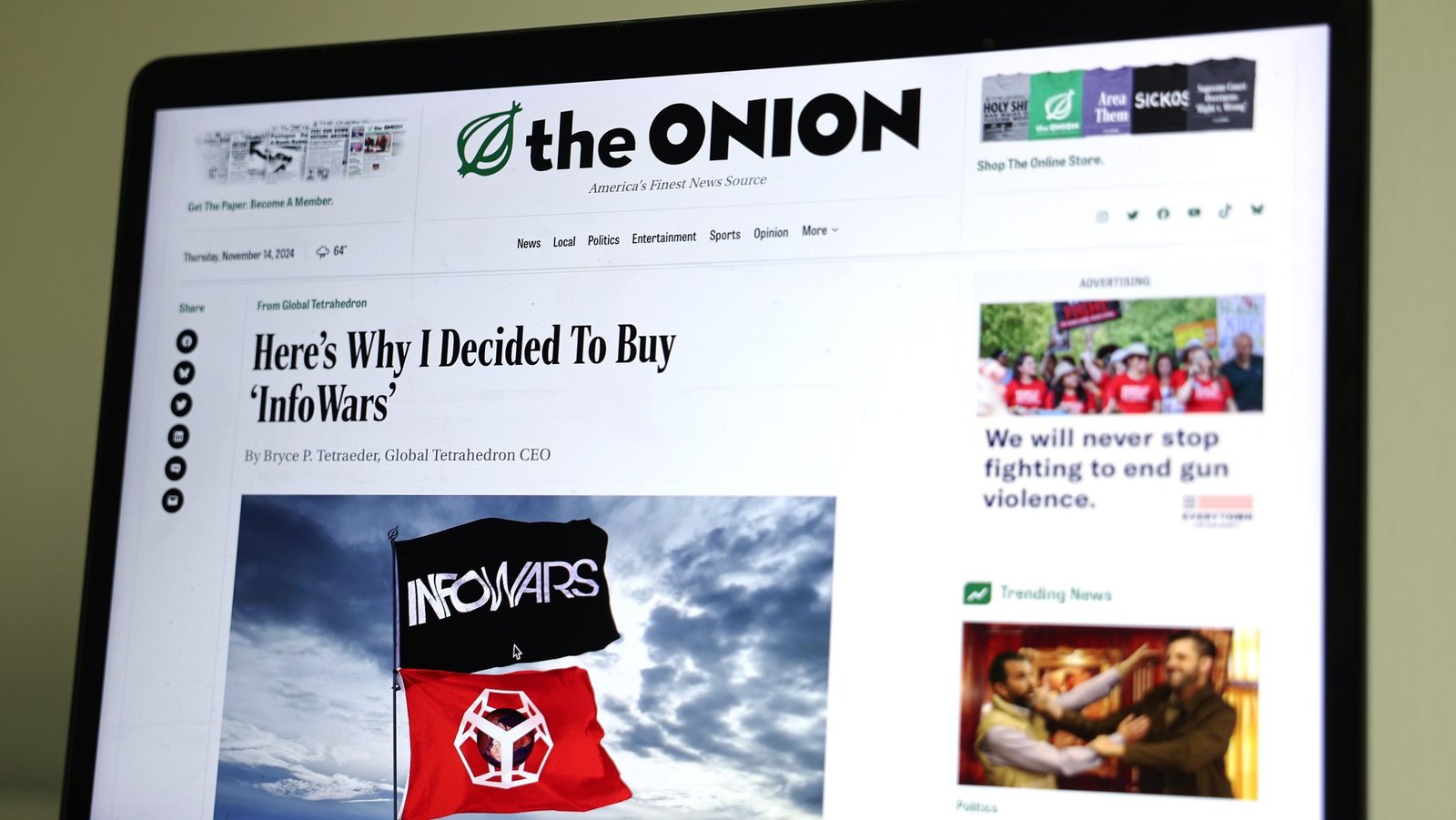
Infowars host Alex Jones on Monday went shirtless as he reacted to a deal unveiled earlier that day by The Onion to acquire his right wing-centric brand and website from bankruptcy.
“Look, just because you’re wearing my shirt don’t mean you’re me, so let’s be 100 percent clear about that,” the Infowars founder and host declared during a livestream on X. Earlier that day, The Onion and its parent company Global Tetrahedron announced a licensing deal for the company’s brand names and IP, including its website. The pact comes nearly a year and a half after The Onion’s prior effort to acquire Infowars was nixed by a bankruptcy judge.
The Jones-founded outlet has been in receivership after the families of Sandy Hook victims successfully sued it into bankruptcy. This new deal with The Onion, though, requires court approval, which has left Jones fuming about what satirical outlet has in store for his website should a judge agree to its proposed takeover.
“They’re gonna misrepresent that they’re us to confuse people and quote, ‘Rip people off like Alex Jones did.’ They’re gonna make money. The whole thing’s about defaming me. You can’t take something over and then act like you’re somebody, even if you say it’s a parody. You could do a parody of somebody, but not if you took something from them,” Jones argued.
The licensing deal will see The Onion pay a $81,000 monthly fee to the bankruptcy manager for the brand for six months, with the option to extend it for another six months. In addition, comedian Tim Heidecker has been attached as Infowars’ creative director.
The bankruptcy proceedings were the result of the defamation lawsuit filed by the families of the Sandy Hook victims against Jones. The latter had claimed that the 2012 school shooting was a “hoax” and was staged by actors. Several families successfully sued Jones for defamation and emotional damages, and in 2022 won a $1.4 billion defamation lawsuit against Jones and his company, Free Speech Systems. Jones declared bankruptcy in 2022, leading to the selling off of his assets to pay his creditors.
Jones on his X livestream said The Onion with its subversive comedy aimed to confuse audiences about Infowars. “They’re body snatchers. They may try to take our clothes, we’re still the Infowars,” he added amid attempts to continue operating Infowars should the website be taken over by the satirical publication.
Reese Witherspoon went viral last week — nearly five million views on Instagram and countless more when her comments were shared across platforms — for suggesting that her followers embrace and learn how to use artificial intelligence. “It’s time. It’s time, people,” she said in an IG Reel.
While some of her famous friends loved the seemingly organic promotion (“THIS,” commented Kerry Washington), not everyone was as enthusiastic. The backlash spread pretty far and wide as many on social media criticized Witherspoon for a multitude of reasons from the impact AI data centers have on the environment to how AI companies have stolen artists’ intellectual property to feed and train models, and more. Others flagged it as suspicious, questioning the timing and whether or not she has a partnership with AI companies.
Well, the Oscar winner has seen the backlash and responded. “Well, I guess my AI post got people talking,” Witherspoon posted on Instagram Stories on Monday. And she directly addressed whether or not she was being paid to promote AI, a claim that surfaced after her comments went viral and gained even more traction after Sandra Bullock said at CNBC’s Changemakers event that it’s time to lean into AI. “We have to use it in a really constructive and creative way, make it our friend,” Bullock said. The back-to-back AI promotion inspired theories that the Oscar winners were being paid to promote AI. Not so fast, Witherspoon said.
“To be clear, no one is paying me to talk about this,” stated her post. “I’m just a curious human. My kids are learning about AI tools, I know a lot of founders who are vibe coding, and I hear about people using AI in EVERY sector of business.”
Witherspoon also directly addressed some of negative impacts AI is having on employment and the environment. “But I want to acknowledge people’s concerns, they are valid. I’m aware of the impact this could have on jobs across so many industries. I understand environmental concerns. I care deeply about local communities. And I have concerns about impending [artificial general intelligence].”
She continued: “I don’t believe computers should replace humanity. I’m planning on learning as much as possible so that I’m educated about this technological revolution. If you want to learn with me, great, let’s do this! If you don’t, that’s okay too.”
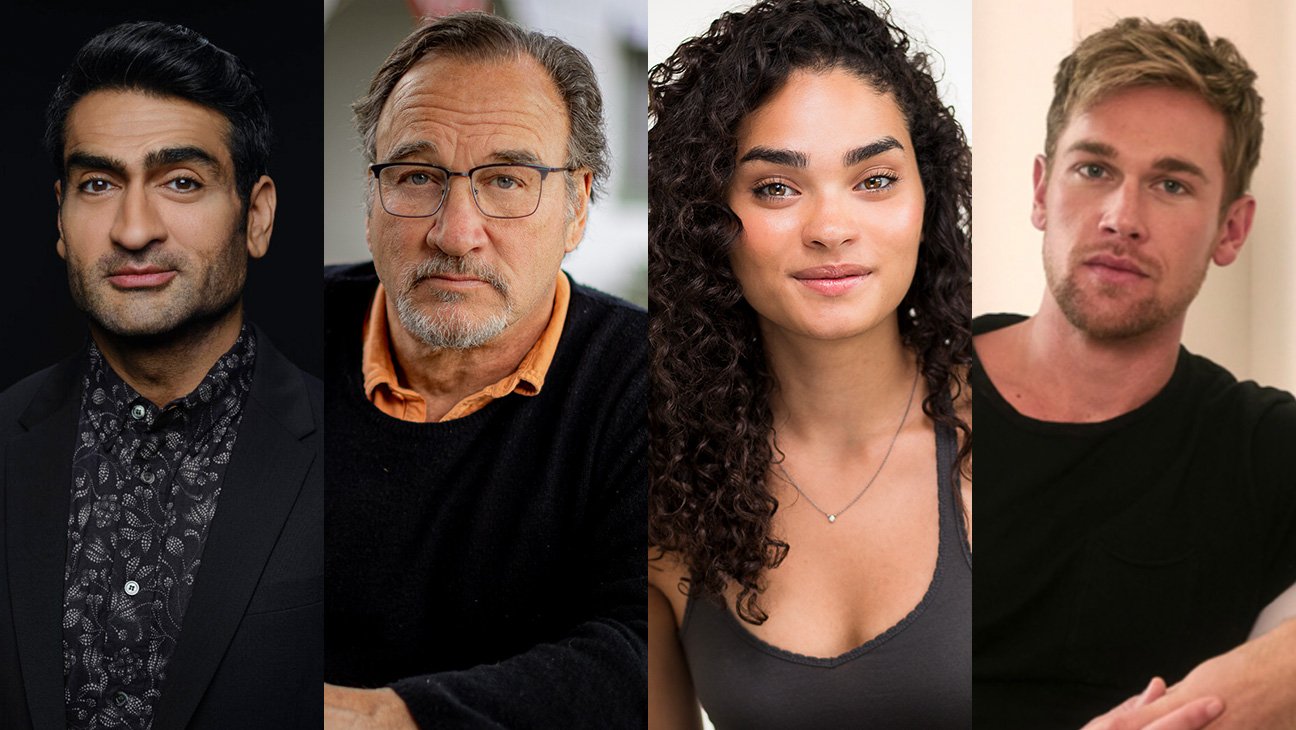
Kumail Nanjiani, Jim Belushi, Brittany O’Grady and Taylor John Smith have joined Tatiana Maslany in Green Bank, an independent sci-fi horror thriller Pangaea Studios, Big Swell Entertainment and Nocturnal Kid.
Josh Ruben, who previously helmed the rom-com slasher Heart Eyes, is directing the feature, which is begins production this week at Pangaea Studios in Atlanta.
Written by Aaron Horwitz (The Cleansing Hour), Green Bank is set in Green Bank, West Virginia, a real world town that has been known since the late 1950s for having a “quiet zone” that severely limits radio and electronic transmissions due to scientific research being conducted in the area. It has since been expanded to include Wi-Fi and cell service.
O’Grady is playing the lead of the story, which follows infant sleep-trainer who discovers that the parents of the child she is caring for are far more than the clueless yuppies they appear to be.
Producing are Andy Horwitz (Suicide Squad, Triple Frontier) of Big Swell Entertainment, Jack Greenberg (Speed The Plow) of Pangaea Studios, and Ruben via his Nocturnal Kid banner. Steve Greenberg is executive producing.
The below-the-line team includes director of photography Magdalena Górka (Star Trek: Strange New Worlds, Marvel Studios’ Echo), production designers Hillary and Courtney Andujar (I Know What You Did Last Summer); VFX producer Chris LeDoux (La La Land, 12 Years A Slave), and casting director Chrissy Fiorilli-Ellington (Die Hart).
Spoiler! There are creatures in this feature. And the creature effects are being overseen by legendary effects artist Greg Nicotero and team at KNB EFX Group, who are known for their work on The Walking Dead and Fallout, among a host of award-winning work.
UTA Independent Film Group is repping the feature.
Nanjiani last year appeared in James L. Brooks’ Ella McCay and Amazon’s hit series Fallout. He is repped by UTA and Mosaic.
Belushi last year appeared with Kate Hudson in Song Sung Blue and in Kristen Stewart’s feature directorial debut, The Chronology of Water. He is repped by CAA, Brillstein Entertainment Partners and LBI.
O’Grady is best known for starring in Fox’s musical series Star as well as being one of the leads on the first season of HBO’s White Lotus. She will next be seen in the next Jumanji movie, Jumanji: Open World, which is due to open Dec. 25. She is repped by CAA and Suskin/Karshan Management.
Smith appeared in 2022’s Where the Crawdads Sing as well as Alex Garland’s Warfare. She is repped by CAA and Vybe Trybe.
Richard Russell is a folk hero to some folks — including more than a few of the wrong ones — but he’s just “Beebo” to the loved ones he left behind.
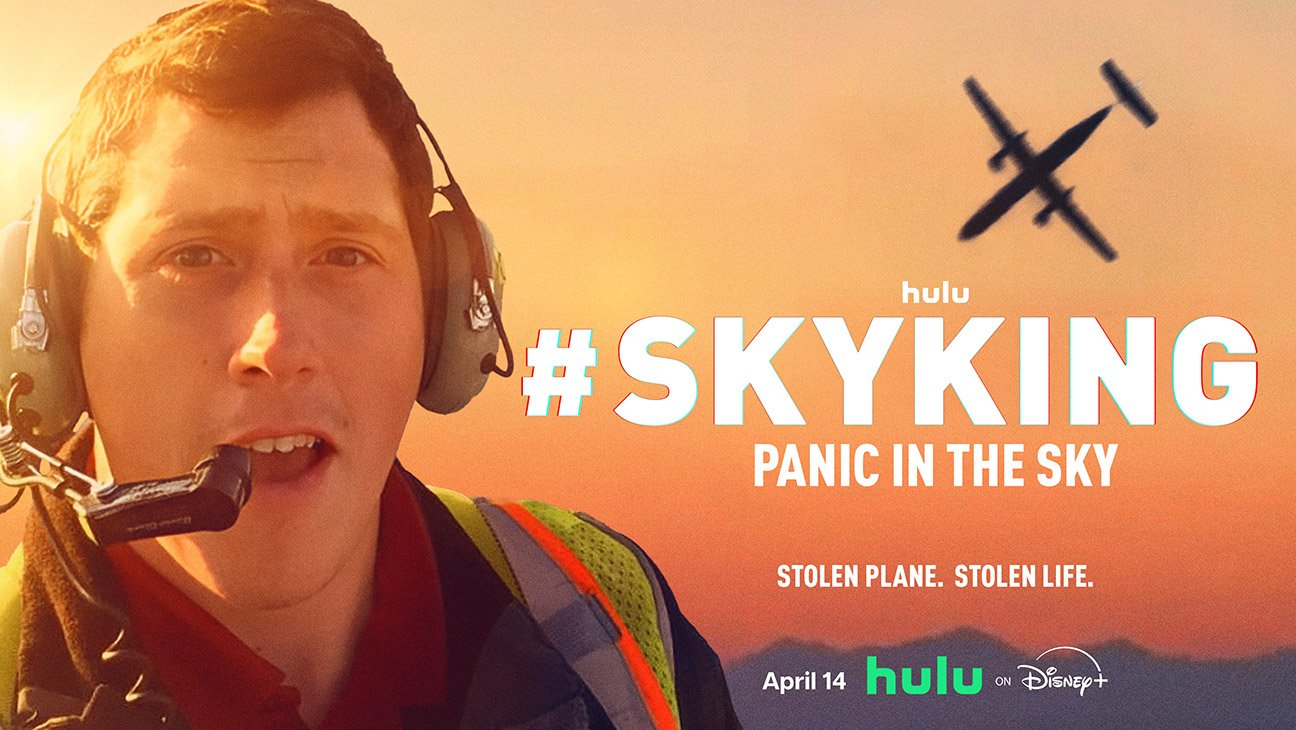
In 2018, the 28-year-old Horizon Air (a subsidiary of Alaska Air) ground service agent clocked into work wearing a shirt that said “The sky’s no limit,” stole a $33 million plane (a Bombardier Q400), and took off into the skies of the Pacific Northwest. There was just one problem (OK, so there were numerous problems, but starting with) … Russell did not know how to fly an airplane. Or at least how to land one.
After a few-hour joyride (as joyous as one can be on a suicide flight) around the mountains and over the water, Russell crashed into the side of a sparsely populated island. He did not attempt to land — Russell chose death over prison, and as a way to escape his personal prison of depression.
Along the way, Russell made a few statements to air traffic control that have lived on. One in particular has completely clouded reality, #SkyKing director Patricia E. Gillespie tells The Hollywood Reporter, turning a mental health issue into a race issue.
Read our Q&A below.
***
I either never heard this story or it went in one ear and out there other — what does that say about me? Or perhaps about society if it’s not just me?
You know what’s interesting? My friends back home — I grew up working class — and my friends back home all knew it. My friends from, you know, the city and the industry and college — I was really lucky, I got to go to NYU and do all that — they did not know it. And so I think it actually says something about the echo chambers we all live in, where the stories gain traction and where they’re discussed, and what some of us that are higher up on the economic ladder don’t hear versus those of us who are in the trenches hear.
Is that simply because Beebo is something of a blue-collar folk hero?
Well, he’s a lot of different things to a lot of people. This film really tries to emphasize that he was a human man, and though you can use him in all these different contexts — some of them true and fair, some of them untrue, some of them productive, some of them quite dangerous — at the end of the day, none of those things really encompass his humanity. Our documentary tries to do that.
I’ve seen some criticism online like, “So he steals an airplane, commits suicide … and gets a documentary?!?”What is your response to that take?
I hope they take a moment to watch the film because the film works very hard to address the fact that suicide — it’s not the end of your pain. It passes the pain on to people who love you the most.
The film also — I hope on some level, for people who are willing to engage with it — highlights the fact that when we do have these hot takes, a lot of the time we miss the deeper story. In this case, people were so quick to sensationalize and politicize and quick to take a stand before they have facts. As a result, you missed a really important story about class and its intersection with mental health. The media approaches these stories in kind of an uncurious way. When we approach these things with curiosity instead of judgment, a lot more story narrative — and frankly, facts — emerge.
You mentioned the politics. For readers, during his conversation with the tower, Beebo says he was passed up for a promotion at work because he’s “just a white guy,” so that’s a DEI dig that has inspired some unsavory speech online. Also, one of Beebo’s brothers wears a Trump cap throughout your interview with him. But neither of them seem racist or hateful.
I think the fam— what I hope people take away is that there are people with very diverse political opinions and life experiences in this film. The sort of mainstream narrative that’s going around on social media and in some mainstream media says these people shouldn’t be able to get along on anything, but they actually have a lot of things in common when it comes to the realities of the American economy. When it comes to the reality of a working life in this country and its intersection with mental health, we have a lot more in common. There’s this phrase that comes from my childhood where it’s like, “Anybody who knows what a bread sandwich tastes like is my friend,” right? If you’re down there on that level, scrapping, people that the world will tell you you have nothing in common with, you actually have a lot more in common with them than you think.
Richard “Beebo” Russell’s car lives on via an annual road trip, now eight years removed from his death by suicide in 2018.
ABC News Studio
In terms of mental health, and I’m probably not correct here, but my understanding is there are two ways somebody can “snap.” One is instantaneous, the brain just flips into unrecognizable thoughts, and the other is a deterioration over time. Which do you believe led Beebo to make his fatal choices?
You know, I could not diagnose him. And the tragedy is, because he ended his life and because he didn’t feel he had the space to discuss what he was feeling, no one will ever be able to. Of course, we all have our opinions or what-ifs or maybe-because — but I don’t think it’s fair to guess. I think the only person who had that answer was him, and it’s a real tragedy that Beebo and guys like him, you know, shuffle off this mortal coil without ever being able to tell anyone exactly what was going on. I do think that if he understood how much his death was going to hurt the people who loved him, who he loved very much, he wouldn’t have done it. I think depression is a monster that hides that truth from you.
Is it fair to say his suicide was premeditated, since Beebo says he researched how to take off but not land?
I think he had never taken flying lessons and he knew how to get the plane to take off. I think people can infer what they want from that, but again, I’ll never be able to live inside his head. As a filmmaker, I try to be just really open to the information that comes to me and not draw any conclusions that don’t have a factual basis or can’t be corroborated. And sadly, the inside of his mind is not a place I was ever able to go.
Beebo was firm that he was not trying to hurt anyone, but then when he finally crashed it wasn’t into a mountain he circled or the water he spent so much time over — he hit an island, albeit not a very populated one. Is the belief that he was trying to land at the last second?
If you look at the— I believe it’s the FBI report, might be the FAA report, I can’t remember. But it does say “controlled descent.” He worked at the airport, he lived in the area. He knew the terrain, and he knew where people lived and where they didn’t. I’m inferring, but I would imagine if you hit the edge of a sparsely populated island where people do not live, you would imagine you were going to die and die quickly. He also said on the flight he didn’t want to drown.
I don’t think you die from drowning if you crash an airplane into water.
But if you don’t know how to fly the airplane, who knows? He was running out of gas, he says that on the call. Again, I can’t speculate on what’s in his mind, but imagine if you run out of gas and you’re not choosing where to crash the airplane? Something really bad could have happened. So again, can’t live in his mind, but I think [crashing into the side of a sparsely populated island] would be what you would do to try to ensure you didn’t harm anyone.
Beebo’s mom Karen visits the beach in ABC News documentary ‘#SkyKing’
ABC News Studio
There is a card at the end of the doc that states Beebo’s wife declined to participate. Totally understandable of course, but did you get a specific explanation from her as to why?
I didn’t, and I don’t think she owes me one. My heart really goes out to her. I think this had to be devastating, and I respect that she didn’t want to comment on it, and I hope the audience respects that. I do want to say there was nothing in our years of copious research that suggested anything other than these were two people who loved each other very much [and existed in] an incredibly difficult, broader cultural context.
You interviewed his boss, Colleen, but did you speak with the FAA tower guy, Andrew?
I did speak to Andrew a great deal. And similarly, it just wasn’t— I think everybody who was involved with this story went through a lot, and it was not the right thing for him to revisit this, to participate, but he’s a lovely, lovely guy. And, again, I support his decision to not want to comment.
Colleen was great.
Colleen is incredible. She is incredible. If you’re ever in a bad situation in the sky, Colleen is the lady you want running the room.
Those you interviewed said or suggested that Beebo’s motive here was to draw attention to the airline paying its workers less than minimum wage. In your research, was that true? And if so, how could they get away with that?
They were factually paying less than Seattle minimum wage, and it was legal that they were doing that. I really encourage people who have those questions, which I’m thrilled to hear raised, to read about the long legal battle over this in Seattle and wherever you live. Be a little more curious about the lives of people working at your airport or, working in service positions around you. There are a lot of rules you’d be surprised to learn.
Is this specific to the airline industry?
I think it’s specific to all working people. And that’s sort of why, at the beginning of our conversation, I was talking about how, even though there are a lot of things we might rightfully disagree on — like firmly, truly disagree on — we have to kind of come together and address this stuff. The more there’s infighting that prevents working people from talking, the more that disadvantageous legislation or court rulings can happen that do pay people less, that do create difficult work environments, that do disentitle us from, you know, the sort of basics of reasonably comfortable American life.
Grizzly Man, Timothy Treadwell, 2005
Lionsgate/Courtesy Everett Collection
You had your interview subjects listen to the full conversation between Beebo and air-traffic control — or as much as they could stand — and comment along the way. It’s a very effective device that takes viewers through the story. Was that always the plan?
Thank you so much for asking that, That was baked in very early on. I thought that was the most responsible way to tell a story about suicide, because I never wanted the audience to lose track of how much this incident affected these people. How much it hurt, much it was painful to listen to for some of these people even eight years later. Karen (Beebo’s mom) didn’t, at the time, want to listen to it, and I respected that decision. I can’t imagine listening to the last 70 minutes of your son’s life. When we premiered at SXSW she decided to listen to it, and she sat between me and my husband and watched the film. It obviously was very tragic to see her watch this, but it was also— I was so happy that she could see herself and this sacrifice she made of opening up her pain to share with so many people, to see it take shape and see people respond to it.
The device itself is borrowed, or inspired, I guess I should say, from the movie Grizzly Man. I’m a Werner Herzog super fan, and the film is a masterpiece. It’s about this guy who’s a naturalist, and he’s filming himself interacting with bears, and it ends badly for him. There’s this tape with audio of the incident where the bear kills him and his partner, and you see in the film Werner Herzog listen to it, but you don’t hear the audio. And he says, “No one should ever listen to this.” I remember that being so affecting. And I said, “OK, well, what about if we use these people, and we are hearing the audio? And we are seeing the context of what is making that tear fall down the cheek, or what is making that gasp in her lungs?” What they say in those those moments is powerful indeed, but what’s most powerful to me is that look on their faces, yeah. I hope people who are struggling, who are thinking, “Maybe it’s time to end it,” or whatever, see that and think, “I don’t want my mom to look that way, or my sister.”
More from our Zoom conversation with Gillespie will be in our June 11 magazine.
Add a “y” to the title of Italian director Giulio Bertelli’s haunting high-art debut and you’ll get a good idea of what’s in store: plenty of agony, both physical and mental, in an eerily life-like account of three female athletes facing major catastrophes.
Not exactly a documentary, yet far from a typical work of fiction, Agon places its trio of heroines in situations ripped from the hard-knocks, highly engineered world of professional sports, pushing them to the limit and then some. After months of intense physical therapy and state-of-the-art training, all three of them wind up competing in a mock Olympic Games known as “Ludoj 2024.” But their chances of going gold are challenged by calamities they have little ability to control, putting their careers at risk.
Agon
The Bottom Line
A fascinating fusion of the physical and technological.
Release date: Friday, April 24 Cast: Alice Bellandi, Yile Vianello, Sofjia Zobina, Michela Cescon, Francesco Acquaroli, Chiara Caseli, Louis Hoffman Director: Giulio Bertelli
1 hour 40 minutes
Decidedly dark, though not necessarily bleak, Bertelli’s hybrid docu-fiction is an unflinching look at the trials and travails of contemporary sports. It’s also a visually seductive meditation on the many ways in which science — whether biological or technological — now plays a pivotal role in any serious athletic endeavor. The director, who’s the son of billionaire fashion designer Miuccia Prada (heir to the famous Italian brand and creator of Miu Miu), is no stranger to such a world, having spent years as a professional sailor before he began designing sailboats and other things himself.
Indeed, Agon lies somewhere at the intersection of athleticism and various forms of design, whether natural or artificial, real or virtual. The human body is ultimately the film’s main protagonist, put through punishing and sometimes deadly exercises to reach its apex, which in this case means winning gold at the Olympics.
Unfortunately — and quite deliberately — the three fictional athletes Bertelli chronicles find themselves facing tragic, career-changing setbacks on their way to the podium.
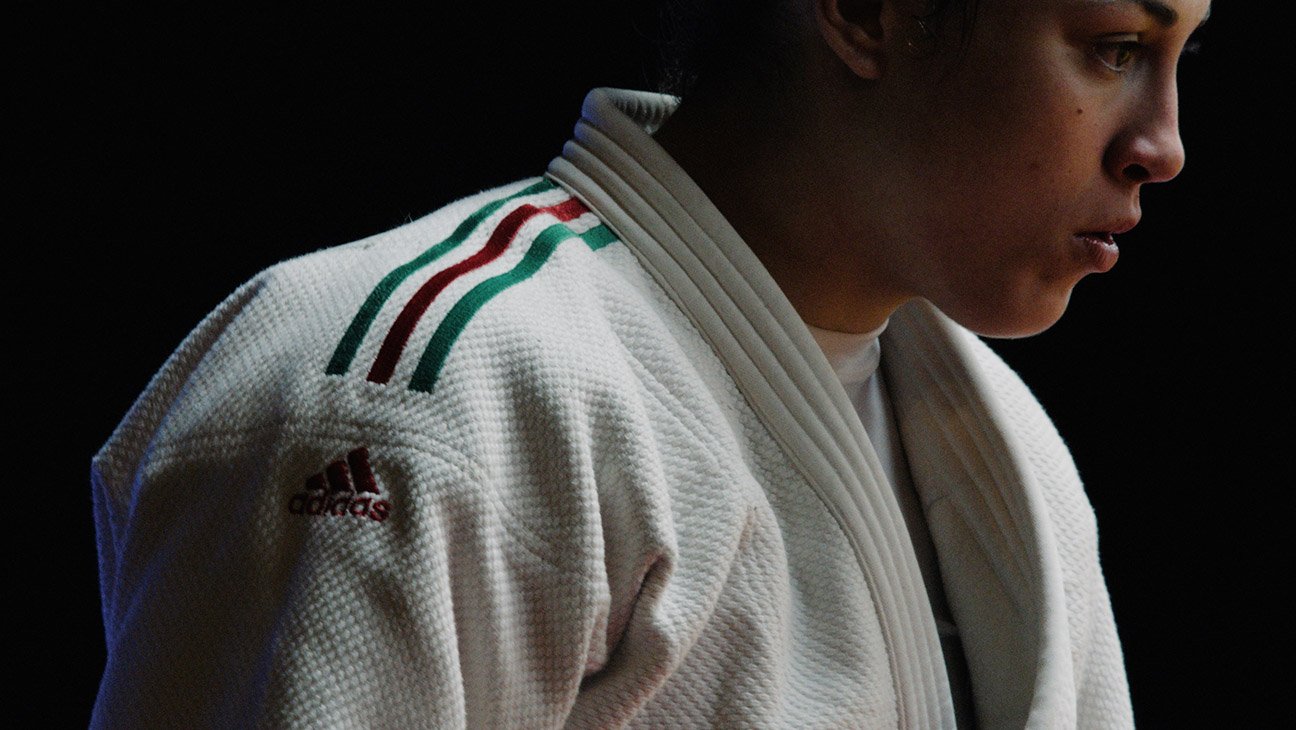
In the case of judo star Alice Bellandi, who plays herself here, that would be a recurring knee problem requiring invasive surgery — witnessed up close in gruesome operating room footage — followed by months of painful PT. For the sharpshooter Alex Sokolov (Sofija Zobina, La Chimera), who’s considered number one in her field during the run up to Ludoj, a leaked video of her hunting wolves turns into an online scandal. And for the fencer Giovanna Falconetti (Yile Vianello, Corpo Celeste), all seems to be going smoothly until a freak accident suddenly has her facing expulsion from the games.
What happens to each of them is pretty much as bad as it gets in their respective fields, underscoring how the best coaches and most sophisticated gear on the planet cannot prevent either the unexpected or the inevitable from occurring. Bertelli definitely puts his characters through the wringer: He doesn’t seem to be directing them as much as dissecting them, as if they were human specimens subjected to endless testing — which, in a way, is what it’s like nowadays to be a pro athlete of the highest order.
Somber and clinical, Agon plays at times like an anti-Chariots of Fire, revealing the dehumanizing underside of the world’s premiere athletic competition. But there’s also plenty of beauty in the way Bertelli captures bodies and technology at work, with DP Mauro Chiarello’s razor-sharp images highlighting the incredible skills needed to rise to such feats of excellence. Bellandi, whose long and grueling post-op recovery serves as the film’s main throughline, can be transfixing to watch — even if she hardly utters a word and spends a fair amount of time either cringing or crying out in pain.
Certain moments recall scenes from the queasy medical doc De Humani Corporis Fabrica, while others resemble the coldly observed planetary studies of Austrian filmmaker Nikolaus Geyrhalter (Homo Sapiens). But Bertelli has also created his own aesthetic here, finding new correlations between the organic and the mechanic. Bodies in motion are intercut with a bespoke gun factory’s grinding gears; human combats are juxtaposed with VR imagery or first-person shooter games. In one chilling scene, the sharpshooter Sokolov masturbates alone in her hotel room while watching a video of Japanese anime porn on her telephone, relieving weeks of stress and suffering.
Nobody winds up a winner in Agon, let alone makes it out of these faux Olympics unscathed. And yet, this fascinating fictional study reveals the extent to which athletes will keep on testing themselves, even if they risk breaking in the process. After so much blood, sweat and tears — all of which feature prominently at different points in the movie — we’re left wondering whether it’s really worth it.
Call Her Daddy host Alex Cooper is facing another bad headline.
According to a new report in Bloomberg, there’s been employee turnover and uneasiness amongst the staff at Trending, a company which encompasses Cooper’s Unwell Network of podcasts as well as ACE Entertainment, the production company started by Cooper’s husband Matt Kaplan.
Per the report, staff have threatened to quit or walk off the job due to Kaplan allegedly yelling and berating crew and staff members. In one example, at Cooper’s Unwell Winter Games, a YouTube program in which influencers faced off against each other in physical activities and drinking games, Bloomberg wrote that Kaplan “berated the staff,” resulting in a number of formal complaints.
Cooper did not immediately respond to a request for comment.
The report comes on the heels of an alleged feud between Cooper and Alix Earle, host of Hot Mess, one of the first podcasts to join the Unwell Network in 2023. Earle’s podcast left the network in February 2025, raising speculation about a feud between the two creators.
The parting of ways was initially not addressed, but in an interview with the Wall Street Journal around that time, Earle said the departure was “behind the scenes, a little bit of a hot mess.”
More recently, Earle reposted a video criticizing Cooper’s business sense and interviewing of subjects in times of vulnerability.
In an April 13 TikTok, Cooper responded saying she was “tired of waking up” and seeing Earle spreading “fake drama.”
“Hey girl, the passive aggressive reposts and the likes and the commenting on things — I’ve got to call you out here,” Cooper said in the video. “You’re going to need to get specific and just say what you’ve got to say about me. There’s no NDA. No one is stopping you. Stop hiding behind other people and just say it yourself.”
Earle then responded on social media, “Okay on it!!”
Cooper’s podcast, Call Her Daddy, was the fourth most popular podcast in the world in 2025, according to Spotify’s year-end list. She struck a $125 million multiyear deal in 2024 to bring her podcast and the network to SiriusXM from Spotify.
Nara Smith — the model and creator who has gained a massive following for her content that combines fashion, cooking and an elevated lifestyle — has signed with Range Media Partners in all areas.
Smith began her career as a model but gained over 17 million followers across TikTok and Instagram after she started making elaborate meals in an even more elaborate wardrobe. Her stylized content, which includes videos of her making everything from roast chickens to Play-Doh while adorned in designer couture pieces, is now covered breathlessly in publications and by the Internet, at large. Smith has been profiled by GQ, TheNew York Times and WWD.
“Nara is a dream client, a true multi-hyphenate with a distinct point-of-view and strong business acumen. She has an incredible ability to bridge fashion, homemaking and aspirational storytelling in a way that feels both modern and entirely her own,” said Eman Redwan, managing partner at Range and co-head of Range Digital, of the signing.
In fashion, she has worked with brands that include Miu Miu, Schiaparelli and Calvin Klein, in addition to Reformation, where she partnered for a clothing line collaboration last year. In food, Smith launched a limited-edition roasted garlic oil created in collaboration with Algae Cooking Club.
It was announced this week that Smith is readying for the release of her first cookbook, Homemade, due out via Harper Collins on Oct. 13. The cookbook features 85 from-scratch recipes, drawing subtle influence from her multicultural upbringing. (Smith was raised in Frankfurt by a South African mother and German father, and now lives in the United States.)
Redwan added, “Through the intersection of her luxury aesthetics and everyday storytelling, I believe Nara is shaping a new blueprint for the modern lifestyle creator.”
The new Xbox CEO is listening — on this one, at least.
Asha Sharma has dropped the price for Game Pass Ultimate from $29.99 to $22.99 a month. PC Game Pass will drop from $16.49 to $13.99 a month.
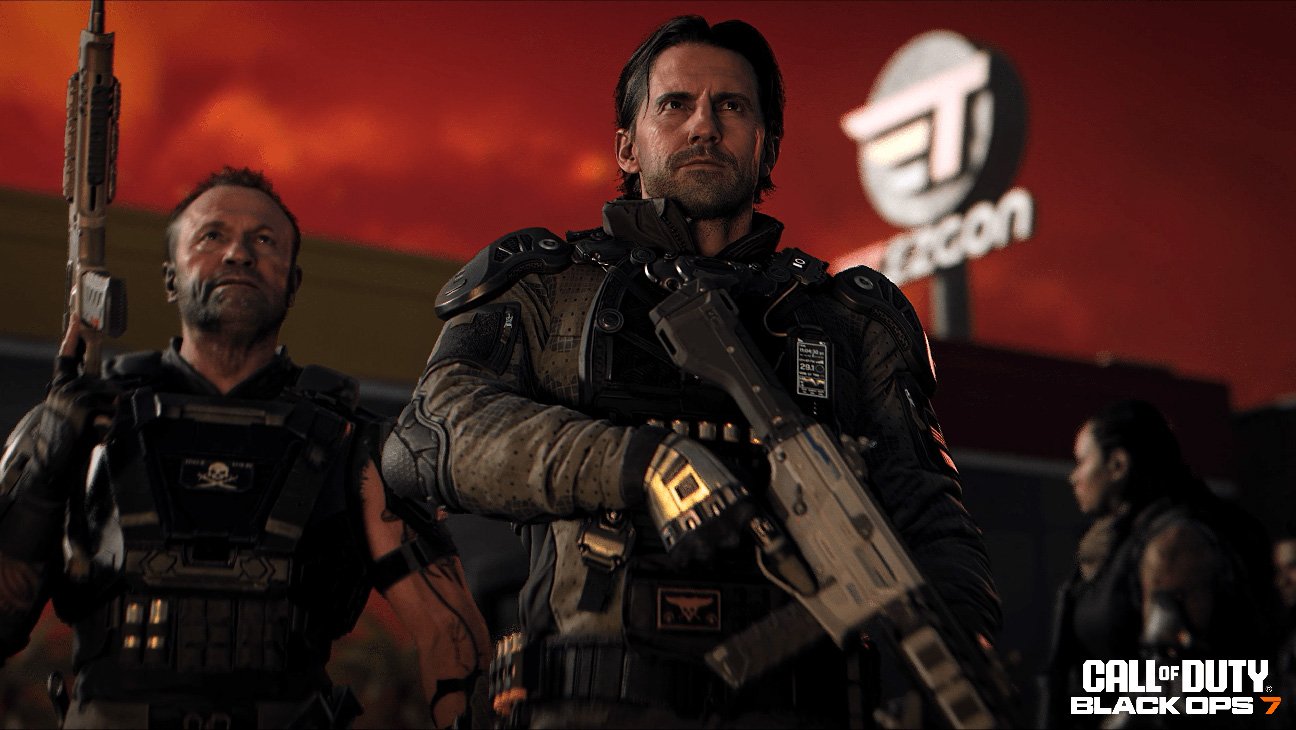
It comes with a catch: Starting this year, future Call of Duty titles won’t join Game Pass Ultimate or PC Game Pass at launch. Instead, they will be added to both plans during the following holiday season, or generally speaking, one year later. Existing Call of Duty titles already in the library will continue to be available, Xbox said on Tuesday.
The annual Call of Duty launches have been major drivers of Game Pass signups and retention.
“Our players cover a wide breadth of geographies, preferences, and tastes, so while there isn’t a single model that’s best for everyone, this change responds to a lot of feedback we’ve gotten so far,” the price update announcement — via a blog post — reads. “We’ll continue to listen and learn. Thank you for being a part of the Xbox community.”
You’re welcome, Asha.
Xbox Game Pass Ultimate gives subscribers access to hundreds of games on console and PC, including major day one releases (like Call of Duty used to be). A membership also allows for online console multiplayer, and there are (some) in-game benefits.
Xbox raised the Game Pass prices in October, ahead of the launch of its handheld devices. The handheld consoles (PCs, really) came at a higher price point than expected. Xbox Series X/S console prices climbed before that. The Xbox ROG Ally (white, basic) and the Xbox ROG Ally X (black, better) were released on Oct. 16, 2025.
The Xbox Series X (black, better) starts at $649.99 and goes up to $799.99. The Series S (white, basic) starts at $399.99 and goes up to $449.99.
Pip Wedge, a broadcast pioneer who helped shape the British and Canadian private TV businesses when first getting off the ground, has died. He was 97.
Wedge passed away peacefully and unexpectedly on April 15 in Toronto from natural causes after feeling unwell and taking a nap from which he never woke, his wife, Lis Wedge, confirmed to The Hollywood Reporter. “After nearly 61 years of marriage, I am missing him tremendously,” she said in a statement.
Born on Dec. 2, 1928 in Forest Hill, in southeast London, U.K., Wedge was named Philip by his parents so that they might call him Pip, after the Charles Dickens character in the classic Great Expectations novel. Following high school studies during the turbulent Second World War, Wedge in May 1946 took a job as a clerk and switchboard operator at a London advertising agency, before joining the UK Navy as a telegraph operator.
It was while Wedge monitored the airwaves around Glasgow Harbor aboard a navy ship that he also listened to the American Forces Network radio station as American artists like Doris Day, Jo Stafford and Johnny Ray performed on air. That pop musical interest eventually had Wedge catching the attention of veteran British musician, broadcaster and Musical Express writer Steve Race.
In a 1994 profile in Playback Magazine, Wedge recalled summoning his courage to approach Race, whom he did meet with and came away with a handful of the musician’s LPs in his arms. When it came time to return the records a few months later, this time Wedge came away with a job offer after offering some useful writing advice during their conversation.
“During our second meeting, Steve was writing his Musical Express column, so I looked over his shoulder, made some comments, which he put into the article. We really got on,” Wedge recounted. In June 1950, Wedge began writing concert reviews at the Musical Express for Race, and in June 1952, he became a reporter and eventually an assistant editor.
By 1955, however, Wedge heard from Race he was part of a license application to launch Associated-Rediffusion, Britain’s commercial TV station to compete against the BBC public broadcaster. So Wedge joined the TV station, helping set up their music department and then moving into light entertainment. That included producing in the rough and tumble world of early TV quiz shows like Double Your Money and Take Your Pick.
In spring 1962, Wedge felt a need to exit quiz show production in the U.K.: “I plateaued and had little hope of breaking through,” he recalled in the 1994 profile about any additional career advancement. But that exit came when Wedge was asked to produce Double Your Money pilots in Canada and Australia.
In Toronto, he set up studio space at CFTO-TV and found contestants, before doing the same in Sydney, Australia. By 1964, Wedge was producing 42 half hours of Double Your Money for the privately-owned CTV Television Network in five cities across the country, while editing the series in Toronto.
A year later, Wedge made the decision to take a job offer at CTV, first in Montreal in August 1965 and then at headquarters in Toronto from August 1967 as a producer under Murray Chercover, executive vp of the network and programming chief Arthur Weinthal.
In 1970, Wedge was promoted to director of development. Suddenly, he was no longer considered strictly a music man or a producer as back in class-ridden UK, but was judged a TV exec asked to help lead a Canadian TV network. “This was a much more democratic environment than what I’d known in London. They took me at face value. They knew what I did, and none of my background mattered. This was a key element in my being happy with CTV,” Wedge recalled in the 1994 profile.
He worked at CTV for 28 years until his retirement in June 1994, with his duties including producing Canadian variety and daytime programming like a trio of Petula Clark TV specials and early seasons of W5, the network’s flagship news magazine series.
And Wedge bought CTV’s foreign programming, including U.S. studio series like Rowan and Martin’s Laugh-In, Soap and The Love Boat acquired each year at the Los Angeles Screenings, as he managed the network’s schedule. After leaving CTV, Wedge did consultancy work for the network and industry associations like the Canadian Association of Broadcasters.
In November 2006, he was inducted into the CAB Broadcast Hall of Fame, and a year later became for 10 years an adjudicator for the Canadian Broadcast Standards Council, which helped regulate taste and standards on Canadian TV for the CRTC, the industry regulator.
Michaelmoonwalked into Hollywood on Monday night, as the story of Michael Jackson‘s early career premiered with the support of the film’s cast and the superstar’s family members.
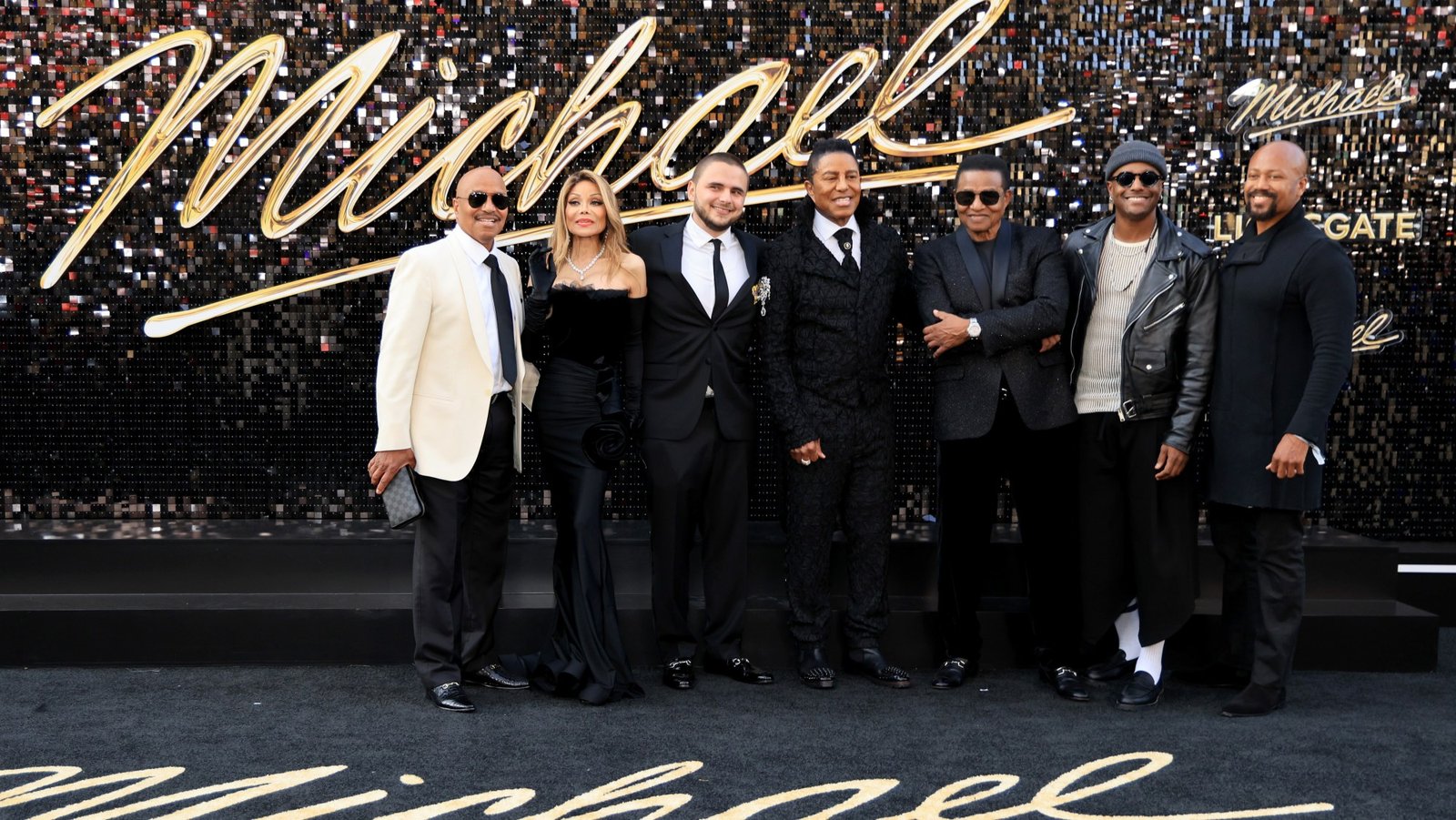
Siblings La Toya, Marlon, Jermaine and Jackie Jackson were all in attendance not only for the movie itself but also for Jaafar Jackson, Michael Jackson’s nephew (and Jermaine Jackson’s son) who transforms into his uncle in the biopic. “I was flabbergasted. I have to tell you that you think it’s Mike,” La Toya Jackson told The Hollywood Reporter of the portrayal. “You forget it’s Jaafar, you think it’s Michael.”
The Jackson family, and Michael Jackson’s estate, was heavily involved in the making of the film, with producer Graham King revealing that in addition to frequent talks with the siblings, Michael Jackson’s son Prince Jackson “was on set every day” during shooting and was also around during the film’s development.
Prince and brother Bigi Jackson have taken part in the film’s promotion — walking the carpet together at the Berlin premiere, while Prince Jackson was solo at the L.A. event — but sister Paris Jacksonhas spoken out against the movie, saying she wasn’t involved at all after she “read one of the first drafts of the script and gave my notes about what was dishonest/didn’t sit right with me and when they didn’t address it I moved on with my life.”
Paris Jackson added on social media in September, “They’re going to make whatever they’re going to make. A big reason why I haven’t said anything up until this point is because I know a lot of you guys are gonna be happy with it. A big section, the film panders to a very specific section of my dad’s fandom that still lives in the fantasy, and they’re gonna be happy with it.”
King acknowledged he hadn’t spoken to Paris Jackson recently and writer John Logan said he didn’t talk to her during his research. “Certain people in the family weren’t interested in talking and that was fine; they didn’t want to be represented in the movie or dramatized in the movie, that’s totally fine,” Logan said. He continued, “And look, Michael is a complicated person, people have complicated opinions, and that’s fine. We chose to tell the uplifting story of his triumph in the movie, and that’s what we did.”
From left: Kendrick Sampson, Adam Fogelson (chairman, Lionsgate Motion Picture Group), Deon Cole, Colman Domingo, Juliano Valdi, Antoine Fuqua, Mike Myers, Jaafar Jackson, Larenz Tate, Laura Harrier, Nia Long, KeiLyn Durrel Jones, Graham King, Miles Teller, Jon Feltheimer (CEO, Lionsgate Entertainment) and Lydia Silverman at the premiere.
Savion Washington/Getty Images for Lionsgate
Michael has faced a number of challenges on its way to the big screen. Reportedly, the film’s third act originally included some of the child sex abuse allegations against the superstar, but it was later discovered that Jordan Chandler, who alleged that Jackson sexually abused him in 1993, had reached an agreement to not be depicted in any dramatization of Jackson’s life. The movie then had to push its release date and do reshoots to rejigger the story.
“I think it’s very important that everybody in the family was involved and took part in this to make sure you get it right. A lot of times people think they know the story and they read about things, but when the family’s involved, the family can say yay or nay,” La Toya Jackson noted, dodging a question on Paris Jackson’s comments but saying that “everybody has their opinion and their choice.”
And as for Jaafar Jackson’s transformation, co-star Mike Myers admitted he was “starstruck” because the young actor seemed so much like the pop icon.
That came from “many, many months, a couple years of preparation just allowing myself to understand everything behind the music, everything behind the moves, what was behind all of that, which was his heart,” Jaafar Jackson said. “Of course I wanted to pay attention to the little details and nuances of the performances but most important was his essence in his heart of how he truly treated people, how he was with everyone. And that was the most incredible experience I could ask for.”