Tag: CRYPTOS FoxBusiness

  • Binance Founder CZ Makes a $1 Million Prediction for Bitcoin

    Binance Founder CZ Makes a $1 Million Prediction for Bitcoin

    Binance founder Changpeng Zhao (CZ) pointed out that the supply of Bitcoin is limited, saying that soon there won’t be enough $BTC for millionaires.

    CZ stated that as of August 2026, the amount of Bitcoin mined will have exceeded 20.07 million, adding that only 4.4% of the total supply of 21 million is yet to be mined.

    Pointing out that while there are approximately 23.6 million millionaires in the US, the number of $BTC in circulation is only 20.07 million, CZ said, “Soon, millionaires won’t be able to own a full Bitcoin.”

    CZ also stated that he estimates 10 to 20 percent of existing Bitcoins are lost, inaccessible, or unrecoverable, characterizing Bitcoin as a deflationary asset.

    According to CZ, the actual usable coin supply may be much less than 21 million, as many long-term $BTC holders are unwilling to sell their assets. Additionally, it’s worth noting that Satoshi Nakamoto’s $BTC holdings are unlikely to move again.

    In addition, CZ claimed that BNB, an altcoin linked to Binance, has a similar structure.

    *This is not investment advice.

  • MiCA’s cleanup is creating a new scam wave across the European Union

    MiCA’s cleanup is creating a new scam wave across the European Union

    The European Union’s (EU) crypto clean-up has handed scammers a weapon.

    When the Markets in Crypto-Assets (MiCA) regulations’ ramework came into full force on July 1, more than 1,700 unlicensed crypto platforms were required to stop serving EU customers and direct them to licensed alternatives. Only 323 companies held a valid MiCA authorization at the time. That gap, in which up to 10 million users were told to move their digital assets, is exactly what fraudsters needed.

    . The mechanism is straightforward. Scammers copy the language of real migration notices, impersonate regulators, and push users to fake platforms before victims realize the difference.

    Social engineering scams were already concerning in 2025. Crypto exchange WhiteBIT found that nearly 41% of crypto incidents last year involved malicious actors deceiving victims through fake investment offers or impersonation. European regulators, however, say they have seen an increase in crypto scams since the July 1 deadline.

    A spokesperson for France’s Autorité des marchés financiers (AMF) noted scammers were posing as AMF employees, convincing victims to pay upfront administrative fees to recover stolen funds.

  • Crypto wallet SafePal reveals a data breach exposing nearly 40,000 customers’ order info

    Crypto wallet SafePal reveals a data breach exposing nearly 40,000 customers’ order info

    The breach has impacted 39,798 customers who placed orders between March 2, 2025 and April 11, 2026.

    SafePal stressed that the core security of its wallets remains intact, adding that users’ seed phrases, private keys, bank passwords, bank account information, payment card numbers, and government-issued IDs were not affected.

    However, SafePal said users who have shared their private keys or seed phrases via a phishing email, phone call, or letter should treat their wallet as compromised and transfer their assets to a new wallet.

    How SafePal is responding

    The company said it had patched the vulnerability and introduced additional security measures in response. SafePal notified all affected customers by email from security@safepal.com on Sunday and hired an independent third-party security firm to audit the fix and review its order-processing systems.

    SafePal also said it would retain customers’ personal data in its order-processing system for only 90 days from the date of collection. In addition, the company identified and removed more than 30 fraudulent websites and phishing links associated with the breach.

    Customers can use a verification tool on SafePal’s website to check whether their data was affected, the company said.

  • The ‘long bitcoin, short the bankers’ era is officially over as TradFi giants embrace digital assets

    The ‘long bitcoin, short the bankers’ era is officially over as TradFi giants embrace digital assets

    “The old ‘long bitcoin, short the bankers’ trade is over: banks have moved from resisting digital assets to building and enabling or distributing them through custody, tokenization and regulated trading,” Dori said.

    He attributed the shift to client demand and clearer rules, calling it structural rather than cyclical.

    Early bank entrants included Swissquote, which added bitcoin trading in 2017, DBS in 2020 and BBVA in 2021. BNY Mellon started institutional crypto custody in 2022, the same year Nubank launched bitcoin and ether trading and LGT added crypto services.

    St.Galler Kantonalbank and Santander followed in 2023, while Zürcher Kantonalbank added retail trading in 2024, before other major financial industry players including Standard Chartered, Charles Schwab, SoFi and Morgan Stanley entered the space.

    Anchorage Digital CEO Nathan McCauley, meanwhile, said its client roster has increasingly reflected the convergence of traditional and decentralized finance over the past two years.

    Large financial firms are partnering with specialist providers rather than building their own infrastructure, he said. Still, real-world assets coming onchain and crypto wrappers being created by large asset managers is showing two worlds are increasingly becoming one.

    “We’re quickly headed towards a world where there isn’t ‘traditional finance’ and ‘decentralized finance.’ There’s just ‘finance,” McCauley told CoinDesk. “

  • Legendary Trader Brandt: ‘Who Cares About XRP?’

    Legendary Trader Brandt: ‘Who Cares About XRP?’

    Veteran trader Peter Brandt has stated that he has little interest in owning the Ripple-linked $XRP cryptocurrency. Moreover, he has made it clear that he would immediately convert a large $XRP position into Bitcoin.

    This comes after the trading vet was challenged over his views on $XRP on the X social media network. “Are you kidding me? Who the heck even cares about $XRP?” he wrote.

    “I do all my betting in futures,” Brandt continued. “Who knows if you would even be good for the bet if you lost. And I could care less about owning a half million $XRP. I would convert it immediately to BTC.”

    $XRP plunges below $1

    In the meantime, the Ripple-linked token is currently struggling to hold the psychologically important $1 level.

    The popular cryptocurrency was recently trading around $0.9992, according to the price data provided.

    $XRP remains about 72.6% below its $3.65 all-time high reached on July 17, 2025, CoinGecko data shows.

    As reported by U.Today, the token recently slipped below $1 for the first time since November 2024. Ironically, it is now worth less than the highly regulated RLUSD stablecoin, which was launched by Ripple in late 2024.

    A veteran $XRP naysayer

    Brandt has frequently clashed with members of the $XRP community, and he is known as one of the most high-profile critics of the token.

    In December 2025, he wrote that “no group of traders has been more easily baited” than $XRP and silver bulls.

    He was even more blunt in October 2025, calling $XRP “addicts” the “most immature unprofessional group on X” and saying he believed they “deserve to end up broke.”

    Earlier, Brandt described $XRP as “the Edsel” (one of the biggest car failures in automotive history).

    In June 2020, he went so far as to call $XRP a “manipulated scam (IMO),” while in July of that year he compared Ripple’s relationship with $XRP to the Federal Reserve’s relationship with the U.S. dollar. He previously argued that Ripple was effectively $XRP’s “bag holder.”

    Still, there was a temporary truce between Brandt and the $XRP community. In late 2024, Brandt warmed up to the token, which was highly unusual for him. In November 2024, the legendary trader noted that $XRP had cleared its 2023 high and pointed to a “massive coil.” Back then, the token was in the middle of a huge rally.

    His bullishness did not last long. In March 2025, he warned of a possible decline toward $1.07 if $XRP‘s bearish head-and-shoulders pattern played out.

    With $XRP again trading around or below $1, Brandt might finally feel vindicated.

  • Michael Saylor Compared Bitcoin to Gold

    Michael Saylor Compared Bitcoin to Gold

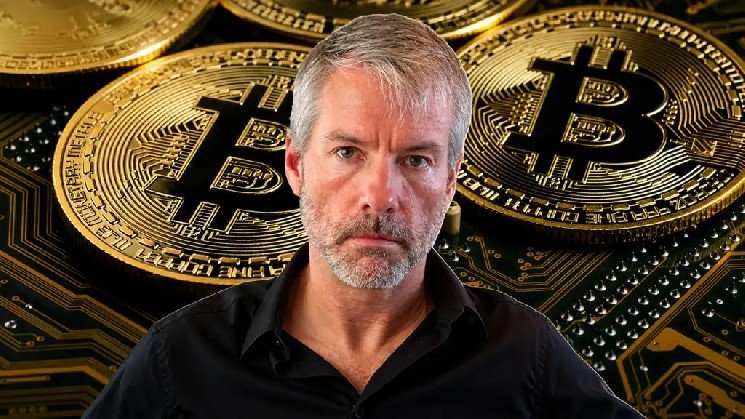
    Strategy founder Michael Saylor said that Bitcoin is reshaping the way wealth is stored and transferred by converting digital scarcity into economic value.

    Saylor stated that Bitcoin combines computers, digital networks, and cryptography, describing this structure as “the first digitally designed monetary network in human history.”

    According to Saylor, Bitcoin digitizes monetary assets entirely, ensuring that supply is controlled by publicly available protocols rather than the decisions of individuals or institutions. Thus, economic value is transformed into information that can be securely transmitted over global communication networks.

    Comparing Bitcoin to gold, Saylor stated that increasing the supply of Bitcoin is more difficult, while integrating it with software and transferring it is easier. He noted that network participants are incentivized to protect the system’s security, arguing that the proof-of-work mechanism connects Bitcoin to the physical world.

    Saylor noted that this mechanism consumes real energy in exchange for ledger security, increasing the cost of altering past transactions. He stated that miners, energy companies, and investors have formed a common defense system around this structure, adding that while Bitcoin could be described as “digital gold,” the term “digital monetary energy” is more accurate.

    Saylor stated that the Bitcoin network is not merely fixed software; it is an adaptable system comprised of miners, nodes, developers, capital, and users. He explained that Bitcoin is deliberately kept simple at its core, and that its primary purpose is to create a secure and reliable ledger for scarce digital assets.

    Saylor stated that complex functions are left to applications at higher levels, arguing that this architecture makes Bitcoin a foundation upon which economic value can be transferred across time and space. According to Saylor, this structure also supports innovations in payment, credit, and financial services.

    Saylor stated that Bitcoin’s deeper impact lies in creating a new form of digital sovereignty, noting that private keys allow individuals to control their economic power without permission. He added that in this system, ownership is verified through mathematical methods rather than institutions.

    Saylor stated that companies, banks, trusts, and applications could build comprehensive economic systems around Bitcoin, and that social networks could also leverage this technology to add real costs and responsibilities to the digital environment.

    Saylor stated, “Gold’s physical scarcity translates into money, while Bitcoin’s digital scarcity does the same.” Arguing that Bitcoin is more than just a means of payment, Saylor likened money to energy, describing Bitcoin as the monetary energy of the digital age.

    *This is not investment advice.

  • Humanity eyes $0.33 as whale wallets grow – H rally at risk IF…

    Humanity eyes $0.33 as whale wallets grow – H rally at risk IF…

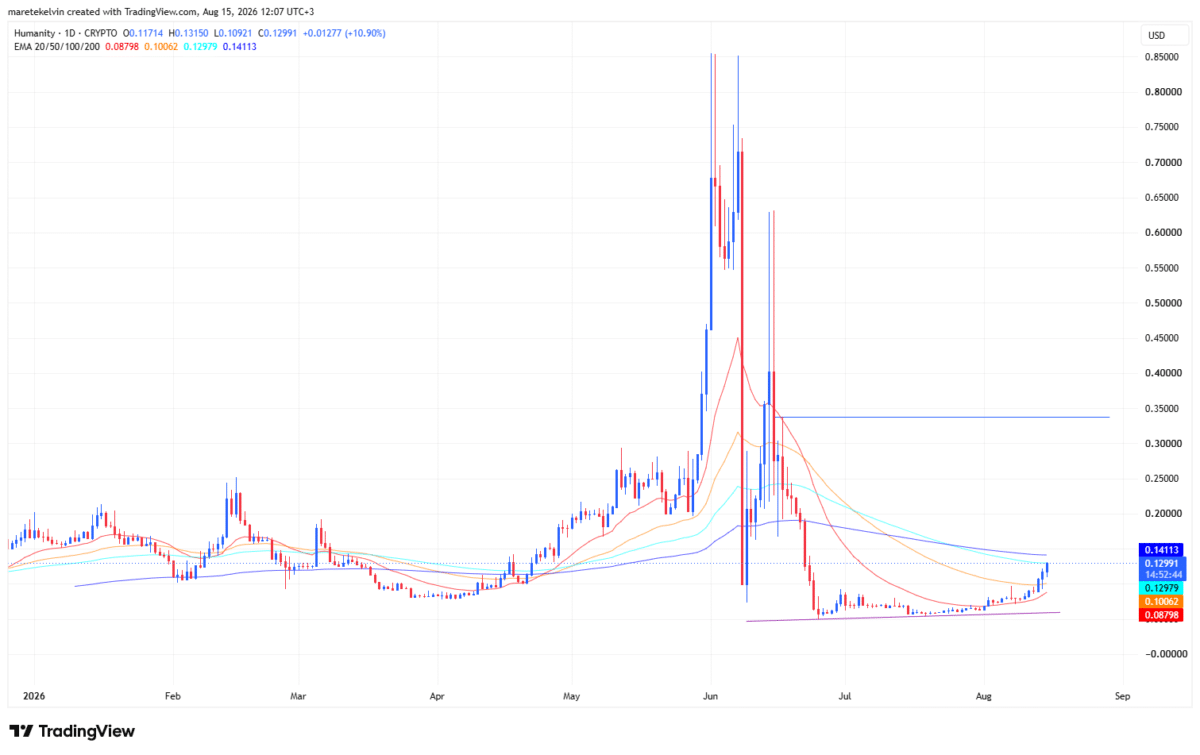
    Humanity [H] extended its weekly rally and moved above the 20-day and 50-day Exponential Moving Averages (EMAs).

    The technical improvement arrived as capital rotated toward altcoins. More large-holder wallets and bullish derivatives positioning supported H’s recovery. Could this momentum push Humanity toward the next resistance at $0.33?

    Can Humanity hold above its EMAs?

    Humanity advanced during the past week and traded above its 20-day and 50-day EMAs. This move suggested that buyers had gained momentum across the short and medium terms.

    Holding above both EMAs could help bulls extend the rally toward $0.33.

    However, losing these levels would weaken the bullish structure and increase the possibility of a deeper correction.

    Source: TradingView

    Are Humanity whales accumulating H?

    Notably, Humanity’s large-holder activity offered another bullish signal.

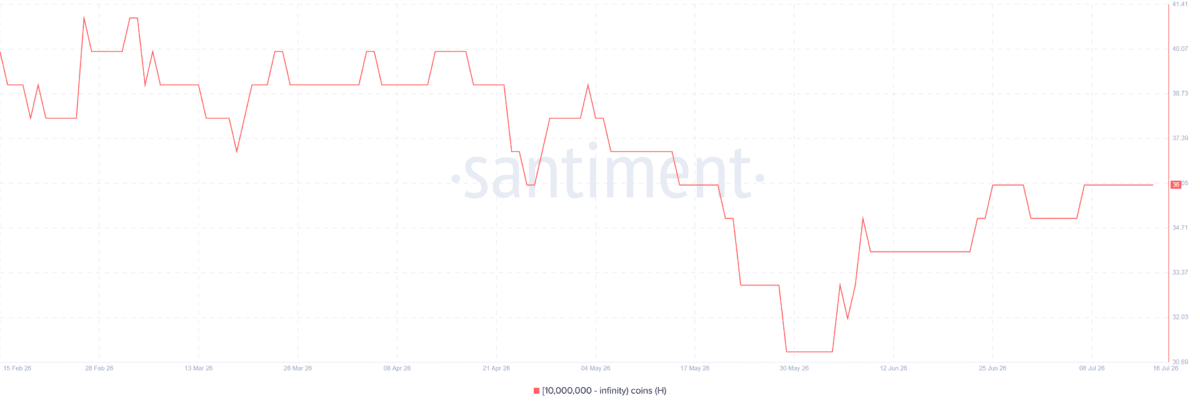
    The number of wallets holding over 10 million H reached 39, its highest level in several months. This increase suggested more wallets had entered that holding bracket. However, the metric alone could not confirm fresh whale purchases.

    Even so, continued growth in large-holder wallets could support H’s attempt to reach $0.33.

    Source: Santiment

    What does H’s 7% volatility mean?

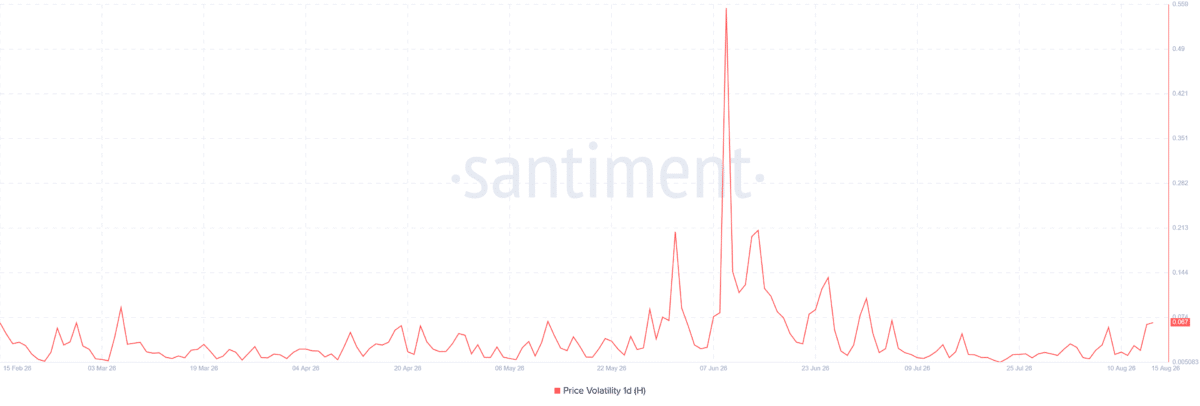
    At the same time, H’s Price Volatility climbed to approximately 7%, reaching its highest recent level. This increase indicated that H had begun experiencing wider price movements as its bullish trend continued.

    Elevated Price Volatility could amplify the rally if buying pressure holds. It could also accelerate losses during a sudden reversal.

    Therefore, the same metric supporting a faster move toward $0.33 also increased H’s pullback risk.

    Source: Santiment

    Are Humanity traders too bullish?

    On top of that, derivatives positioning remained strongly tilted toward buyers.

    Long positions represented approximately 66% of H’s tracked positioning, showing that traders expected further upside. This bullish positioning supported the continuation scenario.

    However, it also left leveraged longs exposed if momentum weakened. A price reversal could trigger Long Liquidations and deepen any resulting pullback.

    Source: Coinalyze

    Can Humanity reach $0.33?

    Humanity’s bullish structure rested on its EMAs, rising large-holder wallets, and strong long positioning.

    If buyers maintain control, H could extend its weekly advance and challenge the $0.33 resistance. For now, both EMAs remain the key support levels below H’s price.

    A sustained move above $0.33 could strengthen the bullish case. Losing EMA support may invalidate the near-term setup.


    Final Summary

    • Humanity traded above its 20-day and 50-day EMAs, strengthening its short-term bullish structure.
    • Wallets holding over 10 million H reached 39, their highest count in several months.
  • CLARITY Act Odds Decline as SEC and CFTC Build Interim Fixes

    CLARITY Act Odds Decline as SEC and CFTC Build Interim Fixes

    Congress and the regulators are no longer moving on the same timeline. The CLARITY Act, the U.S. crypto market structure bill meant to settle long-running questions over digital asset issuance and trading, now looks less likely to pass in 2026. Galaxy Research’s latest read, the original report, points to fading legislative momentum and a shift toward faster agency action.

    The banking sector’s resistance to sweeping market structure changes has already been visible in the Senate, where major crypto legislation faced a last-minute lobbying fight. That friction is now part of the broader backdrop for the CLARITY Act. As the calendar tightens, the practical question for exchanges, issuers, and compliance teams is not whether Congress will act, but which agency will fill the gap first.

    Agency action is accelerating

    The SEC and CFTC have responded to the uncertainty by pushing administrative measures: rulemaking, interpretive guidance, and regulatory exemptions. Galaxy says the goal is to clarify how digital assets should be issued, traded, and supervised while the legislative path remains blocked. A staff interpretation or an exemption can be more useful in the near term than a bill that may never get a floor vote.

    That speed has real value. A token project waiting on registration guidance or a trading platform trying to understand which regulator has jurisdiction can make operational decisions off an agency action far sooner than off a stalled congressional process. For institutional buyers and token issuers, the difference between a statute and an agency exemption is not academic. A statute binds the agency and survives a leadership change. An exemption is only as durable as the current line of thinking at the commission.

    The urgency is especially visible in tokenized real-world assets, where issuance and settlement structures are already scaling. Recent tokenization activity shows that market participants are not waiting for Washington to settle every definition before expanding products.

    Temporary clarity has a hard ceiling

    Galaxy’s caution is straightforward: administrative fixes lack legal durability. Rulemaking and guidance can be revised or reversed by a future administration, and they cannot replace a long-term framework established by Congress. That creates a different kind of uncertainty. Firms can build against an SEC staff position only to have a new chair unwind it after a political transition.

    The result is a two-tier regulatory reality. Congress may still deliver a durable statute, but for now the industry is operating on guidance that is faster to arrive and easier to reverse. That is not a stable foundation for capital-intensive infrastructure decisions.

    For legal and compliance leaders, the shift also changes the type of risk they have to manage. A legislative process carries one set of lobbying and timing risks. An administrative process carries another: the possibility that a guidance document disappears with a new administration, or that a court reads a rule more narrowly than staff intended. That distinction is now a planning cost, not a theoretical concern.

    Meanwhile, builder activity continues to concentrate in a few dominant ecosystems regardless of the legal noise. Developer activity this week remains clustered among major Layer 1 and Layer 2 networks, but the rules for the assets built on those chains still depend on whatever the agencies do next.

  • Ethereum and Solana may become scarcer – THESE Grayscale projections say…

    Ethereum and Solana may become scarcer – THESE Grayscale projections say…

    Ethereum [$ETH] was trading at $1,876.89 at press time, following a slight increase over the previous day but a 2.16% decline over the previous week. Meanwhile, Solana was trading at $75.16 at press time, following a slight increase over the previous week and a slight decline over the previous day.

    These contradictory price movements imply that there is no clear bullish or bearish momentum dominating the cryptocurrency market, which is extremely erratic.

    In fact, there were no clear indications of bulls or bears on the RSI for either $ETH or $SOL as well.

    Grayscale paints a concerning picture for $ETH and $SOL

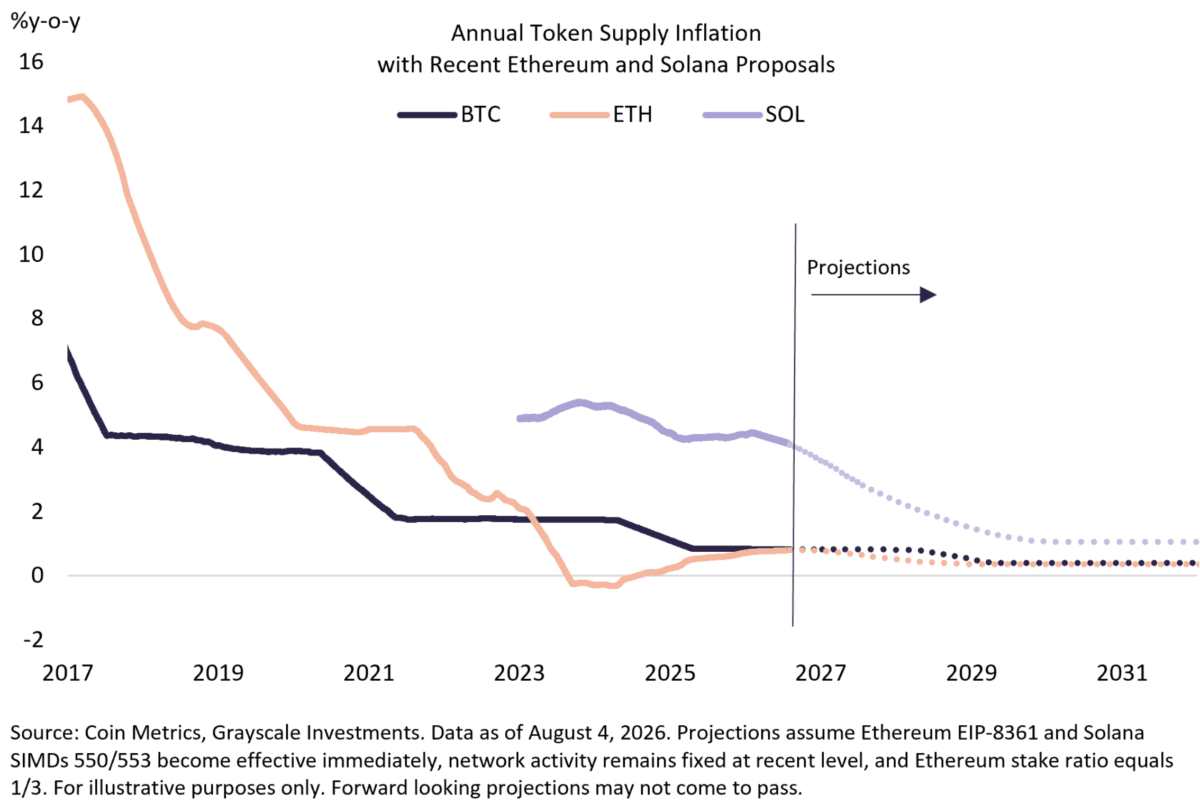
    At the same time, Zach Pandl, Head of Research at Grayscale, presented his analysis indicating that Ethereum and Solana may become more scarce assets due to their respective networks’ consideration of lowering the annual production of new tokens.

    Source: Grayscale

    Currently, issuing new $ETH and $SOL, which expands the total supply, helps to fund staking rewards on Ethereum and Solana.

    This inflation would be decreased by the suggested modifications. Comparable to lowering the production of a commodity, the value of the current tokens may rise if demand remains constant or rises and fewer new tokens are introduced to the market.

    According to Pandl, by 2031, the annual supply growth of $ETH and $SOL may drop to about 0.4% and 1.1%, respectively, bringing them closer to Bitcoin’s supply growth and below gold’s estimated 1.8% annual supply growth.

    What about stakers?

    For stakers, there is a trade-off, though. People who stake their tokens will get fewer tokens as rewards if there are fewer new $ETH and $SOL created.

    After a decrease in inflation, for instance, a staker who earns 5 $SOL might only receive 3 $SOL. Yet, the value of those three $SOL might still surpass the value of the initial five $SOL if the decreased supply makes $SOL more scarce and its price increases noticeably.

    Therefore, while stakers must weigh the potential for higher token prices against the possibility of lower token rewards, unstaked holders may directly profit from increased scarcity.

    s up for debate and do not guarantee changes.

    This was consistent with an earlier report from AMBCrypto that stated that Solana’s ecosystem provides more than just trading and DeFi, which is why it is drawing in more users and money.


    Final Summary

    • Both Ethereum’s and Solana’s price actions are not that strong, with RSI supporting this narrative.
    • Garyscale suggests that Ethereum and Solana may become more scarce assets due to their respective networks’ consideration.