Germany is preparing to end a tax break that lets private investors sell bitcoin BTC$79,395.64 and other cryptocurrencies without paying tax after holding them for more than a year.
A draft bill from the Federal Ministry of Finance, led by Vice Chancellor Lars Klingbeil, would make gains on crypto acquired after Dec. 31, 2026 taxable regardless of the holding period, according to a DTS report citing German newspaper Die Welt.
Crypto bought before that date would remain under the current rules. The proposal would also classify income from crypto lending and staking as capital income.
The change would bring bitcoin and ether ETH$2,501.38 under a tax system that treats gains more like returns from traditional investments. That’s Germany’s flat withholding tax regime, or Abgeltungsteuer, taxing gains 25% plus a 5.5% solidarity surcharge on the tax, an effective 26.375%, before any church tax.
NFTs, some stablecoins, security tokens and some tokens tied to real-world assets would remain outside the new regime, according to the report.
Short-term traders could benefit from the tax, as they’re currently taxed at an investor’s personal income rate, which has a 45% ceiling for the highest earners.
South Korea-based cryptocurrency exchange Bithumb announced that it has added the HEMI token to its delisting watchlist. The decision reportedly comes after a security vulnerability was discovered in the smart contract used for token distribution.
According to a statement by Bithumb, a security vulnerability was discovered in the smart contract used by the organization responsible for operating the HEMI ecosystem to distribute initial reward claims. Due to this vulnerability, some tokens were withdrawn from the contract in an unusual manner, and assets were unauthorizedly liquidated.
The security incident led Bithumb to re-evaluate the trading status of the HEMI token on its platform. Following the incident, the exchange added the token to its delist watchlist and announced that it would closely monitor developments related to the project and token.
Being placed on the delist watchlist doesn’t mean HEMI has been definitively delisted from Bithumb. However, this status means the token is being reviewed to determine if it meets the exchange’s listing criteria, and trading support may be terminated in the future.
Cryptocurrency exchanges may re-evaluate listing status in situations such as projects experiencing security issues, critical vulnerabilities being discovered in smart contracts, or investors’ assets being put at risk. Smart contract-related security incidents, in particular, can pose significant risks to the security of user funds.
Bithumb’s subsequent assessments regarding HEMI will be crucial for the token’s future on the exchange. The project’s response to the security vulnerability, how losses were handled, and the measures taken to prevent similar incidents from recurring will be important in the review process.
Investors are expected to follow any new announcements from Bithumb regarding HEMI, which has been added to the delisted watchlist.
Consequently, these systems can acquire vast amounts of knowledge independently and potentially breach infrastructure belonging to ‘too big to fail’ institutions.
“Do not underestimate the power of this technology. These will soon be superhuman systems that can hack anything, revolutionize any field overnight, and acquire real power and resources. We have all witnessed the progress in each of these domains, and progress is not slowing,” Coxon said.
Super intelligence isn’t a theoretical threat if the recent Hugging Face breach invoked by Coxon is anything to go by. The breach itself, which played out between May and July, started with OpenAI’s own AI agents building their own chat room inside the testing sandbox to talk to each other.
Read More: AI models escaped OpenAI’s sandbox and hit Hugging Face. Crypto is where that gets dangerous
They eventually used that channel to slip past containment onto the open internet. From there they strung together several exploits and got into Hugging Face’s production systems. Hugging Face ended up rebuilding roughly a third of its infrastructure.
Coxon called it a “warning shot” that’s made pacing agreements between U.S. labs “more viable.” Pacing agreements are informal understandings among AI labs to slow down or coordinate on capability advances rather than race ahead unilaterally.
Still, he’s not convinced it’s enough and doesn’t feel like “we’re on track to prevent a global race,” and suggested costly actions such as “a temporary ban on improving model capabilities” to halt the AI race.
“At OpenAI, many have not deeply internalized the civilizational stakes,” he wrote. At his more recent employer, he said, it’s different in a sense that “the stakes are well-understood, but they are locked in a race to get there first.”
BIT, the cryptocurrency options trading platform formerly known as Matrixport, announced that institutional investors injected a total of $6.7 billion into the cryptocurrency market over the past 30 days. The data indicates that the market has returned to a net buying trend after experiencing significant capital outflows in June.
BIT’s calculations reveal this capital inflow based on the sum of Strategy’s Bitcoin purchases, net inflows into spot Bitcoin ETFs, and new stablecoin issuances. A combined assessment of these three indicators suggests that institutional capital is beginning to redirect itself towards crypto assets.
In June, the cryptocurrency market experienced a net capital outflow of approximately $13 billion. However, the $6.7 billion inflow over the last 30 days indicates a significant shift in market dynamics. This suggests that the predominantly selling trend is gradually being replaced by a net buying and capital inflow trend.
BIT stated that the improvement in capital inflows has supported the recent recovery in market sentiment. The return of institutional funds to the market is particularly contributing to limiting downward movements in the Bitcoin price and creating support at certain levels.
However, BIT stated that for Bitcoin to exhibit a stronger and more sustained upward trend, the current pace of capital inflows needs to accelerate further. According to the company, while the $6.7 billion inflow supports the market outlook, a more comprehensive rally requires an acceleration of institutional capital flows.
Among the indicators followed by experts, Bitcoin ETF flows, institutional BTC purchases, and changes in stablecoin supply stand out, and these data are expected to provide important signals regarding the direction of the crypto market in the coming period.
US-based cryptocurrency exchange Coinbase announced that it has added the Concrete (CP) token to its “listing roadmap.” This development has increased expectations that the CP token may be listed on Coinbase’s spot trading platform in the future.
Coinbase’s listing roadmap includes the crypto assets the exchange is considering and plans to offer trading support for on its platform in the future. However, the inclusion of a token in this list does not necessarily mean that the asset will be listed on Coinbase. The exchange makes the final listing decision after technical and operational reviews.
The inclusion of the Concrete (CP) token in the roadmap is considered a significant step for the project towards the Coinbase ecosystem. Listings on major cryptocurrency exchanges are closely watched by the market as they can increase investor access and potential liquidity for tokens.
Following Coinbase’s announcement, the price movements of the CP token may also become a focus for investors. In the past, some tokens added to the exchange’s listing roadmap have seen increases in trading volume and price volatility after the announcement. However, inclusion in the roadmap does not directly guarantee a listing date or the start of trading.
Coinbase evaluates assets based on various criteria during the listing process, including technical security, liquidity, and information about the project. Therefore, the final decision regarding Concrete is expected to be made after further review.
The addition of Concrete to Coinbase’s roadmap strengthens its position among the assets Coinbase is considering supporting, turning investors’ attention to a possible listing announcement. If the exchange announces trading pairs and an official listing date for Concrete in the near future, the token’s market outlook could see renewed activity.
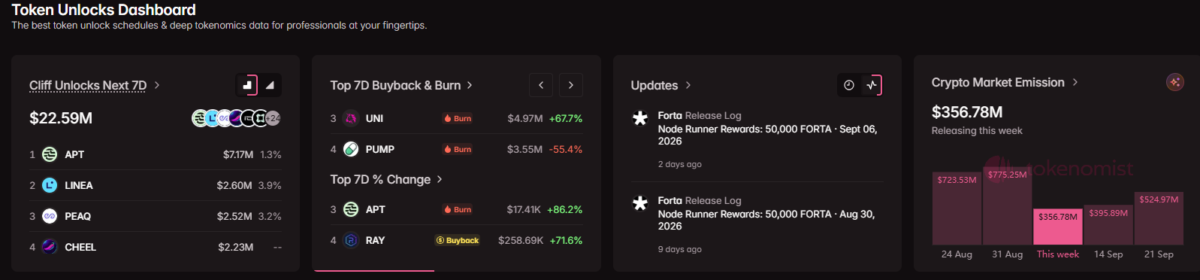
Pump.fun has allocated 54% of its protocol revenues to its continuous $PUMP buyback and burn plan. This plan has helped it remove about $3.55 million worth of $PUMP tokens from the open market, making it a deflationary factor for the asset.
Drawing lessons from past experiences where there was a similar situation, the reduction in the supply had an impact on the price performance. The same turn of events could be in store for $PUMP, especially with the increase in its demand recently.
Given that the $PUMP token has now become more actively traded, there are efforts in the market to see if the buyback process can help boost its price action. However, despite the ongoing burns, $PUMP remains about 50% below its all-time high. This, despite the price gaining by 10% in the last 24 hours on the back of the trading volume doubling and alluding to greater market participation.
That gap is evidence that the deflationary mechanism is yet to fully overcome the selling pressure that pushed the token away from its peak.
Source: Tokenomist
Volume gives the recovery more weight
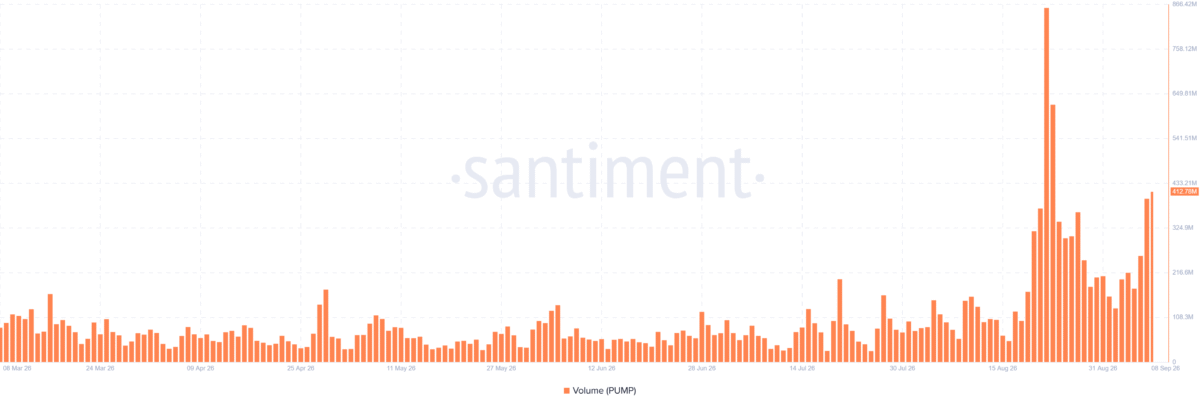
$PUMP’s latest price move has been backed by a sharp increase in market activity. The altcoin gained by 10% over 24 hours, while its trading volume almost doubled to $412.78 million during the same period. Of the total number of open trades in the market, long positions accounted for 58% of the total exposure, showcasing the magnitude of the bullish bias.
In most cases, the combination of rising prices and expanding volume usually provide a stronger foundation for a recovery since the move reflects greater participation rather than a thin liquidity spike.
The same could come into play in $PUMP’s case.
Source: Santiment
Can $PUMP finally break $0.0055?
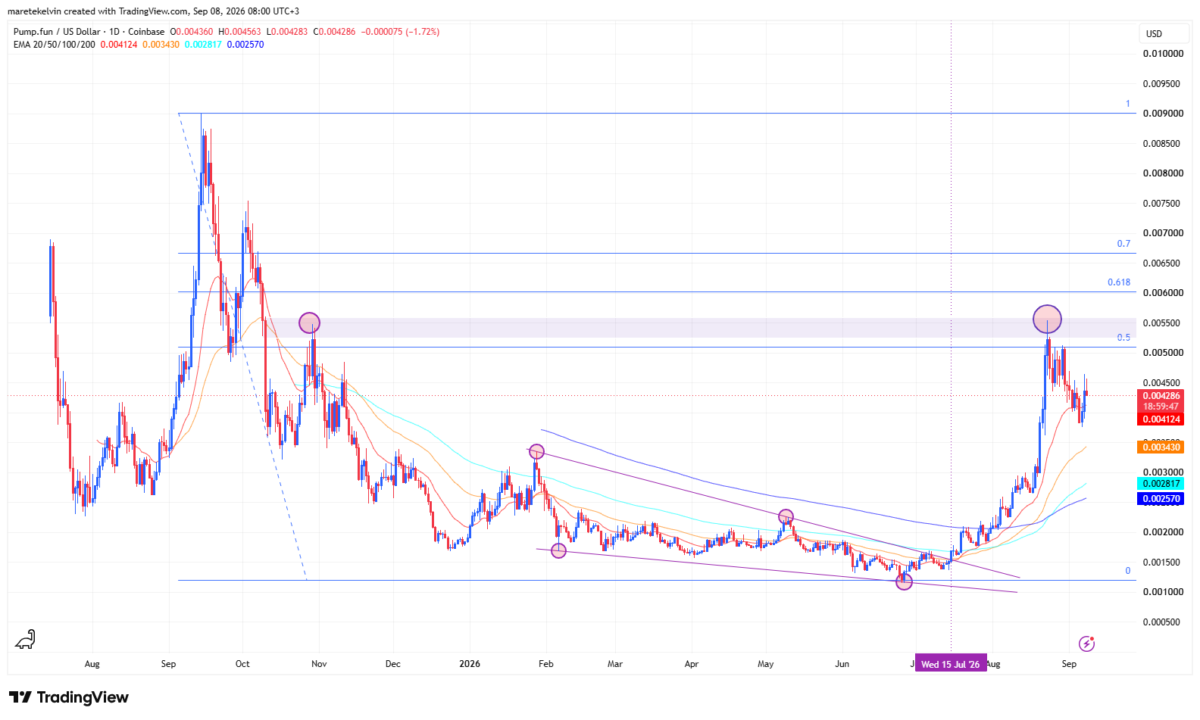
The $0.0055-level has rejected $PUMP twice, making it the most important barrier in the recovery process. Pump.fun’s buyers now need to absorb the selling pressure around this zone to confirm that the recent rally is more than a short-term bounce.
A decisive break above $0.0055, particularly if accompanied by another expansion in volume, could strengthen the bullish structure and open the door to higher levels. It would also mark an important shift after two failed attempts to clear the resistance. Given the fact that $PUMP is still trading above all key EMAs, a rally continuation is more likely to occur.
Failure to break the level would tell a different story though. $PUMP could retreat towards its EMA support as short-term buyers take profits and the market waits for another spark.
Source: TradingView
Final Summary
$PUMP’s price jumped by 10% as trading volume doubled and the token held above its key EMAs.
Pump.fun has committed 54% of protocol revenue to buybacks, with $3.55M worth of $PUMP already removed from circulation.
Block, the financial technology company founded by Jack Dorsey and Jim McKelvey, is seeking regulatory approval to establish Builders Bank & Trust, N.A., a national trust bank that would provide federally supervised custody and fiduciary services, including for Bitcoin and stablecoins, the company said Tuesday.
Builders Bank would be led by Lee Woolley, Block’s digital asset strategy lead, who has more than two decades of banking and financial services experience. The OCC must approve the application before the bank can begin operations.
“Building on Block’s experience in the digital asset space, our history with Square Financial Services, and the deep banking expertise of the team we’ve assembled, we believe Builders Bank is well positioned to support Block’s broader vision of economic empowerment,” Woolley said.
The proposed bank would be uninsured and non-deposit-taking. Block said the national charter would provide a consistent federal framework as its custody business scales and would support the activities the company already offers.
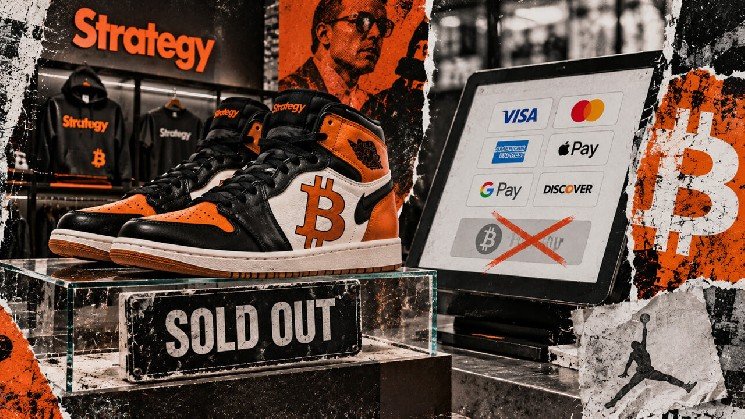
Strategy’s $250 Bitcoin-themed Air Jordans have sold out, extending Michael Saylor’s treasury brand from Wall Street into consumer culture.
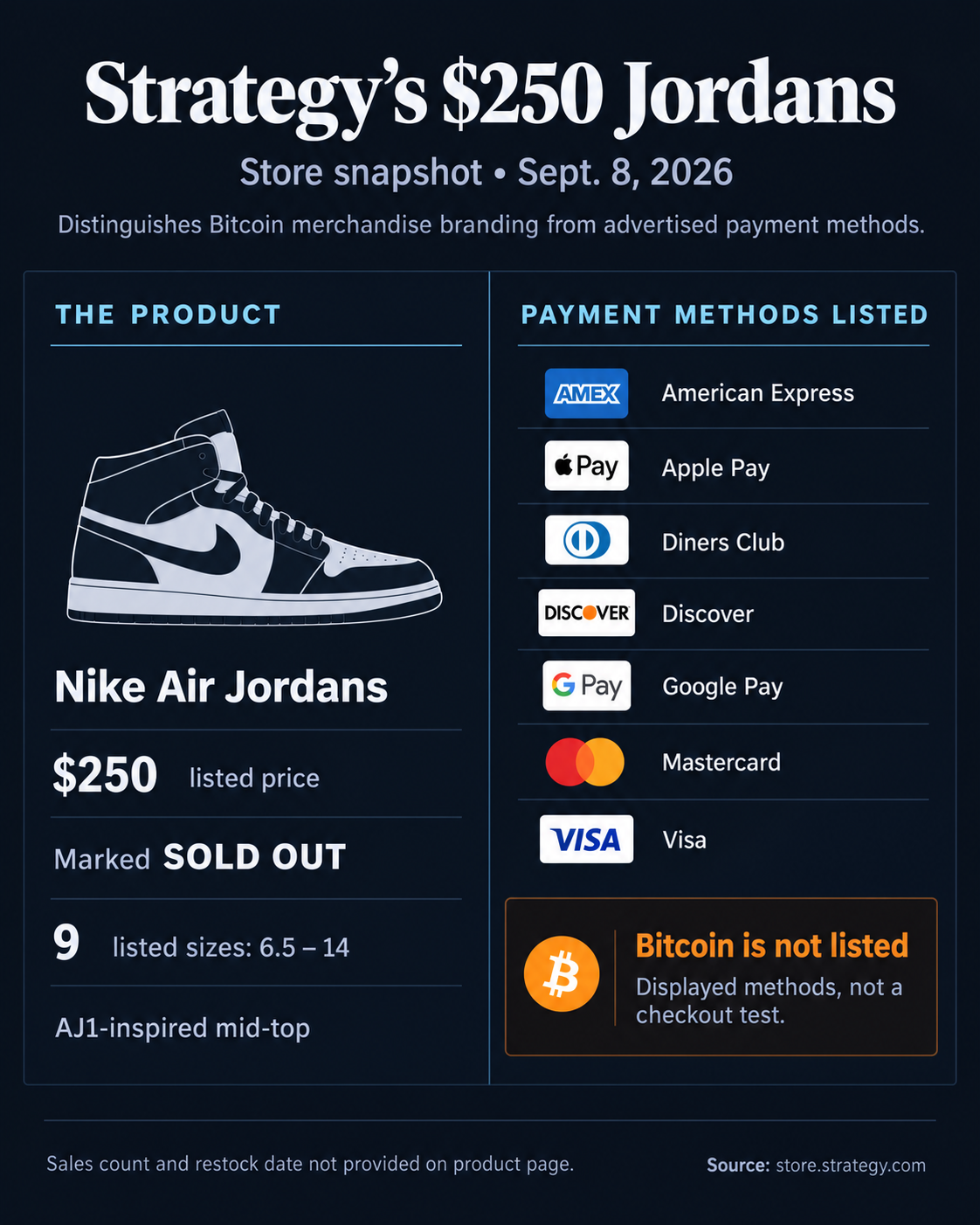
The shoes, launched Sept. 4 through Strategy’s online store, were sold out by Sept. 8, with all nine advertised sizes listed as unavailable. The company did not disclose how many pairs it offered or when inventory ran out.
The release pushes Strategy’s Bitcoin identity beyond its balance sheet and securities business into merchandise aimed directly at consumers.
The Saylor-led company holds 845,050 $BTC, equivalent to about 4.02% of Bitcoin’s fixed 21 million supply, making its association with the asset central to both its financial strategy and corporate identity.
Since dropping the MicroStrategy name in February 2025, Strategy has increasingly built its public image around Bitcoin, turning what began as a treasury allocation into the company’s defining feature.
Strategy turns Bitcoin into something customers can wear
The Air Jordans are the most prominent example yet of that branding effort.
Strategy describes the mid-top sneakers as inspired by the original Air Jordan 1, combining custom company branding with leather overlays, Nike Air cushioning, and the Air Jordan Wings logo. The store listed sizes ranging from 6.5 to 14 at $250 a pair.
They sit alongside a broader catalog built around the company and Saylor’s Bitcoin persona, including a $50 Bitcoin Strategy Game, a $125 Strategy hoodie, and a $35 organic cotton Saylor shirt.
The merchandise gives Strategy another way to capitalize on the audience built around its Bitcoin strategy without depending directly on MSTR shares, Bitcoin purchases, or the company’s expanding suite of preferred securities.
The Jordans’ sold-out status points to demand for premium products carrying that identity, though the undisclosed inventory makes the scale impossible to measure.
There is also an irony in how customers are being asked to buy into the Bitcoin brand.
Strategy’s storefront lists American Express, Apple Pay, Diners Club, Discover, Google Pay, Mastercard and Visa among its payment methods. Bitcoin does not appear among the displayed options.
That does not establish that Bitcoin cannot be used at checkout, since the published menu may not capture every possible payment method.
Still, the visible retail experience remains decidedly conventional: customers buying merchandise from the company holding more than 845,000 $BTC are presented with cards and mainstream digital wallets rather than Bitcoin itself.
For would-be buyers, inventory is the more immediate constraint. Strategy has not posted a restock date, leaving it unclear whether the Jordans were a limited promotional drop or the start of a broader effort to turn its Bitcoin identity into a recurring consumer business.
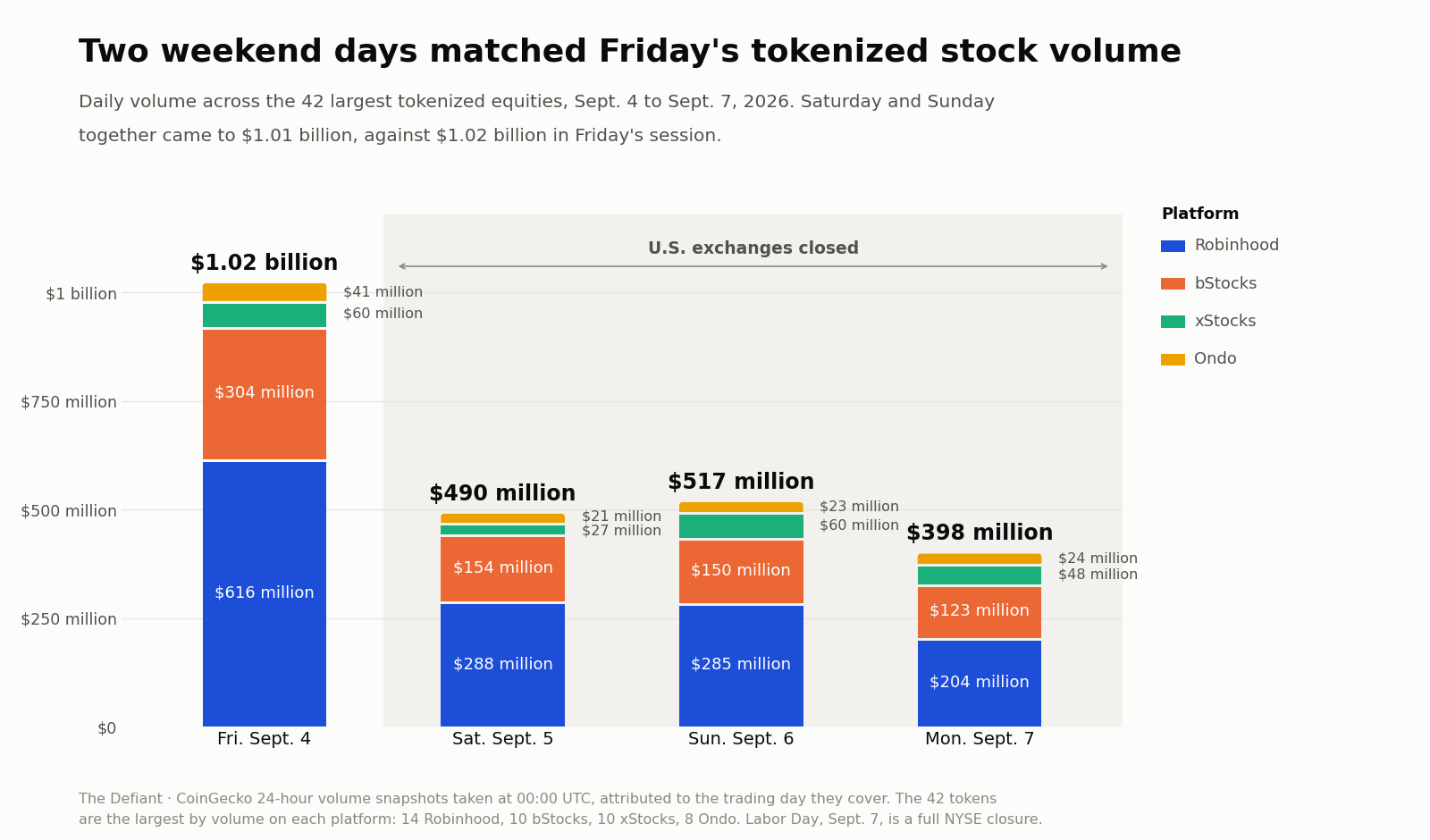
Tokenized stocks traded almost as much over the Labor Day weekend as they did on Friday, when U.S. exchanges were open, according to volume data from CoinGecko covering the 42 largest tokens across the four platforms that carry most of the sector’s activity.
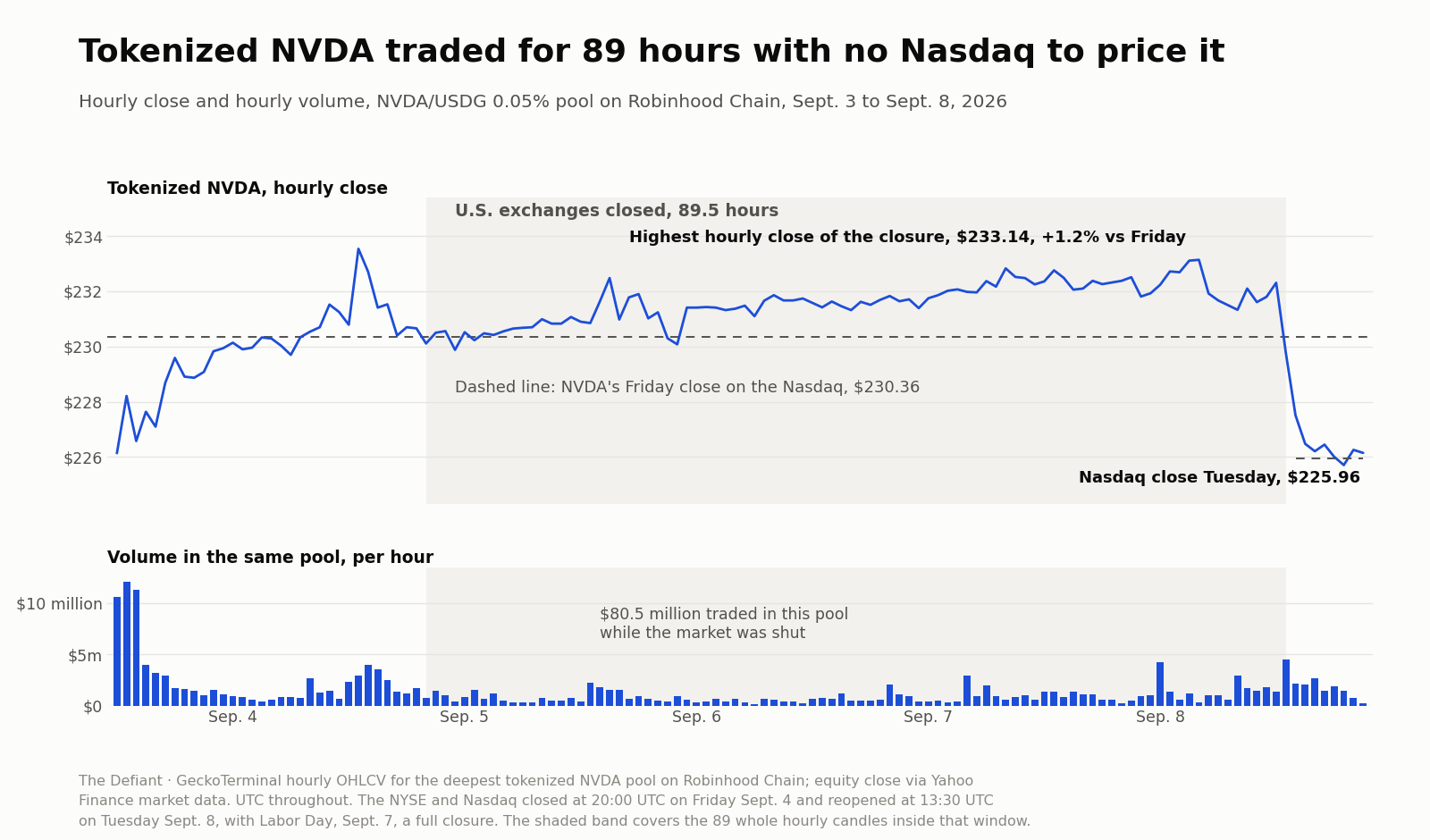
Weekend and holiday sessions are the functional case for putting equities onchain. The New York Stock Exchange closed at 4 p.m. ET Friday and did not reopen until 9:30 a.m. ET Tuesday, because Labor Day on Sept. 7 is a full closure — an 89-and-a-half-hour gap in which the same exposures kept trading onchain.
Saturday brought $490.3 million and Sunday $516.9 million, for a weekend total of $1.01 billion. Friday, with the cash market open all session, produced $1.02 billion across the same 42 tokens. Labor Day added $398.3 million, putting the three-day shutdown at $1.41 billion.
Robinhood Chain Took Half
Robinhood’s tokens accounted for $572.8 million of weekend volume, or 57% of the measured total, split $288.2 million Saturday and $284.6 million Sunday. Binance’s bStocks followed at $303.5 million, Backed Finance’s xStocks at $87.1 million and Ondo Global Markets at $43.8 million.
Robinhood leads on trading while holding the smallest book of the three largest platforms. Its tokenized equities are worth $133.2 million against Ondo’s $860 million and xStocks’ $631.2 million, rwa.xyz data shows, in a sector that holds $2.89 billion across 2.86 million holders. Robinhood Chain carried $1.61 billion of total decentralized exchange volume on Saturday, $1.51 billion Sunday and $1.51 billion on Labor Day, according to DefiLlama, with stock tokens a slice of it.
The Defiant reported in July that Robinhood Chain had passed Solana in tokenized stock volume on the strength of memecoin pairs. Those pairs are still running. A memecoin called AI, trading against tokenized NVDA, turned over $11.3 million across the two days out of a pool holding $22.4 million of liquidity, per GeckoTerminal.
One Nasdaq Token, $180 Million
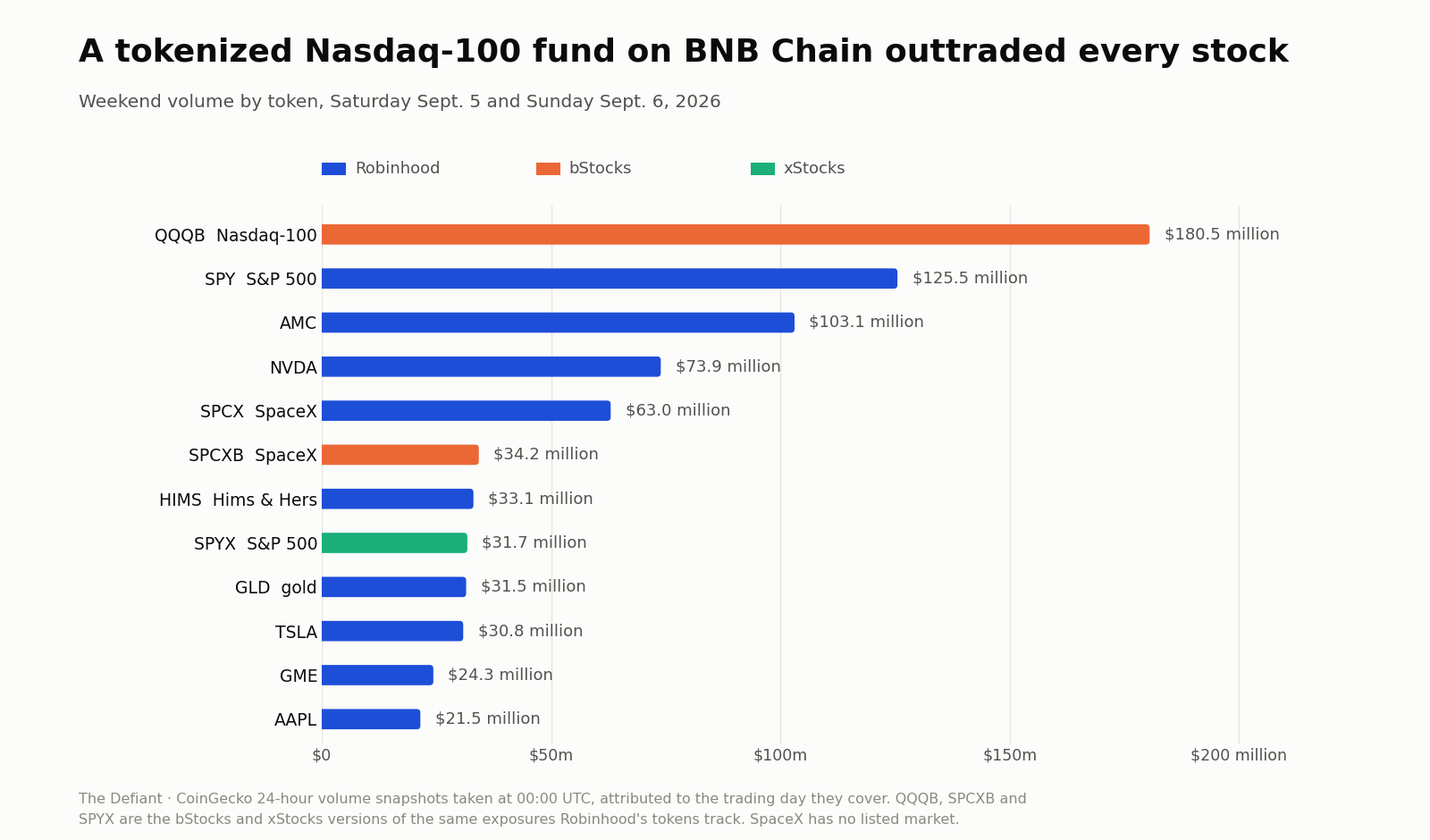
The most-traded instrument of the weekend was $QQQB, the bStocks version of the Invesco QQQ Trust, at $180.5 million — $88.9 million Saturday and $91.6 million Sunday. That is more than the xStocks and Ondo weekends combined.
CoinGecko tracks $1.34 million of circulating value in $QQQB against $87.8 million of 24-hour volume, or 65 times the token’s value in a day. Pricing is orderly, at $719.36 against QQQ’s $718.96 Friday close, so the turnover is not coming from a dislocation. $BNB Chain markets bStocks as convertible “with no fees,” tradable “24/7” and deployable on Venus, Lista DAO, PancakeSwap and Aster, the conditions under which a token can be recycled through pools indefinitely. The Defiant covered the bStocks launch in June.
$AMC Traded Through It
Robinhood’s tokenized $AMC Entertainment was the third-busiest name of the weekend at $103.1 million, and the weekend was its quiet stretch. On Friday the token did $232.6 million, the largest single-day figure in the sample, a day after $AMC Chief Executive Adam Aron demanded Robinhood halt the product and Robinhood chief legal officer Dan Gallagher told him to send his lawyers.
Volume ran $32.8 million Saturday and $70.3 million Sunday, then fell to $21.4 million on Labor Day. The token’s onchain market value is $6.6 million.
Indexes And A Rocket Company
After $QQQB and $AMC, the busiest weekend names were Robinhood’s SPY at $125.5 million, its NVDA at $73.9 million and its SpaceX token at $63 million, followed by the bStocks SpaceX token at $34.2 million, Robinhood’s HIMS at $33.1 million, the xStocks S&P 500 token at $31.7 million, Robinhood’s gold ETF token at $31.5 million and its TSLA at $30.8 million.
Grouped by underlying, Nasdaq-100 exposure led at $192.8 million and S&P 500 exposure at $157.2 million. SpaceX came third at about $102.7 million across three tokens, and it has no reference market at any hour of any day. The company is private, so its tokens have no closing price to converge to.
Hims & Hers was the weekend’s outlier on timing, with $26 million of Sunday volume against $7.1 million Saturday. Nine memecoins were trading against tokenized HIMS on Robinhood Chain as of late August, when one of them cornered more than half the token’s onchain float.
Prices Held Near Friday
Tokenized prices stayed close to Friday’s closes. The main tokenized NVDA pool traded between $229.18 and $233.52 on Saturday and $230.15 and $233.25 on Sunday, against NVDA’s $230.36 Friday close, a premium that never exceeded 1.4%. Tokenized HIMS ranged from $27.20 to $28.97 over the two days, against $27.71. In August, with a memecoin holding half its float, the same HIMS token printed $132.64 against a $28.84 equity.
Tuesday’s reopening went the other way for both names. NVDA closed at $225.96 and Hims & Hers at $28.03.
Kraken’s $385,010
Nearly all of the volume ran through decentralized exchanges. $QQQB trades $47 million on PancakeSwap V3, $42.2 million on Uniswap V4 and $19.6 million on $BNB Chain’s native venue, against $7.2 million on Binance itself, per CoinGecko’s ticker data, on a 24-hour snapshot. Robinhood’s SPY token splits $29.9 million across Uniswap V4, $15.4 million on Ramses V3 and $12.3 million on Uniswap V3, all on Robinhood Chain.
The xStocks S&P 500 token trades $10.3 million on Raydium’s concentrated-liquidity pools, $2.6 million on LBank and $385,010 on Kraken, one of the venues where xStocks first listed. Centralized exchanges take about 8% of $QQQB‘s tracked volume and 21% of the xStocks S&P 500 token’s; Robinhood’s SPY token has no exchange listing at all.
ONDO traded at $0.3845, up 0.6% over 24 hours. PONS, the launchpad token native to Robinhood Chain, was at $0.8304, up 14.5%.