Yields also rose across other major bond markets, including Europe and Japan, as investors remained concerned about inflation, higher oil prices and the sustainability of government borrowing.
The latest $6 billion operation follows the Treasury’s original announcement that it would at least double its long-duration buybacks from their typical $2 billion size. Yields initially fell after that announcement but later reversed sharply higher.
The Treasury is effectively repurchasing longer-dated bonds while continuing to finance itself at the front end of the yield curve. That changes the maturity profile of the government’s debt but does not reduce its overall borrowing needs.
The bond-market intervention followed earlier coordinated action by the U.S. and Japan to support the Japanese yen.
Earlier this week, Treasury Secretary Scott Bessent challenged currency traders to bet against the intervention, declaring, “I am the house now.” A stronger yen is also in the U.S. government’s interest because it reduces the pressure on Japan to sell U.S. Treasuries to finance further currency intervention. Japan is the largest foreign holder of U.S. government debt.
Alongside rising Treasury yields, WTI crude has climbed to around $97 a barrel, matching its May high. The increase has added to concerns that higher energy costs could keep inflation elevated, making the Federal Reserve’s job more difficult.
Hernandez said five largest big tech companies alone plan to invest over a trillion dollars on AI-related projects between 2025 and 2026,. with expectations that global AI-related investment will grow from roughly $500 billion today to between $3 trillion and $4 trillion by 2030. Bridgewater Associates recently reported that Microsoft MSFT$490.41·Market Closed, Alphabet GOOG$328.41·Market Closed, Meta META$654.01·Market Closed and Amazon (AMZ), which have a combined market cap of approximately $12 trillion, expect to spend $650 billion together on AI infrastructure this year alone.
Concerns about an AI bubble have been circulating this year, such asCitrini Research’s bearish 2028 scenario that unsettled technology stocks in February.
“With U.S. stocks accounting for a large share of global equity markets, the effects could propagate globally. In some jurisdictions, windfall gains from rising AI-related exports may also contribute to domestic asset bubbles, further exacerbating financial stability concerns,” he said.
“I do not say that this is where the AI boom must lead.But the scale and speed of the current investment boom, and the weight of expected commercial returns, do warrant some caution.”
The BIS chief said AI’s promise is real, including evidence of productivity gains in coding, consulting and professional writing,but added that the eventual economic effect will depend on how widely the benefits are shared and whether policymakers invest in skills, infrastructure and competition.
Changpeng Zhao (CZ), founder and former CEO of Binance, commented on investment opportunities in the cryptocurrency markets. Zhao stated that the market offers investors numerous opportunities to both buy and sell, emphasizing that the key is making the right decision.
Changpeng Zhao, in a short post on X, stated, “The market offers many opportunities for entry or exit. All you have to do is make the right decision.” Zhao’s statement highlighted the importance of timing and decision-making for investors in a period of constantly changing market conditions.
The statement by Binance’s founder aligns with assessments that price movements in cryptocurrency markets offer investors the opportunity to implement different strategies. Especially during periods of high volatility, investors can view price dips as buying opportunities and price increases as opportunities to reduce positions or exit.
Zhao did not specify a particular cryptocurrency, price level, or investment strategy in his post. Instead, he pointed out that the nature of the market inherently offers investors opportunities to enter and exit at different times.
Investment decisions in cryptocurrency markets are influenced by numerous factors, including price movements, liquidity, trading volume, macroeconomic developments, and investor sentiment. Zhao’s statement, rather than directly recommending a specific asset, emphasizes the need to properly assess the opportunities presented by market conditions.
Zhao, as the founder of Binance, is among the most well-known figures in the cryptocurrency sector, and his social media posts continue to be closely followed by market participants.
BlackRock warned on Sept. 8 that rising Japanese government bond yields could weaken demand for U.S. Treasuries by giving Japanese investors more attractive returns at home.
Japan’s 10-year government bond yield briefly exceeded 3% for the first time since 1996, while its 30-year yield reached a record 4.18%.
The shift matters because Japan holds roughly $1.1 trillion of U.S. Treasury securities. Decades of low and negative domestic interest rates encouraged Japanese banks, insurers and pension funds to invest abroad. Higher Japanese yields are beginning to alter that calculation.
Japan is becoming a key focus in global bond markets.
Surging yields on Japanese government bonds could attract some local investors and weigh on U.S. Treasury demand as competition for capital intensifies.
Explore why Japan matters for U.S. bond investors in our latest… pic.twitter.com/3wpal4oJvp
— BlackRock (@BlackRock) September 9, 2026
Japan bond yields now compete with U.S. debt
A Japanese investor can earn approximately 3% from a 10-year Japanese government bond, according to BlackRock’s commentary. A comparable U.S. Treasury produces about 2% after the investor hedges the dollar exposure back into yen using rolling three-month currency forwards.
The comparison does not mean Japanese investors will immediately sell their foreign holdings. Hedging costs change with currency and interest-rate conditions, while institutions also consider liquidity, portfolio duration and regulatory requirements. However, the return advantage that pushed capital overseas has narrowed.
Fitch Ratings reached a similar view on Sept. 9. The rating agency said higher yields could encourage Japanese institutions to retain more capital domestically. Fitch did not forecast a broad liquidation of existing bond portfolios.
BlackRock used a hypothetical 5% shift in Japan’s Treasury holdings to illustrate the scale. Such a move would redirect about $55 billion, equal to roughly 7% of the U.S. Treasury’s expected net borrowing during the quarter. The calculation is a scenario, not a forecast of actual selling.
Bank of Japan tightening raises repatriation risk
Japanese yields have risen as inflation, wages and yen weakness increase pressure on the Bank of Japan to tighten policy. The central bank raised its policy rate to 1% in June and left it unchanged in July.
BOJ board member Kazuyuki Masu said on Sept. 10 that the bank may need to increase rates more rapidly if inflation accelerates. A Reuters poll found economists expected a rise to 1.25% during September, followed by further tightening through 2027. Those forecasts remain subject to the BOJ’s decision.
The yen previously weakened to about ¥160 per dollar before recovering. The U.S. and Japan also conducted a coordinated yen-buying intervention, the first joint operation of its kind since 1998. A stronger yen can reduce the value of unhedged overseas assets for Japanese investors and make domestic holdings more attractive.
A weaker yen creates a different risk. Japanese authorities could sell foreign assets to finance intervention, potentially adding pressure to U.S. Treasuries. BlackRock described this as a possible feedback loop rather than a confirmed capital flow.
Higher global yields add pressure to Bitcoin
The global bond sell-off continued into Sept. 10. The 10-year JGB yield stood near 2.91%, below its recent 3% peak, while the U.S. 10-year Treasury yield reached approximately 4.84%. The 30-year U.S. yield traded near 5.29%.
Higher government bond yields can weigh on Bitcoin and other non-yielding assets by increasing the returns available from lower-risk securities. They can also raise corporate borrowing costs and reduce liquidity available for speculative markets.
As crypto.news reported, Bitcoin faced a possible decline toward $70,000 after retreating from $82,283 and struggling to hold the $78,000–$79,000 area. That weakness coincided with rising Treasury yields, stronger oil prices and renewed inflation concerns.
Bitcoin’s reaction does not establish that Japanese yields caused its decline. Crypto prices respond to several factors, including ETF flows, leverage, dollar liquidity and investor positioning. Japan’s rate reset adds another source of competition for global capital.
Inflation and central-bank decisions come next
U.S. consumer inflation data scheduled for Sept. 11 will shape expectations before the Federal Reserve’s Sept. 15–16 policy meeting. A stronger inflation reading could support higher U.S. yields and reinforce competition between bonds and risk assets.
Investors will then focus on the Bank of Japan’s September decision. A faster tightening cycle could push JGB yields higher and strengthen the yen, increasing incentives for Japanese institutions to hold more domestic assets.
The main indicator will be actual portfolio data rather than modelled scenarios. U.S. Treasury disclosures, Japanese institutional reports and currency-hedging costs will show whether investors are repatriating capital or merely adjusting new purchases.
BlackRock remains underweight Japanese government bonds because it expects yields to face further upward pressure. Its central argument is conditional: rising domestic returns could reduce Japanese demand for U.S. debt, but the scale and timing of any shift remain uncertain.
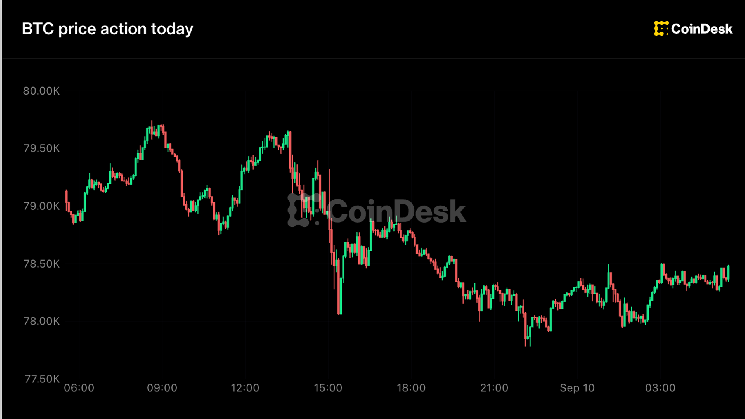
Bitcoin traded just above $78,000 as of Asian morning hours on Thursday, down about 1% over 24 hours, with the rest of the majors falling harder.
Dogecoin was the worst of them, down more than 5%, followed by BNB at about 4% and XRP at 3%. Solana, hyperliquid’s HYPE and ether each shed between 1% and 3%, leaving ether just under $2,475 and solana near $102. Tron was the only gainer, up less than 1% to about 34 cents, according to CoinDesk data.
Bitcoin’s 50-day average price crossed above its 200-day average on Tuesday.
FxPro analysts said a similar crossover in October 2024 and May 2025 produced nothing, but that this one follows a prolonged bull market rather than appearing inside a correction.
“The current situation bears a closer resemblance to what we saw in 2019,” they wrote, pointing to a 90% rally in under two months after that signal.
Read More: Bitcoin’s golden cross is here
Brent crude climbed as high as nearly $102 a barrel in Asian trade after Iran said it was prepared for a more intense war, and the higher oil price is feeding straight into rate expectations.
Among five wallets Nansen examined, one was sitting on a roughly $199,000 total loss after realising $171,000 and holding another $27,900 in unrealised losses. Another that bought about 28,400 $LAPTOP without selling was down roughly $118,000.
One address that bought about 49,700 $LAPTOP was sitting on roughly $13,000 in unrealised profit at the time of the snapshot.
Nansen put $LAPTOP at roughly a $720 million market capitalisation and a $2.1 billion fully diluted valuation even after the fall. Those figures flatter newly launched tokens, because small trades in thin liquidity move the quoted price a long way.
As such, $LAPTOP‘s team pushed back against suggestions that insiders had an advantage, saying there was no presale and no allocations for investors, influencers or key opinion leaders. The contract address, token allocation, security audit and other disclosures were published before trading began, it said.
“Everyone had the same information, at the same time,” the project said in the Thursday blog post.
It reiterated that ounders’ 30% allocation is locked for six months and vests over two years. Another 30% of supply is tied to a predictions mechanism, under which tokens are either burned or sent to charity depending on the outcome of specified events.
Consensys Software Inc. is separating into two companies, the firm said Wednesday.
The existing corporate entity will continue and rebrand as MetaMask, running the wallet and its consumer products under co-founder Joe Lubin as chairman and chief executive. Its Protocols Group and institutional blockchain infrastructure business, including the Linea layer 2, becomes a newly formed company named Consensys.
The split separates Ethereum’s most widely used wallet from one of its largest protocol development shops for the first time since Lubin founded the company in 2014. Each side gets its own chief executive, board and capital allocation: a consumer business now selling stablecoin yield and card spending, and an enterprise business selling tokenization infrastructure to banks.
Who Runs What
Mike Kriak becomes chief executive of the new Consensys, with David Cunningham as president and Declan Fox as chief product officer, according to the company’s post on X. Lubin will be executive chairman. That entity keeps Linea, the Besu Ethereum execution client used in permissioned enterprise networks, the Teku consensus client and Consensys’ Ethereum protocol work. The announcement does not say which company takes Infura, whose website now brands it as part of MetaMask Developer.
MetaMask keeps the wallet and the Money Account, the self-custodial product combining automated yield, card spending and swaps that launched on June 30 paying up to 4% on stablecoin balances. The company says the wallet has passed 100 million downloads across roughly 190 countries. Completion of the separation is expected by the end of 2026, and users need to take no action.
“Stepping into this role full-time is a recognition that consumer finance deserves the same focus and ambition that we’ve brought to building Ethereum itself,” Lubin said in the announcement.
The Institutional Pitch
Cunningham framed the institutional side around settlement plumbing. “Financial institutions and market infrastructure are moving to always-on operations with tokenization at the core,” he said. The release cited a June 2026 Citi report estimating tokenized assets could reach $5.5 trillion to $8.2 trillion by 2030.
Linea’s own numbers are smaller. The network holds $29 million in DeFi deposits, DefiLlama data show, against $38.1 million in stablecoins issued on it. LINEA trades at $0.002664, down 2.2% over 24 hours and 94% below its September 2025 all-time high, according to CoinGecko, for a market capitalization of $65.3 million. Another 960 million tokens unlock on Sept. 10.
The token launched at roughly a $500 million market capitalization a year ago, and Lubin teased further rewards for holders after it halved within weeks.
The $MASK Question
Neither the press release nor Lubin’s accompanying blog post mentions a MetaMask token. Lubin confirmed on The Block’s podcast in September 2025 that a $MASK token was coming, and tied it to “the decentralization of certain aspects of the MetaMask platform.” The company registered a claim.metamask.io domain in October 2025 and has not shipped a token since.
The announcement is also silent on the initial public offering the company has been preparing. Axios reported in October 2025 that Consensys had hired JPMorgan and Goldman Sachs to advise on a listing. Which of the two entities carries that process forward is unstated.
Euro stablecoin activity is small, but rapidly growing. Euro vault AUM across DeFi increased from roughly €12 million a year ago to €135 million today, still representing only 2.4% of total vault AUM. We believe euro-denominated real-word asset (RWA) yield products will accelerate EUR stablecoin growth.
Path Dependency & Missing Infra
Onchain euro issuance is trailing the offchain world primarily for two reasons: a historical path dependency and lack of euro-denominated DeFi infrastructure.
Path dependency. Stablecoins were built to settle crypto trading, and crypto pairs were originally priced in dollars. Since the base pair was USD, USD stablecoins launched to match the assets they settled.
Missing infrastructure. Vault infrastructure and looping (where each loan funds the next purchase) accelerated dollar-denominated DeFi. Dollar-denominated yield-bearing assets were issued onchain. Lending protocols accepted them as collateral and issued dollar debt against them, allowing users to buy more dollar-denominated yield-bearing assets.
Consequently, every major lending market onchain today reflects this dollar-denominated looping trade. Euro-denominated leverage markets did not take off because the legs of the loop didn’t exist.
Dollar Defi is Insufficient for Euro-Denominated Users
Euro-denominated vault infrastructure is a market necessity for European asset managers, corporate treasuries that operate and report in euros and European DeFi users who think in euro terms. These users represent significant latent demand, as they have been structurally limited from fully participating in the onchain economy due to burdensome FX risk and hedging costs.
As countries around the world continue to regulate cryptocurrencies, taxation stands out as one of the most important issues.
The latest notable regulatory effort on this issue comes from Germany.
A New Era in Bitcoin and Cryptocurrency Earnings!
Germany, one of Europe’s largest countries, is preparing comprehensive regulations to tax gains from cryptocurrencies, particularly Bitcoin and Ethereum.
According to BlockBeats, a draft prepared by the German Ministry of Finance plans to subject cryptocurrency gains to a flat tax of 25 percent, similar to stocks and other capital investments.
The draft legislation is not yet enacted and will be submitted to parliament for approval after a review process within the government.
One Year of Tax Exemption is Ending!
Under the current system, gains made by individual investors from selling cryptocurrencies held for more than a year are exempt from tax. However, the ministry wants to abolish this exemption, and the new regulation proposes removing this exemption and classifying cryptocurrencies as capital gains.
At this point, the new system is planned to be applied to cryptocurrencies acquired on or after January 1, 2027.
The draft also envisages preserving some important advantages for investors. The current annual tax exemption limit of €1,000 ($1,170) is expected to remain in effect. Furthermore, according to the report, the draft text also includes a provision allowing crypto investment gains and losses to be offset against gains and losses from other securities such as stocks.
Blockchain Association CEO Summer Mersinger similarly said in a statement that Illinois would not be able to use any of the funds it is projected to raise during the litigation, so “the State loses very little by waiting. Everyone else loses a great deal by forging ahead.”
Much of Wednesday’s filing reiterates arguments that the crypto industry has already brought: That the Internet Tax Freedom Act and the U.S. Constitution both preempt Illinois’ state tax on digital asset transactions. It also argued that the state would be treating digital assets differently from other financial services.
“Illinois generally does not tax transactions or services involving financial assets, beyond taxing income and capital gains associated with those transactions or services, and sales in which financial assets (such as money) are used as a method of payment,” the filing said. “The State’s sales and use taxes do not otherwise reach activities involving intangible personal property, including most financial assets, and those laws expressly exempt money and precious metals.”
Mersinger also hinted that other states might try to copy Illinois if the state wins its case: “If this Act stands, Illinois will not be the last state to try it.”