Tag: CRYPTOS FoxBusiness

  • BVNK Adds Stellar Blockchain for Cross-Border Payments and Treasury

    BVNK Adds Stellar Blockchain for Cross-Border Payments and Treasury

    • Global reach: The integration becomes immediately operational for corporate clients in over 130 countries.
    • Operational performance: In 2025, the Stellar network recorded a volume of $55.6 billion through 3.6 billion transactions, with average settlement times of 5 seconds.
    • Technical structure: Users access Stellar rails and its native assets through a single API, requiring no additional infrastructure development.

    BVNK announced that it will integrate the Stellar blockchain to enhance its cross-border payment, remittance, and corporate treasury disbursement services starting September 22, 2026.

    Stellar is now live on @BVNKFinance.

    This integration gives enterprise customers access to the blockchain designed for high-volume, sub-penny digital asset transfers.

    Cross-border payments, remittances, and treasury management. Stellar was made for global value movement. pic.twitter.com/ZkUBicPEOX

    — Stellar (@StellarOrg) September 22, 2026

    With this deployment, the corporate payment platform expands its multichain architecture for stablecoins. Through this tool, businesses will be able to process international payments with low fees and near-instant finality, connecting crypto liquidity with traditional banking infrastructure.

    Multichain expansion for corporate settlements

    The technical integration of the Stellar network allows business clients to execute fund disbursements and international transfers directly. BVNK reported that the implementation is designed to mitigate the operational complexity companies face when individually connecting to multiple blockchains.

    By centralizing access within a single Application Programming Interface (API), organizations avoid rebuilding their IT systems as they incorporate new payment rails.

    In terms of performance, in 2025, the Stellar network reported cumulative processing of $55.6 billion distributed across 3.6 billion operations, maintaining 99.99% uptime. Data from the network operator suggests that the cost per transaction represents a fraction of a cent, presenting a competitive alternative to conventional banking rails.

    Regarding this, Denelle Dixon, CEO of the Stellar Development Foundation, stated that businesses moving capital at scale demand operational certainty in every payment corridor. According to her institutional stance, the alliance seeks to extend proven financial rails to regulated corporations processing regular settlements with stable digital assets.

    This strategic move responds to the increase in institutional demand for stablecoins destined for daily treasury operations. Data from BVNK in July 2026 indicates that corporate stablecoin wallets function most frequently as global dollar account layers to mitigate operational frictions between diverse jurisdictions.

    Through this technological layer, companies issuing B2B payments, international payroll, or supplier settlements can convert stablecoin balances into local fiat currencies and vice versa.

    The regulatory framework has accompanied this corporate evolution. BVNK holds more than 40 licenses and registrations across different jurisdictions, including an Electronic Money Institution (EMI) license in the United Kingdom under FCA supervision, licenses in Malta adapted to MiCA regulations, and money transmitter authorizations in the United States.

    Technical data from the firm suggests the progressive addition of more native Stellar assets within the same connection environment during the coming quarters.

    As the next verifiable milestone on the company’s calendar, BVNK will complete the functional rollout of its unified stablecoin card and account infrastructure in the European market during the final quarter of 2026.

  • DOGE Rally Accelerates as Price Reaches Highest Level in Months

    DOGE Rally Accelerates as Price Reaches Highest Level in Months

    • Dogecoin is trading near $0.09986, up 1.04% over the last 24 hours, after briefly reaching around $0.1059.
    • The move follows X’s rollout of trading links through its Cashtag system, involving Coinbase, Kraken, Gemini, Moomoo, and Interactive Brokers.
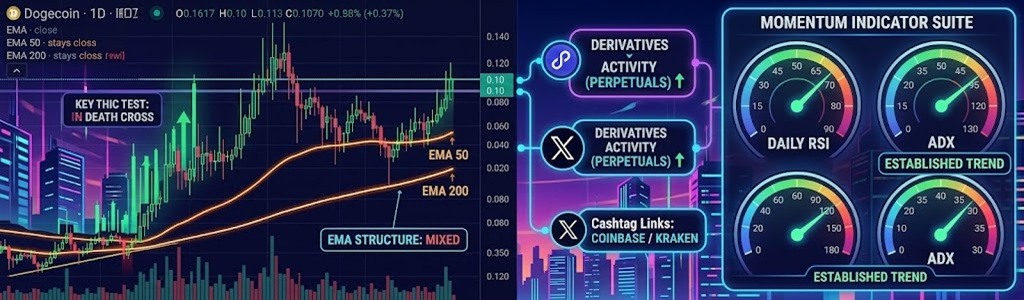
    • Rising derivatives activity has added momentum, although $DOGE’s longer-term technical structure remains mixed as traders watch key moving averages.


    Dogecoin has extended its recent recovery, with $DOGE reaching its highest intraday level in months as the broader crypto market continues to attract buyers. The token is now trading around $0.09986, up 1.04% over the past 24 hours, keeping the psychological $0.10 level within close range.

    The latest move comes alongside increased attention around X and its new Cashtag trading program. The platform has connected U.S. users with Coinbase, Kraken, Gemini, Moomoo, and Interactive Brokers, allowing supported stock and crypto tickers to display market information and a Trade option that redirects users to participating platforms.

    $DOGE Rally Gains Momentum From X Trading Access

    The connection with X is particularly relevant for Dogecoin because of Elon Musk’s long-standing public association with the cryptocurrency. While the new program does not mean $DOGE has been integrated as a payment asset on X, it creates a shorter path between financial discussions, market data, and trading activity.

    $DOGE moved from an opening level near $0.0999 to an intraday high around $0.1059 before giving back part of the advance. Recent market activity around the $0.10 area suggests that traders are actively responding to the renewed momentum.

    Derivatives are adding another layer to the move. Dogecoin futures markets have recorded significant trading activity, with perpetual contracts attracting substantial participation. Higher derivatives activity can amplify price movements when traders increase leveraged positions, creating opportunities for faster gains but also increasing downside risk.

    Technical Signals Point To A Key Test

    Momentum indicators also show why $DOGE has attracted renewed attention. Recent market analysis has placed its daily RSI near the upper end of the neutral-to-bullish range, while ADX remains above the level commonly associated with an established trend. These readings indicate that momentum has strengthened, although they do not guarantee that the advance will continue.

    At the same time, the chart still carries a longer-term technical obstacle. $DOGE’s 50-day EMA remains below its 200-day EMA, preserving the bearish crossover that traders often monitor after extended periods of weakness. A sustained recovery would therefore require more than a single strong session to change the broader moving-average structure.

  • Crypto market structure can’t wait for shot at post-election Clarity Act surge: White House

    Crypto market structure can’t wait for shot at post-election Clarity Act surge: White House

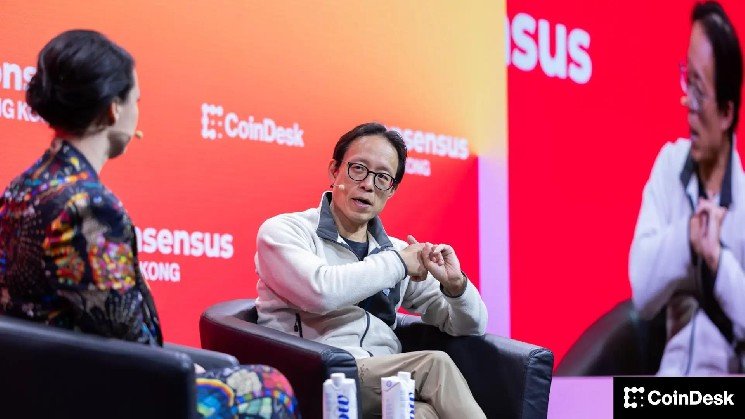
    The congressional elections will determine whether the Republican majorities change hands in the U.S. House of Representatives, Senate or both and “will motivate certain people or reduce motivation for others,” Witt noted — with many political observers assuming Democrats won’t want to make any Clarity Act deals if they surge to greater authority at the end of the year.

    “There’s no time to waste now,” said Witt, whose primary task to get the Clarity Act passed by this Congress was foiled by U.S. Senate politics. He pointed to a rush of crypto progress since last week at the U.S. Securities and Exchange Commission and the Commodity Futures Trading Commission. “There’s no holding them back in hopes of a lame duck passage of the bill.”

    Witt granted that the regulators’ rules and exemptions may run into “challenges, legally,” without the underpinning of the law the administration had hoped to see, but he said, “We’re going to do what we can with the authorities that we have, which are many.”

    The crypto adviser was still reeling from the legislative loss.

    “Did we really need to drag that out for a year only to get a purely political result like that?” Witt asked. “I know we’re close to an election, but still, I just think it was a major disappointment.”

  • Keep an Eye on Bitcoin and XRP: Analyst Shares New Bullish Targets

    Keep an Eye on Bitcoin and XRP: Analyst Shares New Bullish Targets

    Crypto analyst Ali Martinez shared some notable technical levels following the recent strong price increases in Bitcoin ($BTC) and $XRP. According to Martinez, a break above $1.60 in $XRP could open the door to a new upward movement, while for Bitcoin, $100,000 has once again become a significant target.

    $XRP gained 27.6% in value, rising from $1.25 to $1.58. Martinez noted that this move may have completed the right shoulder of a large-scale inverse head and shoulders pattern forming on the daily chart.

    According to the analyst, the most critical level for $XRP right now is $1.60. This area corresponds to the neckline of the formation. Martinez stated that if $XRP makes a decisive breakout above $1.60, the formation could be confirmed, and in such a scenario, a further increase of approximately 30% could bring the $2 level into play.

    In addition to the technical outlook for $XRP, the actions of large investors are also attracting attention. According to data shared by Martinez, whales have recently accumulated more than $2 billion worth of $XRP.

    According to Martinez, Bitcoin is Back on the Agenda at $100,000.

    Martinez also believes the bullish outlook continues for Bitcoin. Bitcoin has risen more than 50% since its low of $57,749 seen on July 1st.

    According to the analyst, one noteworthy point is that despite the sharp rise in prices, large investors are remaining active in the market instead of taking profits. In just the last day, the Bitcoin network recorded over 2,722 transactions worth more than $1 million.

    On the institutional side, demand for spot Bitcoin ETFs is also a key factor supporting the rise. According to data shared by Martinez, US-based spot Bitcoin ETFs have accumulated over $1.60 billion worth of $BTC in the last 72 hours.

    One of the key support areas for Bitcoin is at $84,569. This area, where approximately 600,000 $BTC have previously changed hands, is noted as a strong demand zone, while the second important support level is indicated at approximately $77,000.

    In upward movements, on-chain cost breakdown data indicates a significant resistance level around $104,765. It’s noted that approximately 283,000 $BTC have already changed hands at this level.

    MVRV price bands present a similar picture. According to Martinez, the average MVRV band, around $100,670, is one of the next major resistances for Bitcoin. On the downside, the MVRV band around $74,361 stands out as a strong support zone.

    *This is not investment advice.

  • Tokenized stocks may see limited U.S. demand: TD Cowen

    Tokenized stocks may see limited U.S. demand: TD Cowen

    The SEC has opened a five-year route for tokenized U.S. stock trading, but TD Cowen has found that domestic investors, institutions, and listed companies show little appetite for the products.

    TD Cowen said U.S. investors already have efficient access to listed shares, leaving tokenized venues under pressure to offer benefits that outweigh thin liquidity and added operational work.

    Reid Noch, vice president of U.S. equity market structure at TD Cowen, wrote in a Friday paper that both retail and institutional demand will likely remain limited during the market’s early stage.

    “U.S. investors already have efficient access to the underlying shares,” Noch wrote, adding that tokenized platforms need a compelling benefit to offset their operational complexity and restricted liquidity.

    The assessment followed the U.S. Securities and Exchange Commission’s five-year tokenized stock exemption, announced on Sep. 17. The conditional relief lets qualifying Tokenized Securities Venues use permissioned automated market makers and liquidity pools to trade tokenized National Market System stocks.

    Eligible liquidity providers can also receive temporary relief from certain dealer-registration requirements. Each participating venue remains subject to limits on the number of stocks it supports and the trading volume processed through the system.

    Tokenized stocks must compete with efficient U.S. markets

    For American investors, TD Cowen’s concern centers on whether tokenization improves a market that already offers deep liquidity, low-cost brokerage services and fast electronic execution.

    Blockchain-based venues could extend stock trading into nights, weekends and holidays. Their automated market makers, or AMMs, would price transactions through asset pools and preset rules instead of matching buyers and sellers in a conventional order book.

    In practice, Noch warned that continuous access does not guarantee favorable execution. A pool with limited assets may produce weaker prices, especially when fewer traders and liquidity providers are active outside the main U.S. session.

    AMM pricing also places more weight on the amount and composition of assets deposited in each pool. Although a venue may remain technically open around the clock, TD Cowen’s analysis indicates that investors could still prefer established exchanges if the onchain market offers less liquidity or higher trading costs.

    U.S. exchanges generally operate their main sessions between 9:30 a.m. and 4 p.m. Eastern Time on weekdays. Several brokers already provide premarket and after-hours access, reducing the value that some domestic traders may place on a separate blockchain venue.

    The SEC has attached investor protections to its experiment. Approved tokens must represent NMS stocks and preserve the economic interest, dividends, voting power, and liquidation rights associated with the underlying shares.

    Synthetic products that merely follow a company’s stock price do not qualify. As previously covered by crypto.news, the agency’s investor-rights requirements separate qualifying stock tokens from offshore products that may offer economic exposure without making the buyer a shareholder.

    Issuer objections could restrict tokenized stock listings

    Before a third party tokenizes a company’s shares, the SEC framework requires the proposed venue to notify the issuer. The company then has 30 days to object, according to the TD Cowen paper.

    Listed businesses therefore retain some control over whether unrelated operators create blockchain versions of their securities. Trading cannot proceed under the exemption when an issuer objects.

    According to Noch, discussions with dozens of issuers found little interest in offering tokenized shares. The group included several companies with large retail investor bases, although crypto-linked businesses such as Figure showed more interest.

    “Our conversations with dozens of issuers” revealed minimal demand outside crypto-adjacent companies, Noch wrote.

    Figure provides an existing comparison between traditional and blockchain-based shares. Its Nasdaq-listed FIGR stock trades alongside blockchain-native FGRS shares carrying the same economic exposure and voting rights.

    During the 24-hour period studied by TD Cowen, conventional FIGR shares accounted for 99.9% of the company’s notional trading. The finding suggests that equal economic and governance rights have not been enough to move meaningful activity away from the Nasdaq-listed security.

    Other SEC conditions may also limit how quickly venues can add markets. Smart contracts must be public and auditable, while operators must disclose trading activity, related-party transactions, and key details about their systems.

    A venue must also halt a tokenized stock whenever the primary exchange stops trading the underlying shares. As a result, round-the-clock availability would not override an official halt related to volatility, company news or a regulatory issue.

    In early September, the SEC also proposed a transfer-agent rule overhaul covering digital ownership records, cybersecurity, asset protection and third-party technology providers. Transfer agents maintain the official shareholder register used for voting, dividends, stock splits and other corporate actions, making their records important when a token claims to represent legal ownership.

    Stock perpetuals show stronger demand than tokenized shares

    For crypto traders seeking exposure to public companies, TD Cowen found more activity in perpetual futures than in spot stock tokens.

    A snapshot of Nvidia-related trading on Binance showed that perpetual futures generated 96% of notional volume, while spot products accounted for 4%. Perpetuals track the price of an asset without transferring ownership of the referenced shares.

    The contracts have no fixed expiration date and use recurring funding payments to keep their prices close to the underlying stock. They may also offer leverage, which lets traders control a larger position with less capital but increases liquidation risk when prices move against them.

    “As we continue to outline, we see perpetual futures as the stronger demand story,” Noch wrote.

    TD Cowen expects platforms to keep adding the products inside and outside the United States, citing retail demand for leverage.

    Recent filings support the comparison. On Sep. 18, Coinbase submitted proposals for 50-plus stock perpetuals tied to companies including Nvidia, Microsoft and Tesla. The exchange plans to offer 24-hour trading from Monday through Friday if U.S. regulators clear the contracts.

    Coinbase’s proposed products would provide leveraged price exposure without voting rights, dividends or ownership of the referenced shares. Their listing remains subject to regulatory review, and the company has not announced a launch date or complete contract specifications.

    Earlier in September, Ondo Finance also asked the SEC and Commodity Futures Trading Commission to apply existing security-futures rules to stock perpetuals. Its Panama-based affiliate had processed $8 billion in cumulative volume within about six weeks, according to Ondo’s regulatory submissions.

    Ondo said the offshore platform settles contracts in stablecoins and remains unavailable to American users. Many of its perpetuals reference U.S.-listed companies, allowing eligible non-U.S. traders to follow their stock prices without opening a conventional brokerage account.


  • Chainlink blockchain finance push hits Sibos with Microsoft, DTCC in room

    Chainlink blockchain finance push hits Sibos with Microsoft, DTCC in room

    Sergey Nazarov, the Chainlink Co-Founder, is heading to one of the biggest gatherings in global banking technology next week, and his presence says a lot about where Chainlink blockchain finance integration currently stands. Nazarov is set to take part in three sessions at the Sibos conference, appearing alongside representatives from Microsoft and DTCC in what amounts to one of Chainlink’s most visible moments on a traditional finance stage this year.

    Key takeaways

    • Chainlink Co-Founder Sergey Nazarov will participate in three sessions at the Sibos conference next week.
    • Sibos is a major global financial services and technology conference that brings together banks, market infrastructure providers, and technology firms.
    • Chainlink is engaging with institutions including Microsoft, DTCC, Clearstream, and the International Finance Corporation at the event.
    • Chainlink operates as a decentralized oracle network that connects smart contracts to real-world data.
    • The event highlights growing collaboration between blockchain infrastructure and traditional banking systems.

    Chainlink’s Sergey Nazarov to Participate at Sibos Conference

    Nazarov’s appearance at Sibos next week puts Chainlink squarely in front of the institutions that decide whether blockchain tools get adopted at scale. This isn’t a niche crypto meetup — it’s a conference built for banks, custodians, and payment networks, which makes Chainlink’s presence there notable in itself.

    Involvement in Three Sessions

    According to details shared around the event, Nazarov is scheduled to speak across three separate sessions at Sibos. That kind of repeated stage time signals more than a courtesy appearance; it suggests Chainlink has multiple threads of conversation running with the conference’s institutional audience at once.

    Significance of Sibos as a Financial Event

    Sibos has long served as a meeting point for the world’s financial services and technology sectors, drawing major banks and infrastructure providers under one roof. Having a blockchain company’s co-founder featured in three sessions there reflects how far the conversation around blockchain financial services has shifted from experimental pilots toward mainstream discussion.

    Chainlink’s Collaboration with Leading Financial Institutions

    Chainlink isn’t attending Sibos in isolation — it’s showing up alongside some of the biggest names in global finance and payments. That lineup matters because it shows which institutions are willing to be publicly associated with blockchain infrastructure conversations right now.

    Engagements with Microsoft, DTCC, Clearstream, and IFC

    At Sibos, Chainlink is engaging directly with Microsoft and DTCC, and reports point to further connections with Clearstream and the International Finance Corporation. Each of these names carries weight in its own corner of finance: DTCC handles a huge share of securities settlement infrastructure, Clearstream is a major post-trade services provider, and the IFC operates as a development finance institution with global reach. Chainlink positioning itself among this group suggests it’s aiming for relevance in the plumbing of financial markets, not just the crypto trading layer.

    Focus on Bridging DeFi and Traditional Banking

    The throughline across these engagements is Chainlink’s stated ambition to bridge decentralized finance with traditional banking systems. This isn’t happening in a vacuum. Chainlink has already been extending its infrastructure into institutional-grade networks elsewhere this month.

    Chainlink’s Decentralized Oracle Network and Its Role in Finance

    At its core, Chainlink functions as a decentralized oracle network designed to connect smart contracts with real-world data, which is what makes it relevant to institutions in the first place. Smart contracts on their own can’t reliably pull in information like asset prices, settlement confirmations, or market data from outside their own blockchain — that’s the gap Chainlink’s oracle infrastructure is built to fill.

    This function is precisely why Chainlink keeps showing up in conversations about blockchain financial services. Financial institutions exploring tokenization, settlement, or cross-chain transfers need dependable, tamper-resistant data feeds, and that’s the practical value proposition Chainlink brings to the table at events like Sibos.

    Implications and Expectations from Sibos Participation

    Nazarov’s three sessions at Sibos matter less for the appearance itself and more for what could follow. Conferences like this often become launchpads for new partnership announcements, and Chainlink’s presence at Sibos discussions suggests the company is trying to build momentum on multiple fronts at once.

    Why this matters: regulators are beginning to explore the potential benefits of blockchain technology within traditional finance, and each high-profile engagement — whether a conference session or a mainnet integration — adds to the case that decentralized infrastructure can coexist with regulated financial systems rather than compete against them. For a market currently sending mixed signals, a strong showing at Sibos could shape sentiment around Chainlink heading into the rest of the year, particularly if new partnerships or technical announcements emerge from the sessions Nazarov is part of.

    FAQ

    Who from Chainlink is participating at the Sibos conference?

    Sergey Nazarov, Chainlink Co-Founder, will participate in three sessions at the Sibos conference.

    What is the significance of the Sibos conference for Chainlink?

    Sibos is a major global financial services and technology conference where Chainlink engages with leading financial institutions to advance blockchain adoption.

    Which institutions will Chainlink engage with at Sibos?

    Chainlink will engage with institutions like Microsoft, DTCC, Clearstream, and the International Finance Corporation.

    What is Chainlink’s role in the blockchain and finance integration?

    Chainlink is a decentralized oracle network that connects smart contracts with real-world data, aiming to bridge decentralized finance with traditional banking systems.

    Article produced with the assistance of artificial intelligence and reviewed by the editorial team.

  • Animoca Brands delays IPO plans, suspends merger talks with Currenc

    Animoca Brands delays IPO plans, suspends merger talks with Currenc

    Animoca Brands suspended discussions for a proposed reverse merger with Currenc Group Inc. (CURR), which would have seen the digital asset investment company secure a Nasdaq listing.

    The two companies decided the proposed timeframe to finalize the transaction didn’t align with their respective goals, Animoca announced on Tuesday.

    Talks between Animoca and Currenc kicked off late last year, with plans for the former to own 95% of the merged company.

    Hong Kong-based Animoca said it “remains fully committed” to listing on a major public exchange, with co-founder Yat Siu adding it will “continue to pursue optimal routes” to a public listing.

    Animoca Brands’ portfolio spans decentralized finance (DeFi), AI, non-fungible tokens (NFTs) and gaming, with advisory services forming an increasing chunk of its revenue stream in recent years.

    Currenc shares closed at $3.23 on Monday, 1.25% higher on the day, before dropping 0.93% in after-hours trading.

  • Pepe price jumps 25% but overbought RSI warns of pullback

    Pepe price jumps 25% but overbought RSI warns of pullback

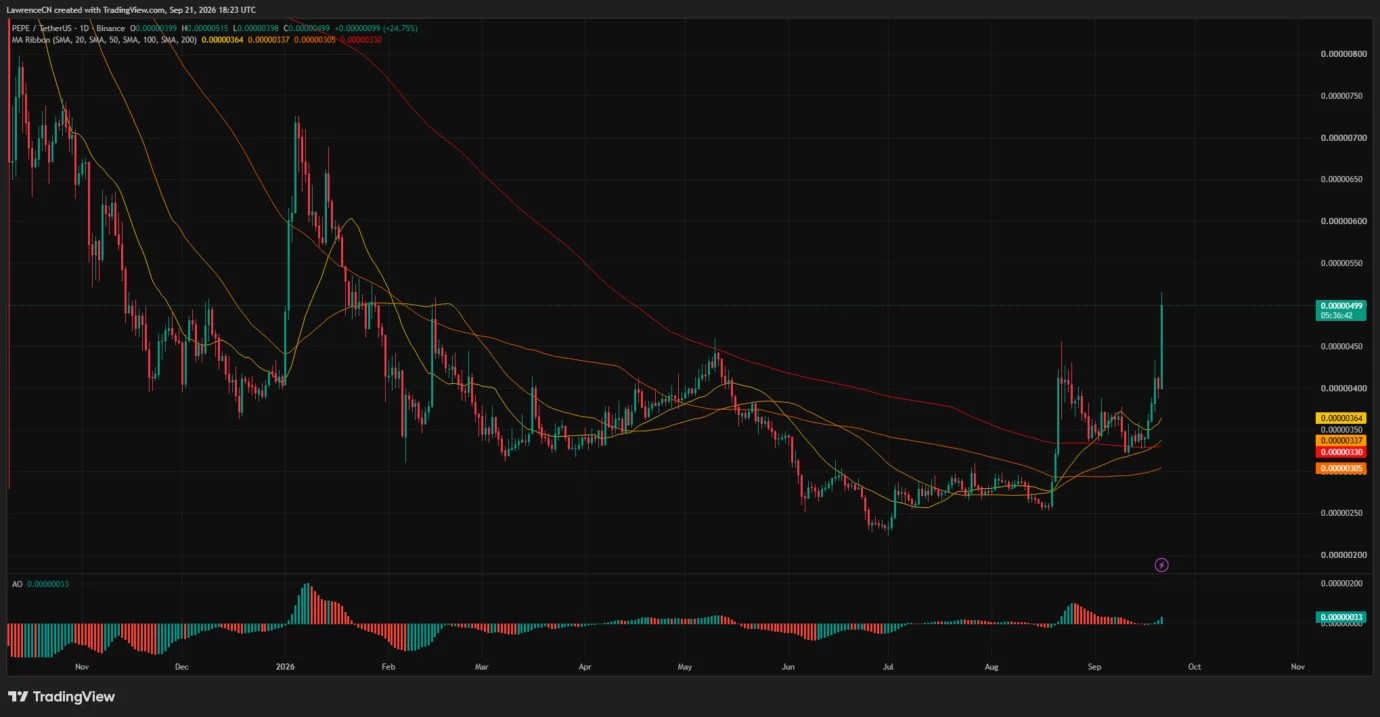
    Pepe price surged nearly 25% on Sep. 21 as the meme coin cleared a major resistance level, although an overbought 4-hour reading raises the risk of a short-term pullback.

    According to data from crypto.news, Pepe ($PEPE) price traded around $0.00000499 at the time of writing after reaching an intraday high of $0.00000515. The rally lifted the meme coin by 24.75% during the daily session and extended its seven-day gain to nearly 40%, according to CoinGecko.

    The token’s market capitalization climbed above $2 billion, while its 24-hour trading volume approached $900 million.

    $PEPE’s advance came alongside a wider crypto rally led by Bitcoin, which crossed $85,000 for the first time in eight months. Bitcoin exchange-traded funds operated by firms including BlackRock and Fidelity received about $433 million on Friday, according to JPMorgan data cited by the Wall Street Journal.

    Broader demand for risk assets helped $PEPE accelerate beyond the gradual recovery visible earlier in the week. However, its latest technical readings suggest that buyers may struggle to maintain the same pace without a period of consolidation.

    Pepe price clears its major moving averages

    The daily $PEPE/USDT chart shows that the token has moved above its 20-day, 50-day, 100-day and 200-day simple moving averages.

    Pepe price daily chart — Sep. 22 | Source: crypto.news

    $PEPE’s 20-day SMA stood near $0.00000364, while the 50-day and 100-day averages were located around $0.00000337 and $0.00000330, respectively. The 200-day SMA remained lower at approximately $0.00000305.

    Trading above all four averages marks a sharp change from the bearish structure that controlled the market during the first half of 2026. Price had fallen from above $0.000007 in late 2025 to a June low near $0.00000220 before forming a base.

    The daily Awesome Oscillator also moved into positive territory at approximately 0.00000033. A positive reading means short-term momentum is stronger than longer-term momentum, supporting the current bullish setup.

    The next technical test sits between $0.00000515 and $0.00000550. $PEPE briefly touched the lower end of that area during the rally but had not produced a confirmed daily close above it at the time the chart was captured.

    4-hour RSI warns of an overheated rally

    Shorter-term readings show greater pullback risk after the rapid price increase.

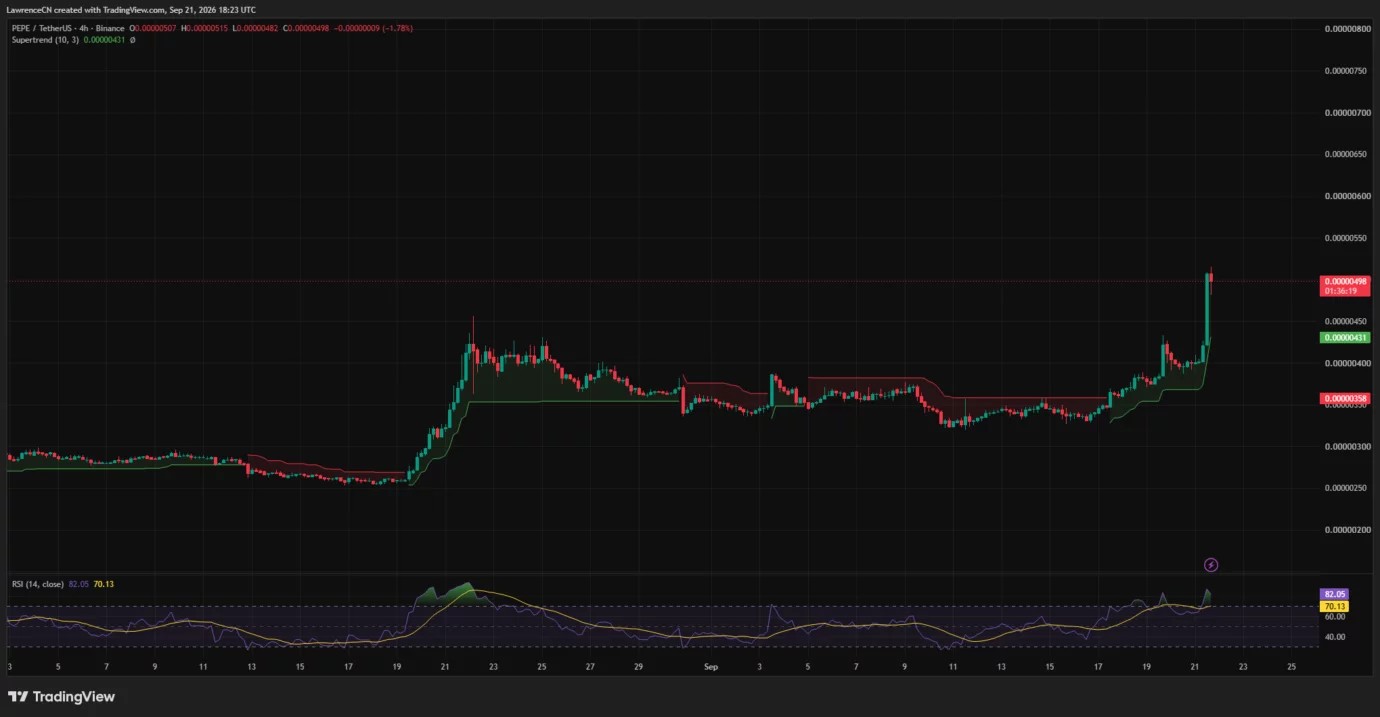
    The 4-hour Relative Strength Index rose to 82.05, well above the 70 level commonly used to identify overbought conditions. Its RSI-based moving average stood at 70.13, confirming that momentum accelerated sharply during the breakout.

    Pepe price 4-hour chart — Sep. 22 | Source: crypto.news

    An overbought RSI does not guarantee an immediate fall, but it can indicate that buyers have already committed substantial capital over a short period. $PEPE’s latest 4-hour candle had declined 1.78% from its opening price after reaching $0.00000515, showing early profit-taking near the session high.

    The 4-hour Supertrend remained bullish, with its support line near $0.00000431. Holding above that level would preserve the current short-term trend and could allow buyers to retest $0.00000515.

    A drop below $0.00000431 would weaken the breakout and expose the former resistance area around $0.00000400. Deeper support sits near the 20-day moving average at $0.00000364.

    $PEPE liquidation clusters increase pullback risk

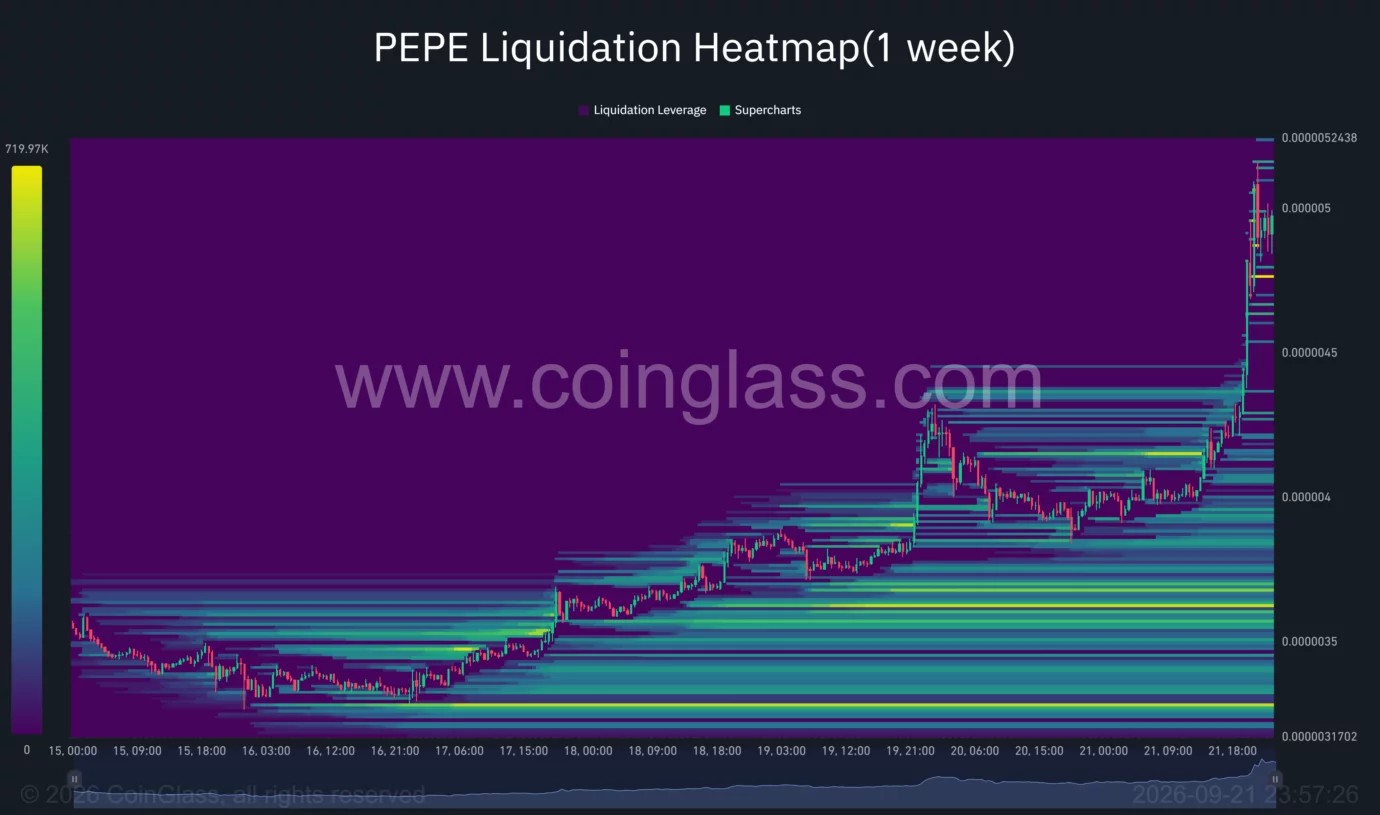
    CoinGlass’s one-week liquidation heatmap shows that $PEPE’s rally moved through several concentrations of leveraged positions between $0.00000410 and $0.00000450.

    Pepe liquidation heatmap | Source: CoinGlass

    The largest remaining liquidity concentrations appear below the current price. Dense bands are visible around $0.00000355–$0.00000370, with another strong cluster near $0.00000320.

    Liquidation heatmaps show where leveraged positions could face forced closure if the market reaches certain prices. They do not establish that price must move toward those zones, but concentrated leverage can add volatility when a reversal begins.

    Smaller clusters also sit above $PEPE near $0.00000510–$0.00000524. A renewed move through the intraday high could force additional short liquidations and extend the rally before the market tests higher resistance.

    $PEPE breakout puts $0.00001 back in focus

    Crypto analyst Crypto Patel said $PEPE has risen about 97% from a higher-time-frame accumulation zone between $0.00000200 and $0.00000270.

    “The accumulation move is already underway. The next trigger is the breakout.”

    Patel identified $0.000004583 as the level $PEPE needed to reclaim and convert from resistance into support. The market has now traded above that threshold, but a daily close and successful retest would provide stronger confirmation than the initial intraday break.

    The analyst listed $0.000010, $0.0000,16 and $0.000027 as possible longer-term targets if $PEPE also breaks its higher-time-frame downtrend. Those levels remain projections rather than confirmed destinations, with the first target requiring the token to roughly double from its current price.

    $PEPE’s immediate outlook depends on whether buyers can defend $0.00000458 after the 25% daily advance. Holding that level would keep $0.00000515 and $0.00000550 in view, while losing it could send the token toward Supertrend support at $0.00000431 or the larger liquidation zone near $0.00000360.

  • Solana’s Blockchain Powers Innovative Tokenized Projects

    Solana’s Blockchain Powers Innovative Tokenized Projects

    Solana’s blockchain is becoming a hub for innovation, particularly with the launch of a tokenized magazine based on the popular One Piece series. This initiative highlights the platform’s capability to revolutionize digital collectibles. Additionally, Raoul Pal will join the Breakpoint event to discuss the future of on-chain transactions, especially regarding the token supercycle. This growing interest in tokenization could bring new opportunities for Solana users.

    The Latest

    Recently, Phygitals launched a tokenized magazine tied to the One Piece franchise, leveraging Solana’s blockchain to transform how digital collectibles are created and traded. The Solana Foundation has also noted a surge in interest surrounding tokenized AI stocks, indicating a robust ecosystem that could attract more users and investors. Meanwhile, Solana co-founder Toly’s advocacy for the SGP 3 proposal aims to align incentives within the community while facing some pushback. These developments suggest a dynamic and evolving landscape for Solana as it continues to innovate.

    What the Data Shows

    The current market context shows mixed signals across the broader crypto landscape, with Solana’s unique offerings potentially standing out. Although specific volume data is not available, the excitement surrounding tokenized projects and AI stocks indicates a potential uptick in user engagement and interest. As the market adapts, Solana’s initiatives may lead to increased on-chain activity and participation from diverse user groups.

    Solana is a high-performance blockchain platform designed for decentralized applications and crypto projects. Its jurisdiction encompasses various digital applications, making it a fitting choice for tokenization efforts. The platform’s capacity for scalability and speed attracts developers and businesses looking to leverage blockchain technology effectively.

    What Traders Are Watching Next

    Traders should keep an eye on Solana’s upcoming initiatives, particularly the outcomes of the Breakpoint event and the discussions around the token supercycle. The ongoing community debates regarding the SGP 3 proposal will likely influence sentiment and could lead to significant shifts in the ecosystem. As Solana expands its offerings, the market will be watching for increased adoption and engagement metrics.

    This article is for informational purposes only and does not constitute financial advice.