Tag: CRYPTOS FoxBusiness

  • The GENIUS Act turns 1: State of Crypto

    The GENIUS Act turns 1: State of Crypto

    A year on, the rules aren’t quite ready for implementation, but we have a much clearer idea as to how the regulators are thinking about stablecoins and where they’re likely to land on those rules.

    In an emailed statement, Crypto Council for Innovation CEO Ji Hun Kim called the passage of the bill “a landmark moment.”

    “A year in, agencies, institutions, and innovators are building on a clearer foundation, and stablecoins are moving rapidly toward mainstream adoption,” he said.

    The various regulators have proposed rules out for comment on the different aspects of stablecoin governance and regulation, including a proposal that would require stablecoin issuers to conduct similar know-your-customer checks to more traditional financial firms. The FDIC published 144 questions a few months ago about how it would oversee stablecoin issuers, looking at concerns like custody, capital and liquidity standards. The OCC, for its part, put out its own proposal in February laying out how it was interpreting the law.

    There’s still a few months left before these rules start being finalized. And in the meantime, the industry is still working on getting the Digital Asset Market Clarity Act passed.

    The text of the combined Clarity Act drafts is not yet public, at least as of Friday night. While industry sources expected the bill to be released last week, the timeline has constantly evolved. On Thursday, Senators Cynthia Lummis and Bernie Moreno were supposed to brief Trump on the bill. There was no public readout of that meeting available after, but both lawmakers tweeted about Trump’s remarks on the election later Thursday.

  • Watch Out: A Large Number of Token Unlocks Are Scheduled for 18 Altcoins This Week—Here’s the Day-by-Day, Hour-by-Hour Listat

    Watch Out: A Large Number of Token Unlocks Are Scheduled for 18 Altcoins This Week—Here’s the Day-by-Day, Hour-by-Hour Listat

    The cryptocurrency market has experienced a balanced week over the past week, influenced by positive economic data from the US and escalating tensions between the US and Iran.

    Bitcoin is trading at $64,578 at the time of writing, up 0.69% in the past week, while Ethereum has seen a stronger recovery of 2.60%.

    However, many altcoins, including XRP, Solana, BNB, Tron, and $HYPE, are poised to close the week with losses.

    The token unlock events for numerous altcoins in the new week will also be closely watched. Here is the token unlock schedule we have specially prepared for you at Bitcoinsistemi.com.

    (All times are given in UTC+3 Turkish time)

    Kaito (KAITO)

    Market Value: $230.70 million

    Amount of Tokens Unlocked: $16.93 million (7.29% of market value)

    Date: July 20, 2026, 03:00

    LayerZero (ZRO)

    Market Value: $284.17 million

    Amount of Tokens Unlocked: $19.78 million (6.97% of market value)

    Date: July 20, 2026, 6:00 PM

    Plume (PLUME)

    Market Value: $61.07 million

    Amount of Tokens Unlocked: $2.45 million (4.01% of market value)

    Date: July 21, 2026, 03:00

    ETHGas (GWEI)

    Market Value: $51.17 million

    Amount of Tokens Unlocked: $1.34 million (2.63% of market value)

    Date: July 21, 2026, 03:00

    Akedo (AKE)

    Market Value: $42.10 million

    Amount of Tokens Unlocked: $3.90 million (9.25% of market value)

    Date: July 21, 2026, 03:00

    Trusta.AI (TA)

    Market Value: $26.28 million

    Amount of Tokens Unlocked: $1.75 million (6.65% of market value)

    Date: July 21, 2026, 03:00

    River

    Market Value: $62.52 million

    Amount of Tokens Unlocked: $2.86 million (4.58% of market value)

    Date: July 22, 2026, 03:00

    0G (0G)

    Market Value: $37.18 million

    Amount of Tokens Unlocked: $1.52 million (4.09% of market value)

    Date: July 22, 2026, 03:00

    Hyperlane (HYPER)

    Market Value: $11.53 million

    Amount of Tokens Unlocked: $1.81 million (15.71% of market value)

    Date: July 22, 2026, 03:00

    Spacecoin (SPACE)

    Market Value: $34.44 million

    Amount of Tokens Unlocked: $1.52 million (4.41% of market value)

    Date: July 23, 2026, 03:00

    SoSoValue (SOSO)

    Market Value: $98.05 million

    Amount of Tokens Unlocked: $7.50 million (7.63% of market value)

    Date: July 24, 2026, 03:00

    Mango Network (MGO)

    Market Value: $16.03 million

    Amount of Tokens Unlocked: $1.32 million (8.24% of market value)

    Date: July 24, 2026, 03:00

    Related News The Anticipated Bitcoin Post from Big Bull Michael Saylor Has Arrived, but There’s Some Confusion

    Humanity (H)

    Market Value: $171.91 million

    Amount of Tokens Unlocked: $15.86 million (9.24% of market value)

    Date: July 25, 2026, 03:00

    Plasma (XPL)

    Market Value: $144.34 million

    Amount of Tokens Unlocked: $7.13 million (4.94% of market value)

    Date: July 25, 2026, 03:00

    ChainOpera AI (COAI)

    Market Value: $57.98 million

    Amount of Tokens Unlocked: $2.56 million (4.42% of market value)

    Date: July 25, 2026, 03:00

    Perle Labs (PRL)

    Market Value: $30.03 million

    Amount of Tokens Unlocked: $1.71 million (5.69% of market value)

    Date: July 25, 2026, 03:00

    GateToken (GT)

    Market Value: $713.97 million

    Amount of Tokens Unlocked: $44.60 million (6.26% of market value)

    Date: July 26, 2026, 03:00

    Sahara AI (SAHARA)

    Market Value: $18.34 million

    Amount of Tokens Unlocked: $1.46 million (7.95% of market value)

    Date: July 26, 2026, 3:00 PM

    *This is not investment advice.

  • Sales Continue in the Hacked Altcoin: The Hacker Still Holds a Large Number of Tokens

    Sales Continue in the Hacked Altcoin: The Hacker Still Holds a Large Number of Tokens

    The trader who legally withdrew 4.426 trillion $BONK tokens from the $BONK treasury through the governance process is reportedly continuing to sell.

    According to on-chain data shared via X, the trader in question sold another 800 billion $BONK tokens today. The sale is said to be worth approximately $2.48 million.

    In the incident on July 6th, the trader gained control of a total of 4.426 trillion $BONK tokens from the $BONK treasury, worth approximately $21.2 million. Since then, the price of $BONK has fallen by about 40%.

    Related News An Altcoin Is Heading to a Vote That Will Have Numerous Implications, Including a Token Burn

    According to the shared data, the trader still holds 2.4 trillion $BONK tokens in their wallet. This amount is said to be worth approximately $6.94 million at current prices.

    $BONK, once one of the largest memecoins in the Solana ecosystem, is experiencing difficult times due to the decline in the memecoin movement and the recent cyberattack. The token continued its losses today, experiencing a 14% drop. Having reached a peak market capitalization exceeding $4 billion, the token currently holds a market capitalization of $243 million at the time of writing.

    *This is not investment advice.

  • The Debate Over BIP 110 in Bitcoin Is Intensifying: Michael Saylor Has Published a 110-Point Objection

    The Debate Over BIP 110 in Bitcoin Is Intensifying: Michael Saylor Has Published a 110-Point Objection

    Strategy founder Michael Saylor has published a comprehensive assessment of the BIP 110 proposal, which aims to limit data usage on the Bitcoin network. Saylor notes that while supporters of the proposal share the goals of reducing node running costs, keeping payments accessible, and preserving Bitcoin’s sound money focus, he opposes changing consensus rules as a solution.

    Saylor added that those supporting BIP 110 were acting in good faith, stating that the debate stemmed not from individuals but from the technical and governance risks posed by the proposal. While not defending every inscription, token, file, or application, Saylor said the fundamental question was whether transactions that are valid and payable under existing rules should be blocked at the consensus level on the grounds of controversial use.

    BIP 110 is projected to introduce seven new restrictions to Bitcoin’s consensus rules during its approximately one-year active period. The proposal aims to limit new scriptPubKey sizes, certain payloads, Taproot control blocks, and some Tapscript functionality, while also temporarily disabling the use of the Taproot annex, OP_SUCCESSx, and future witness and Tapleaf versions.

    The proposal also includes an activation model that differs from the standard BIP 9 mechanism. It plans to lower the miner signal threshold from the usual 95% to 55%, implement a mandatory signal period, and eliminate the classic timeout mechanism. According to Saylor, opting for a lower activation threshold in a controversial consensus change increases the risk of chain breakage and economic uncertainty.

    At the heart of Saylor’s objections was Bitcoin’s neutrality. He argued that the BTC network cannot discern whether the data in a transaction is visual, a contract, an authentication record, proof of reserve, or another application to be developed in the future, and therefore, restrictions based on technical forms could also affect legitimate use cases.

    Saylor argued that the concept of “spam” cannot be objectively defined by consensus rules, and that a transaction being deemed meaningless, speculative, or controversial does not invalidate it. According to Saylor, if a transaction complies with existing rules and pays the required fee, societal dissatisfaction with its intended use does not constitute sufficient justification for a change in consensus.

    Saylor noted that BIP 110 does not offer measurable targets regarding node costs, decentralization, transaction fees, and benefits for payment users, adding that bandwidth, storage, UTXO growth, validation overhead, and fee impacts need to be analyzed separately.

    Saylor pointed out that the proposal would close areas reserved for future Bitcoin software updates, such as the Taproot annex, future witness releases, Tapleaf releases, and OP_SUCCESSx. He stated that the fact that these features aren’t actively used today doesn’t mean they’re redundant, adding that these areas were deliberately reserved for future needs.

    Saylor noted that the proposal could affect advanced off-chain contracts similar to BitVM, some builds generated by Miniscript, and custom Taproot scenarios, adding that even a temporary restriction could significantly alter developers’ plans, wallet software, and institutional risk policies for a long time.

    According to Saylor, the temporary nature of BIP 110 does not eliminate the risk. He argues that the activation and expiration dates will create two separate critical consensus thresholds, and that the exemptions granted to historical UTXOs will make the validation rules more complex.

    Saylor stated that although BIP 110 aims to reduce payment fees by limiting data processing, the economic consequences are uncertain, noting that demand could shift to more complex methods or that total transaction fee revenue could decrease.

    Saylor, noting that transaction fees are becoming increasingly important for miner revenue due to the decrease in the Bitcoin block reward with each halving, argued that a decrease in total fee demand could weaken investments in hash power, all other things being equal.

    Saylor also noted that Bitcoin already distributes scarce block space neutrally through its block weight cap and fee market. He said users aren’t required to disclose the purpose of their transactions, and miners can decide which transactions to add to their blocks according to their own policies.

    Related News Chief Market Strategist Reveals Two Predictions in Favor of a Major Bitcoin Bull Run

    Saylor proposed using node, relay, and mining policies instead of consensus changes to address controversial data transactions. He noted that data transport policies in Bitcoin Core are configurable, arguing that miners have the freedom to exclude certain transaction types from their blocks, but that this differs from the entire network invalidating the same transactions.

    He said that if resource usage is proven to be truly disproportionate, narrower regulations based on measurable technical costs rather than transaction intent could be considered. He also suggested working on pruning, on-demand data storage, Layer 2 solutions, and more advanced fee market tools.

    According to Saylor, the most dangerous consequence of BIP 110 will not be the temporary rules, but the permanent precedent it will create. He argued that changing the consensus today to block certain data uses could pave the way for similar demands in the future for privacy tools, new storage methods, stablecoin consensus, token systems, or enterprise applications.

    Saylor stated that no single group in Bitcoin has exclusive authority over consensus, emphasizing the need for broad collaboration among developers, node operators, miners, investors, exchanges, wallet providers, custodians, and institutions.

    Saylor, who also argued that institutional participation is legitimate for Bitcoin, said that companies provide capital, scale, accountability, and continuity, but this does not give institutions special authority to reach a consensus.

    Saylor concluded his 110-point assessment with the view that the solution proposed by BIP 110 is more dangerous than the problem it addresses. He characterized the proposal as the “Bitcoin Iatrogenic Proposal,” meaning that the treatment applied to Bitcoin causes greater harm.

    *This is not investment advice.

  • Bitcoin’s quantum problem gets a recovery tool, but not for Satoshi’s 1.1 million coins

    Bitcoin’s quantum problem gets a recovery tool, but not for Satoshi’s 1.1 million coins

    Bitcoin signatures rely on elliptic curve cryptography, a system in which a private key generates a public key through math that runs only one way. Anyone can check the public key, but nobody can work backward to the private one. However, Shor’s algorithm, a quantum method published in 1994 for problems that ordinary computers cannot crack, can be fed a public key and return the private key that generated it.

    Hashing is a different kind of problem. A hash scrambles an input into a fixed-length fingerprint and cannot be run backward, and the best quantum attack on it, called Grover’s algorithm, only halves the exponent rather than collapsing it, taking a 256-bit hash from 2^256 guesses down to 2^128.

    That is still more guesses than a machine making a billion a second could get through in the lifetime of the universe.

    Modern wallets are built on hashing. A wallet generates addresses in a tree, deriving each key from its parent, and a “hardened” derivation step feeds the parent’s private key through HMAC-SHA512 to produce the child key.

    That is a one-way function. An attacker who breaks an address after Q-Day ends up holding exactly the key held, and cannot climb the tree to the key it came from.

  • Will Robinhood Chain flip Solana? The math says not close.

    Will Robinhood Chain flip Solana? The math says not close.

    Robinhood Chain launched, filled with memecoins, briefly ranked third among DEXs, and the “Solana killer” talk started immediately. Then you look at the actual numbers. Solana has 27 times the value locked and 2 million more users. This is not a flippening. It is a fair fight over the wrong metric.

    Within days of Robinhood Chain going live, the comparison wrote itself. A memecoin frenzy sent the chain’s DEX volume past $3 billion in a week; it briefly cracked the top three networks by daily DEX volume, and crypto Twitter did what crypto Twitter does: it declared a Solana killer.

    The parallel was tidy. Solana also grew through a memecoin boom, so surely Robinhood was running the same playbook toward the same destination. Then you pull the actual data, and the tidy story falls apart. Solana has roughly 27 times Robinhood Chain’s value locked and millions more users.

    The one metric where Robinhood looked competitive, raw volume, is the flimsiest number on the board. This piece is about whether Robinhood Chain can flip Solana, and the short answer is no, not close, and the more interesting answer is that flipping Solana was never the right frame.

    The scoreboard

    Start with the numbers, because the numbers settle most of the argument before it starts.

    Solana, as of mid-July 2026, carries around $4.93 billion in total value locked, does roughly $1.91 billion in daily DEX volume, has more than 2 million active addresses, and generates about $3 million in daily application revenue. These are the metrics of a mature, heavily used layer-1 with a deep DeFi ecosystem, years of accumulated liquidity, and a large, sticky user base.

    Robinhood Chain, roughly 2 weeks after launch, sits at around $185 million in value locked, having posted more than $3 billion in DEX volume across its first week. Depending on the day and the source, its TVL has been quoted between $185 million and $312 million, with the higher figure heavy on stablecoin deposits. Active addresses are counted in the hundreds of thousands cumulatively, not the millions active.

    LATEST: Robinhood chain DeFi TVL exceeds $100m pic.twitter.com/9JkvoigFEA

    — crypto.news (@cryptodotnews) July 8, 2026

    Line the durable metrics up, and the gap is stark. On value locked, Solana leads by a factor of roughly 27 to one against the lower Robinhood figure, and still around 16 to 1 against the higher one. On active users, the gap is larger still. On application revenue, Solana’s ecosystem earns real fees across a diverse set of protocols; Robinhood Chain’s revenue is concentrated in memecoin trading and inflated by incentives. There is exactly one metric where Robinhood looked competitive in its first fortnight, and that is raw DEX volume, where a memecoin frenzy briefly pushed it into the same conversation as networks many times its size.

    That single metric is doing all the work in the flippening narrative, and it is the metric that deserves the least trust.

    Why volume is the wrong number

    Volume is seductive because it is large and it moves fast, and it is misleading for the same reasons.

    Robinhood Chain’s $3 billion first week was overwhelmingly memecoin trading. $CASHCAT alone generated roughly $98 million in a single day, about 17% of the chain’s entire DEX volume, and the broader wave of Robinhood-themed tokens, Cash Dog in Hood, Little John, Hoodrat, drove most of the rest.

    Memecoin volume is the most transient category of on-chain activity there is. It arrives with attention and leaves with it, and it leaves no infrastructure behind. A chain doing $3 billion in memecoin volume this week can do a fraction of that next month, as the 33% single-day $CASHCAT drop after its launchpad exited already showed.

    JUST IN: Robinhood Chain protocol TVL crosses $400 million dollars pic.twitter.com/MxScKayF6Q

    — crypto.news (@cryptodotnews) July 18, 2026

    Then there is the subsidy. Robinhood Chain ran a 90-day gas fee subsidy from launch, which makes transactions artificially cheap and inflates transaction counts and, indirectly, trading activity. Any volume comparison during the subsidy window is measuring a promotion as much as organic demand. The honest read of that number will only be available once the subsidy expires and users start paying real costs.

    Value locked, by contrast, is sticky. It represents capital that has chosen to reside on the chain, in lending protocols, liquidity pools, and asset-management strategies, and it does not evaporate with a memecoin’s attention cycle. Solana’s ~$4.93 billion in TVL is the accumulated result of years of protocols, integrations, and users committing capital. Robinhood’s ~$185 million is a 2-week-old figure heavily weighted toward stablecoin deposits and speculative liquidity. TVL is the metric that predicts whether a chain is durable. Volume is the metric that predicts whether it is currently trending. They are not the same, and the flippening narrative relies entirely on the second.

    The bull case for Robinhood

    The strong case for Robinhood Chain does not run through on-chain metrics at all, and the people making the flippening argument are looking in the wrong place because the actual advantage is off-chain.

    Robinhood has roughly 28 million customers across 38 countries and more than a decade as one of the largest retail investment platforms in the United States. That is a distribution asset no crypto-native chain possesses. Solana had to acquire its users one at a time through the slow, expensive work of crypto adoption.

    Robinhood already has tens of millions of funded accounts belonging to people comfortable trading both stocks and crypto, and it can put its chain in front of them inside an app they already use. If even a modest fraction of that base becomes active on-chain, the user numbers change quickly. Brand equity and distribution are exactly what earlier tokenization projects lacked, and Robinhood has both in abundance.

    The memecoin-as-ignition argument also has real historical support. Solana itself grew through a memecoin cycle: BONK, WIF, and the Pump.fun era, before it produced serious infrastructure and institutional adoption. Base followed a similar arc. Speculative trading bootstraps the liquidity, the market makers, the tooling, and the attention that serious applications later need. In this reading, Robinhood Chain’s memecoin phase is not a failure to attract real activity; it is the normal first stage, and judging a 2-week-old chain by its TVL is like judging Solana by its 2021 numbers.

    JUST IN: $Cashcat memecoin down over 70% since Hyperliquid perpetual listing pic.twitter.com/HvRwCzPYzx

    — crypto.news (@cryptodotnews) July 17, 2026

    And Robinhood is playing a different game entirely. Its chain is built for tokenized stocks and real-world assets, a category Solana is also chasing but where Robinhood brings brokerage licenses, custody relationships, and regulatory infrastructure that a crypto-native chain has to build from scratch. If the RWA thesis plays out, Robinhood competes on ground where its traditional-finance credentials are an advantage, not on the DeFi metrics where Solana is years ahead. The flippening question assumes the two chains want to be the same thing. They may not.

    The bear case for Robinhood

    The skeptical case is that Robinhood Chain has attracted exactly the kind of activity that does not convert, and that the gap to Solana is not a head start Robinhood can close but a structural difference it may never close.

    The mercenary-liquidity problem is the core of it. Memecoin traders are loyal to activity, not to chains. They arrived on Robinhood Chain because that is where the new-launch action was, and they will leave for the next chain offering quicker profits without a second thought. The Noxa launchpad that powered the entire boom generated roughly $12 million in fees and then stopped accepting launches and went dark within 11 days of the chain’s launch. That is not the behavior of infrastructure settling in; it is the behavior of an extraction cycle moving through. When the memecoin attention leaves, the question is what remains, and right now what remains is roughly $12.8 million in actual tokenized real-world assets, the thing the chain was built for.

    The convert-the-traffic problem compounds it. Robinhood’s 28 million customers are a distribution asset only if they can be moved on-chain, and there is no evidence yet that memecoin degens and Robinhood’s retail stock traders are the same people or that 1 becomes the other. The chain’s current users may have almost no overlap with the tokenized-asset investors Robinhood hopes to serve. Distribution is potential, not conversion, and the conversion has not been proven.

    Then there is the structural point that on-chain metrics are not a race Robinhood is quietly winning. Solana continues to outperform Robinhood Chain across essentially every DeFi metric despite the new chain’s loud debut, and Solana is not standing still. It has its own institutional momentum, its own tokenized-asset push, its own SBI partnership for on-chain financial markets in Japan. Robinhood is not catching a stationary target. It is entering, 2 weeks old, a competition against a network with a multi-year head start that is itself accelerating. Closing a 27-to-1 TVL gap against a moving, growing competitor is a different proposition than the volume charts suggest.

    The Base comparison nobody makes

    The flippening debate fixates on Solana, but the more instructive comparison is Coinbase’s Base, because Base is the closest thing to a control group for exactly what Robinhood is attempting, and it complicates both the bull and bear cases.

    Base launched in 2023 as a corporate-backed Ethereum layer 2, built by a licensed, publicly traded American financial company with a large existing user base, aimed at bringing mainstream users on-chain. That is Robinhood Chain’s template almost exactly. And Base’s early growth, like Robinhood’s, ran heavily through memecoins before it developed into a more diversified ecosystem. So Base is the case study for whether a corporate chain can convert a speculative launch into durable activity, and the answer it offers is genuinely mixed.

    On the bull side, Base did convert. It built real DeFi, real stablecoin activity, and real applications on top of the initial speculation, and it became one of the larger L2s by several measures. Coinbase’s distribution, tens of millions of users, mattered, and the memecoin phase did function as ignition rather than as the whole story. That is the precedent Robinhood is betting on, and it is a real one: a corporate chain did turn a speculative launch into something lasting.

    On the bear side, Base did not flip Solana either, and it had a 2-year head start on Robinhood plus a parent company that was crypto-native from birth. If Base, with Coinbase’s crypto-specific expertise and a longer runway, sits alongside Solana instead of above it, the idea that Robinhood Chain will vault past Solana looks even less plausible. And Base has its own value-capture questions as an Ethereum L2, the same ones that apply to Robinhood Chain, where the base layer captures little of the economics. Base shows the corporate-chain model can work; it also shows that working means becoming a significant chain, not dethroning the incumbent. That is the realistic ceiling for Robinhood Chain too: not flipping Solana, but earning a durable place alongside it, and only if it converts the way Base did rather than fading the way most launch-frenzies do.

    What a flippening would actually require

    The word “flippening” gets thrown around loosely, so it is worth being precise about what would have to happen for Robinhood Chain to actually surpass Solana, because the specifics show why the headline math is not close.

    Flipping Solana is not one event; it is a set of them across separate metrics, and they do not move together. On total value locked, Solana holds roughly $4.93 billion against Robinhood Chain’s ~$185 million, a gap of about 27 times. Closing that does not mean matching Solana’s memecoin volume for a week. It means persuading serious capital, lending markets, stablecoin issuers, restaking protocols, and asset managers to park billions on a corporate L2, which is a trust-and-time problem that speculative volume does nothing to solve. TVL is sticky precisely because it represents commitment, and commitment is the thing a memecoin wave cannot manufacture.

    On active addresses, Solana runs above 2 million against a far smaller base on Robinhood Chain, and the composition matters more than the count. Solana’s addresses span DeFi users, NFT traders, payment apps, and memecoin degens across a mature ecosystem. Robinhood Chain’s early activity is concentrated in memecoin speculation and a gas subsidy that inflates the raw transaction figure. An address trading $CASHCAT once is not equivalent to an address running a lending position, a payment flow, and a staking allocation. The headline number can converge while the underlying engagement stays a chasm apart.

    On application revenue, Solana generates around $3 million daily from a diversified base of protocols. Robinhood Chain’s revenue is thin and skewed toward the launchpad-and-memecoin complex that already showed it can evaporate in days when Noxa went dark. Sustainable app revenue requires applications people use for reasons other than speculation, and building that catalog is measured in years of developer adoption, not weeks of viral trading.

    Then there is the structural ceiling nobody in the flippening conversation mentions: Robinhood Chain excludes US persons from its flagship products. Stock Tokens are barred to Americans, wallet perpetuals are barred to Americans, and the chain’s entire regulated-RWA thesis is aimed at a user base that cannot legally touch its marquee offerings from Robinhood’s home market. Solana has no such wall. A chain competing for global L1 dominance with its largest potential market fenced off from its best products is running the race with a weight the incumbent does not carry.

    Put those together, and the flippening is not a single line for Robinhood Chain to cross. It is four separate lines, on four metrics that move at different speeds for different reasons, at least one of which is capped by regulation. Memecoin volume, the one number Robinhood Chain can actually post, is the least sticky and least predictive of the set. That is why the honest answer to the headline is not “not yet.” It is “not close, and the gap is wider than the volume charts make it look.”

    The verdict

    So will Robinhood Chain flip Solana? On the metrics that matter, no, and not close, and not soon.

    The value-locked gap is roughly 27 to 1. The user gap is larger. The revenue gap is structural. The only metric where Robinhood was competitive is raw volume, which is the least durable measure available, is dominated by transient memecoin trading, and is inflated by a temporary gas subsidy. A chain does not flip a mature layer-1 by winning the one number that evaporates when attention moves on. Every durable indicator points to Solana remaining well ahead for the foreseeable future.

    But the question contains a flawed assumption, and that is the more useful thing to say. “Flip Solana” treats the two chains as competitors for the same prize, and they may not be. Solana is a general-purpose, crypto-native layer-1 with a deep DeFi ecosystem built by and for crypto users. Robinhood Chain is a corporate settlement layer built by a licensed brokerage to bring tokenized stocks and real-world assets to a retail base that already trades on Robinhood. Their overlap right now is memecoins, which is precisely the activity neither of them was built for and which will belong to whichever chain is currently paying attention. The lasting competition, if there is one, is over tokenized real-world assets, and that race has barely started.

    The honest framing is this. Robinhood will not out-DeFi Solana; that is not a contest it is positioned to win and probably not one it is trying to win. What Robinhood can do is convert a slice of 28 million existing customers into on-chain users of tokenized-asset products, on rails where its brokerage credentials matter more than its DEX volume. If it does that, it does not need to flip Solana, because it will be winning a different game. If it does not, the memecoin volume fades, the chain settles back to its $12.8 million of real assets, and the flippening talk looks like what it probably is: a volume chart mistaken for a verdict. The number to watch is not DEX volume and not the gap to Solana. It is whether tokenized real-world assets on Robinhood Chain grow, and Robinhood’s July 29 earnings are the first real look.

    Frequently Asked Questions

    Is Robinhood Chain bigger than Solana?

    No, and the gap is large. As of mid-July 2026, Solana holds around $4.93 billion in total value locked against Robinhood Chain’s roughly $185 million, a gap of about 27 to 1. Solana also has more than 2 million active addresses and around $1.91 billion in daily DEX volume from a mature ecosystem. Robinhood Chain briefly matched Solana on raw DEX volume during a memecoin frenzy, but trails badly on every durable metric.

    Why do people compare Robinhood Chain to Solana?

    Because Robinhood Chain’s DEX volume surged past $3 billion in its first week, briefly ranking among the top networks, and because Solana famously grew through a memecoin cycle of its own before maturing. The parallel is that both bootstrapped with speculation. The comparison relies heavily on volume, which is the least durable metric and, for Robinhood, is inflated by memecoin trading and a temporary gas subsidy.

    Could Robinhood Chain flip Solana eventually?

    On DeFi metrics, it is unlikely any time soon, given a 27-to-1 value-locked gap against a competitor that is itself growing. Robinhood’s real advantage is off-chain: roughly 28 million existing customers and strong retail brand equity. If it converts a meaningful share of that base into on-chain users of tokenized-asset products, it could become large without ever matching Solana on DeFi, because it would be competing on different ground.

    Why is DEX volume a misleading metric?

    Because it is transient and easily inflated, Robinhood Chain’s volume was overwhelmingly memecoin trading, which arrives and leaves with attention and builds no lasting infrastructure. A 90-day gas subsidy also made transactions artificially cheap during the launch window. Value locked, which represents capital committed to the chain’s protocols, is a far better predictor of durability, and on that measure Solana leads decisively.

    What is Robinhood Chain actually built for?

    Tokenized stocks and real-world assets. It launched as an Ethereum layer 2 with Stock Tokens as the flagship product, targeting a retail base that already trades equities on Robinhood. Its competitive advantage is brokerage licenses, custody relationships, and regulatory infrastructure. The memecoin activity that drove its early volume is not the use case it was designed for, and only about $12.8 million in real-world assets currently sit on it.

    What happened with $CASHCAT and the memecoins?

    $CASHCAT, a token named after Robinhood’s original working name, surged to a roughly $156 million market cap and at one point generated about 17% of the chain’s daily DEX volume. It spawned a wave of Robinhood-themed tokens. The launchpad driving the boom, Noxa, earned around $12 million in fees, then went dark within 11 days, and $CASHCAT fell more than 33% in a day, illustrating how quickly memecoin activity can leave.

    Does Robinhood’s user base guarantee success?

    No. Roughly 28 million customers is a distribution advantage, but distribution is potential, not conversion. There is no evidence yet that Robinhood’s retail stock traders will become active on-chain users, or that the memecoin traders currently driving activity overlap with the tokenized-asset investors the chain targets. Converting existing customers into on-chain users is the unproven step the entire strategy depends on.

    When will we know if the strategy is working?

    Watch the tokenized real-world asset figure on the chain, currently around $12.8 million, rather than DEX volume or the gap to Solana. If real assets grow substantially while memecoin activity fades, the traffic is converting, and the strategy is working. Robinhood’s second-quarter earnings on July 29 should offer the first real look at Stock Token adoption, and liquidity behavior after the gas subsidy expires will be the next test.

    Disclaimer: This article is for information and educational purposes only and does not constitute financial or investment advice. It compares blockchain networks and company strategies, not the merits of any token. Memecoins are highly speculative, and most participants lose money. Nothing here is a recommendation to buy any asset or use any platform. Always do your own research. On-chain figures move quickly and are accurate as of July 17, 2026.

  • Did L2s break Ethereum’s ultrasound money?

    Did L2s break Ethereum’s ultrasound money?

    Ethereum’s best marketing line was that using it destroyed it, that every transaction burned $ETH and shrank the supply. Then the network solved its scaling problem, activity fled to layer 2s, and the burn collapsed. The scaling worked. The scarcity did not survive it.

    For about eighteen months, Ethereum had the best story in crypto, and the story was a paradox: the more people used the network, the rarer its token became. Every transaction burned a little $ETH, and when the network was busy enough, it burned more than it created. Supply went down. The community called it ultrasound money, a deliberate jab at Bitcoin’s “sound money,” complete with a bat emoji and a movement.

    For a while, the data backed it up. Then Ethereum did the thing it had promised to do for years, which was to scale, and scaling broke the story. Activity moved to layer-2 networks that pay almost nothing to the base chain, the burn collapsed, and $ETH quietly went inflationary again. This is the story of how Ethereum’s greatest technical success dismantled its best economic narrative, and whether a December upgrade can put the pieces back.

    What ultrasound money actually meant

    The mechanism is worth getting exactly right, because the whole debate turns on it.

    In August 2021, Ethereum activated EIP-1559, which changed how transaction fees work. Instead of paying miners directly, every transaction now pays a base fee that is burned, permanently removed from circulation. The busier the network, the higher the base fee, and the more $ETH destroyed. On its own, that is just a fee-burning mechanism. It became a monetary thesis when Ethereum switched from proof-of-work to proof-of-stake in the September 2022 Merge, which cut new $ETH issuance by roughly 90%, because the network no longer had to pay energy-intensive miners.

    Put the two together, and you get the ultrasound thesis. Issuance dropped to a trickle after the Merge. Burning continued with every transaction. If burning exceeded issuance, total $ETH supply would shrink over time, making the asset deflationary. And a deflationary asset with growing demand should, in theory, appreciate. Ethereum would become harder money than Bitcoin, whose supply still grows, hence “ultrasound.” The tracking site ultrasound.money existed to display exactly this: supply ticking down, day by day.

    For a stretch after the Merge, it happened. Supply fell back toward and below the level it sat at during the Merge itself. Burns outpaced issuance. The narrative was not hype; it was, for that window, an accurate description of the data. That is what made it powerful, and what made its reversal so awkward.

    NEW: Tom Lee calls Robinhood Chain proof that $ETH is money

    The chain uses Ethereum as native gas, denominates fees in $ETH, and settles on Ethereum L1 while generating volume exceeding many established DEXes pic.twitter.com/Ir2hTsaMiu

    — crypto.news (@cryptodotnews) July 12, 2026

    How scaling broke it

    The break came from Ethereum solving its most famous problem, and the irony is total.

    Ethereum’s scaling strategy is to push transactions off the expensive base layer and onto layer-2 rollups, networks like Arbitrum, Optimism, and Base that process transactions cheaply and then post compressed data back to Ethereum for security. The base layer becomes a settlement and target=”_blank”>daily burn dropped to as low as 50 to 70 $ETH. The base layer had lost its primary fee source. With issuance running around 1,700 $ETH per day and burn collapsing well below that, the equation flipped: Ethereum began creating more $ETH than it destroyed. By various measures across 2025 and into 2026, net annual inflation ran somewhere between roughly 0.2% and 0.8%, depending on the window. $ETH supply crossed back above its Merge-era level. The deflation was over.

    The mechanism that made ultrasound money true, EIP-1559 burning at scale, had not been removed. It had been bypassed. The activity simply moved to a layer where the burn does not happen in any meaningful amount. Ethereum scaled successfully and, in doing so, severed the link between usage and scarcity that the entire thesis depended on.

    The bull case: it still works, just differently

    The response from Ethereum’s defenders is not denial. It is reframing, and parts of it are genuinely strong.

    The first point is that elastic scarcity is the actual feature, not permanent deflation. Ethereum was never designed to deflate forever at a fixed rate. It was designed to burn in proportion to demand, which means it becomes deflationary when the network is busy and mildly inflationary when it is quiet. During periods of high mainnet activity, above roughly 16 gwei average gas, burn still exceeds issuance, and $ETH still goes net deflationary, temporarily. The mechanism works exactly as designed; it is just that a scaled network spends more time in the quiet regime. In this reading, ultrasound money was always conditional, and the condition is demand, not a promise.

    The second point is that issuance is still radically lower than before. Even mildly inflationary, Ethereum issues roughly 90% less $ETH than it did under proof-of-work. Compared to Bitcoin, which currently inflates at around 0.8% annually on a fixed schedule, Ethereum’s roughly 0.2% net inflation in calmer periods is actually lower. Both assets inflate in 2026; Ethereum, by some measures, inflates less. The “harder than Bitcoin” claim survives in a narrow, technical form even without net deflation.

    The third point is that the supply figure overstates the sell pressure. Roughly 28% to 30% of all $ETH is locked in staking, earning yield and not circulating. The tradeable float, $ETH actually available on exchanges, is meaningfully smaller than the headline supply number, and it shrinks as more $ETH is staked. A modestly inflating total supply with a large and growing staked portion is a very different pressure than the raw inflation number suggests. Demand from ETFs, treasury companies, and staking can absorb 0.2% inflation without difficulty.

    NEW: Ethereum ETFs see 58 million dollars in net inflows on July 14

    Fresh capital flowed into spot Ethereum ETFs during the latest session pic.twitter.com/V3vb5Y7x39

    — crypto.news (@cryptodotnews) July 16, 2026

    And the fourth point is simply that the store-of-value case never rested on deflation alone. As long as demand for Ethereum’s blockspace, its role as settlement for stablecoins, tokenization, and DeFi, grows faster than supply, price can rise regardless of whether supply ticks up 0.2% a year. Scarcity was a nice story. Utility is the real thesis.

    The bear case: the narrative was load-bearing

    The skeptical reading is that the ultrasound story was not just marketing, that it was doing real work in the investment case, and that losing it matters more than the reframing admits.

    The blunt version comes from the on-chain data and the people watching it leave. Daily network fee revenue on Ethereum fell from near $40 million in early 2025 to a local low around $10 million in 2026. That is not just a burn problem; it is a value-accrual problem. If the base layer captures little fee revenue because activity happens on rollups that pay it almost nothing, then holding $ETH is a bet on an asset whose own network is monetizing its users poorly. Some analyses have tied this directly to developer attrition and reduced whale support, framing the end of ultrasound money as the end of a period when $ETH had a clean, quantifiable reason to appreciate.

    The deeper problem is structural and hard to argue away: a scaled, efficient Ethereum is less deflationary than a congested, expensive one. This is the tension at the center of the whole debate. The very thing that makes Ethereum better as infrastructure, cheap transactions, more capacity, activity on fast rollups, is the thing that reduces the burn. Ethereum cannot simultaneously be the cheap, high-throughput settlement layer it wants to be and the fee-burning deflationary asset the ultrasound thesis needed. Those are in direct conflict, and the roadmap chose scaling. The asset thesis was, in a real sense, sacrificed to the technology roadmap.

    Then there is the value-capture question that rollups sharpen. Layer 2s use Ethereum for security and pay it a pittance for the privilege. Robinhood’s own chain is an example: analyses of corporate L2s show the base layer capturing a rounding error of the economics while providing the security that makes the whole arrangement credible. If Ethereum’s future is thousands of rollups settling to it cheaply, then Ethereum is providing enormous value and capturing little of it, and no amount of narrative reframing fixes a value-capture problem that lives in the fee structure.

    The fix nobody is talking about

    Which brings us to December 2025, and the upgrade that was designed, in part, to address exactly this, and that most of the market ignored.

    The Fusaka upgrade activated on December 3, 2025. Its headline features were about scaling further, PeerDAS and expanded blob capacity. But buried in it was EIP-7918, the “blob base fee bound,” which is the most direct attempt yet to repair the burn. The problem Dencun created was that blob fees could collapse to near-zero, one wei, when execution costs dominated and blob demand was soft, which meant rollups consumed Ethereum’s capacity almost for free and burned almost nothing. EIP-7918 sets a floor: it ties the minimum blob fee to the execution base fee, roughly the execution base fee divided by 16, so that even in quiet periods rollups pay a meaningful minimum, and a minimum stream of $ETH gets burned.

    The modeling is striking. Fidelity Digital Assets analyzed what would have happened if EIP-7918 had been active since blobs launched, and found that on 93% of days since the 2024 Dencun upgrade, the adjusted fee would have exceeded the actual fee, generating an estimated additional $78.6 million, roughly 24,641 $ETH, in cumulative blob-fee revenue. Blockworks noted that had the mechanism been introduced in June 2025, burnt blob fees would have been nearly 8x higher. The intent is explicit: restore a floor under the burn so that as stablecoins, DeFi, and tokenization migrate to rollups, $ETH still captures value from that activity instead of subsidizing it.

    The honest caveat is that this is a floor, not a restoration. EIP-7918 prevents the burn from collapsing to zero; it does not recreate the thousands-of-$ETH-per-day burn of the congested mainnet era. Whether it produces measurable, sustained deflation depends on how much activity flows through blobs and how high execution base fees run, and the market is still watching. It is a serious, well-designed attempt to reconnect usage and scarcity. It is not a return to 2022.

    Sound money versus ultrasound money, honestly compared

    Because the entire thesis was built as a shot at Bitcoin, it is worth putting the two monetary models side by side without the tribalism, since the comparison is more interesting than either camp admits.

    Bitcoin offers fixed scarcity. The supply schedule is written into the protocol, capped at 21 million coins, and halves on a predictable timetable roughly every four years. A holder knows today, with certainty, what Bitcoin’s issuance will be in 2030 and 2040. That certainty is the entire product. Bitcoin does not react to demand, does not burn, does not adjust; it simply issues on schedule toward a hard cap, and its current inflation runs around 0.8% annually, trending toward zero over decades. The trade-off Bitcoin holders accept is that the base layer offers little native utility and no yield. You hold it for the certainty, and you give up productivity in exchange.

    Ethereum offered, and to a degree still offers, elastic scarcity. Supply responds to network demand: high usage burns more and can push $ETH net deflationary; low usage burns less and lets mild inflation through. The appeal was a token that becomes scarcer precisely when it is most used, tying the asset’s scarcity to the network’s success. The trade-off, which the L2 era exposed, is that elasticity cuts both ways.

    A demand-responsive supply is only deflationary when demand is high on the layer that burns, and Ethereum deliberately moved demand to layers that do not burn. Bitcoin’s rigidity, often criticized as inflexible, turned out to be the thing that made its monetary promise keepable. Ethereum’s flexibility, often praised as sophisticated, turned out to be the thing that made its monetary promise conditional.

    NEW: Eric Trump says $ETH is pumping hard and crypto is the future pic.twitter.com/iVQYUclLz6

    — crypto.news (@cryptodotnews) July 12, 2026

    The honest scorecard is that these are different products for different buyers, not better and worse versions of the same thing. Bitcoin sells certainty and asks you to forgo utility. Ethereum sells utility and asks you to accept that its scarcity depends on how that utility is used. The ultrasound-money era was the brief window when Ethereum appeared to offer both, certainty of deflation and utility of a working network, and that window closed not because Ethereum failed but because it succeeded at scaling.

    A holder choosing between them in 2026 is really choosing between guaranteed scarcity with no yield and demand-driven scarcity with staking yield and network utility. Framed that way, the loss of ultrasound money is less a defeat than a clarification: Ethereum was never going to be Bitcoin, and the burn was hiding how different the two bets actually are.

    What this means for holding $ETH

    Strip away the narrative fight and the practical question is whether the ultrasound story mattered to the price, and the uncomfortable answer is that it is hard to tell, because $ETH has underperformed through the entire period regardless.

    The clean way to see it: the ultrasound thesis was strongest right after the Merge, and it has been dismantled steadily since Dencun in March 2024. Over that same window, $ETH has been a persistent underperformer against both Bitcoin and its own former highs. Either the market was pricing the loss of the deflation narrative, or the market never cared about the narrative and $ETH’s problems lie elsewhere, in L2 value leakage, in competition from Solana, in the sheer difficulty of the modular roadmap. Both readings are defensible, and they point to different conclusions about whether fixing the burn fixes the price.

    The most honest framing is that ultrasound money was a proxy for a real question that has not gone away: does Ethereum capture value from its own success? When the network was congested and expensive, the answer was visibly yes; the burn made it legible. When the network scaled and cheapened, the answer became murky, and the burn stopped telling the story. EIP-7918 is an attempt to make the answer legible again by putting a floor under value capture.

    Whether it works will show up not in the marketing but in two numbers over the next year: net $ETH supply, and base-layer fee revenue. If both turn up meaningfully, the thesis has a second life. If they do not, then ultrasound money was a phase, not a property, and Ethereum’s investment case has to stand on utility alone, which is a harder, slower, less tweetable argument than the one that shrank the supply.

    Frequently Asked Questions

    What is Ethereum ultrasound money?

    It is the thesis that Ethereum’s $ETH token would become deflationary and a superior store of value to Bitcoin. It rests on two mechanisms: EIP-1559, activated in 2021, which burns a portion of every transaction fee, and the 2022 Merge, which cut new $ETH issuance by roughly 90%. When burning exceeds issuance, total supply shrinks. The term was a play on Bitcoin’s “sound money” branding.

    Is Ethereum still deflationary in 2026?

    Not on a net basis, in normal conditions. After the March 2024 Dencun upgrade shifted activity to cheap layer-2 rollups, the burn collapsed, and $ETH became mildly inflationary, with net supply growth around 0.2% to 0.8% annually depending on the period. During bursts of high mainnet activity, it can still turn temporarily deflationary, but the sustained deflation of the immediate post-Merge period ended.

    Why did layer 2s break the burn?

    Because they moved activity off the base layer, where transactions burned meaningful $ETH, onto rollups that pay near-zero fees. The Dencun upgrade introduced cheap “blob” transactions for rollups, cutting their costs 10 to 100 times. Blob space was oversupplied, so blob fees fell close to zero, and the daily burn dropped from thousands of $ETH to as low as 50 to 70. The activity continued; the burn did not follow it.

    Does this mean $ETH is a worse investment?

    Not necessarily, and defenders make several counterpoints: issuance is still about 90% lower than under proof-of-work, roughly 0.2% net inflation in calm periods is actually below Bitcoin’s, nearly a third of $ETH is locked in staking and off the market, and the real case rests on demand for blockspace rather than deflation. Critics counter that base-layer fee revenue collapsed too, raising a genuine value-capture problem.

    What is EIP-7918?

    A change introduced in Ethereum’s December 2025 Fusaka upgrade that sets a minimum price for blob transactions, tied to the execution base fee, roughly that fee divided by 16. It prevents blob fees from collapsing to near-zero during quiet periods, ensuring a minimum stream of $ETH is burned. Fidelity modeled that it would have added roughly $78.6 million in cumulative burn across 93% of days since 2024 had it existed earlier.

    Did Fusaka restore ultrasound money?

    No, it put a floor under the burn rather than restoring the deflation of the post-Merge era. EIP-7918 stops the burn from collapsing to zero and improves value capture as activity migrates to rollups, but it does not recreate the thousands-of-$ETH-per-day burn of the congested mainnet period. Whether it produces sustained net deflation depends on blob activity and execution fees, and remains to be seen.

    Is Ethereum still harder money than Bitcoin?

    In a narrow technical sense, sometimes. In calm periods, Ethereum’s roughly 0.2% net inflation can run below Bitcoin’s roughly 0.8% fixed-schedule inflation. But Bitcoin offers predictable, protocol-guaranteed scarcity indefinitely, while Ethereum’s supply is elastic and responds to demand, so it can inflate more during quiet, scaled periods. They offer different kinds of scarcity: fixed and certain versus elastic and demand-driven.

    What should I watch to know if the thesis recovers?

    Two numbers over the next year: net $ETH supply growth, and Ethereum base-layer fee revenue. If EIP-7918 and rising rollup activity push net supply back toward flat or negative while base-layer revenue climbs from its roughly $10 million lows, the value-capture story recovers. If supply keeps growing and fee revenue stays depressed, ultrasound money was a temporary phase, and $ETH’s case rests on utility and demand alone.

    Disclaimer: This article is for information and educational purposes only and does not constitute financial or investment advice. It describes monetary mechanics and network upgrades whose effects are uncertain and still developing. Nothing here is a recommendation to buy or sell any asset. Always do your own research. Figures on supply, burn, and inflation move continuously and are accurate as of July 17, 2026.

  • SBI Holdings Acquires Majority Stake in Coinhako After Singapore Approval

    SBI Holdings Acquires Majority Stake in Coinhako After Singapore Approval

    SBI Holdings has completed the acquisition of a majority stake in Singapore-based cryptocurrency exchange Coinhako, marking another move in the Japanese financial group’s expanding digital asset strategy across Asia.

    The transaction closed on July 16 after receiving approval from the Monetary Authority of Singapore (MAS), bringing Coinhako under SBI’s corporate structure. The acquisition follows a number of digital asset initiatives by SBI, including its agreement to acquire Japan’s Bitbank and its partnership with Ondo Finance to support the tokenization of Japanese equities using its yen-backed stablecoin.

    Coinhako Becomes Part of SBI’s Digital Asset Business

    SBI Holdings announced that it has acquired a controlling interest in Holdbuild Pte. Ltd., the parent company of Coinhako. The transaction combined a capital injection along with the purchase of shares from existing investors, although the companies did not disclose the financial terms.

    Following the completion of the deal, Coinhako officially became an SBI Holdings subsidiary. Through its entity Hako Technology, the exchange operates under a Major Payment Institution (MPI) license issued by the Monetary Authority of Singapore.

    The acquisition also gives SBI access to Coinhako’s network of more than 400,000 customers, as well as its established operations and regulatory experience across Southeast Asia.

    SBI Outlines Cross-Border Digital Asset Strategy

    SBI Chairman and Chief Executive Officer Yoshitaka Kitao said the acquisition supports the group’s objective of connecting digital asset exchanges across multiple jurisdictions.

    According to Kitao, the company plans to create a global digital asset network that allows investors to participate in markets without being limited by national borders or currency barriers. He also described Singapore as an important market because of its advanced regulatory framework for digital assets.

    SBI said Coinhako will become part of its broader digital finance business, which includes its yen-backed stablecoin JPYSC. The company also plans to expand services related to tokenization, stablecoins, blockchain-based finance, and cross-border payments linking Japan with Southeast Asia.

    Coinhako co-founder and Chief Executive Officer Yusho Liu said the partnership will provide the exchange with broader institutional support and access to SBI’s financial ecosystem. He added that the company intends to use those resources to continue developing digital financial services across the region.

    Related: SBI Holdings to Acquire Crypto Exchange Bitbank in $288 Million Deal

  • DOG Mode explains Bitcoin’s next governance fight

    DOG Mode explains Bitcoin’s next governance fight

    Debates and disputes about Bitcoin’s governance often pivot on the rules baked into the world’s original blockchain network’s code. The latest dispute suggests the reality is more nuanced.

    The alternative Bitcoin client “$DOG Mode”, introduced by Bitcoin developer “Leonidas”, doesn’t attempt to rewrite Bitcoin’s consensus rules. Instead, it targets the default relay policies used by Bitcoin Core and other node software. These are in effect the settings that determine which valid transactions are forwarded around the network before miners include them in a block.

    In doing so, the developer is reopening a philosophical debate over censorship, free markets and who really governs the network.

    Leonidas is an advocate of the Ordinals protocol, which allows data to be stored on the Bitcoin blockchain, often in the form of images or texts to essentially create a version of non-fungible tokens (NFTs).

    The Bitcoin Improvement Proposal (BIP) 110 sought to tighten the network’s rules to make such transactions more difficult, prompting accusations of censorship from its critics.

    Bitcoin consensus rule changes are rare, hence why attempts to alter them seem so seismic. In many ways, $DOG Mode represents the philosophical mirror image of BIP-110.

  • An Altcoin Is Heading to a Vote That Will Have Numerous Implications, Including a Token Burn

    An Altcoin Is Heading to a Vote That Will Have Numerous Implications, Including a Token Burn

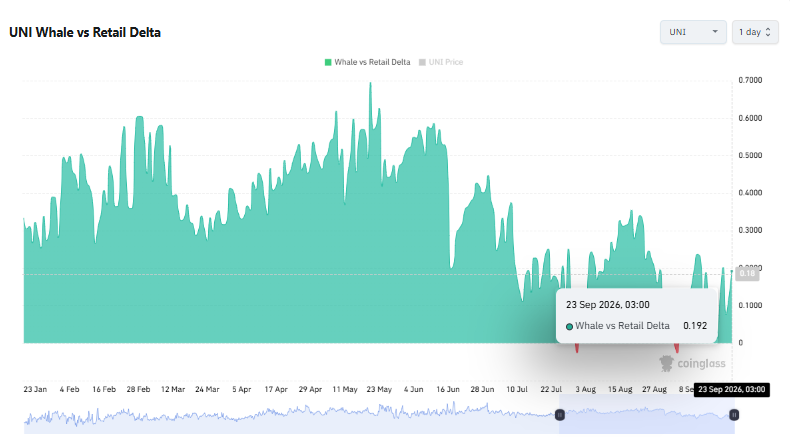
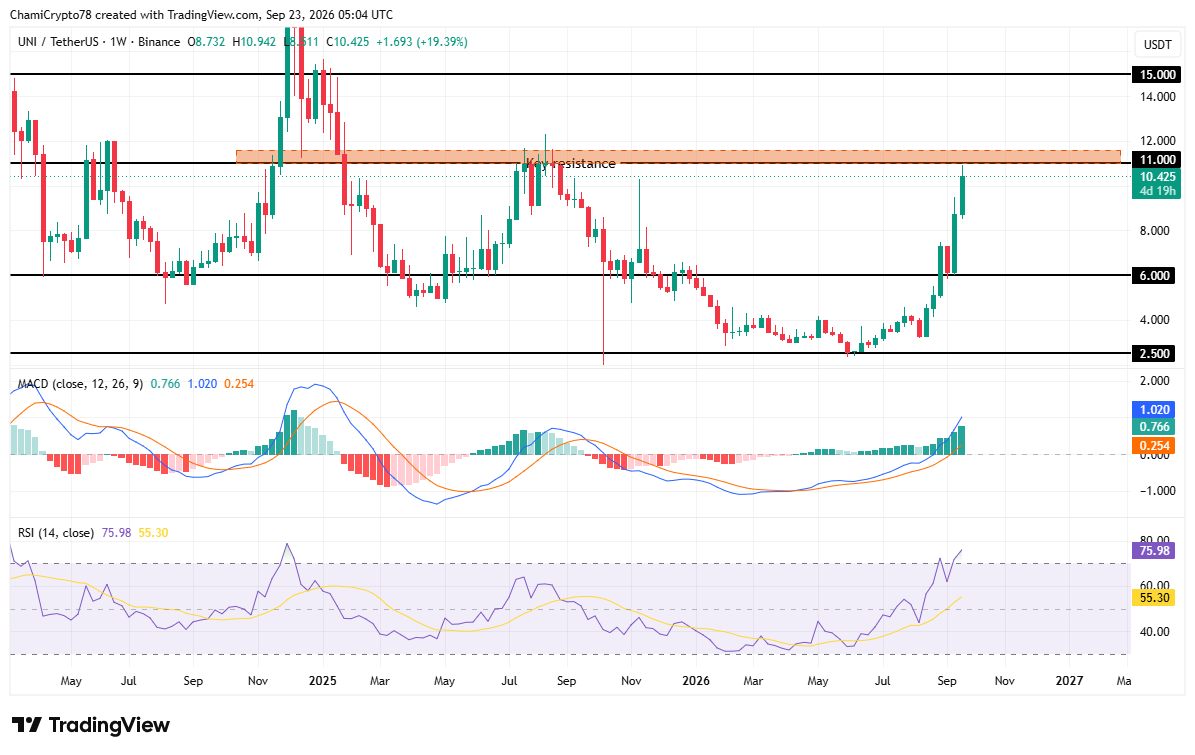
    Uniswap management is preparing to vote on a proposal that would enable protocol fees for the first time in select Uniswap v4 liquidity pools. Separately, a proposal plans to extend the fee mechanism implemented in Uniswap v2 and v3 to Robinhood Chain.

    The final on-chain voting process has begun for both proposals. Voting opens on Sunday and will continue until July 26th. Uniswap founder Hayden Adams said they expect the proposals to have a significant impact on the $UNI burning mechanism, particularly highlighting the current trading volumes on Robinhood Chain.

    The Uniswap v4 proposal calls for enabling protocol fees in fixed-fee pools, pools created through perpetual swap auctions, and pools using aggregator hooks. The regulation will cover Ethereum, Arbitrum, Base, BNB Chain, Polygon, Optimism, and Robinhood Chain networks.

    According to the proposal text, a second vote will be held later for the remaining five networks. This is because Uniswap’s GovernorBravo governance agreement allows a maximum of 10 on-chain transactions in a single offer.

    A separate Robinhood Chain proposal by Hayden Adams aims to enable fees on Uniswap v2 and v3 pools on the network. All three protocol versions of Uniswap were made available with Robinhood Chain’s mainnet launch on July 1st.

    Related News Analyst: “The Leverage Cleanup in XRP Is Complete; Conditions Are Similar to the Period When It Surged 8x”

    According to data included in the proposal, the total exchange volume of Uniswap applications on Robinhood Chain exceeded $6 billion as of July 10th. The Ethereum Layer 2 network, developed with Arbitrum infrastructure, recorded approximately $3.1 billion in decentralized exchange volume in its first week. It was noted that memecoins were predominantly traded in the initial transactions.

    The protocol fees collected under both proposals will be transferred to the $UNI combustion mechanism, which was established by the UNIfication governance regulation approved with 99.9% support in December.

    With this governance change, protocol fees were enabled in the Uniswap v2 and v3 pools on the Ethereum mainnet, and 100 million $UNI were burned in the Uniswap treasury. However, the implementation of v4 fees was postponed to a later proposal pending the completion of the necessary technical infrastructure.

    The fee mechanism has reportedly been expanded to 11 different networks to date. According to the Uniswap v4 proposal, the protocol set a daily record last month by burning 186,000 $UNI in a single day.

    Enabling fees in Uniswap v4 requires a more complex infrastructure compared to previous versions. While v2 and v3 used fixed fee tiers, v4’s hook architecture allows pools to change their fees from block to block.

    The new proposal creates a management-controlled system that categorizes pools under specific “families” and calculates the fee for each pool according to predefined rules, rather than setting the fee individually.

    Both proposals utilize the accelerated governance process adopted under UNification. This process skips the request for comments phase and proceeds directly to on-chain voting after a five-day Snapshot voting period.