Spot Bitcoin ETFs traded in the U.S. continued their positive capital inflow for the sixth consecutive trading day, recording net inflows of approximately $190.7 million on September 24. According to SoSoValue data, BlackRock’s IBIT fund led the way in inflows into Bitcoin investment products.
The highest net inflow of the day was in BlackRock IBIT, with $162.6 million. Other net inflows included $12.9 million into Fidelity’s FBTC fund, $10.2 million into Morgan Stanley’s MSBT fund, $4.9 million into Franklin Templeton’s EZBC fund, and $4.1 million into Bitwise’s BITB fund.
In contrast, WisdomTree’s BTCW fund recorded a net outflow of $4 million. Despite the differing capital movements among the funds, the overall net flow of US spot Bitcoin ETFs remained in positive territory.
The inflow into Bitcoin ETFs was among the data showing continued investor demand for spot Bitcoin investment products. With net inflows of approximately $190.7 million on September 24, the positive flow streak reached six trading days.
A similar trend was observed in US spot Ether ETFs. According to SoSoValue data, spot Ether ETFs recorded net inflows of approximately $66.1 million on September 24th. This marked the fifth consecutive day of net inflows into Ether ETFs.
Among Ether ETFs, BlackRock’s ETHA fund stood out with a net inflow of $26.8 million. Fidelity’s FETH fund saw a net inflow of $21.5 million, while Grayscale’s Mini ETHE fund experienced a net inflow of $17.8 million.
The data revealed that both Bitcoin and Ether-focused spot ETFs continued to experience positive capital inflows in recent trading days.
Worldcoin [$WLD] had dropped in value by 11% in the early hours of the 24th of September, when bull activity was at its highest. The capital pullout has driven the decline across $WLD’s Spot and perpetual markets.
The impact on price could, in fact, exacerbate beyond the present dynamic, forcing the asset to trade even lower in the coming trading sessions.
Spot and perpetual markets point to continued weakness
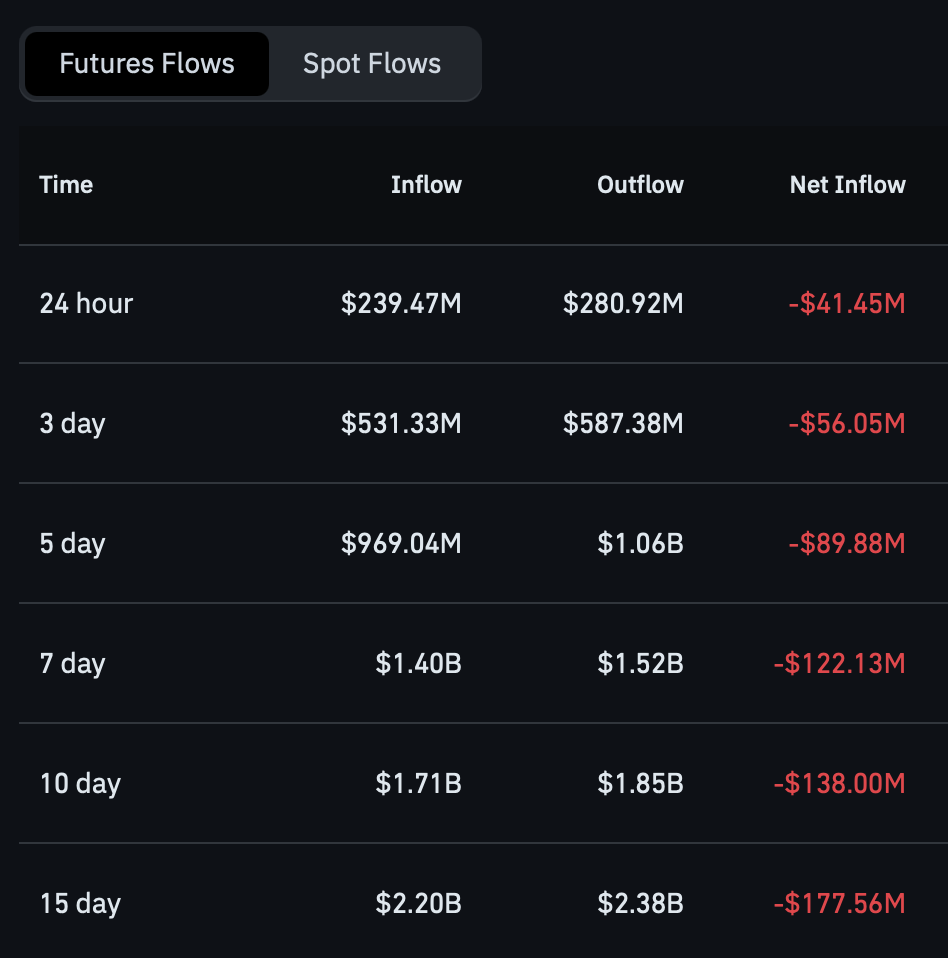
Capital flow data showed that traders sold $280.92 million worth of $WLD in the perpetual market over the past 24 hours.
The sell-off was more than the total $WLD purchased within that same period, putting its netflow at a negative $41.45 million. This is a significant difference.
Source: CoinGlass
When capital moves out of an asset’s perpetual market at this scale, it can trigger further selling as demand fails to keep pace with selling pressure. The same trend is visible in the Spot market, where investors are also pulling out capital as demand struggles to catch up.
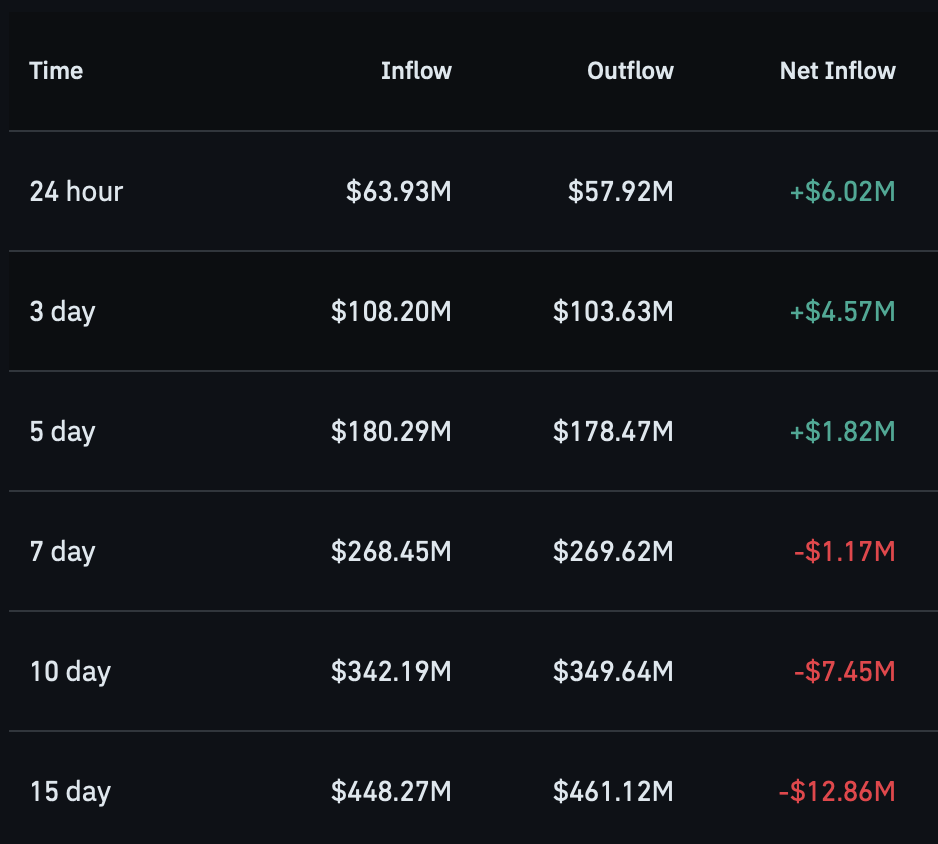
The Spot market saw massive inflows of $WLD across multiple exchange venues, bringing its total inflow to around $63.89 million, more than the outflow.
When there is more inflow than outflow in the Spot market, it confirms that there are more investors selling their assets in the Spot market than there are holding on for the long term.
Source: CoinGlass
The netflow here stays positive, with a reading of $6.02 million, adding another pressure to price, which is already not getting sufficient demand to prevent it from a decline.
Negative Funding Rate leaves recovery uncertain
Analyzing the perpetual market further through the lens of the Funding Rate data on the chart shows that there is a possible chance.
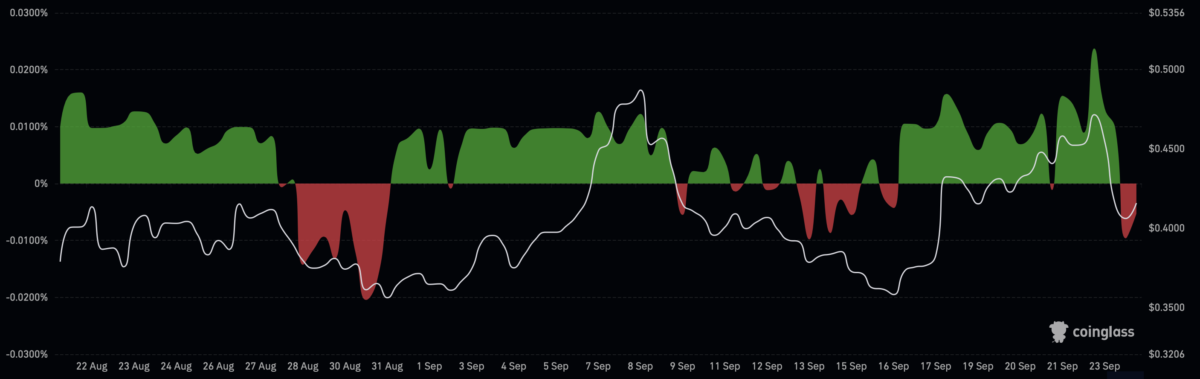
The conditions with the Funding Rate data show that while it plummeted significantly, dropping towards -0.0096% in the early hours of the day, it has since seen a recovery to -0.0046% on the chart while trending upward.
Source: CoinGlass
This drop-to-rise pattern shows that following a large exposure to short contracts, the amount of long contracts in the market rose within that period.
Still, this does not confirm a bullish reversal, as the presence on the negative side of the Funding Rate shows that short positions still dominate overwhelmingly.
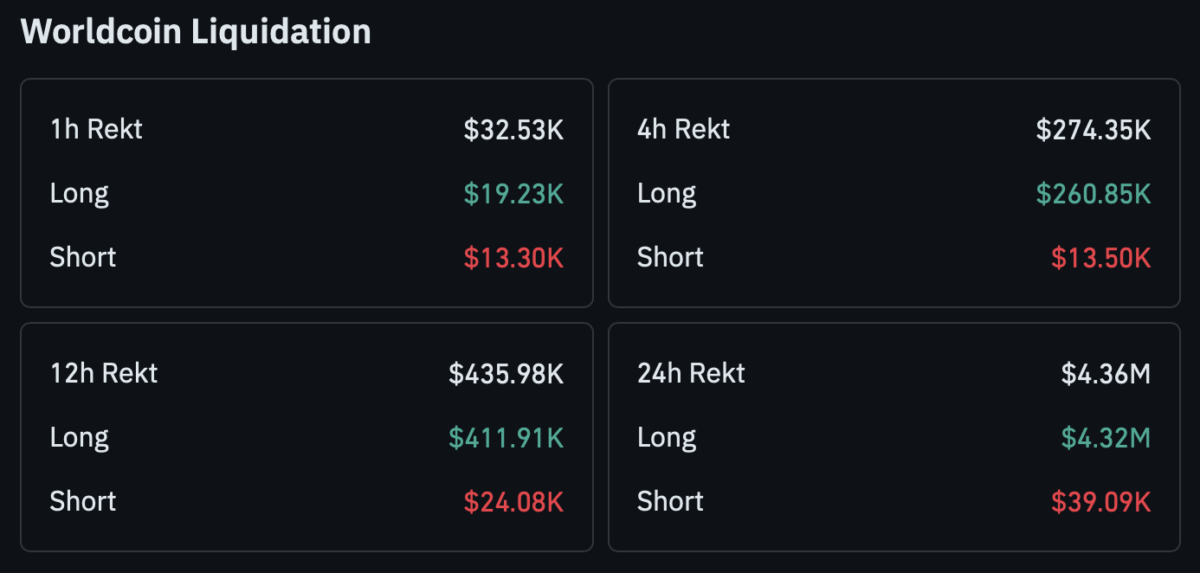
Comparing liquidation data from long and short positions further weakens the optimism. According to CoinGlass, of the total $4.36 million liquidated, long positions lost roughly $4.32 million to the market compared to shorts that lost just $39,090 within this same period.
Source: CoinGlass
This means that for every $1 lost by shorts, longs lost around $110.50. Simplified further, it means that it is more profitable, if properly positioned, to short $WLD than to go long on the asset.
Investors’ best approach would be to maintain a cautious stance as capital outflow and liquidated capital put longs positioned at risk.
More concerning is the rising Funding Rate, which shows investors may be attempting a stop hunt to further liquidate long positions before continuing downwards.
Final Summary
$WLD faces continued selling pressure as perpetual and Spot Market Netflow data shows that capital moving against the asset.
Negative Funding Rate and heavier long liquidations keep downside risks elevated despite the recent recovery in funding.
Some individual victims lost $1 million or more after someone posing as Coinbase support warned that their crypto was at risk. On Sept. 23, Brooklyn Supreme Court Justice Danny Chun sentenced Ronald Spektor to four to 12 years in prison, according to Brooklyn District Attorney Eric Gonzalez. Prosecutors put the losses at approximately $15,944,000 across about 100 U.S. victims.
The 23-year-old from Sheepshead Bay pleaded guilty Sept. 2 to all 31 counts of the indictment, including first-degree grand larceny and first-degree money laundering. Chun imposed the promised sentence over prosecutors’ objection; the district attorney’s office had sought seven to 21 years. Gonzalez said: “This case should put crypto scammers on notice: we will follow the digital trail wherever it leads and aggressively pursue those responsible.”
The sentencing follows Spektor’s indictment in the Coinbase impersonation case, announced in December. The district attorney’s office stated:
“The defendant was also ordered to forfeit cash, cryptocurrency and personal property with an estimated value of more than half a million dollars and make restitution of almost $16 million.”
The forfeiture and restitution are separate orders; the value of property subject to forfeiture is far below the amount victims lost. Under New York law, the four-to-12-year term sets a minimum and maximum: Spektor can first appear before the state parole board after serving the minimum, though credits for certain nonviolent offenders can move that date earlier, and release is at the board’s discretion.
A Warning About Hackers Led Victims to Transfer Their Crypto
Spektor contacted Coinbase users while pretending to represent the exchange, prosecutors said. He told them a hacker threatened their assets and directed them to move their funds into a new wallet. Victims believed they alone controlled those wallets, but Spektor could access them and emptied them after the transfers. Coinbase says its representatives will never call users to request a fund transfer.
Investigators traced the stolen assets through repeated swaps at cryptocurrency exchanges and onward to services where the funds could be gambled, converted to cash, or used to buy gift cards and digital assets. Prosecutors said large portions reached gambling platforms and online storefronts. In a separate Coinbase impersonation case involving fake websites, criminals obtained account credentials and verification codes; Spektor’s victims were persuaded to make the transfers themselves.
The false security warning was central to the theft. A person who sends crypto to an address supplied by an impersonator can lose control of the funds even when the transfer is made from a legitimate account. Phishing and wallet fraud schemes can use messages, calls, and lookalike services to make a fraudulent request appear to come from a trusted company.
Digital Records Connected Spektor to the Wallets
Prosecutors linked Spektor to the thefts through transaction records, blockchain analysis, digital evidence, and search warrants. They said his home internet address was connected to multiple wallets that cryptocurrency was stolen from. Investigators also found that he recruited others on online forums to work as social engineers and bragged about the scheme on Telegram.
Messages recovered by investigators showed Spektor claimed to have lost $6 million in cryptocurrency through gambling and implied that he had made millions through scams. That figure reflects what he wrote, rather than a separate accounting of gambling losses. Prosecutors also said texts on his phone showed he disposed of a hardware wallet and bought another after online fraud allegations surfaced.
The Federal Trade Commission warns that scammers may claim money is at risk and direct people to move it to an account the scammer controls. The Brooklyn district attorney advised users to verify unexpected security claims through a company’s established channels before moving funds. That warning addresses the pressure used in Spektor’s scheme: victims were told their assets were at risk from a hacker and needed to move fast.
In a separate Singapore police operation involving Coinbase, officers reached more than 145 potential scam victims before funds were lost. The police-led effort used blockchain analysis and information from participating exchanges to identify people at risk. Authorities reported preventing more than $4.2 million in potential losses.
Block has joined the x402 Foundation and added Bitcoin Lightning support to the payment protocol as the company expands its push into payments for AI agents.
Block on Thursday said Lightning is suited to the low-cost, high-volume payments that agentic commerce will depend on.
“Bringing Lightning to x402 is a concrete step toward making Bitcoin everyday money for people and the agents acting on their behalf, and we’re excited to help the industry build on it,” said Steve Lee, head of Block’s Bitcoin development initiative Spiral.
x402 is an open payment standard that enables AI agents and web services to autonomously pay for API access, data and digital services.
Block joins Google, Microsoft, Amazon Web Services and crypto companies including Coinbase and the Solana Foundation in backing the x402 Foundation, which launched in April under the Linux Foundation.
The move builds on Block’s participation in the Universal Commerce Protocol, an effort to enable AI-driven commerce for small businesses, according to the company’s announcement.
Cathie Wood’s $ARK Invest is putting its venture fund on blockchain rails, bringing a portfolio that includes stakes in OpenAI, Anthropic, Stripe and Databricks onto blockchain rails.
The $ARK Venture Fund (ARKVX) will issue tokenized interests using infrastructure from Securitize (SECZ), with the tokenization firm handling onchain issuance and the investor experience.
ARKVX will be first available on Ethereum
ETH$2,648.01
with other networks potentially following, the firms said.
“Making the $ARK Venture Fund available onchain is a natural extension of our mission to democratize access to technologically enabled disruptive innovation,” Wood, $ARK‘s founder, CEO and chief investment officer, said in a statement.
For Securitize CEO Carlos Domingo, one draw is giving investors diversified exposure to sought-after private technology companies.
“If you don’t know whether OpenAI or Anthropic are gonna win the AI race, here you get both of them in a diversified pool,” Domingo told CoinDesk TV.
The Solana Foundation has appointed former Binance executive Rachel Conlan as its new chief strategy officer, adding a high-profile crypto industry veteran as the Solana (SOL) blockchain makes a bigger push into institutional finance and tokenized assets.
Conlan will lead strategy across institutional partnerships, ecosystem growth and efforts to bring more companies onto Solana, the foundation said Thursday. She spent previously three years at Binance, most recently as global chief marketing officer, before leaving the crypto exchange in June.
The foundation also hired Jamal Raees as general manager for payments. Raees joins from Polygon Labs, the development organization behind the Polygon network (POL), and previously worked at stablecoin infrastructure firm Bridge (now part of Stripe) and crypto payments firm Wyre. He will focus on getting payments companies and other businesses to use Solana for moving money.
The appointments come as Solana increasingly courts traditional financial firms and positions its network as infrastructure for more than crypto trading. Stablecoin payments, tokenized funds and equities have become a bigger part of that pitch as financial institutions experiment with moving assets and settlement onto public blockchains.
Solana has reached a significant milestone by surpassing the 1 million mark in the number of tokenized stock holders. This achievement is considered a science fiction feat just two years ago. Solana holds approximately 95% market share in on-chain tokenized stock trading and continues to outperform its competitors in this area.
Solana’s Rise in Numbers
The supply of tokenized shares on Solana reached a record high of $684 million in mid-September, representing a 47% increase in just three weeks. During the same period, the 30-day real-world asset trading volume reached $3.3 billion. Among Solana’s tokenized shares, NVDAx, a tokenized representation of NVIDIA shares, leads in holder numbers. New listings like Nike have accelerated this trend, moving beyond technology-heavy portfolios. Furthermore, integration with platforms like Pump.fun has attracted users who previously lacked access to tokenized shares.
The Meaning of Tokenized Shares
Tokenized shares, as blockchain-based tokens, represent ownership or exposure to traditional shares. These tokens are traded on-chain, exchanged almost instantly, and are accessible 24/7. On Solana, primary issuers like xStocks distribute them through networks like Backpack Securities.
Points to Consider
While the figure of 1 million seems impressive, this number measures wallet addresses, not verified unique individuals. A person may have multiple wallets, and incentive programs can inflate these numbers. As of the end of September, the verified number was recorded as 900,000. Furthermore, the composition of these wallets is also important.
If the majority of growth is driven by users holding almost insignificant positions, the headline figure might appear more impressive than the underlying economic activity warrants. However, supply and volume figures tell a more solid story; a total supply of $684 million and a monthly volume of $3.3 billion reflect the true flows of capital.
European financial authorities warned that an advanced quantum computer could undermine cryptography used to secure blockchains, saying the threat could emerge before the technology has a viable commercial application.
The warning from the Joint Committee of the European Supervisory Authorities (ESAs), which includes the European Banking Authority (EBA), European Securities and Markets Authority (ESMA) and European Insurance and Occupational Pensions Authority (EIOPA), brings fresh urgency to a long-running question for bitcoin of whether to freeze or not freeze the BTC in legacy wallets. In the event that quantum computers one day do become capable of breaking bitcoin’s cryptography, roughly 6.9 million bitcoin, worth roughly $586 billion, are currently vulnerable, according to Cryptoquant.
“Threats could materialize earlier than any viable commercial application,” the authorities said in their Autumn 2026 Risk and Vulnerabilities report released Wednesday. An advanced quantum computer “could undermine some cryptography systems widely used to secure communications, transactions, databases and blockchains,” according to the report..
Although the report does not mention timelines for quantum computing becoming commercially viable, a recent IBM report says it will be in use in four years or less.
As global bond yields rise, the usual narrative frames it as bearish for bitcoin
$BTC$83,262.77
. Yet over most of $BTC’s history, the asset has shown little to no consistent correlation with bonds.
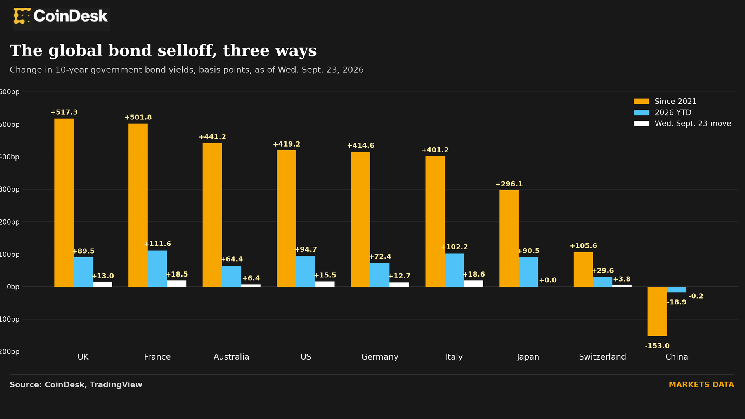
Yields snapped back into focus Wednesday. The U.S. 10-year jumped 15 basis points to its highest level since 2007, topping 5.13%, and pulled yields higher across the globe, as the feature image shows.
The standard interpretation is that as yields climb, the opportunity cost of holding non-yielding assets like bitcoin and gold rises, potentially pulling money toward bonds instead. In short, it’s a headwind, not a tailwind, for crypto.
That logic makes sense on paper. But correlations don’t back it up.
The 90-day correlation between bitcoin’s daily returns and the U.S. 10-year yield’s daily moves is just −0.18, according to data analyzed by CoinDesk. That’s close to zero and almost indistinguishable from no relationship at all.
Longer windows show the same thing, with the 180-day correlation at −0.06 and the 1-year figure at −0.03. Bitcoin is equally uncorrelated to yields of other nations.
U.S. Treasury yields across the entire curve are pushing to new highs as traders prepare for a longer stretch of tighter monetary policy. CME FedWatch puts the 4.75% to 5% federal funds range as the likely outcome for June 2027.
That would mean four quarter-point hikes from today’s 3.75% to 4% range. Meanwhile, the Federal Reserve has already raised the fed funds rate by 25 bps this month.
The pressure is across the entire Treasury market. The 20-year yield is approaching 5.5%, which has sent the long-bond ETF (TLT), to all-time lows below $80. While the 10-year yield is above 5.1%, levels last seen in 2007. Borrowing costs are rising beyond the U.S. too, with government bond yields under pressure in France, Germany, the U.K. and Japan.
Higher yields and a stronger dollar are weighing on risk assets. The dollar index has climbed above 101, up 3% this year. While, bitcoin has fallen below $83,000, from its local high of $87,500 and gold remains just above $4,200, down 25% from its January all-time high.