Tag: CRYPTOS FoxBusiness

  • Cardano expands in Japan – So why is ADA’s price down 4%?

    Cardano expands in Japan – So why is ADA’s price down 4%?

    AMBCrypto previously reported that Cardano founder Charles Hoskinson expects Midnight [NIGHT] (the privacy-focused network), to become bigger than Zcash [ZEC].

    The pitch here is selective privacy. The thing is, Hoskinson didn’t really say what “bigger” means here. Price? Market cap? Users? Network activity? It’s anyone’s guess.

    $ADA crypto price drops 4% as shorts take over

    Has any of this done much for $ADA’s price?

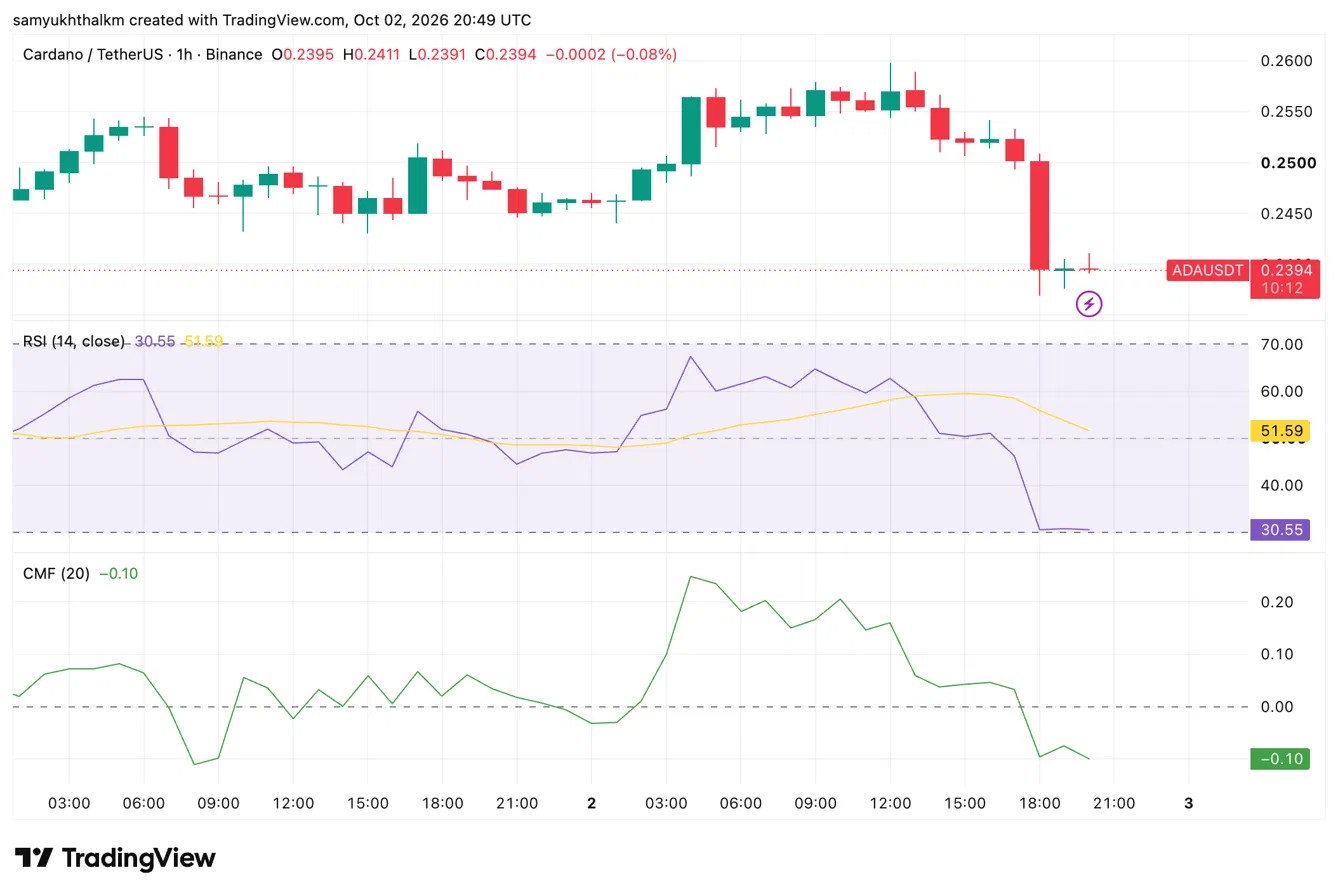
    Cardano fell to $0.239 in a single hourly candle on the 2nd of October. That’s a reset of most of the day’s gains. Earlier, $ADA tested at $0.26 before sellers pushed it back.

    Source: TradingView

    At press time, the RSI fell to 30.55, teetering at the edge of being oversold and well below its signal line at 51.59. The Chaikin Money Flow (CMF) also dropped to -0.10; more capital is flowing out of $ADA than coming in.

    Source: Coinalyze

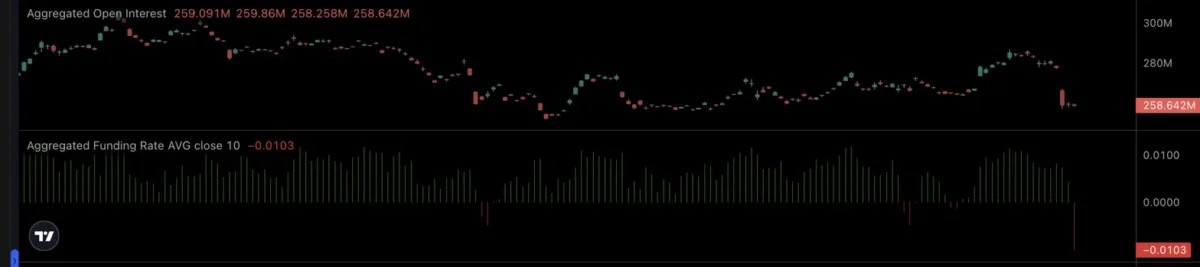
    Open Interest fell to about $258.6 million after the drop; some traders closed their positions. Meanwhile, Funding Rate was at -0.0103, so short sellers are now paying to hold their bets against $ADA.

    A short-term bounce isn’t off the table. But for now, bears have the upper hand.


    Final Summary

    • Cardano Foundation partners with Pacific Meta.
    • $ADA price drops; funding is negative and shorts took control.
  • NEAR co-founder pitches AI pets, private trading and cross-chain payments

    NEAR co-founder pitches AI pets, private trading and cross-chain payments

    “Building itself got easier too, so it’s really about what to build and how stand out to get distribution.”

    $NEAR payment ideas connect checkout and event deposits

    For merchants and application developers, Polosukhin proposed a universal checkout widget that would let customers pay through $NEAR Intents using the wallet and blockchain they already hold assets on.

    Under his suggested approach, developers would offer the button directly to merchants and seek to bring it into Shopify. His post presented Shopify as a potential distribution target for the proposed widget.

    For event organizers, he suggested a registration system that would hold attendees’ deposits in escrow until the host checks them in. Participants who attend would then divide the contributed funds, according to his outline.

    Drawing on an earlier project called Kickback, he proposed extending the model across different blockchains and assets to make crypto event registrations more reliable.

    Wallet compatibility also featured in his distribution advice. Through Aurora’s Intent Connect, he recommended allowing people to use applications from other chains without arranging a bridge or learning how to operate on $NEAR.

    An existing integration provides context for that suggestion. On Sep. 17, Aurora Labs announced one-signature Sui execution, allowing supported assets from other networks to enter Sui applications through its Intents Connect product. According to the company, users could complete supported actions without separately switching wallets, bridging funds, or obtaining SUI for transaction fees.

    Aurora Labs said $NEAR Intents supplied the liquidity, settlement infrastructure and connections between chains, while applications could use the integration for lending, trading, staking and yield products.

    AI pets would carry NFTs and computing balances

    For a consumer-facing application, Polosukhin proposed an “AI Tamagochi” built around digital characters represented by non-fungible tokens.

    In his design, each character would carry a $NEAR balance to fund AI inference, with $NEAR AI running verifiable inference from a prompt encoded onchain. He suggested feeding and dressing features, followed by possible battle arenas and competitions.

    His proposed payment mechanism has related infrastructure already in place. As crypto.news reported on July 31, $NEAR introduced staking-based AI payments that convert locked tokens into monthly computing credits. $NEAR said the system covered 43 AI models at launch, including models from OpenAI, Anthropic, and Google.

    According to the protocol, users retained ownership of their staked tokens and could recover them after unstaking, while their locked balance determined the computing credits available.

    For another information product, Polosukhin suggested an AI encyclopedia whose facts would become ongoing prediction markets, borrowing from the Augur model. Rather than relying on community editing, his proposal would have AI generate pages from the markets’ current assessment of each fact.

    In a separate benchmarking idea, he proposed testing AI models against private datasets without exposing the underlying material. His outline called for certified results tied to a particular model and the identifying hash of the test set, with developers submitting a testing framework or privately hosted model.

    Private trading proposals cover counterparties and position management

    For over-the-counter trading, Polosukhin identified finding a counterparty as an obstacle in $NEAR Intents’ existing “private deals” feature.

    According to his post, users currently need to know whom they are trading with. He proposed a marketplace where participants could communicate available deals and let others fill them through $NEAR Intents.

    For social trading, he suggested selling viewing keys that would give selected customers access to otherwise private transactions. In his outline, traders could display their profit and loss publicly while limiting access to the activity that followers would copy.

    Under the label “Never get liquidated,” he also proposed using $NEAR Intents to manage lending and perpetual futures positions, seeking interest income while managing liquidation exposure. He presented the phrase as an application idea, rather than a demonstrated guarantee.

    A separate strategy proposal would pair spot holdings with perpetual futures positions under a $NEAR contract that manages transactions through Intents. Polosukhin described the concept as “Delta neutral anything.”

    U.S. investors already have a listed route to the network’s token. On Sep. 29, Bitwise announced its U.S. $NEAR ETF launch on NYSE Arca under the ticker NRR, with a 0.75% management fee. According to the asset manager, the fund holds $NEAR directly and plans to stake its holdings, with rewards accruing through its net asset value.

    In explaining Bitwise’s investment case, chief investment officer Matt Hougan cited $NEAR Intents as an example of settlement infrastructure for AI agents handling activities such as payments and swaps.

    Private AI tools would handle code, health data and recordings

    For software teams, Polosukhin proposed an agent that would privately review private pull requests through $NEAR AI, with verifiable execution.

    In healthcare, he suggested a frontend that would encrypt medical data end-to-end before sending it to $NEAR AI for a second opinion. His proposal paired crypto and fiat payments with custom prompts stored in NFTs, which users could choose for different agent expertise.

    For desktop users, he outlined a private transcription application modeled on Granola. According to his design, $NEAR AI would process the transcription while users kept their records locally, with backups encrypted using their own keys.

    As an alternative to subscription payments, he suggested funding the transcription service through $NEAR staking.

    For companies raising capital, his list included a capitalization-table tool with related fundraising instruments, crypto payment acceptance, and banking support.

    On distribution, Polosukhin advised developers to engage NEARLegion, reach other communities through cross-promotion, and promote their products through Product Hunt, similar discovery platforms, and X.

  • Major Bull Cathie Wood Weighs In on Bitcoin and Gold – “Positive for BTC”

    Major Bull Cathie Wood Weighs In on Bitcoin and Gold – “Positive for BTC”

    $ARK Invest CEO Cathie Wood made noteworthy statements about Bitcoin on the latest “In The Know” program, where she discussed billionaire investor Bill Ackman’s warnings about inflation. Wood argued that despite rising inflation concerns in the markets, technological advancements could create strong disinflation, or even deflation in some areas, in the coming period, while noting a significant shift in Bitcoin’s performance relative to gold.

    According to Wood, major technological transformations such as artificial intelligence, robotics, energy storage, blockchain technology, and multiomics sequencing could lower production costs, putting significant pressure on inflation. Therefore, the $ARK Invest CEO believes that, contrary to market expectations, inflation is more likely to decline rather than rise in the long term.

    Wood also argued that the recent rise in US bond yields was largely due to an increase in real interest rates, rather than inflation expectations. According to Wood, this indicates that markets are beginning to price in higher real economic growth. Wood stated that if artificial intelligence and other innovative technologies accelerate productivity growth, economic growth could significantly exceed current expectations.

  • OUSD Stablecoin Goes Live on Solana, Backed by $18M Reserves

    OUSD Stablecoin Goes Live on Solana, Backed by $18M Reserves

    By the Numbers

    The launch of $OUSD is crucial for Solana’s market landscape, as it seeks to enhance its appeal to businesses operating within the ecosystem. The stablecoin’s backing by $18 million in reserves indicates a strong financial foundation, which is vital for fostering user trust and adoption. Given the competitive nature of the stablecoin market, $OUSD’s success will hinge on its ability to attract users away from leading competitors.

    Solana is a high-performance blockchain designed for decentralized applications and crypto projects, facilitating fast transactions and lower fees. The launch of $OUSD underlines Solana’s commitment to expanding its financial services offerings, enhancing its position as a go-to platform for businesses and developers in the crypto space.

    Key Levels to Watch

    Traders and market observers will be keenly watching $OUSD’s adoption rates and market performance in the coming weeks. Key indicators will include the speed of integration into existing platforms and the response from established competitors. Additionally, potential partnerships and user feedback will be critical in determining $OUSD’s trajectory in the stablecoin market. As the competitive landscape evolves, $OUSD’s ability to differentiate itself will be instrumental in shaping its future success.

    The information provided is based on current data and market conditions, which are subject to change.

  • Bank group sues U.S. regulator over granting crypto trust charters

    Bank group sues U.S. regulator over granting crypto trust charters

    The ICBA is one of the largest banking advocacy organizations in the U.S., typically representing smaller institutions. It also played a significant role in pushing back against the Digital Asset Market Clarity Act that failed to advance in the U.S. Senate last month — in part due to the bankers’ objections that its stablecoin provisions didn’t protect them against direct competition with the deposit accounts that are core to their businesses. Now, the group is targeting the trust charters crypto firms are pursuing as an entry point into the U.S. banking and payments system.

    “Congress did not create the national trust charter as a side door into the banking system for crypto firms seeking the credibility of a federal bank charter,” ICBA President and CEO Rebeca Romero Rainey said in a statement, adding that the firms don’t get the same obligations on such things as capital, liquidity, supervision and the need for insurance from the Federal Deposit Insurance Corp.

    Asked for comment by CoinDesk, an OCC spokesperson said the agency “does not comment on litigation.”

    The OCC has been granting a steady stream of trust charters to crypto firms, however those companies don’t operate under the same business model or intend to offer the same services as typical community banks. For instance, they don’t offer the same kind of cash deposit accounts for which FDIC insurance is designed and required.

  • There Will Be a Massive Token Unlock for This Altcoin in the Rest of the Year

    There Will Be a Massive Token Unlock for This Altcoin in the Rest of the Year

    The final quarter of 2026 will see significant token unlocks for many projects in the cryptocurrency market. According to CryptoRank data, numerous projects will conduct their first major “peak” unlocks, releasing tokens allocated to investors, team members, early supporters, and other initial participants.

    Such key releases are closely watched by investors because they can cause a significant increase in the amount of tokens in circulation in a short period of time. In particular, the release of a large amount of tokens relative to market capitalization can raise concerns about increased selling pressure.

    Related News This Altcoin’s Price Skyrocketed: News from South Korea Sparked the Surge

  • U.S. added just 29,000 jobs in September, with unemployment rate rising to 4.2%

    U.S. added just 29,000 jobs in September, with unemployment rate rising to 4.2%

    The U.S. labor market showed weakness in September, potentially giving the Federal Reserve room to hold interest rates even as inflation remains elevated.

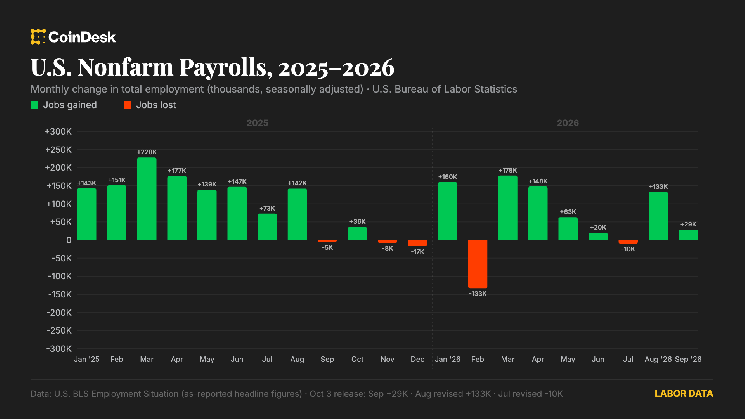
    The U.S. added 29,000 jobs in September, according to the government’s Nonfarm Payrolls Report released Friday morning. That was below the consensus forecast of 90,000 and compared with August’s gain of 133,000 (revised down from an originally reported 162,000).

    The unemployment rate rose to 4.2%, versus expectations of 4.1% and August’s reading of 4.1%.

    In addition to August’s downward revision, July’s 21,000 jobs gain was revised to a jobs loss of 10,000.

    Already higher on the session, bitcoin continued just under $87,000 in the minutes following the release. U.S. stock index futures were adding to gains, the Nasdaq rising 1.2%.

    The 10-year Treasury yield slumped by 7 basis points to 5.17%, and the 2-year yield fell by a similar margin to 4.71%. Gold gained more than 1%, and the greenback fell versus major currencies.

    Checking other report numbers, average hourly earnings rose just 0.1% last month, well shy of forecasts for 0.3% and August’s 0.3%. On a year-over-year basis, average hourly earnings were higher by 3% against forecasts for 3.2% and August’s 3.1%.

  • BREAKING: US Non-Farm Payrolls and Unemployment Data Released! Here’s Bitcoin’s (BTC) Initial Reaction!

    BREAKING: US Non-Farm Payrolls and Unemployment Data Released! Here’s Bitcoin’s (BTC) Initial Reaction!

    The leading cryptocurrency, Bitcoin, got off to a strong start in October. After being stuck in the $82,000–$85,000 range at the end of September, $BTC broke above this consolidation zone and rose to levels around $86,900.

    While the continuation of the upward trend for $BTC is being closely watched, global and cryptocurrency markets are focused today on critical employment data from the US. The main reason for this is the impact of the employment market on the Fed’s monetary policy.

    Whether the announced figure comes in significantly above or below expectations could increase volatility in risky assets, including the Fed’s interest rate policy, US bond yields, the dollar, gold, and Bitcoin. Conversely, a lower-than-expected employment figure could signal a weakening US labor market, strengthening expectations of Fed interest rate cuts; in this scenario, a potential decline in the dollar and bond yields could support demand for risky assets like Bitcoin.

  • America at a crossroads: Commissioner Peirce’s parting challenge

    Today is Hester Peirce’s last day as an SEC Commissioner. The digital asset industry, and every American who believes regulation should mitigate risk and foster innovation, owes her an enormous debt of gratitude.

    For more than eight years, Commissioner Peirce served as a principled voice at the Commission. Under the previous SEC Chairman, she frequently dissented when the Commission chose to bring enforcement actions rather than write rules the industry could comply with. She proposed a token safe harbor years before regulators were ready to listen. She led the Crypto Task Force and insisted that the agency’s duty to protect investors meant it must use its authority to provide regulatory guardrails for the rapidly expanding industry.

    Commissioner Peirce brought humility, conviction, and a sense of humor to work every day. Washington could use more like her. Although she will no longer be at the SEC, her presence and the ideals she stood for will live on.

    Will Schwartz is a Policy Associate at Blockchain Association, where he conducts research and analysis on digital asset legislation, regulation, and emerging policy developments.

    Commissioner Peirce’s work is not done yet