Tag: CRYPTOS FoxBusiness

  • Tokenized Stocks Hit Records Across Every Major Venue as Sector Reaches $2.3B

    Tokenized Stocks Hit Records Across Every Major Venue as Sector Reaches $2.3B

    The market for tokenized stocks reached a record $2.3 billion in market capitalization in mid-July, according to Token Terminal data, nearly doubling since March, when the sector first cleared $1 billion, and the growth is showing up across every major issuer at once.

    On July 21 alone, Artemis data recorded all-time highs for Ondo Finance’s tokenized shares outstanding (514.5 million) and holder count (93,880), Backed Finance’s tokenized market cap ($579.4 million), and Robinhood Chain’s tokenized shares (126,720) and equity holder count (36,170).

    Arcus, the tokenized-stock exchange launched this month by the team behind dYdX, posted record daily perps volume of $11.9 million and record open interest of $6.8 million the same day.

    Ethereum leads the sector with 34% of tokenized stock market share, followed by $BNB Chain at 30% and Solana at 23%, per Token Terminal. Tokenized stocks remain a small corner of the broader tokenized real-world asset market — roughly 5% by Token Terminal’s count, while DefiLlama tracks about $27.3 billion in active RWA market cap — but they have been the fastest-growing asset class on Ethereum this year.

    Ondo Extends Its Lead
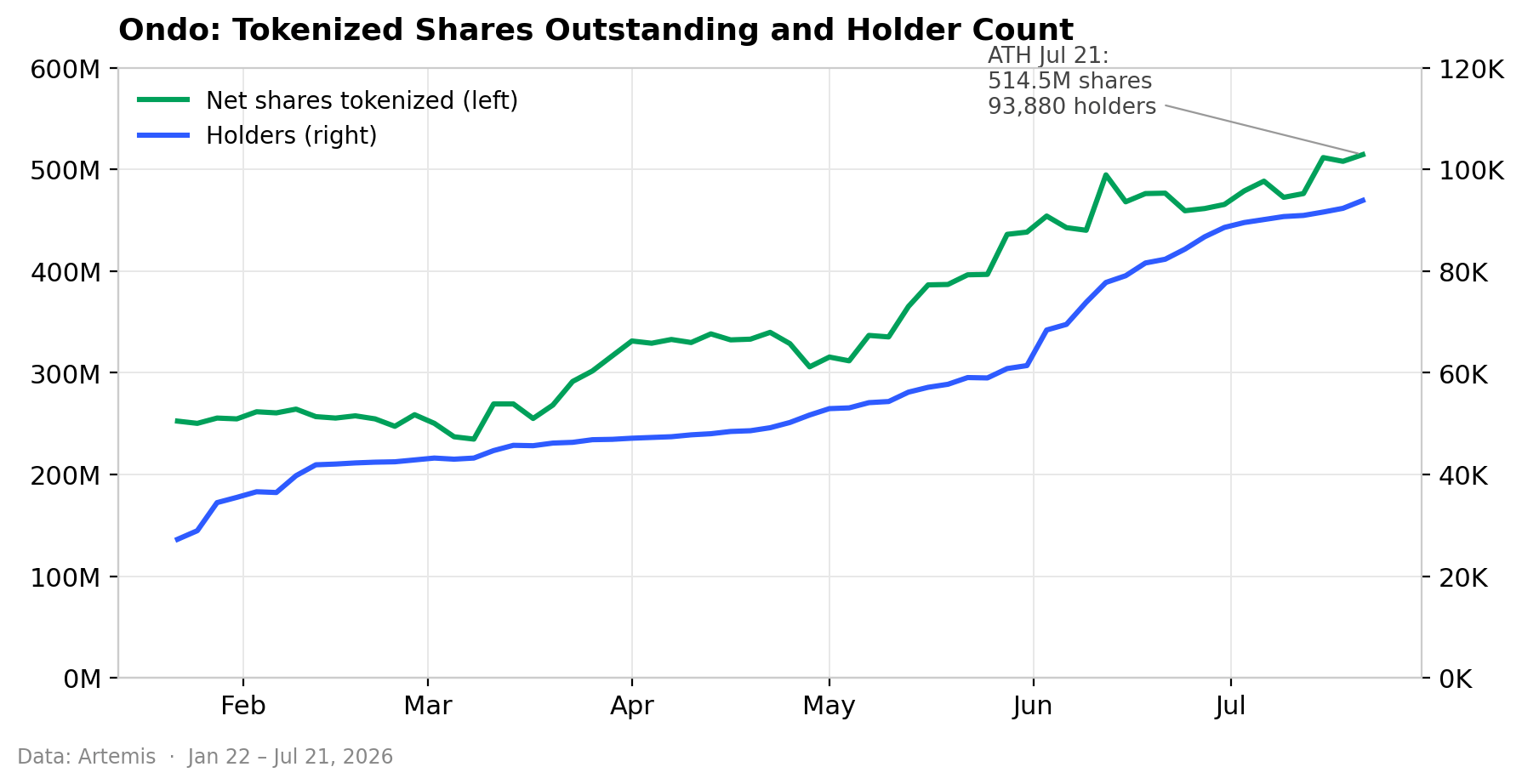
    Ondo’s tokenized shares outstanding roughly doubled over six months to 514.5 million, while holder count more than tripled to 93,880 — both all-time highs on July 21. Data: Artemis.

    Ondo Finance is the largest issuer with $955 million in onchain equities, per Token Terminal, and its July has been dense with catalysts. The firm partnered with Japan’s SBI Group on July 16 to tokenize Japanese stocks and explore settlement in JPYSC, SBI’s trust-backed yen stablecoin. It also switched on 24/7 minting and redemption for tokenized US stocks and ETFs, added voting rights to its tokenized stocks, and enabled tokenized stock collateral on OndoPerps, its perpetual futures venue — the product behind its record $39.8 million in open interest, per Artemis.

    The firm’s catalog has passed 430 tokenized stocks and ETFs across Ethereum, Solana, and $BNB Chain, and its distribution now runs through MetaMask and Felix on Hyperliquid.

    ONDO traded around $0.41 on July 22 with a market capitalization of $1.99 billion, near the top of its seven-day range of $0.32 to $0.41, per CoinGecko. The token jumped roughly 15% in the 24 hours after the SBI announcement.

    Backed and the Exchange-Issued Wave

    Backed Finance, the Swiss issuer behind the xStocks product distributed on Kraken, Bybit, and Solana DeFi, reached a record $579.4 million in tokenized market cap on July 21, per Artemis. Kraken said xStocks surpassed $25 billion in cumulative transaction volume within eight months of launch. Token Terminal puts xStocks’ onchain holdings at $507 million, with Binance’s bStocks third among issuers at $334 million — a sign exchange-issued products are becoming a distinct growth channel alongside DeFi-native issuers.
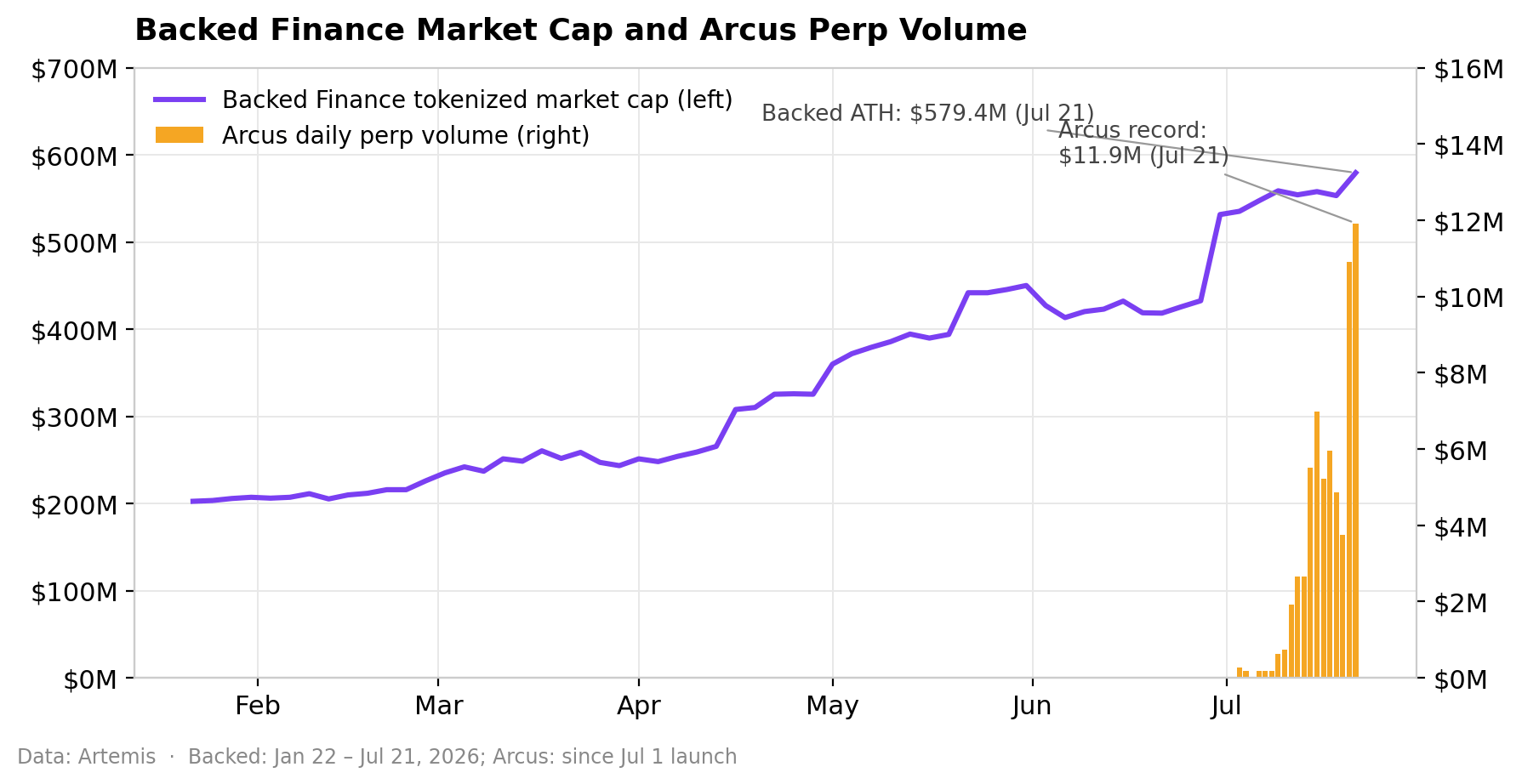
    Backed Finance’s tokenized market cap nearly tripled since late January, jumping from about $430 million to over $530 million in a June 29 step-change before its July 21 record. Arcus perp volume, overlaid since its July 1 launch, hit $11.9 million the same day. Data: Artemis.

    New Entrants: Robinhood Chain and Arcus

    Robinhood’s Stock Tokens, issued on the company’s own Layer 2 that launched July 1, remain the smallest of the cohort at $19.3 million in tokenized market cap, but all three of the product’s Artemis metrics — market cap, shares tokenized, and holder count — hit records on July 21. The tokens are available in more than 120 countries and are already being used as collateral on Lighter, a derivatives protocol on the chain.

    The speculative layer is arriving too. Arcus, launched July 1 by dYdX Labs with investment from Robinhood Crypto, offers 24/7 spot trading on 95 stock tokens with zero fees and is rolling out perpetual futures on equities, commodities, and indices with up to 50x leverage. The exchange is not available in the US, UK, or Canada. Its record $11.9 million in daily perps volume, while small against crypto-native perps venues, is an early data point for leveraged trading built on tokenized equities.

    The Road to $3B

    An Ondo executive said in May the company expects the tokenized equity market to reach between $2.5 billion and $3 billion by year-end, per TheStreet. At the current pace — the sector has nearly doubled in four months — that target implies slower growth than the market is delivering.

    Holder counts remain the metric to watch. Ondo’s 93,880 and Robinhood Chain’s 36,170 tokenized-equity holders are records, per Artemis, but are small next to any retail brokerage’s user base. Whether 24/7 settlement, DeFi collateral use, and yen-settled Japanese stocks translate into sustained holder growth is what the next two quarters will show.


  • CertiK: France sees 33 of 52 crypto wrench attacks as H1 2026 exposure hits $124.1 million

    CertiK: France sees 33 of 52 crypto wrench attacks as H1 2026 exposure hits $124.1 million

    CertiK, a blockchain security firm, said on Wednesday that 52 confirmed physical attacks on crypto holders occurred in the first half of 2026. The amount of money at risk was ~$124.1 million, up from $10.5 million the previous year.

    Nowadays, there is a much more common and much more expensive threat to anyone with a known identity who has real crypto.

    There were 52 confirmed incidents, a 33.3% increase year over year from the 39 cases in H1 2025. CertiK defines a wrench attack as any form of violence, intimidation, or credible threat used to force someone to transfer digital assets, provide private keys, or unlock a wallet.

    The tactic is an “established threat vector for cryptocurrency holders,” CertiK said. It works on even strong digital security because it attacks the person, not the software.

    France drives Europe’s wrench attack wave

    Of the 52 confirmed incidents, 39 were in Europe. France alone was home to 33 of them, according to CertiK. Europe was already highlighted as the riskiest region for crypto holders in CertiK’s 2025 wrench-attack report.

    Increasingly, victims are being confronted in their own homes by attackers. CertiK reported that the number of crypto-related home invasions soared from one publicly reported case in H1 2025 to 20 in H1 2026. Kidnappings also increased, from 12 to 16.

    Elsewhere, there was little movement. There were four cases of torture, as in the year before. Each period had one murder in association with a crypto coercion event.

    The rise was attributed to home invasions. The attackers are now finding out where the targets live instead of waiting to catch them somewhere else.

    $124 million exposure figure isn’t stolen crypto

    The ~$124.1 million number is an estimated exposure, not a confirmed theft. It includes ransom demands, money victims paid, and assets later frozen by authorities or providers. Some of this money was never lost.

    The average recorded exposure per incident rose from ~$270,000 in H1 2025 to ~$2.39 million in H1 2026. CertiK says its totals understate the true picture. Attack victims often don’t report them because they’re afraid of getting hurt, being taxed, or having their reputations hurt.

    The half-year total obscures two different phases. The increase was led by Q1 2026, with 35 incidents compared to 22 in Q1 2025. January saw 15 cases compared to 9 a year ago, March had 13 compared to 7, and April shot up to 8 from 2. Then May and June were down below 2025. CertiK attributes that to a combination of better holder security, reporting delays, and law-enforcement pressure. Q2 2026 ended with 17 incidents, the same as Q2 2025.

    Extrapolating the first half in a straight line would indicate about 100 incidents for the entire year. CertiK warns that this is not a prediction, especially given the differences between the two quarters.

    Cryptopolitan reported this month that 63% of the 164,538 traders active in Robinhood Chain’s top memecoins were underwater. Wrench attacks target a different profile. Holders whose money and location are sufficiently obvious that it is worth the trouble to coerce.

    CertiK’s advice is to break the link between a person’s public identity and their holdings. It proposes limiting data that links a name, location, or daily pattern of a holder to ownership of a crypto. Significant assets should be stored so that no one person can move them on demand.

    Crypto holders should keep their wallets, signing tools, and recovery data separate. The company also says that people should make their homes secure, talk to their family about what to do in an emergency, and avoid using sensitive accounts on any devices they take with them when they travel.

  • New Provisions Added to the Anticipated Cryptocurrency Bill, the Clarity Act—Could Be Critical

    New Provisions Added to the Anticipated Cryptocurrency Bill, the Clarity Act—Could Be Critical

    New provisions limiting the ability of presidents and other federal officials to profit from digital assets have been added to the CLARITY Act, a bill under consideration in the US Senate that includes comprehensive regulations targeting the cryptocurrency market.

    According to updated draft legislation obtained by CNBC, US presidents, federal officials, and certain public officials will not be able to issue cryptocurrencies or other digital assets, or sponsor such projects.

    Senate Republicans, in an update to the CLARITY Act on Wednesday, included the first legal limits on how US presidents can earn income from the cryptocurrency sector.

    Related News Flash Analysis of Four Altcoins: “Two Are Bullish, Two Are Bearish”

    The CLARITY Act, which aims to comprehensively regulate the digital asset market, seeks to determine which institutions will oversee the cryptocurrency sector and under what rules. Newly added ethical provisions aim to prevent public officials from using their positions to profit personally from cryptocurrency or digital asset projects.

    If the bill becomes law, U.S. presidents and other federal officials serving in office will face significant restrictions on issuing cryptocurrencies in their own names, sponsoring a digital asset project, or directly profiting from such ventures.

    Previously, US President Donald Trump launched his own TRUMP token, which has recently experienced significant declines.

    *This is not investment advice.

  • Keep an Eye on $68,000 on the Upside and $63,000 on the Downside for Bitcoin—Analysts Warn

    Keep an Eye on $68,000 on the Upside and $63,000 on the Downside for Bitcoin—Analysts Warn

    After Bitcoin surged above $66,000, reaching its highest level in the past month, analysts noted that the $68,000 level could be a critical resistance point. According to experts, Bitcoin testing this region for the first time could create significant selling pressure as investors nearing their cost basis begin to sell.

    Spot Bitcoin ETFs traded in the US recorded net inflows of $203 million yesterday, extending their positive streak for the sixth consecutive trading day. This brings the total net inflow since July 13 to approximately $779 million. Spot Ethereum ETFs also saw inflows of $37.5 million on the same day, marking a third consecutive day of positive trading.

    Bitfinex analysts stated that the next significant level for Bitcoin is $68,000. They noted that this region coincides with the average cost level for short-term investors and the opening price of the second quarter. According to the analysts, investors who bought Bitcoin in the last five months and are still at a loss may choose to sell as the price rises back to their cost levels. Therefore, a strong supply is likely to be encountered during the first test of $68,000.

    Related News Flash Analysis of Four Altcoins: “Two Are Bullish, Two Are Bearish”

    Vetle Lunde, Head of Research at K33, stated that Bitcoin trading volumes continue to remain seasonally low. According to Lunde’s data, as of July 19th, the 30-day spot trading volume was only 62.4% of the annual average.

    Institutional investor activity in the futures market also remains weak. Bitcoin open interest on the CME stayed below 100,000 BTC throughout July, reaching its lowest level since October 2023. This indicates that institutional participation has not yet recovered strongly. While ETF inflows improved during the same period, flows were largely driven by BlackRock’s IBIT fund.

    CapitalCom analyst Daniela Hathorn considers the $63,000 level a significant support point in the short term. According to Hathorn, if Bitcoin remains above this level and settles back above the $65,000-$66,000 range, it could strengthen the upward momentum. Conversely, a loss of the $63,000 support could lead to increased profit-taking by investors, creating renewed pressure on the price.

    *This is not investment advice.

  • Have Bitcoin’s Recent Gains Confirmed a Recovery? Experts Weigh In

    Have Bitcoin’s Recent Gains Confirmed a Recovery? Experts Weigh In

    Cryptocurrency market maker Wintermute analyzed the rise in Bitcoin and Ethereum following the release of June inflation data in the US. The company stated that there are signs of recovery in the structure of the cryptocurrency market, but the upward trend is not yet confirmed.

    The US consumer price index (CPI) fell 0.4% month-on-month in June, marking its largest monthly decline since April 2020. Annual inflation also dropped from 4.2% to 3.5%, below market expectations of 3.8%.

    Following the inflation data, markets largely excluded the possibility of a Fed rate hike in July from their pricing. However, renewed tensions between the US and Iran and the renewed discussion of port blockades caused Brent oil to rise by 15.54 percent during the week.

    Risky assets showed divergent performance. During the same period, Ethereum gained 3.64% and Bitcoin gained 1.46%, while the Nasdaq index fell by 4.16%.

    Following the release of US inflation data, Bitcoin surged from approximately $62,000 to $64,900 in a short period. Ethereum also rose by up to 7%, reaching $1,884. As a result of the rapid market surge, approximately $134 million worth of short positions were liquidated within an hour.

    Spot Bitcoin ETFs traded in the US recorded net inflows of approximately $191 million on Tuesday and Wednesday, ending a ten-day streak of outflows from ETFs.

    Wintermute stated that the recent inflows were a positive development, but compared to the record net outflow of $4.5 billion recorded in June, the current magnitude was insufficient to confirm a new trend.

    Related News Expert Analyst Argues Altcoin Bear Trend is Nearing Its End, Reveals His Favorite Altcoins!

    According to the company, Bitcoin’s ability to maintain its gains following the inflation data release during the sell-off in chip stocks indicates an improvement in the structure of the cryptocurrency market. However, a definitive upward trend has not yet formed in the market.

    Wintermute stated that the relative strength of the market could be confirmed if spot Bitcoin ETFs record uninterrupted net inflows for a week and the Bitcoin price remains above $66,000 for several trading days.

    However, it was added that macroeconomic risks could intensify again if Brent oil rises above $90 or if the Strait of Hormuz is officially closed, and the positive assessment of the cryptocurrency market could lose its validity.

    *This is not investment advice.

  • Ramp opens stablecoin accounts to every business, settling on Solana

    Ramp opens stablecoin accounts to every business, settling on Solana

    Ramp has made stablecoin accounts and payments available to all its customers, giving businesses one platform to hold, send, and receive both regular dollars and stablecoins like $USDC and USDT.

    Until now, most finance teams treated stablecoin payments as a separate hassle, requiring a different wallet, no approval controls, and hours of manual reconciliation.

    One Ramp beta customer found that stablecoin payments made up just 10% of vendor payments but consumed half of their accounts payable team’s time.

    Ramp’s approach folds stablecoins directly into the same system businesses already use for cards, bills, and accounting, so a payment settling in $USDC follows the same approval chain as one settling in dollars.

    “Businesses shouldn’t need a second financial system just because a payment settles on different rails,” said Andrew Chapello, Stablecoin Product Manager at Ramp.

    How it actually works

    Businesses can hold stablecoin balances, earn rewards on them, and pay vendors or employees directly from a stablecoin account, a checking account, or a linked bank account, without needing to pre-fund anything.

    Every transaction syncs automatically into the company’s existing accounting system with the same categorization and audit trail as a regular payment.

    Trending on TheStreet Roundtable:

    • White House official postpones military duty right before a major vote
    • Analyst reveals Bitcoin is massively undervalued at $65,000
    • Bernie Sanders rallies against crypto, AI in new campaign

    Stablecoin deposits are supported across seven blockchain networks, including Solana, a high-performance blockchain known for its speed and low transaction costs.

    Solana has increasingly become a preferred settlement layer for stablecoin activity, and its inclusion here reflects a broader trend of payment platforms building directly on top of it rather than treating it as one option among many.

    More than 150 businesses adopted stablecoin accounts during Ramp’s public beta, spanning far beyond crypto-native companies, including a farming business and a church managing donations.

    Ramp built the feature in partnership with Stripe, whose Bridge and Privy infrastructure powers the stablecoin issuance and wallets behind the scenes. Stablecoin accounts and payments are now available to all Ramp customers.

  • TRON Network Releases Major Update to Improve Its Technical Infrastructure!

    TRON Network Releases Major Update to Improve Its Technical Infrastructure!

    TRON has implemented a significant update to improve its technical infrastructure. According to a statement from TRON, GreatVoyage v4.8.2 (Pyrrho) is now officially available.

    The new version enhances compatibility with the Ethereum ecosystem while also including various improvements in smart contract execution performance, node management, and network monitoring capabilities.

    With the released update, the TRON Virtual Machine (TVM) has been made more compatible with Ethereum’s Pectra and Osaka upgrades. Additionally, the CLZ (Count Leading Zeros) command has been added for developers, and a new precompiled function for secp256r1 digital signature verification has been introduced. These improvements aim to facilitate the migration of Ethereum-based applications to the TRON network and enhance the developer experience.

    Significant changes were also made to the infrastructure. With the new version, the JSON processing infrastructure was migrated from the Fastjson library to the Jackson platform. In addition, node monitoring and performance metrics were transferred from the InfluxDB system to the Prometheus infrastructure. This aims to make network monitoring, performance analysis, and operational management more efficient.

    The TRON team emphasized that GreatVoyage v4.8.2 is a mandatory update. According to the announcement, node operators need to upgrade to the new version before 11:59 PM on August 16, 2026 (Singapore time). Failure to update by this date may result in node synchronization issues and loss of compatibility with the network.

    On the other hand, TRON’s Event Plugin component has also been updated to version v3.0.0. Node operators using the official plugin are advised to update the Event Plugin first, then upgrade their main node software. Operators using their own custom plugins are recommended to complete compatibility work with the new version as soon as possible.

    Experts believe this update will strengthen TRON’s technical integration with the Ethereum ecosystem, modernize developer tools, and significantly contribute to the network’s long-term scalability and operational efficiency. This is expected to enhance TRON’s competitiveness in decentralized applications and smart contract development.

    *This is not investment advice.

  • U.S. DOJ Moves to Seize $25 Million in Cryptocurrency Linked to International Fraud Ring

    U.S. DOJ Moves to Seize $25 Million in Cryptocurrency Linked to International Fraud Ring

    The U.S. Department of Justice has initiated forfeiture proceedings to seize more than $25 million in cryptocurrency tied to an international fraud investigation, according to a report by The Block. The action marks the latest effort by federal authorities to recover digital assets linked to cross-border financial crimes.

    DOJ Targets Digital Assets in Global Fraud Crackdown

    Prosecutors are pursuing a formal forfeiture action to transfer the seized cryptocurrency to the state, the DOJ confirmed. The assets were secured during a broader investigation into an international fraud scheme, though officials have not disclosed specific details about the alleged perpetrators or the nature of the fraudulent activity. The case underscores the growing role of cryptocurrency in illicit financial networks and the government’s increasing capacity to trace and recover digital funds.

    Broader Recovery Efforts Under the Scam Center Strike Force

    The DOJ’s Scam Center Strike Force, established to combat large-scale fraud, has recovered over $800 million in victim assets to date. This figure includes funds from various schemes, such as investment fraud, romance scams, and business email compromises, many of which involve cryptocurrency as a payment or laundering vehicle. The $25 million forfeiture action is part of this ongoing campaign, which leverages blockchain analytics and international cooperation to identify and freeze illicit assets.

    Implications for the Crypto Industry

    This case highlights the dual nature of cryptocurrency: while it enables financial innovation, it also presents new avenues for fraud. For legitimate investors and businesses, the DOJ’s actions signal a maturing regulatory environment that prioritizes consumer protection and asset recovery. However, the seizure also raises questions about due process for asset owners and the challenges of proving ownership in decentralized systems. The outcome of this forfeiture could set a precedent for how U.S. authorities handle similar cases involving digital assets.

    Conclusion

    The DOJ’s pursuit of $25 million in cryptocurrency tied to international fraud is a significant step in its broader mission to dismantle illicit financial networks. With over $800 million already recovered, the Scam Center Strike Force demonstrates the government’s commitment to using advanced tools to protect victims. As the case progresses, it will provide further clarity on the legal treatment of digital assets in fraud-related forfeiture proceedings.

    FAQs

    Q1: What is the DOJ’s Scam Center Strike Force?
    A: It is a specialized unit within the U.S. Department of Justice that focuses on investigating and recovering assets from large-scale fraud schemes, including those involving cryptocurrency.

    Q2: How does the DOJ trace cryptocurrency in fraud cases?
    A: Investigators use blockchain analytics tools to follow transaction trails on public ledgers, often collaborating with exchanges and international law enforcement to identify and freeze assets.

    Q3: What happens to seized cryptocurrency after forfeiture?
    A: Once forfeited, the assets are typically converted to fiat currency through a government-approved process, and the proceeds are used to compensate victims or fund law enforcement activities.

    Related Reading

    • South Korea Seizes $275 Million in Illicit Crypto and Financial Crime Proceeds
    • Crypto Tracing in Cross-Border Litigation: New York Bar Sets Framework
    • South Korea Customs Unearths 47 Illegal Crypto Money Exchangers in Targeted Crackdown
    • UK Government Cracks Down on Foreign Political Funds, Targeting Reform Party’s Crypto Backers
    • Chilean Regulator Revokes License of Crypto Exchange Linked to Venezuelan Crime Syndicate
  • Illinois crypto tax faces first legal challenge before it even takes effect

    Illinois crypto tax faces first legal challenge before it even takes effect

    The Digital Chamber sued Illinois on Tuesday to block the state’s new 0.2% tax on digital asset transactions, becoming the first trade group to challenge the law in court before it even takes effect.

    🧵1/ Today we filed suit in Sangamon County, IL, to stop the Digital Asset Tax Act. No one should be taxed differently because of how ownership of digital assets is recorded or transferred. pic.twitter.com/pv3J3FPybM

    — The Digital Chamber (@DigitalChamber) July 21, 2026

    The verified complaint, filed in Sangamon County Circuit Court against Illinois Department of Revenue Director David Harris and Attorney General Kwame Raoul, argues the state has not taxed a new kind of property, it has taxed an old kind of property recorded in a new way.

    Illinois tax could reach users outside the state

    The complaint’s clearest argument comes through a hypothetical: a man named Steve Doe splits time between Austin and Chicago and once registered his crypto accounts using a Chicago mailing address. He then buys coffee with a stablecoin debit card and moves governance tokens to vote in an online protocol, all while never setting foot in Illinois.

    The Act makes the old Chicago address sufficient to create a presumption that each of those transfers is an Illinois transaction, taxable individually, failure to comply with which constitutes a Class 3 felony.

    TDC’s six-count complaint argues this violates Illinois’ Uniformity Clause, due process protections in both the state and federal constitutions, and the Commerce Clause, and is preempted outright by the federal Internet Tax Freedom Act.

    The filing’s core argument is blunt: “it distinguishes only between traditional financial infrastructure and blockchain infrastructure.”

    Beyond a court order blocking the tax, TDC is also asking the state to cover its legal fees.

    Crypto levy was added through a rewritten farm bill

    Senate Bill 3019 did not start as a tax measure at all. It began as a narrow amendment to the Illinois Finance Authority Act covering agricultural financing, then a floor amendment gutted and replaced it with an entire omnibus budget bill carrying the tax provision, according to the complaint.

    That maneuver means the Digital Asset Tax Act was never introduced, heard, or debated as its own bill. As Cryptopolitan earlier reported, Kalshi already sued Illinois over a separate provision buried in the same SB 3019 package, that one requiring prediction market platforms to hold a state gambling license. This means there have been two lawsuits against the same bill in one month.

    Lawsuit warns blockchain tax could spread beyond crypto

    Buried in the complaint is a line that should worry more than just crypto brokers. As per TDC, if Illinois has the right to impose taxes on blockchain technology because it is a new method of recording, then the same logic would justify taxing AI-powered settlement or cloud-powered payments in other states.

    Michael Selig, Chairman of the CFTC, has separately referred to the fee as a “sin tax,” noting that it poses a threat to Chicago being a financial hub.

    The case is now going before a court in Springfield, which will determine whether or not Illinois can tax identical properties differently depending on which ledger the property is recorded in.

  • Robinhood Chain’s Early Boom Could Become Arbitrum’s Next Major Growth Driver

    Robinhood Chain’s Early Boom Could Become Arbitrum’s Next Major Growth Driver

    • Robinhood Chain recorded an average of 10 million daily transactions during the first three weeks following its official launch.
    • The protocol transfers 10% of its net fee revenue to the ArbitrumDAO treasury and the developer guild.
    • Total value locked in real-world assets (RWA) on the network reached $12.8 million by mid-July 2026.

    At least 10 million daily transactions were recorded by the Layer 2 networkRobinhood Chainduring the first three weeks following its launch. Built on Arbitrum’s technology stack, the platform directly connects its operational throughput to the treasury of Ethereum’s scaling ecosystem.

    Revenue mechanisms and operational metrics

    Token Terminal revealed data indicating that the daily transaction count consistently remained between 7 and 11 million since early July, while average block times dropped to 100 milliseconds. However, the analytics firm itself clarified that Robinhood will cover all user gas fees during the network’s first 90 days of operation.

    This temporary waiver reduces transaction costs to zero for participants. According to industry analysts, the measure acts as an incentive capable of temporarily boosting activity volume until the subsidies end in late September.

    At a financial level, the economic link between both platforms operates under the framework of the Arbitrum Expansion Program rules. Official ArbitrumDAO documentation indicates that the Layer 2 network allocates 10% of its net protocol revenue to the ecosystem, distributing 8% to the DAO treasury and 2% to the protocol’s developer guild.

    This structure strengthens the funds under governance management. Nevertheless, industry sources point out that the current model does not include automatic open-market purchases of the ARB token nor direct dividend distributions to holders of the cryptocurrency.

    During the subsidy phase, fees generated by the network averaged around $4,000 per day. According to estimates from FalconX, the network is projected to reach approximately $1.1 million in fees over a six-month operational period.

    By mid-July 2026, DefiLlama metrics showed that early activity was driven by stablecoin and memecoin trading, recording $12.8 million in tokenized real-world assets. The platform’s retention capacity will be formally evaluated in the fourth quarter of the year, when users assume regular payment of network fees.