Tag: CRYPTOS FoxBusiness

  • Ripple MiCA Authorization Opens A Wider European Payments Lane

    Ripple MiCA Authorization Opens A Wider European Payments Lane

    Ripple MiCA Authorization Opens A Wider European Payments Lane

    Ripple has secured full MiCA authorization in Europe, giving the company a clearer regulatory path to expand crypto-enabled payment services across EU and EEA markets.

    The authorization applies to Ripple’s corporate payment entity and allows compliant operations under the European Union’s Markets in Crypto-Assets framework. That is an important distinction. This is not a blanket regulatory endorsement of $XRP trading itself. It is a licensing milestone for Ripple’s business activities under MiCA.

    Still, the development matters for $XRP watchers because Ripple’s payments business remains central to the token’s broader narrative.

    If Ripple can operate more cleanly across Europe, it may strengthen the company’s ability to work with banks, payment firms, fintechs, and institutional clients in one of the world’s most important regulatory blocs.

    TL;DR

    • Ripple has secured MiCA authorization for European crypto-asset services.
    • The approval supports Ripple’s compliant payment operations across EU and EEA markets.
    • The authorization applies to Ripple’s corporate payment entity, not direct regulatory clearance for $XRP trading.

    Why MiCA Matters For Ripple

    MiCA has become one of the most important crypto regulatory frameworks in the world.

    Instead of forcing firms to deal with fragmented rules across every European country, MiCA creates a more unified regime for crypto-asset service providers. That can make it easier for licensed firms to scale across member states while still meeting compliance obligations.

    For Ripple, this is particularly relevant.

    The company has spent years positioning itself as a payments and settlement infrastructure provider. Its core pitch has always depended on working with regulated institutions, not simply appealing to retail token traders.

    A MiCA authorization can therefore make business conversations easier.

    Banks and payment companies are more likely to work with a crypto firm when the regulatory status is clear. Compliance teams can point to a recognized framework. Legal departments can assess obligations more directly. Operational partners can understand the boundaries of what is permitted.

    That is exactly the kind of clarity Ripple needs if it wants to expand deeper into European payment corridors.

    What This Means For $XRP

    The $XRP market will naturally pay attention to the authorization, but the connection needs to be framed carefully.

    Ripple’s regulatory progress can improve the environment around its payment business. That may support the broader $XRP narrative if the company’s products continue to involve $XRP-related liquidity or settlement tools.

    But the authorization itself does not mean regulators have approved $XRP as an investment product. It does not mean all $XRP trading has received blanket clearance across Europe. It does not guarantee token demand.

    The strongest read is more measured: Ripple has gained a clearer legal route for its European crypto-asset service operations.

    That matters because institutional adoption depends on trust, licensing, and compliance. $XRP’s long-term utility case is stronger when Ripple can operate in major markets without constant regulatory uncertainty.

    Still, token price impact depends on actual usage, liquidity, and product adoption.

    Europe Is Becoming A Crypto Licensing Battleground

    Ripple’s MiCA approval also fits into a wider industry trend.

    Crypto companies are racing to secure European regulatory footing because MiCA offers something the US still lacks: a comprehensive digital asset rulebook. The framework is not light-touch, but it is relatively clear.

    That makes Europe attractive for firms that want certainty.

    Exchanges, custodians, stablecoin issuers, payment firms, and infrastructure providers all need to decide where to base operations and how to structure services. MiCA creates a pathway, but it also raises the bar.

    Firms that secure authorization early may gain an advantage.

    They can approach institutional clients with a stronger compliance story while rivals are still working through approvals. For Ripple, that could be meaningful given the company’s focus on cross-border payments.

    The Real Test Is Adoption

    Regulatory approval is useful, but it is not the finish line.

    Ripple still needs to turn authorization into real payment volume, partnerships, and institutional usage. Licenses create permission. They do not automatically create demand.

    The next thing to watch is whether Ripple uses the MiCA approval to announce new European clients, expanded corridors, or deeper integration with banks and payment providers.

    That is where the story becomes more important for $XRP holders.

    If authorization leads to more payment activity, the market may view it as a practical step forward. If it remains mostly a compliance milestone, the immediate effect may be limited.

    Either way, it is a positive development for Ripple’s European strategy.

    Crypto markets have spent years asking for regulatory clarity. In Europe, that clarity is now becoming operational. Ripple’s MiCA authorization shows how larger crypto companies are beginning to use that framework to expand regulated services rather than wait for perfect global rules.

    For Ripple, Europe just became a more navigable market.

    This article is based on Ripple and ESMA materials.

    This article was written by the News Desk and edited by Samuel Rae.

    This report is based on information released in official primary source disclosures at primary source documentation.

  • Bitcoin, Ethereum-linked protocols lose $35 million in multiple attacks hours apart

    Bitcoin, Ethereum-linked protocols lose $35 million in multiple attacks hours apart

    A bridge is a blockchain-based tool that lets assets move between two networks that otherwise cannot interact with each other. It holds real tokens on one side and issues claims against them on the other, and its safety depends entirely on correctly verifying that every withdrawal is genuinely backed by assets locked on the other chain.

    The Verus flaw let an attacker trigger payouts on the Ethereum side that were never properly backed on the Verus side, so the bridge released real money against a claim worth almost nothing.

    The attacker returned most of the funds in exchange for a bounty after the May attack. Verus then redeposited the recovered money into the same bridge on July 8, according to onchain records compiled by security researchers, and the bridge was drained again two weeks later.

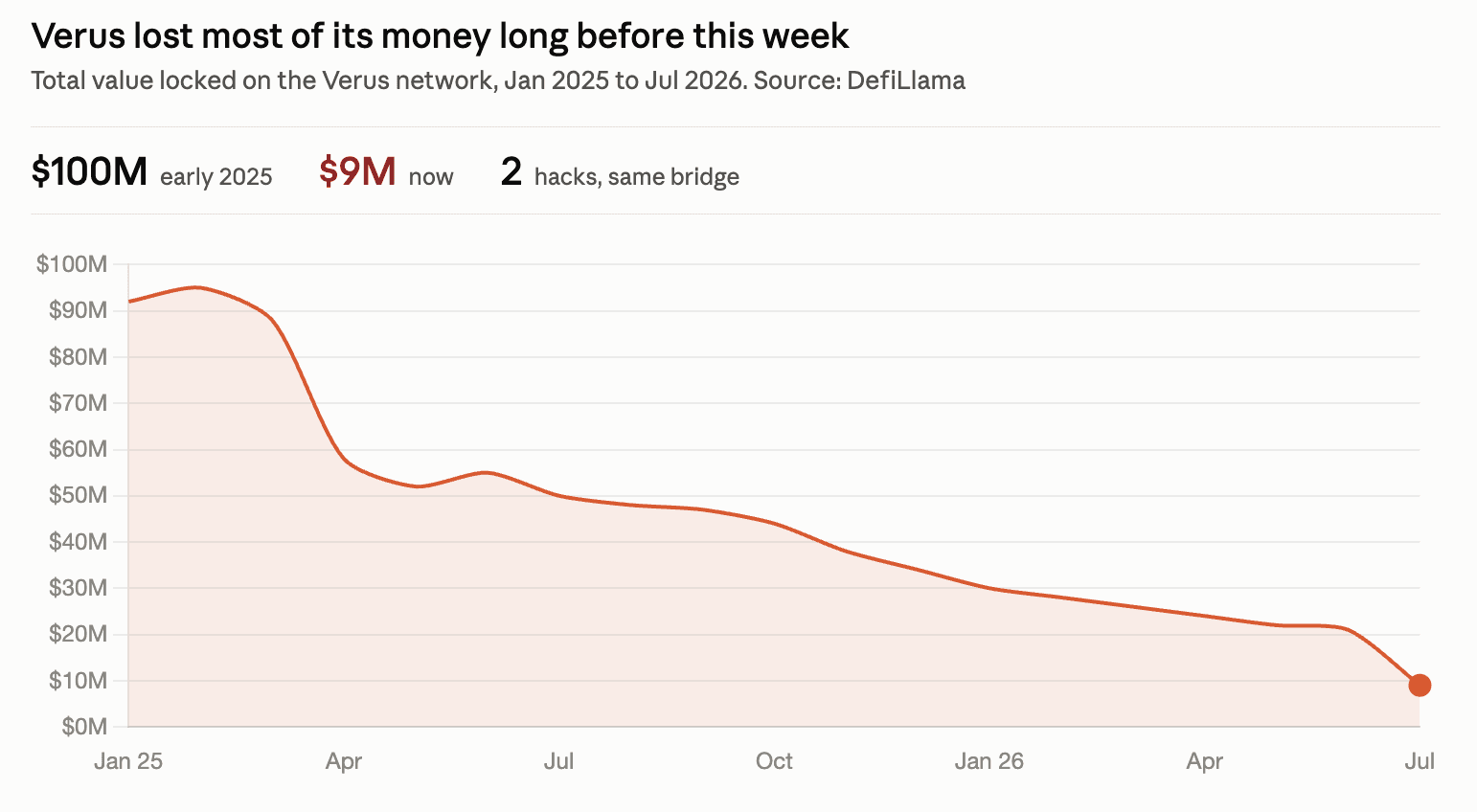
    The cost of that trust is visible in the protocol’s own numbers. Verus held close to $100 million in total value locked at the start of 2025, according to DefiLlama. It holds about $9 million as of Thursday, a slow bleed punctuated by a fresh drop this week as the latest hack landed.

    (Shaurya Malwa/CoinDesk)

    Such repeated failures do not just cost the money stolen in any single attack, but drain the confidence that keeps assets on the platform at all.

  • Cardano (ADA) Founder Charles Hoskinson Speaks Out for the First Time Following the Hack

    Cardano (ADA) Founder Charles Hoskinson Speaks Out for the First Time Following the Hack

    Cardano founder Charles Hoskinson made a statement following the security incident in the Midnight ecosystem that led to a sharp drop in the price of the $NIGHT token. Hoskinson stated that the attack did not affect the Midnight protocol or the $NIGHT smart contract on Cardano, but rather the problem occurred in the third-party bridge infrastructure.

    Hoskinson stated, “Midnight itself wasn’t hacked. $NIGHT’s smart contract on Cardano wasn’t hacked. What was hacked was the third-party bridge.”

    Hoskinson stated that initial findings indicate the incident is entirely limited to the Wanchain infrastructure, noting that the system has four core components—on-chain and off-chain—running on Cardano and BNB Chain. He emphasized the need for a comprehensive audit to determine which component was affected and how the vulnerability was exploited.

    Hoskinson stated that they were awaiting an explanation from the Wanchain team, saying, “Questions must be answered and audits must be conducted. We will get to the truth about why this happened, who is responsible, how much the loss is, and how the damage will be remedied.”

    Cardano’s founder also warned that similar attacks could become more frequent in the future due to advancements in artificial intelligence technologies. Hoskinson stated that AI has made significant progress in the field of information security, noting that vulnerabilities in systems can be found and fixed much faster than humans can.

    Related News Following a Hacking Attack, the Value of an Altcoin Dropped to Nearly Zero

    Hoskinson, who noted that he has been in the cryptocurrency sector for 15 years, said that the sector has started to become desensitized to these events due to the constant attacks and bridge security problems. Stating that this situation seriously undermines consumer confidence, Hoskinson argued that there is a need for next-generation financial infrastructures.

    According to Hoskinson, the $NIGHT project aims to combine the regulatory mechanisms, insurance products, and asset recovery capabilities of the traditional financial system with the features of cryptocurrencies, such as individual custody and self-sovereign identity. Hoskinson stated that this model aims to give users back control over how their money works.

    Hoskinson stated that the $NIGHT token has begun to recover after the sharp drop, indicating that the Midnight ecosystem has overcome its first major crisis. Hoskinson commented, “$NIGHT experienced its first major event and emerged stronger. Midnight has begun to recover and has passed its first major test.”

    *This is not investment advice.

  • Chainlink Moves BUILD Rewards Toward Fee-Based LINK Agreements

    Chainlink Moves BUILD Rewards Toward Fee-Based LINK Agreements

    Chainlink is shifting the economics of its BUILD program toward commercial fee agreements, a move that could make $LINK’s utility more closely tied to paid oracle and infrastructure services.

    The update follows the final BUILD rewards claims ending July 7, 2026. Under the new direction, participating projects are expected to move toward commercial agreements with fees paid in $LINK or other liquid tokens.

    That matters because $LINK investors have long watched one question closely: how does Chainlink’s adoption translate into token utility?

    This does not mean immediate price impact. It does not mean every Chainlink integration suddenly creates direct $LINK demand. But it does show the network continuing to push toward clearer commercial rails for its services.

    TL;DR

    • Chainlink is moving BUILD program economics toward commercial fee agreements.
    • Fees may be paid in $LINK or other liquid tokens, depending on the agreement.
    • The shift is about long-term token utility, not guaranteed short-term $LINK price movement.

    Why $LINK Utility Is Always The Question

    Chainlink is one of the most widely used infrastructure networks in crypto.

    Its oracle services help deliver price data, proof of reserves, cross-chain messaging, and other off-chain inputs to blockchain applications. DeFi protocols, stablecoin issuers, tokenized asset platforms, and financial institutions all rely on oracle infrastructure in some form.

    But for $LINK holders, adoption alone is not the entire story.

    The market wants to understand how usage connects to the token. Does more oracle demand create more $LINK-denominated fees? Do stakers benefit? Are payments made in $LINK? Are tokens held, distributed, or sold? How much of the network’s commercial activity flows through the token economy?

    Chainlink’s move toward commercial fee agreements is relevant because it speaks directly to that issue.

    It makes the economic relationship between projects and Chainlink services more explicit.

    BUILD Was About Ecosystem Alignment

    The BUILD program was designed to align early-stage projects with Chainlink’s ecosystem.

    Projects could receive support, services, or integration help while committing a portion of their token supply or economic upside back to Chainlink’s network. That model made sense for bootstrapping adoption, especially when many crypto projects were still building toward product-market fit.

    But as Chainlink matures, the network needs commercial arrangements that look less like ecosystem support and more like paid infrastructure.

    That is where fee-based agreements come in.

    A project that relies on Chainlink services can pay for those services. If fees are paid in $LINK or other liquid tokens, the arrangement becomes easier to evaluate and potentially easier to connect to broader network economics.

    The Shift Does Not Guarantee Price Action

    It is important not to overstate this.

    A move toward fee-based agreements does not automatically mean $LINK will rally. Token price depends on many factors, including market conditions, supply dynamics, staking design, investor sentiment, and the actual size of commercial payments.

    There is also nuance around “$LINK or other liquid tokens.”

    If some agreements use tokens other than $LINK, the direct $LINK demand effect may vary. If fees are paid in $LINK but later distributed or sold, the market impact may also depend on the flow structure.

    So the safe interpretation is not “fees equal price increase.”

    The safe interpretation is that Chainlink is continuing to build a more commercial model around its infrastructure, and $LINK remains part of that model.

    For long-term holders, that is still meaningful.

    Chainlink’s Institutional Push Needs Revenue Logic

    Chainlink has been pushing deeper into institutional finance, cross-chain messaging, tokenized assets, proof-of-reserve systems, and data services.

    Those areas require reliable infrastructure. They also require clear business models.

    Institutions do not want vague token incentive systems. They want service-level reliability, pricing, compliance comfort, and dependable technical support. Commercial agreements make that easier.

    At the same time, Chainlink’s crypto-native community wants to know that the token continues to matter.

    Balancing those two audiences is difficult. Chainlink needs to be credible to institutions without making $LINK feel disconnected from network usage.

    Fee-based commercial agreements are one way to bridge that gap.

    The Next Metric To Watch

    The next thing $LINK investors will watch is not just how many projects sign agreements, but how those agreements are structured.

    Important details include payment token, fee size, whether fees connect to staking, how revenue is distributed, and whether enterprise adoption produces visible on-chain flows.

    Until those details become clearer, the update is best viewed as a structural step rather than a complete economic answer.

    Still, the direction is notable.

    Chainlink is moving from early ecosystem reward alignment toward more direct commercial infrastructure relationships. That is what mature middleware networks eventually need.

    For $LINK, the value of that shift will depend on execution.

    If Chainlink can turn adoption into recurring fees while keeping $LINK connected to the economics of the network, the token utility debate becomes more concrete.

    This article is based on Chainlink’s update on commercial agreements and BUILD program rewards.

    This article was written by the News Desk and edited by Samuel Rae.
    This report is based on information released in disclosures at primary source documentation.

  • Uniswap Governance Proposal Would Route Optimism Fees To UNI Burns

    Uniswap Governance Proposal Would Route Optimism Fees To UNI Burns

    Uniswap governance is reviewing a proposal that would route protocol fees from selected Optimism pools toward $UNI token burns, testing a more direct connection between deployment-level activity and token economics.

    The proposal is specific to Optimism pools. That distinction matters because it is not a protocol-wide fee burn across all Uniswap deployments.

    Still, the idea is significant.

    $UNI holders have long debated how Uniswap’s massive trading footprint should connect to the $UNI token. A fee-routing and burn mechanism on Optimism would give governance a narrower test case rather than changing the entire protocol at once.

    TL;DR

    • Uniswap governance is reviewing a proposal tied to Optimism pool fees.
    • The proposal would route selected fees toward $UNI token burns.
    • The scope is Optimism-specific, not a protocol-wide Uniswap burn mechanism.

    $UNI Tokenomics Are Back In Focus

    Uniswap is one of the most important decentralized exchanges in crypto, but its token economics have always been debated.

    The protocol processes large amounts of trading volume, yet $UNI does not automatically capture value from every trade in a direct, simple way. Governance controls key decisions, but tokenholders have often wanted clearer links between protocol usage and token value.

    That is why fee routing matters.

    If protocol fees from selected pools can be used to buy and burn $UNI, the token may gain a more visible economic connection to exchange activity. Burns reduce supply, at least mechanically, and they are easy for the market to understand.

    But implementation is everything.

    Which pools are included? How much fee revenue is routed? How are burns executed? What are the legal and governance implications? Could the model expand beyond Optimism later?

    Those are the questions governance needs to answer.

    Why Optimism Is A Sensible Test

    Optimism is a useful place to test the idea because it narrows the scope.

    Uniswap is deployed across multiple networks. A protocol-wide change would be more complex and more controversial. Testing fee routing on a specific deployment gives governance a way to examine the mechanics without rewriting the entire system.

    It also reflects how DeFi is becoming more chain-specific.

    Activity on Ethereum mainnet is different from activity on Optimism, Arbitrum, Base, Polygon, or other networks. Fees, users, liquidity, incentives, and trading behavior vary by chain.

    A deployment-level test may help Uniswap learn whether fee burns are practical in one environment before considering broader changes.

    That does not guarantee the proposal will pass or expand.

    But it gives $UNI holders a concrete experiment to debate.

    Burns Are Simple, But Not Magic

    The market often likes token burns because they are easy to understand.

    Fewer tokens can sound bullish. But burns only matter if the underlying fee stream is meaningful, recurring, and large enough to affect supply over time.

    A small burn from limited pools may be symbolically important but economically modest. A larger mechanism could matter more, but it may also raise more governance, liquidity, and regulatory questions.

    That is why the Optimism-specific scope is important.

    The proposal can show how the process works without overpromising immediate impact. $UNI holders should watch the mechanism, not just the headline.

    If fees are routed transparently and burns are executed reliably, the model may gain support. If the impact is tiny or the process creates new complications, governance may be more cautious.

    Uniswap Is Searching For Token Value Alignment

    The broader issue is value alignment.

    Uniswap has strong product-market fit. It is widely used, deeply integrated, and central to DeFi liquidity. But tokenholders still want to know how that usage translates into $UNI’s long-term role.

    Governance power alone may not be enough for every investor.

    A fee burn proposal gives the DAO another possible answer. It connects protocol activity, chain-specific revenue, and token supply mechanics in a way that is easier to track.

    That does not mean every Uniswap fee should automatically flow to tokenholders. The protocol also needs liquidity, incentives, legal resilience, and sustainable governance.

    But the discussion is important.

    It shows that DeFi’s largest protocols are still experimenting with how to align users, liquidity providers, developers, and tokenholders.

    For Uniswap, the Optimism proposal could become a small but meaningful test of whether deployment-level fee routing can support $UNI economics without disrupting the protocol’s broader market position.

    This article is based on the Uniswap governance proposal for Optimism pool fee routing.

    This article was written by the News Desk and edited by Samuel Rae.

    This report is based on information released in disclosures at primary source documentation.

  • Base And Optimism Push Native Account Abstraction Toward The OP Stack

    Base And Optimism Push Native Account Abstraction Toward The OP Stack

    Base and Optimism are working to bring native account abstraction to the OP Stack, with developer testing already live on Base Vibenet and mainnet rollout planned for the Cobalt upgrade in September 2026.

    The update centers on EIP-8130 and aims to make user accounts more flexible across OP Stack chains.

    For users, the idea is simple: crypto wallets need to feel less clunky. Account abstraction can help make that happen by supporting features such as smoother onboarding, better transaction flows, and more flexible account logic.

    The important caveat is that this is not fully live across mainnet OP chains yet. The feature is in testing, with broader rollout planned later.

    TL;DR

    • Base and Optimism are working on native account abstraction for the OP Stack.
    • Developer testing is live on Base Vibenet.
    • Mainnet rollout is planned for the Cobalt upgrade in September 2026.

    Why Account Abstraction Matters

    Crypto still has a user experience problem.

    Seed phrases are intimidating. Gas fees are confusing. Wallet approvals are messy. Signing flows are hard for ordinary users to understand. Even experienced crypto users can make mistakes when moving across chains and apps.

    Account abstraction is one of the industry’s main attempts to fix that.

    Instead of treating every wallet like a simple externally owned account with limited logic, account abstraction allows more programmable account behavior. That can support features such as sponsored transactions, session keys, recovery systems, spending limits, batched actions, and app-specific permissions.

    In plain English, it can make wallets behave more like modern financial apps without giving up the benefits of blockchain infrastructure.

    That is why Base and Optimism pushing native support into the OP Stack matters.

    If account abstraction becomes part of the stack itself, developers may not need to build as many workarounds at the app layer.

    Base Gives The Upgrade Real Distribution

    Base has become one of the most important consumer-facing Layer 2 networks in crypto.

    Its Coinbase connection gives it distribution, brand recognition, and access to a large pool of potential users. That makes Base an important testing ground for wallet and account improvements.

    If native account abstraction works well on Base, it could improve onboarding for apps built on the network. Users may be able to interact with applications more easily, while developers get better tools for designing smoother experiences.

    The Optimism side matters too.

    The OP Stack is used by multiple chains. Improvements to the stack can spread across the broader Superchain ecosystem if adopted. That means the work is not limited to one network in theory.

    But adoption will still depend on implementation, timing, and developer support.

    The Vibenet testing phase is useful because it gives builders a place to experiment before mainnet rollout.

    Mainnet Timing Is The Key Caveat

    The September Cobalt upgrade is the important timeline marker.

    Until then, users should not assume native account abstraction is fully available on mainnet. Developer testing is not the same as production deployment. Apps may experiment before the broader rollout, but real user impact depends on mainnet readiness.

    That distinction matters because account abstraction is often discussed as if it has already solved crypto UX.

    It has not.

    The technology is promising, but it needs wallet support, app integration, secure implementation, and user-friendly design. A technical upgrade alone does not automatically make crypto easy.

    Still, native support can remove a major barrier.

    If Base and Optimism make account abstraction easier for developers to use, the next generation of apps may feel much less awkward than today’s DeFi and wallet flows.

    The OP Stack Is Becoming More User-Focused

    The OP Stack conversation often focuses on scaling, fees, sequencer revenue, and network architecture.

    Account abstraction brings the focus closer to the user.

    Lower fees are helpful, but they do not solve confusing wallet experiences. Faster confirmations are useful, but they do not fix bad onboarding. A better account model can attack those problems more directly.

    That is why this update matters for the broader Ethereum Layer 2 market.

    Competition between L2s is no longer just about throughput. It is about which networks can attract real users and keep them active. Better wallet experiences may become a major differentiator.

    Base and Optimism are betting that account abstraction belongs inside the infrastructure layer, not only as an optional app feature.

    If the Cobalt rollout succeeds, the OP Stack could become more attractive to consumer apps, gaming projects, payment tools, and DeFi platforms that want simpler user flows.

    The market should watch the testnet phase closely.

    The promise is big, but the proof will come when developers turn the upgrade into products that ordinary users can actually understand.

    This article is based on Base’s announcement of native account abstraction work for the OP Stack.

    This article was written by the News Desk and edited by Samuel Rae.

    This report is based on information released in disclosures at primary source documentation.

  • Ethena price prediction: Why ENA could rally 25% despite a long-term downtrend

    Ethena price prediction: Why ENA could rally 25% despite a long-term downtrend

    Ethena [$ENA] has made some modest gains to get the week off to a good start. Since making the $0.078 low on Monday, July 20, the altcoin has rallied 13%. In the past 24 hours, its Open Interest has expanded by 7%.

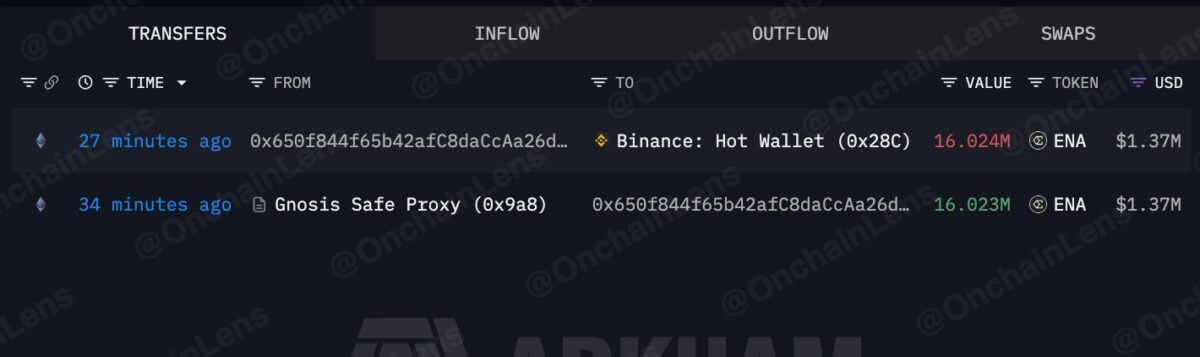
    Source: Onchain Lens on X

    On July 21, Onchain Lens observed a 16 million $ENA move, worth around $1.37 million. The wallet withdrew this from their Gnosis multisig wallet to Binance. Transfers to centralized exchanges generally point toward sell pressure.

    Ethena holders have experienced profits, as seen on the daily transaction volume in profit metric. A rise in average order size also indicated potential whale interest in $ENA, AMBCrypto reported.

    $ENA operates within a downtrend, but a temporary uptrend was underway

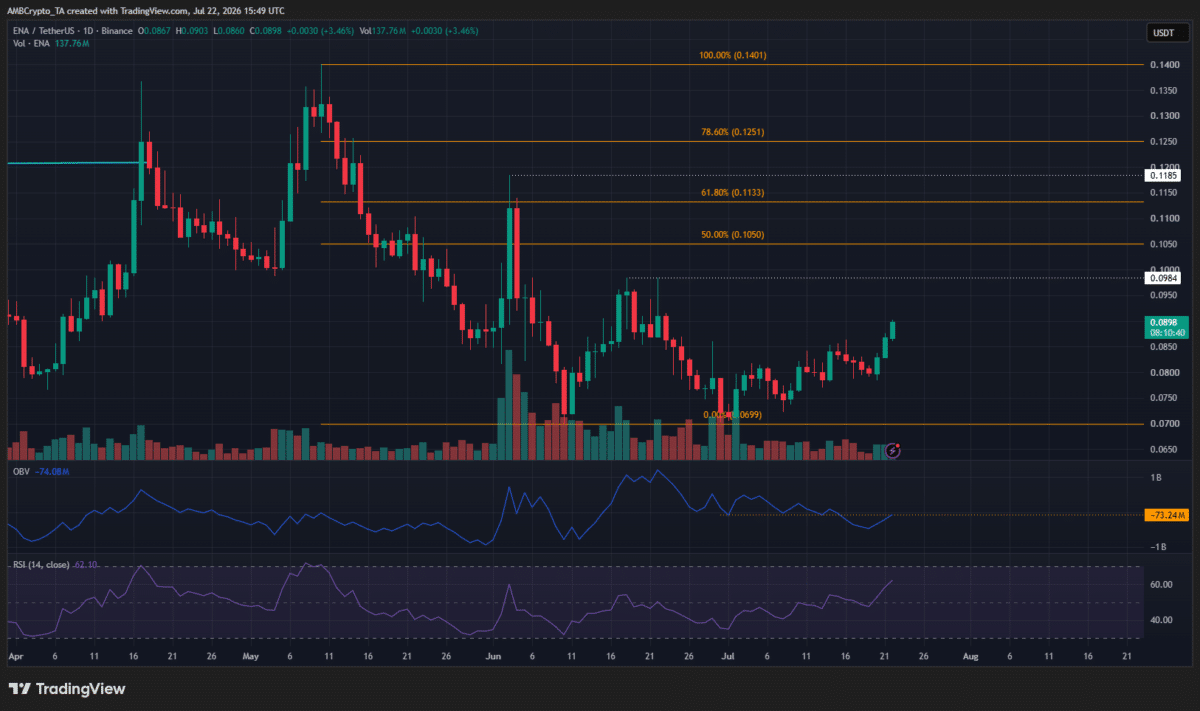
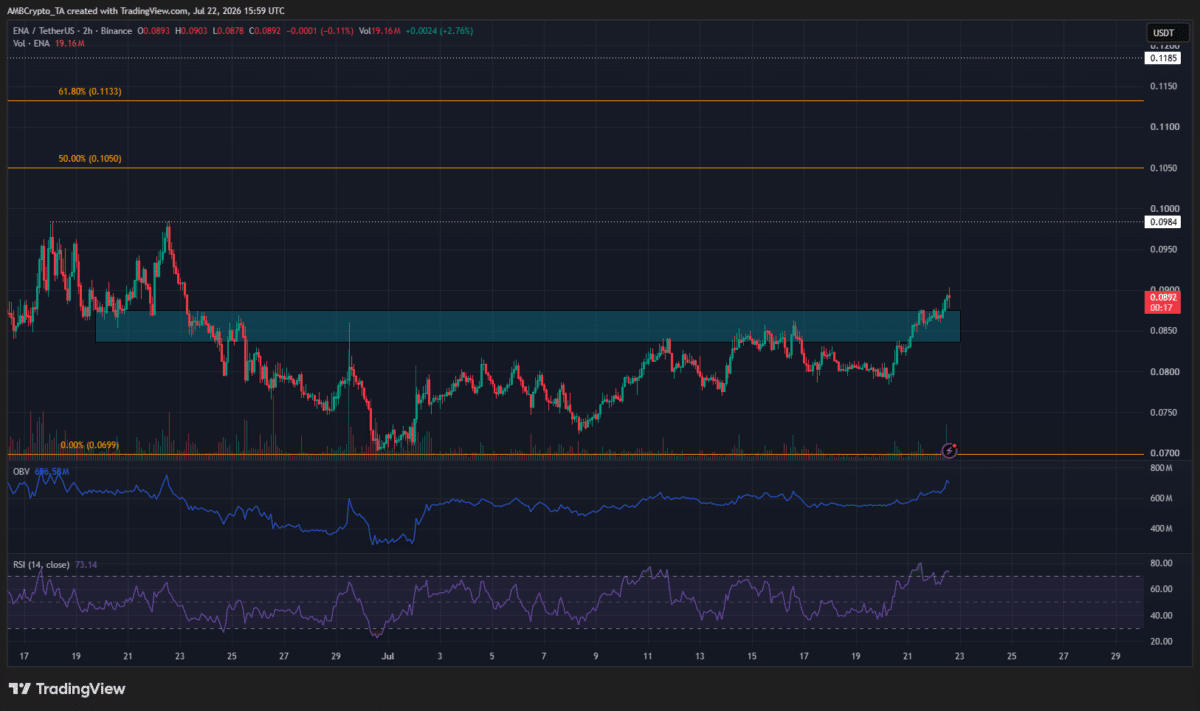
    The $0.085 target presented has been met and cleared. However, the higher timeframe trend remained bearish.

    Source: $ENA/$USDT on TradingView

    The local highs at $0.098 and $0.118 are the potential price targets in case of a short-term uptrend. As the Fibonacci retracement levels show, the swing structure on this timeframe was bearish.

    A rally could rise to $0.123, but the likelihood of this had been in question as $ENA repeatedly failed to breach the $0.085 resistance zone over the past three weeks. The gains at the start of this week were a positive sign.

    Source: CoinGlass

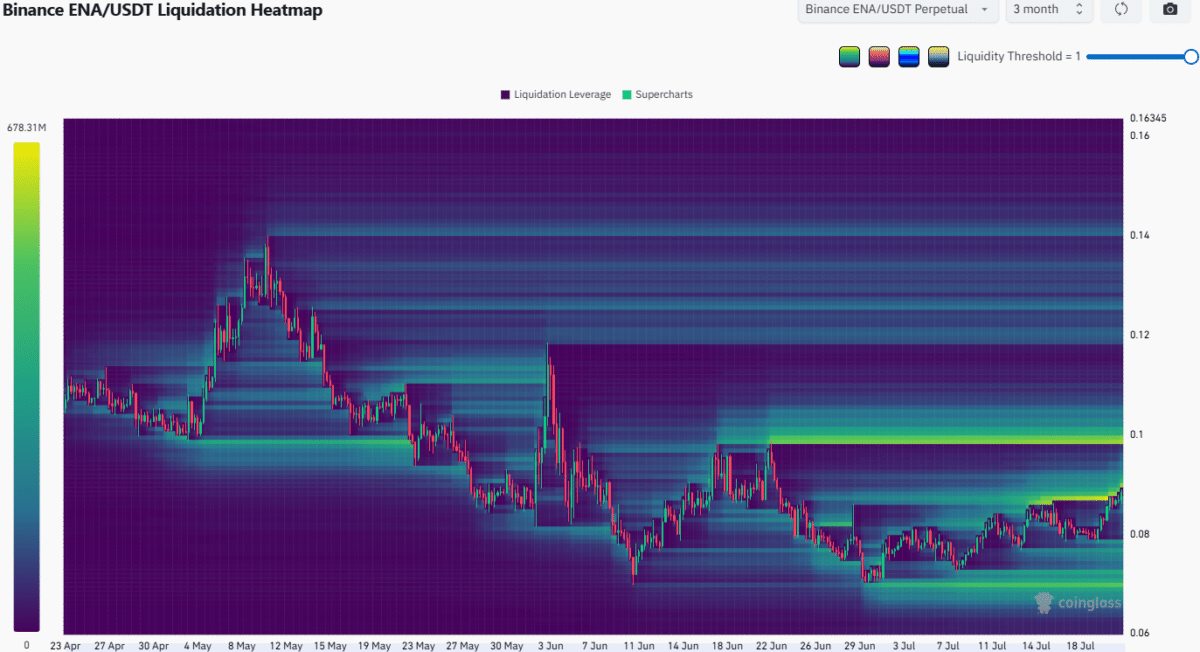
    The liquidation heatmap of the past three months agreed. There were two magnetic zones to keep an eye on. The $0.09 and $0.10 had dense short liquidations that traders should keep an eye on.

    Traders’ call to action- Cautiously bullish stance warranted

    Source: $ENA/$USDT on TradingView

    The $0.085 zone was flipped to support. The OBV was making new local highs to indicate increased buying pressure. The RSI showed strong bullish momentum, though a bearish divergence warned of a brief dip toward $0.085.

    Such a dip would likely present a short-term buying opportunity. As noted earlier, the $0.098,$0.118, and $0.123 levels are viable targets for $ENA in a pullback within its higher timeframe downtrend.


    Final Summary

    • The $0.085 local resistance zone was flipped to support, though a short-term RSI bearish divergence could cause a minor price dip.
    • Traders can wait for the current upward move to push toward $0.11-$0.12 before looking to take profits. Bitcoin volatility could hurt this short-term setup.

  • Senator Lummis: Ethics, other provisions in crypto Clarity Act to be further discussed

    Senator Lummis: Ethics, other provisions in crypto Clarity Act to be further discussed

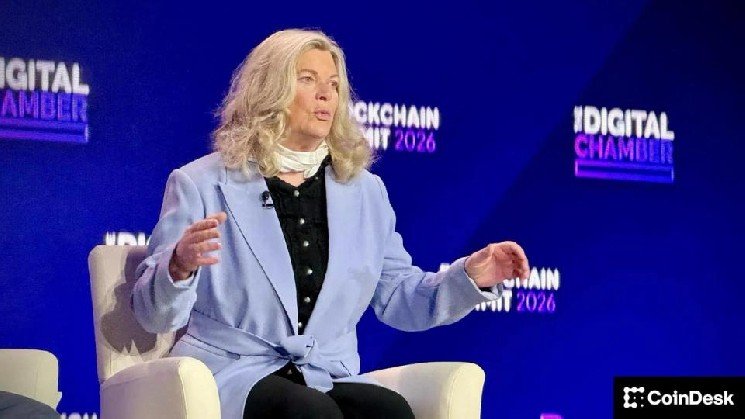
    The U.S. Senate’s Digital Asset Market Clarity Act draft is still open to changes on a number of big-ticket items that include its government-ethics section, Senator Cynthia Lummis, one of the lead negotiators on the bill, said about the effort that’s “finally” getting closer to passage with the release of the text.

    The Senate’s Judiciary, Ethics and Intelligence Committees all had input into the bill, Lummis told CoinDesk on Wednesday, and while the process has “been very difficult,” the bill is ready for additional feedback.

    “It’s time to show everyone the fully integrated bill that we will be voting on, and get the feedback from the industry that’s about to be regulated, as well as others,” Lummis said. “So I’m pleased we’ve reached this point.”

    Lummis released an updated text of the Clarity Act earlier Wednesday that merged the bills passed by the Senate Banking and Agriculture Committees into one longer bill. The updated text is not likely to be the final version of the bill.

    The bill’s proposed conflict-of-interest limits for government officials’ crypto involvement will continue to be discussed through the weekend, and some of the illicit finance provisions may also see further discussion, Lummis said.

  • Bitcoin Analysts Pinpoint Key Levels As Crypto Fluctuates Near $65,000

    Bitcoin Analysts Pinpoint Key Levels As Crypto Fluctuates Near $65,000

    Bitcoin prices fluctuated close to $65,000 on Wednesday, July 22, as analysts pointed out key technical levels that traders should monitor.

    The world’s largest digital currency by total market value fell to as little as $65,484.00, according to Coinbase data from TradingView.

    At this point, the cryptocurrency had fallen close to 50% from the all-time high of more than $125,000 it reached in October 2025, a price reported by Reuters.

    As the digital asset traded near the $65,000 level, several analysts highlighted key technical levels that short-term traders should watch.

    Maxime Seiler, cofounder and CEO of STS Digital, offered some input on this matter, stating via email that “$70.000 to $72,000 is the upside zone to watch into month end, which lines up with where the bullish structures are set, and $67,000 to $68,000 is the immediate resistance that has to give first.”

    “On the downside, $60,000 is still the level the market cares about,” he added, shedding some light on where bitcoin has support in this market.

    Seiler also highlighted some macro developments, clarifying that “The main catalyst is the Fed meeting on July 28 and 29, which the market is treating as the thing that resolves the range one way or the other.”

    “In addition, it’s worth watching alongside whether the ETF inflow streak holds,” he stated, referring to the flows into bitcoin exchange-traded funds.

    Julio Moreno, head of research for CryptoQuant, supplied a similar take on the matter.

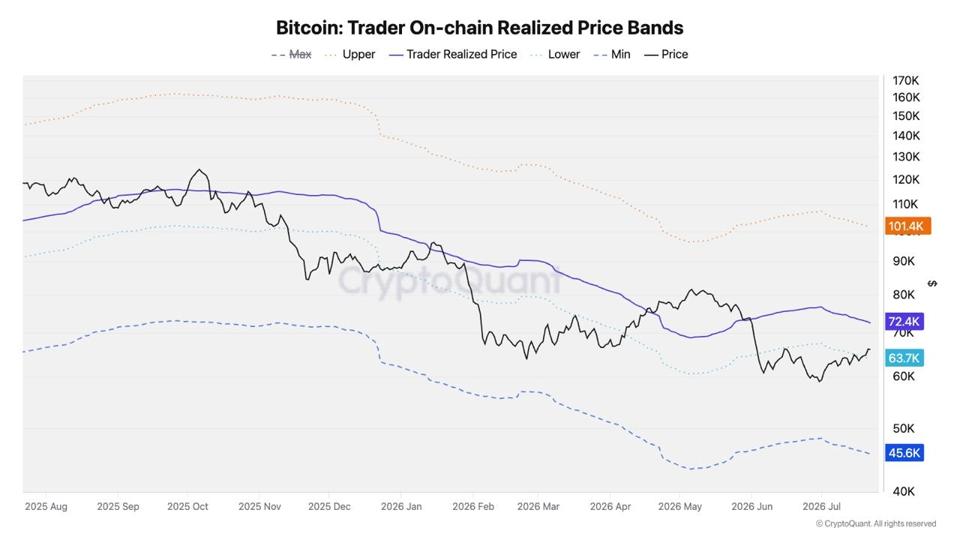
    “From a traders’ perspective, I would watch the $64K price level as a support (dotted light blue line) and $72K as resistance (purple line) in the short term,” he said via email, referring to lines in a chart provided below.

    “These levels are the lower band and traders’ on-chain realized price, and have been reliable support and resistance levels during this bear market,” noted Moreno.

    Trader on-chain realized price bands

    CryptoQuant

    Tim Enneking, managing partner of Psalion, also chimed in.

    “After months of indecision, it appears that $60k is finally a rather firm bottom for $BTC,” he said through emailed commentary.

    “Since initially falling back to $60k in early February of this year (after breaking that level on the way up almost two years ago), $BTC has spent a full six months bouncing between $57k and $83k.”

    “It’s spent the last almost two months between $57k and $67k, with $BTC today trying to push through the $67k ‘high’ set on June 15. Breaking that level is critical to continue putting in the higher lows and highs which began about one month ago.”

    “My one fear is that this kind of looks like fall 2022, when $BTC also took its time putting in a bottom, and then completed one more leg down before moving up significantly beginning the following January.”

  • Ondo price defies market fatigue as Wall Street tokenization bet pays off

    Ondo price defies market fatigue as Wall Street tokenization bet pays off

    Ondo price has climbed 27% from $0.32 on July 15 to an intraday high near $0.42 as institutional tokenization deals and a decisive chart breakout have strengthened bullish sentiment around the RWA-focused token.

    According to data from crypto.news, Ondo ($ONDO) price traded near $0.41 at press time, up about 2% on the day, with a market capitalization close to $2 billion. The token has outperformed Bitcoin and Ethereum over the past week as traders moved toward crypto projects tied to real-world financial infrastructure.

    Recent interest followed Ondo Finance’s work with the Depository Trust & Clearing Corporation on a model for tokenizing securities held at the Depository Trust Company. Products linked to assets such as the SPDR S&P 500 ETF and Circle shares could use entitlements tied to securities held within existing custody systems, rather than stand-alone synthetic copies.

    Ondo’s institutional case also includes a cross-border redemption completed with Mastercard, Kinexys by J.P. Morgan and Ripple. The transaction announced in May tested the redemption of tokenized U.S. Treasuries across two banking networks, giving investors another example of how regulated assets can move between blockchain and conventional payment systems.

    Meanwhile, Ondo has expanded its tokenized-stock platform to more than 440 assets, while its website reports about $1.05 billion in value locked across those products. The company also introduced round-the-clock minting and redemption for tokenized stocks in June, reducing the dependence on U.S. market hours.

    A separate agreement with Japan’s SBI Group added another source of demand for the RWA narrative. The companies plan to explore tokenized Japanese securities distributed through SBI’s network, with yen-based settlement through the JPYSC stablecoin.

    Institutional deals have driven $ONDO’s breakout

    Daily active addresses rose from 2,589 to around 3,300 on July 21 as the price approached $0.40, according to network data cited in the market analysis. The increase came alongside a sharp rise in trading volume, which helped $ONDO break from a descending channel that had controlled price action since May.

    Spot buying also pushed cumulative volume delta back above zero, while derivatives open interest rebounded from its recent low. Those moves show that fresh capital entered both markets during the advance, although the speed of the recovery also forced traders holding short positions to close contracts as $ONDO crossed $0.39.

    Investor sentiment has turned firmly positive after repeated failures below the same resistance. According to analyst Michaël van de Poppe, the token’s brief return to $0.34 created a successful retest before the latest push.

    “I assume that, with this short retest at $0.34 and the fact that we’re having a test of this resistance so fast, it’s likely that we’ll continue to rally upwards.”

    Van de Poppe placed $0.45 as the next likely objective and argued that strength in $ONDO could also pull other RWA tokens higher. His view matches the latest spot structure, though the token must first absorb sellers between $0.41 and $0.42.

    Macro conditions have also favored assets with clear institutional links. Bitcoin traded near $66,000, and Ethereum hovered around $1,930 as both assets registered limited daily gains, while investors assessed commodity volatility and the next round of central-bank decisions. $ONDO’s 27% weekly advance has separated it from that subdued large-cap performance.

    $ONDO price must secure $0.42 before targeting $0.47

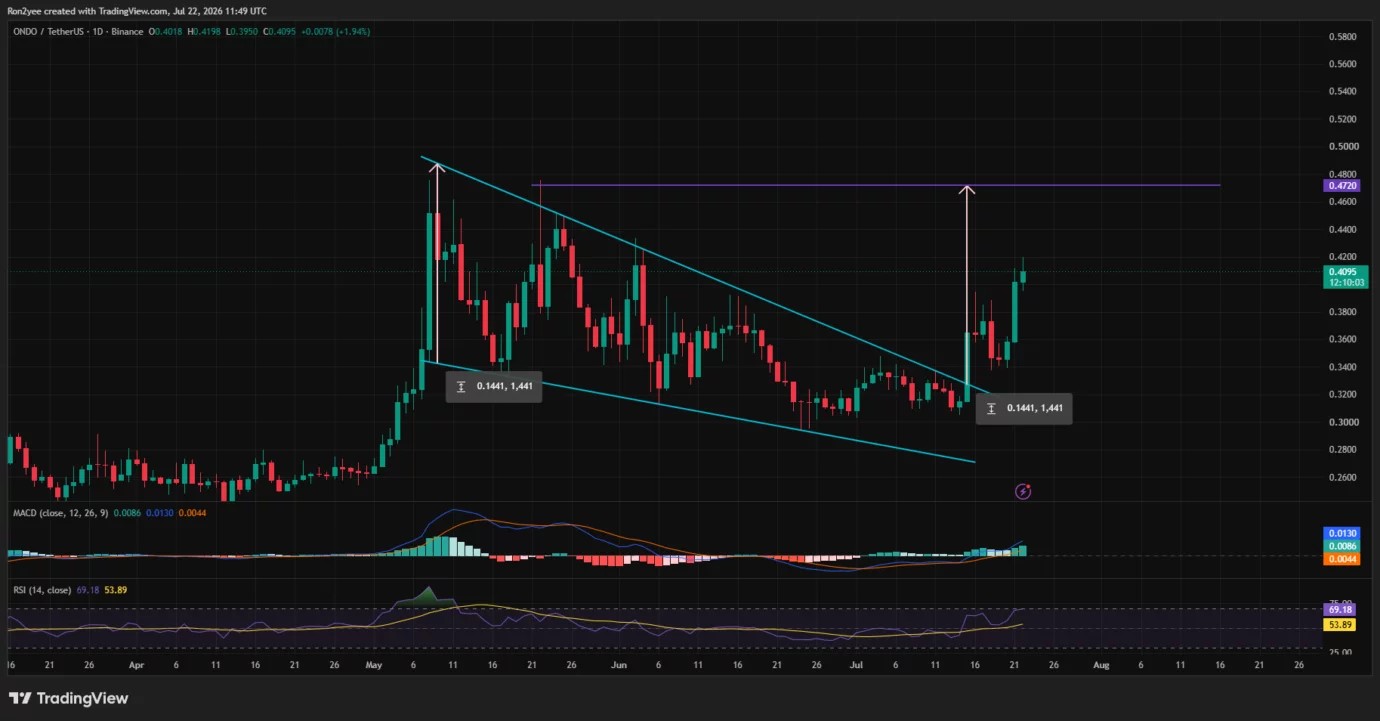
    The daily chart shows $ONDO breaking above the upper boundary of its multimonth descending channel after several failed attempts. Based on the height of the channel, the measured move places the main bullish target near $0.472, an area that also served as resistance during May.

    Ondo price daily chart has broken out of a descending channel pattern on the daily chart — July 22 | Source: crypto.news

    Momentum supports the advance but leaves little room for a weak close. The daily relative strength index has reached 69.18, just below the conventional overbought threshold of 70, while its average remains at 53.89. The MACD line has risen to 0.0130 above the 0.0044 signal line, and the positive histogram has expanded to 0.0086.

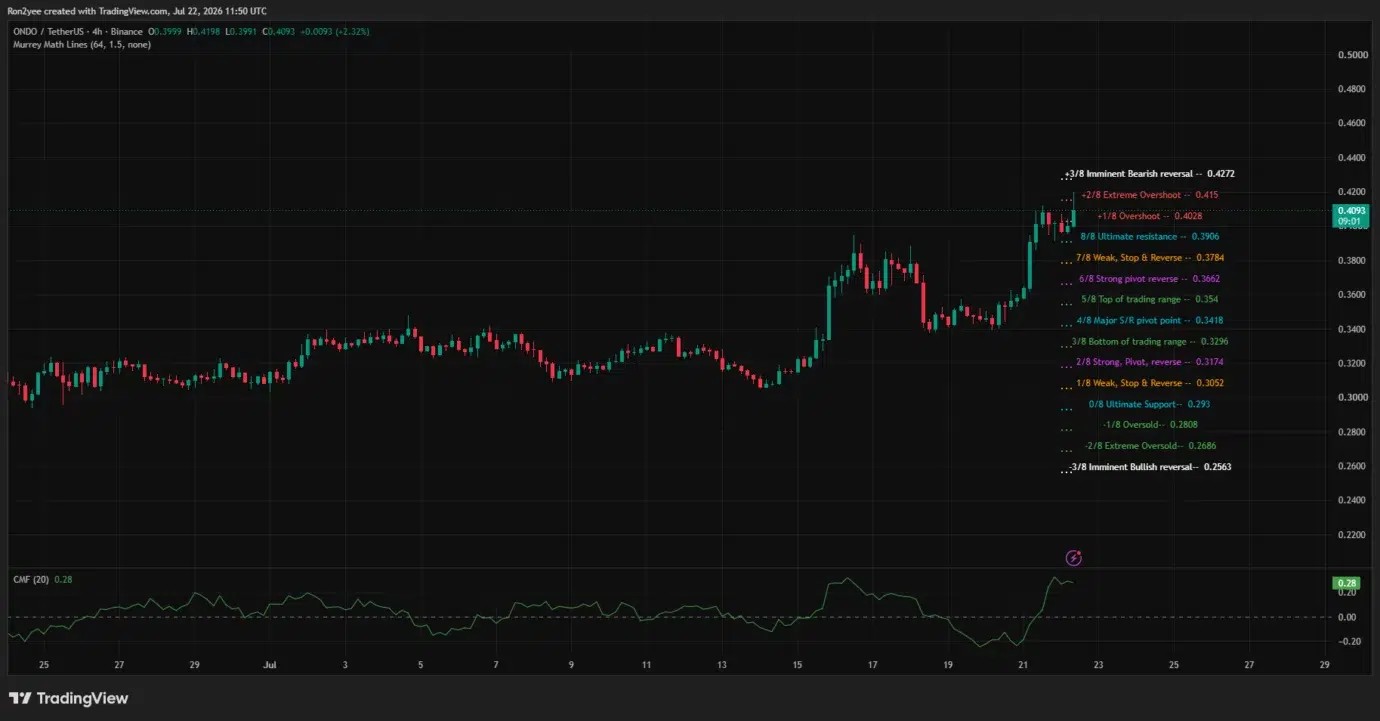
    On the 4-hour chart, $ONDO has moved above the Murray Math ultimate resistance at $0.3906 and the $0.4028 overbought level. Price has now entered the band between $0.4028 and $0.4150, where traders may take profits after the rapid advance. The next extension sits at $0.4272 if buyers secure a 4-hour close above $0.415.

    Ondo price 4-hour chart — July 22 | Source: crypto.news

    Cash flow remains supportive, with the 4-hour Chaikin Money Flow reading at 0.28. A positive value of that size confirms that buying volume has outweighed selling volume during the breakout, though a drop below $0.3906 would weaken the immediate setup. Lower supports sit at $0.3784 and $0.3662.

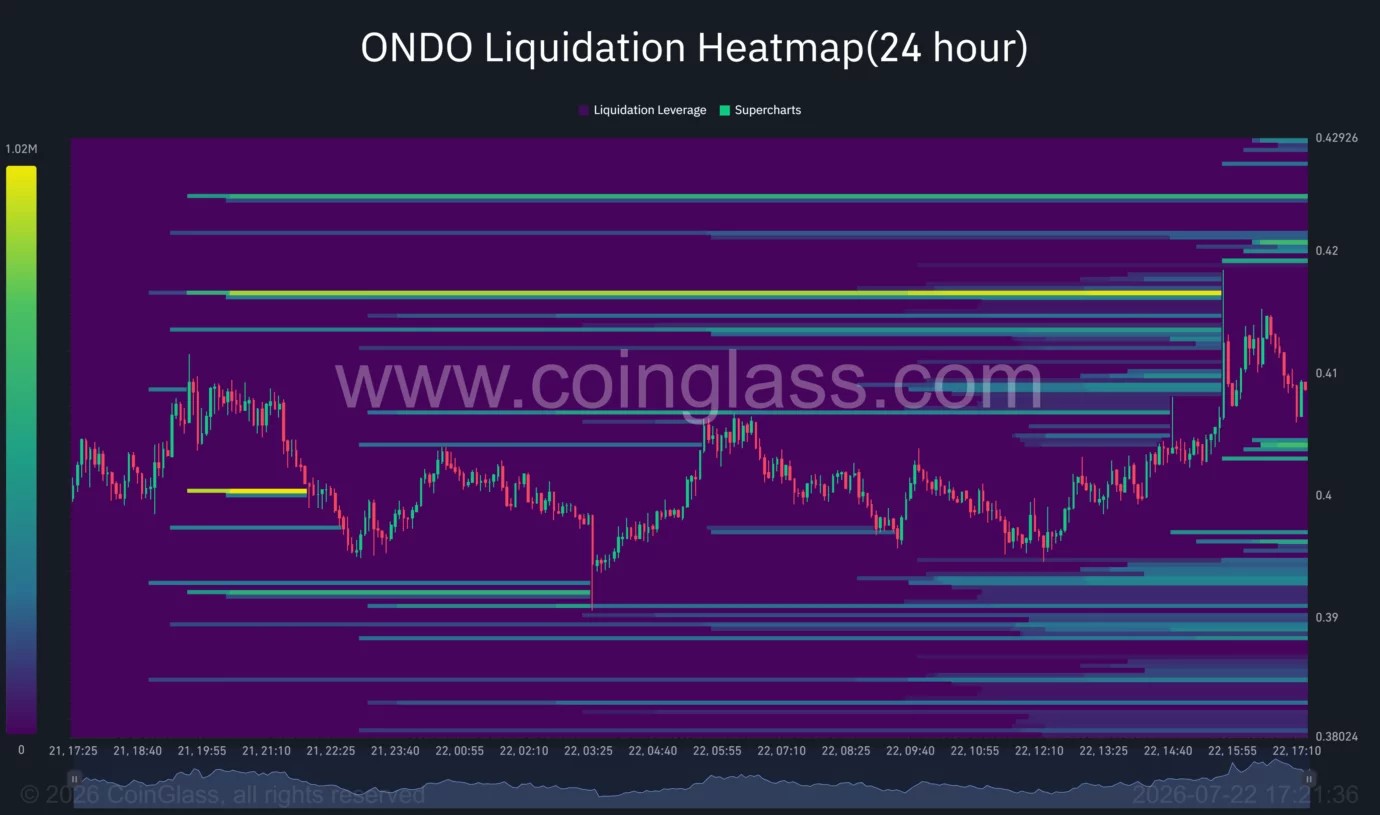
    CoinGlass’ 24-hour liquidation heatmap places the largest nearby leverage pool around $0.416–$0.417, just above the current price. A push through that cluster could liquidate additional short positions and carry $ONDO toward $0.42. Below the market, leveraged positions are concentrated near $0.393–$0.390, with another dense pocket around $0.389.

    Ondo liquidation heatmap | Source: CoinGlass

    A daily close above $0.42 would open the route toward $0.45 and the channel target at $0.472. Rejection from the current resistance could send $ONDO back toward $0.39, while loss of that level would expose $0.378 and delay the bullish continuation.