Tag: CRYPTOS FoxBusiness

  • Samsung Wallet to Support Stablecoins

    Samsung Wallet to Support Stablecoins

    Samsung has taken a significant step in the cryptocurrency world by adding stablecoin support to its mobile wallet, Samsung Wallet. At the recent Galaxy Unpacked event, it was announced that Samsung Wallet will support stablecoins like $USDC. This move brings digital dollars into the pockets of hundreds of millions of Galaxy device users.

    Innovations Announced by Samsung

    Stablecoin integration was introduced as part of an effort to make Samsung Wallet a unified hub for payments, rewards, and digital assets. Samsung framed this innovation as a “secure payments and rewards experience.” A definitive launch date for the stablecoin feature has not yet been announced, and it hasn’t been officially confirmed which stablecoins will be supported besides $USDC. However, there are strong indications that $USDC will be supported.

    This announcement came alongside Samsung’s introduction of the Galaxy Card, issued by Barclays and operating on the Visa network. This credit card offers various cashback rewards to US users. A partnership with Coinbase in 2025 provided millions of US Galaxy users with access to cryptocurrency services directly through their devices, laying a significant foundation for transforming Samsung Wallet into a more comprehensive digital asset platform.

    What it Means for Investors

    For Circle, the company behind $USDC, this partnership could strengthen its position ahead of a potential IPO or market activity. However, regulatory frameworks for stablecoins are still under development in many regions. Samsung will have to overcome varying compliance requirements in its global markets, which could initially lead to the feature being limited to certain regions. The Galaxy Card, in partnership with Barclays, is likely to launch in the US market as the first target.

    The partnership with Coinbase in 2025 provided Samsung with a foundation in crypto services, but stablecoin integration offers an entirely different proposition. It’s one thing to offer users the ability to buy Bitcoin through a partner app, but integrating the dollar equivalent of digital currency into the core wallet experience is quite another.


  • An Altcoin Has Formed a Partnership with a Major Company; It Will Acquire Its Tokens—Price Surges Suddenly

    An Altcoin Has Formed a Partnership with a Major Company; It Will Acquire Its Tokens—Price Surges Suddenly

    AGI3, a conglomerate of Kinetic Group and developer of the decentralized finance protocol Fluid, has submitted a governance proposal for a strategic ecosystem partnership focused on corporate finance and real-world assets.

    According to the proposal, Kinetic Group plans to acquire up to 10% of the total supply of $FLUID tokens through secondary market purchases and over-the-counter transactions. It was stated that the tokens to be purchased will not come from the Fluid DAO treasury or team allocation.

    The Fluid Foundation will also reserve 5% of the $FLUID supply for safekeeping in compliant private banks and institutional digital asset custodians in Switzerland, the European Union, Hong Kong, and Singapore. These tokens will remain locked for at least four years, until 2030.

    Related News Goldman Sachs CEO Makes a Surprise Bullish Statement on Cryptocurrencies

    As part of the partnership, AGI3 will also transfer 2% of its company shares to Fluid Foundation. A four-year lock-in period will apply to these shares.

    AGI3 Markets, the core product of AGI3, is designed as a permissioned DeFi platform for institutional investors. The platform will feature KYC and anti-money laundering controls and will support trading and lending of real-world assets such as tokenized private loans, government bonds, commodities, equities, and corporate bonds.

    According to the agreement between the parties, all protocol revenues and incentive budgets generated through AGI3 Markets will be shared 50/50 between Fluid and AGI3.

    *This is not investment advice.

  • Mirae plans to turn crypto exchange Korbit into something Korea hasn’t seen before

    Mirae plans to turn crypto exchange Korbit into something Korea hasn’t seen before

    Korbit currently holds less than 1% of South Korea’s domestic crypto market, far behind giants Upbit and Bithumb. When asked directly about its strategy to compete, Mirae Asset stressed that the goal is not to overtake any other company or exchange, but to promote sustainable growth of the digital assets industry in South Korea.

    “We intend to combine Mirae Asset’s extensive global investment expertise with Korbit’s digital asset capabilities to promote the sound and sustainable growth of the digital asset industry in Korea and globally.”

    In other words, Mirae Asset isn’t trying to outdo Upbit or Bithumb, but to offer a one-stop shop that brings together institutional investment capabilities, research, education, and digital asset infrastructure under one roof.

    The group also told CoinDesk it would strictly comply with AML, KYC, and fraud-detection standards across all areas, a signal that Digital X is being positioned for institutional clients as much as for retail traders.

    Mirae Asset’s affiliate Mirae Asset Consulting recently increased its stake in Korbit to 97.15%, completing the acquisition after receiving regulatory approval from South Korea’s Fair Trade Commission.

    “The acquisition was carried out through lawful procedures following a thorough review of the relevant laws and regulatory framework. Mirae Asset Consulting was selected as the acquiring entity after comprehensive consideration of each affiliate’s business purpose and role, as well as its potential synergies with the digital asset business,” the firm said.

  • Bitcoin Exchange Binance Announces Adding Three Altcoins to its Risky Asset List! Here Are Those Altcoins

    Bitcoin Exchange Binance Announces Adding Three Altcoins to its Risky Asset List! Here Are Those Altcoins

    Binance, one of the world’s largest cryptocurrency exchanges, has decided to expand its risk warning system for some digital assets listed on its platform. According to the exchange’s statement, as of July 24, 2026, Across Protocol (ACX), Lisk (LSK), and Stacks (STX) tokens will also be included in the Monitoring Tag system.

    Binance stated that the Monitoring Tag application is used to show investors tokens that are deemed to have higher volatility and risk compared to other listed assets. Projects with this tag are regularly reviewed and may face complete delisting from the platform if they fail to meet the exchange’s listing criteria.

    The exchange emphasized that adding the tag does not mean the tokens in question will be directly delisted, and stated that the performance of the projects will continue to be closely monitored. The Monitoring Tag may be removed as a result of periodic evaluations, and different tokens may be included in this scope if deemed necessary.

    Binance also shared the criteria it considered during the review process. These include the project team’s commitment to development activities, the level and quality of software development work, trading volume and liquidity, network security and resilience to attacks, the stability of smart contracts, and the level of communication with the public.

    The project teams’ responses to Binance’s periodic audit requests, significant changes in token supply, updates to the token economy, any activity suspected of being unethical or fraudulent, and the project’s contributions to the crypto ecosystem are also considered in the evaluation process.

    Users who wish to trade tokens covered by the Monitoring Tag are required to complete a risk awareness test and approve the relevant risk disclosures at regular intervals. Binance states that this practice aims to help investors make more informed decisions about high-risk assets.

    *This is not investment advice.

  • Ripple’s RLUSD gets two boosts as transfer volume drops 25%

    Ripple’s RLUSD gets two boosts as transfer volume drops 25%

    Fintech firm Ripple made two moves on Thursday aimed at growing its dollar-backed stablecoin, $RLUSD, in a month when transfer volume across the token has dropped by 25%.

    The first is Ripple Mint, a platform that lets institutional customers create, redeem, bridge and track $RLUSD through a web dashboard or direct integration.

    Until now, minting $RLUSD — the process of issuing new tokens when a customer deposits dollars — generally meant arranging it directly with Ripple and waiting on a manual issuance process. The APIs let a firm trigger minting and redemption automatically from its own systems and track each transaction from dollar transfer to onchain settlement.

    Ripple has also been extending $RLUSD beyond the $XRP Ledger and Ethereum onto the XRPL EVM sidechain, Base, Optimism, Ink and Unichain, widening the number of networks where the token can circulate.

    Separately, Ripple announced late Thursday a strategic investment in Notabene. This compliance network places $RLUSD inside its business-payments platform, putting the token in front of institutions positioned to send and receive it.

    So, while Mint is designed to make $RLUSD simple to create and manage, Notabene is built to get it moving through institutional payment rails.

  • Bears tighten grip on AVAX as open interest rises alongside falling prices

    Bears tighten grip on AVAX as open interest rises alongside falling prices

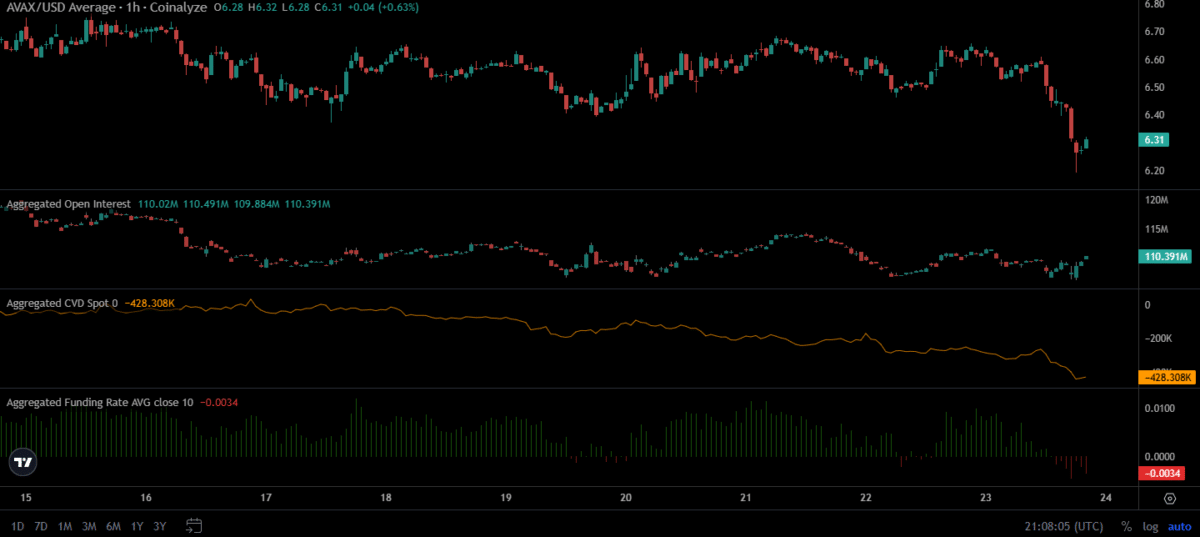
    Avalanche [$AVAX] token prices were down by 4.91% in the past 24 hours. This was among the biggest price drops for crypto assets in the top 35, by market capitalization, CoinMarketCap data showed.

    Source: Coinalyze

    The price drop came alongside an uptick in Open Interest in the past few hours, even as prices fell below the $6.50 local support zone. The spot CVD declined noticeably, and the funding rates also slipped into negative territory.

    In other words, the short-term market expectations were firmly bearish. Let’s see what the price trends hold in store for $AVAX bulls.

    The Avalanche bulls’ struggles have centered around $7 recently

    In a recent report, AMBCrypto detailed how the altcoin’s price trends were stalling even after a 20x surge in daily transactions onchain. The long-term price trend of Avalanche was pointed downward.

    It did not help that in the past 24 hours Bitcoin [BTC] fell below the $65.5k local support zone and was trading below $65k too at the time of writing. If this selling persists, it could trigger a bearish market sentiment shift, dragging $AVAX further south.

    Source: $AVAX/USDT on TradingView

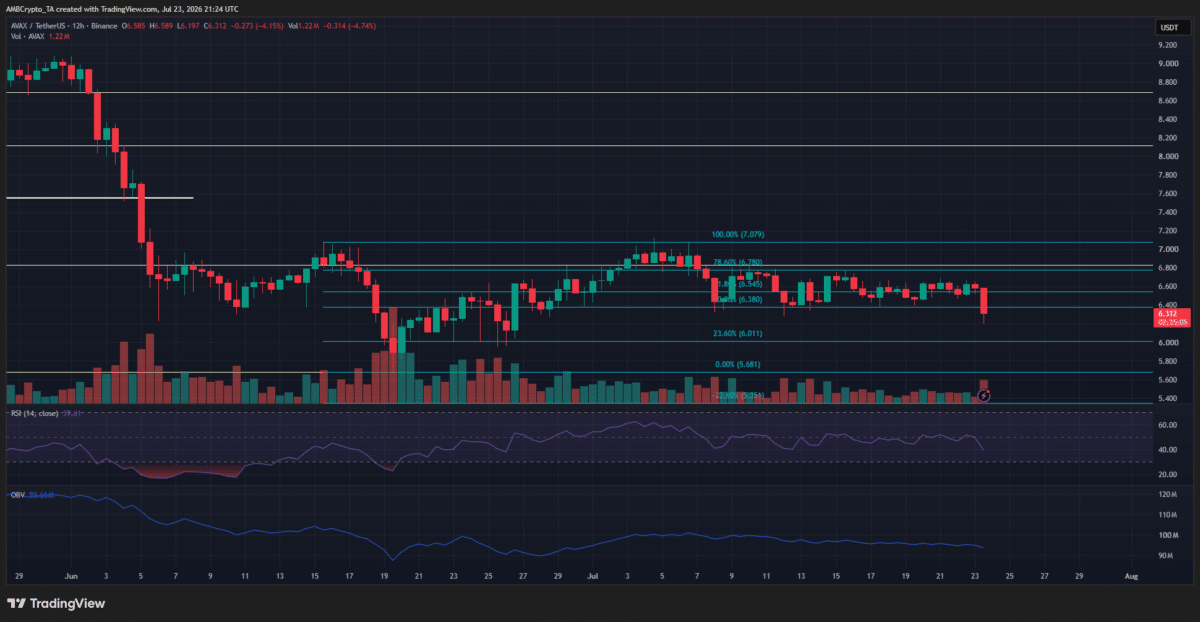
    The longer-term downtrend saw a new swing low registered at $5.68. On the 12-hour timeframe price chart above, this has given rise to a bearish swing structure. A bullish structure would have come into play had the $7.08 swing high been broken.

    It was tested in early July, but not broken. The subsequent rejection has dragged prices lower. Over the past two weeks, $AVAX has traded between $6.38 and $6.78.

    At press time, the band of support around $6.40 appeared to have been breached. This could accelerate the downtrend and drive prices toward $6 and below in the coming days.

    Traders’ call to action- Maintain a bearish bias

    As the Coinalyze data showed, short-selling was becoming popular. As bearish conviction takes root in the derivatives market, it could lead to a short squeeze.

    Source: CoinGlass

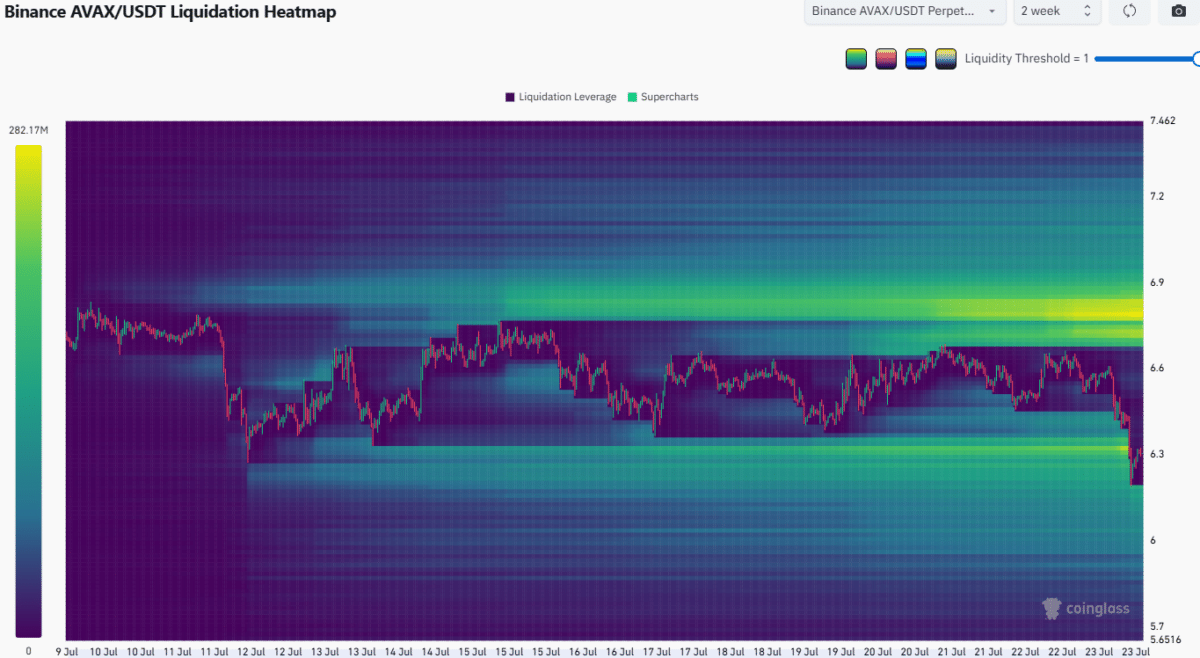
    The 2-week $AVAX liquidation map underlined this threat precisely. To the north, the $6.70-$6.85 area had a dense cluster of short liquidations. This area can be a key magnetic zone that pulls prices upward briefly, before a continuation of the existing bearish trend.

    Therefore, traders can maintain a bearish bias but also be wary of a short squeeze.

    Final Summary

    • Avalanche witnessed steady spot selling, a slight uptick in Open Interest, and negative funding rates in recent trading hours- pointing to heightened short-selling.
    • The loss of the $6.50 support zone could push prices toward and below $6.0 next, but traders should beware of a potential short squeeze.
  • Cathie Wood Snaps Up $60M In Tesla, Circle, Securitize Shares As US Stock Market Crashes

    Cathie Wood Snaps Up $60M In Tesla, Circle, Securitize Shares As US Stock Market Crashes

    On Thursday, July 23, Cathie Wood’s ARK Invest purchased almost $60 million worth of Tesla, Circle Internet Group and Securitize Corp. stock. The purchases coincided with a dramatic sell-off in U.S. stocks. Inflation-driven higher oil prices, higher US Treasury yields and a strong dollar led to a bearish investor sentiment.

  • Stripe in Talks to Acquire AI Marketplace at $10 Billion Valuation

    Stripe in Talks to Acquire AI Marketplace at $10 Billion Valuation

    Stripe, the global payments infrastructure giant, is in discussions to acquire OpenRouter, a marketplace for AI models, at a valuation of approximately $10 billion, according to a report from Cointelegraph. The talks are ongoing, and sources familiar with the matter have indicated that no final decision has been reached.

    What OpenRouter Brings to the Table

    OpenRouter operates as a platform that aggregates access to various large language models and AI services, allowing developers to compare pricing, performance, and capabilities across providers. The marketplace simplifies the process of integrating AI into applications by offering a single API endpoint for multiple models. If the acquisition proceeds, it would mark a significant expansion of Stripe’s technological footprint beyond payment processing into the rapidly growing AI infrastructure sector.

    Strategic Implications for Stripe

    Stripe has been steadily increasing its investments in AI-related tools for developers. The company already offers Stripe Connect for platform payments and Stripe Billing for subscription management, both of which are widely used by AI startups. Acquiring OpenRouter would provide Stripe with a direct channel into the AI model distribution layer, potentially allowing it to bundle payment services with AI access. This move could create a more integrated ecosystem for developers building AI-powered applications, simplifying both their technical and financial operations.

    Market Context and Valuation

    The $10 billion valuation under discussion reflects the premium placed on AI infrastructure companies amid a broader technology industry shift. OpenRouter’s position as a neutral aggregator of AI models gives it strategic value, particularly as enterprises seek to avoid vendor lock-in with a single AI provider. For Stripe, which processes hundreds of billions of dollars in transactions annually, the acquisition would represent one of its largest deals to date, signaling a bet on the long-term convergence of payments and AI services.

    Uncertainty Remains

    It is important to note that the talks are preliminary and may not result in a finalized transaction. Regulatory scrutiny, valuation disagreements, or competing offers could alter the outcome. Neither Stripe nor OpenRouter has publicly confirmed the negotiations. The information currently available is based on sources close to the discussions, and further details may emerge as the process develops.

    Conclusion

    The potential acquisition of OpenRouter by Stripe underscores the growing intersection between financial technology and artificial intelligence. If completed, the deal would give Stripe a foothold in the AI model marketplace, offering developers a unified platform for both AI access and payment infrastructure. For now, the industry watches closely as these high-stakes negotiations continue.

    FAQs

    Q1: What is OpenRouter?
    OpenRouter is a marketplace that provides developers with access to multiple AI models through a single API, allowing them to compare and integrate different large language models without managing separate integrations.

    Q2: Why is Stripe interested in acquiring OpenRouter?
    Stripe likely sees OpenRouter as a strategic asset to expand its developer tools ecosystem, combining AI model access with its existing payment and subscription services to create a more comprehensive platform for AI-powered businesses.

    Q3: Is the deal finalized?
    No. The acquisition talks are ongoing, and no final agreement has been reached. The outcome remains uncertain, and the deal could still fall through.

  • Senate leader casts doubt on Clarity Act passage before August recess: CoinDesk

    Senate leader casts doubt on Clarity Act passage before August recess: CoinDesk

    The US Senate may begin considering the Digital Asset Market Clarity Act before its summer recess, but completing the crypto market structure bill by the industry’s preferred August 7 deadline appears increasingly unlikely, according to a CoinDesk report.

    Senate Majority Leader John Thune told reporters Thursday that he would like to at least begin the floor process.

    “I would like to at least get Clarity started,” Thune said. “We’ll see where the votes are.”

    Beginning consideration before the recess could preserve a path for the Senate to resume work when lawmakers return in September. The chamber is scheduled to begin its summer state work period on August 10 and return on September 14.

    The bill had not entered floor consideration as of Thursday, with the Senate instead working through judicial nominations, an Iran war powers resolution, and the annual defense authorization bill.

    Industry representatives and congressional negotiators had viewed August 7 as the practical deadline for passing the bill before lawmakers shift their attention toward the November midterm elections.

    The Senate will sit for only a limited period in September. Any amended version approved by senators would also need to return to the House before reaching President Donald Trump’s desk.

    The latest draft combines proposals from the Senate Banking and Agriculture committees and sets rules for digital asset exchanges, intermediaries, issuers, and federal oversight.

    Lawmakers remain divided over stablecoin rewards and ethics restrictions on senior government officials. Democrats have objected to giving the Justice Department responsibility for enforcing those rules, while some Republicans oppose the treatment of stablecoin rewards.

    The disputes could prevent the bill from securing the 60 votes needed to advance. Senator Cynthia Lummis said the most contentious provisions remain open to revision as negotiators seek Democratic support.

    The Clarity Act would define the roles of the SEC and CFTC in overseeing digital assets. The House approved its version in July 2025, while the Senate released a combined draft this week.

    Missing the August window would leave the bill with less floor time and greater political pressure ahead of the midterm elections.