Tag: Business – Decrypt

  • There’s a New DeFi Bill in Congress—What Does That Mean for Crypto Market Structure?

    There’s a New DeFi Bill in Congress—What Does That Mean for Crypto Market Structure?

    In brief

    • A bipartisan group of lawmakers introduced a bill to protect non-custodial crypto developers from criminal prosecution.
    • The bill would amend a criminal code used to convict multiple crypto developers last year.
    • While similar protections may appear in a broader crypto market structure bill, the bill may not pass this year.

    A bipartisan group of lawmakers introduced a bill Thursday that would exempt certain decentralized software developers from criminal liability.

    With crypto’s stalled market structure bill poised to contain similar language, what does the bill’s introduction mean for the state of privacy-focused crypto legislation in Washington?

    The new bill goes further than similar language currently being debated in market structure legislation—but should not be seen as an indication that the market structure bill’s language on developer protections is too weak, nor that the market structure bill itself is doomed, a source familiar with the thinking behind the new bill told Decrypt.

    The new bill, dubbed the Promoting Innovation in Blockchain Development Act, would formally amend the language of a U.S. criminal statute that has been successfully used—by both the Joe Biden administration and the current Donald Trump administration—to prosecute crypto software developers.

    The statue, U.S. code 1960, defines an illegal money transmitting business. Today’s legislation would amend the code to ensure it applies only to individuals who “exercise control over currency.” It was introduced in the House today by Reps. Scott Fitzgerald (R-WI), Ben Cline (R-VA), and Zoe Lofgren (D-CA).

    Last year, an Ethereum software developer was found guilty by a Manhattan jury of violating code 1960 for developing a crypto privacy tool called Tornado Cash. The developer argued that because the software was decentralized, and he did not take custody of user funds, he should not be considered the operator of an illegal money transmitting business.

    Some months later, the Trump Department of Justice secured guilty pleas under code 1960 from two Bitcoin software developers who created a similar platform called Samourai Wallet. The developers are both currently serving sentences in federal prison.

    “This bill is critically important for engineers,” the DeFi Education Fund, an industry advocacy group, said today of the Promoting Innovation in Blockchain Development Act.

    “It makes it clear that software developers who do not take custody of or control other people’s money can build neutral technology, here at home, without worrying about being criminally prosecuted as if they are a financial intermediary,” the group said.

    The crypto market structure bill is likely to include language addressing code 1960—but not language that actually rewrites the statute itself. The language would, instead, order that “non-controlling developer[s]” not be treated as engaged in money transmitting under code 1960. 

    Language in the bill surrounding decentralized finance, or DeFi, is currently in relative flux, however, as lawmakers and industry stakeholders attempt to salvage the legislation after months of delays. DeFi refers to the collection of financial applications that exist natively on blockchain networks, circumventing the need for third-party intermediaries such as banks.

    DeFi language in the bill, though, while not finalized, is unlikely to be the hill the bill dies on, sources familiar with the matter told Decrypt. Industry leaders and the banking lobby are currently locked in another disagreement regarding stablecoin rewards, while Senate Democrats and the White House remain at an impasse on language regarding conflicts of interest and President Trump’s numerous crypto ventures.

    Lawmakers have urged that the bill needs to see significant progress in the coming weeks, or it risks falling by the wayside as Congress grinds to a halt in the spring ahead of November’s midterms.

    Daily Debrief Newsletter

    Start every day with the top news stories right now, plus original features, a podcast, videos and more.

  • Block Stock Pops as Jack Dorsey’s Bitcoin, Payments Company Dumps 4,000 Jobs

    Block Stock Pops as Jack Dorsey’s Bitcoin, Payments Company Dumps 4,000 Jobs

    In brief

    • Block expects most restructuring charges to land in the first quarter, driven by severance and share-based compensation costs.
    • The company employed just over 10,200 workers at the end of 2025, highlighting the scale of the workforce reduction.
    • Block’s business spans consumer and merchant payments through Cash App and Square, alongside a growing Bitcoin operation tied to trading and payments.

    Jack Dorsey’s Block Inc said it will cut more than 4,000 jobs, over 40% of its workforce, as part of a broad restructuring unveiled alongside its fourth-quarter and full-year 2025 earnings.

    Shares of the New York Stock Exchange-listed payments company jumped more than 23% in after-hours trading, Yahoo Finance data shows.

    The scale of the layoffs places Block among the companies carrying out the largest workforce reductions in the fintech sector so far this year, as payments and financial technology firms grapple with slower growth, tighter capital conditions, and increased scrutiny of operating costs.

    In a 8-K filing with the Securities and Exchange Commission on Thursday, Block said the workforce reduction is intended to better align its organizational structure with its “operating model and strategic priorities.”

    Block said it expects to record between $450 million and $500 million in restructuring charges, largely related to severance, notice-period pay, employee benefits, and other cash costs, as well as non-cash expenses tied to the vesting of share-based awards. 

    Most of the charges are expected to be recognized in the first quarter of fiscal 2026, with the restructuring largely completed by the end of the second quarter.

    The company cautioned that the estimates are based on assumptions and that actual costs could differ materially.

    As of the end of 2025, Block employed just over 10,200 full-time workers globally, according to its 10-K annual filing with the regulator, underscoring the scale of the cuts.

    Cash App had 59 million monthly transacting users in the U.S. at year-end, bringing in $316 billion of customer inflows during 2025.

    Block’s core business spans consumer and merchant payments through Cash App and Square, alongside a long-running push into Bitcoin products, including trading, self-custody, and merchant payments.

    Block now reports its business across three revenue categories: commerce enablement, financial services, and its Bitcoin ecosystem, which together generated $10.4 billion in gross profit in 2025, per its annual filing.

    Block said it would hold an earnings conference call and webcast later Thursday to discuss its results for the quarter and year ended December 31, 2025.

    Daily Debrief Newsletter

    Start every day with the top news stories right now, plus original features, a podcast, videos and more.

  • OCC Lays Out Framework for Regulated Stablecoins Under GENIUS Act

    OCC Lays Out Framework for Regulated Stablecoins Under GENIUS Act

    In brief

    • The OCC opened a 60-day comment period on draft rules implementing the GENIUS Act.
    • The proposal prohibits anyone other than a “permitted payment stablecoin issuer” from issuing a payment stablecoin in the U.S.
    • AML and sanctions rules will follow separately, with the Act taking effect the earlier of 18 months after enactment or 120 days after final regulations.

    The Office of the Comptroller of the Currency on Wednesday proposed rules to implement the GENIUS Act, laying out how payment stablecoins would be issued and supervised under the agency’s jurisdiction.

    In a notice of proposed rulemaking issued Wednesday, the OCC said it is launching a 60-day public comment period to determine how payment stablecoins are issued, backed, supervised, and potentially shut down under federal oversight.

    Wednesday’s move aims to operationalize the Guiding and Establishing National Innovation for U.S. Stablecoins (GENIUS) Act, the first federally established stablecoin framework that passed into law last July.

    The law generally prohibits anyone other than a “permitted payment stablecoin issuer” from issuing a payment stablecoin in the U.S. and bars digital asset service providers from offering non-compliant stablecoins to U.S. users.

    “The regulations effectively bring the industry into the traditional finance world with significant oversight and connectivity with the banking industry,”  Musheer Ahmed, founder and managing director of Finstep Asia, told Decrypt.

    The U.S. market is expected to see a host of “regulated stablecoins from non-banks, payments, and crypto institutions” for “tokenized TradFi use cases.” 

    The OCC’s draft covers reserve asset standards, mandatory redemption at par, liquidity and risk management controls, audits, supervisory examinations, custody requirements, and application pathways for new issuers. 

    It also introduces a “capital and operational backstop” and amends existing capital adequacy and enforcement rules.

    The agency said it “will have regulatory or enforcement authority over certain permitted payment stablecoin issuers,” including subsidiaries of national banks and federal savings associations, Federal qualified payment stablecoin issuers, and certain State qualified issuers. 

    “In addition, the OCC will have regulatory authority over foreign payment stablecoin issuers,” the proposal says, an expansion that could pull offshore issuers seeking U.S. access into federal oversight.

    Notably absent are Bank Secrecy Act and sanctions rules, which the OCC said will be addressed separately with the Treasury Department.

    The new stablecoin regime is expected to kick in no later than January 2027, but could begin as soon as 120 days after regulators finalize implementing rules, shortening the transition window if rulemaking moves faster than the statutory 18-month deadline.

    Last August, the banking groups wrote to Congress demanding closure of “several loopholes” in the GENIUS Act, warning that third-party yield offerings on stablecoins could still trigger major deposit flight.

    OCC Chief Jonathan Gould has previously dismissed fears of a sudden deposit crisis, telling ABA conference attendees in October that any material deposit flight “would not happen in unnoticed fashion” and “would not happen overnight.”

    To that end, Ahmed said regulated stablecoins could be “potentially safer than traditional banks” in stress events, noting banks operate on 10–20% capital ratios while stablecoin issuers are mandated to hold 100% reserves for 1:1 redemptions, making them “fairly solvent” if rules are maintained.

    In an extreme market scenario, Ahmed said, “one could say that the lender of the last resort will be the U.S. Fed,” not by directly backstopping issuers, but by “supporting the underlying assets that form stablecoin reserves — largely US treasuries and cash equivalents.”

    Daily Debrief Newsletter

    Start every day with the top news stories right now, plus original features, a podcast, videos and more.

  • ETHZilla Drops Ethereum Treasury Label in Rebrand After Share Price Collapse

    ETHZilla Drops Ethereum Treasury Label in Rebrand After Share Price Collapse

    In brief

    • ETHZilla will rebrand as Forum Markets and trade as FRMM on Nasdaq at the start of March
    • The move follows a week after investors exited as it turned away from an Ethereum balance sheet model.
    • Observers say single-asset treasury strategies depend on sustained equity premiums and strong market conditions.

    Former Ethereum treasury firm ETHZilla said it will rebrand as Forum Markets and adopt a new Nasdaq ticker next month, formalizing a shift away from balance-sheet crypto exposure toward tokenized real-world assets.

    The move marks a departure from the company’s earlier strategy of positioning its shares as a public proxy for Ethereum, an approach that faltered as the stock fell sharply from last year’s highs and the firm reduced its crypto holdings.

    ETHZilla’s shares peaked at $107 on August 13, 2025, shortly after the company announced plans to build a $425 million Ethereum treasury following a pivot from its former biotech business.

    The strategy initially drew investor interest but later unraveled as the share price declined, investors exited, and the company began selling assets to scale back its exposure.

    Shares rose 13.3% on Wednesday to $3.91 following the rebranding announcement, though the stock remains down about 96% from its August peak, according to Google Finance data.

    Under the Forum Markets name, the company said it plans to focus on developing tokenized products backed by real-world assets, using regulated infrastructure rather than holding large crypto positions on its balance sheet.

    The rebrand follows Peter Thiel’s Founders Fund exiting its position in ETHZilla earlier this month. The departure of a prominent early backer came as the stock slid sharply, and the firm’s positioning as a publicly traded proxy for ETH exposure drew increased scrutiny.

    Earlier this month, the company said it would pivot into jet engine leasing and other aviation-related assets to further bolster its business model and equity performance amid a weakening Ethereum price.

    “Single-asset treasury strategies are highly dependent on strong market conditions and sustained equity premiums,” Vincent Liu, chief investment officer at quantitative trading firm Kronos Research, told Decrypt.

    “Treasury-focused firms ultimately need revenue-generating businesses and broader asset exposure to remain relevant long term,” Liu said.

    Such strategies, like Forum’s previous endeavors, could be considered “fragile because its value is tightly linked to network activity,” thereby creating “a correlation trap where purchasing power weakens during ecosystem downturns,” he explained.

    That vulnerability is compounded by fragmentation across Ethereum’s main network and its layer-2 chains, which Liu said dilutes its narrative and premium. This condition, he said, is “further undermined by the absence of a hard supply cap, leaving its long-term scarcity proposition open to question.”

    Forum Markets is expected to begin trading under the ticker symbol “FRMM” on March 2, after previously trading under the ticker “ETHZ” on the Nasdaq Capital Market.

    Daily Debrief Newsletter

    Start every day with the top news stories right now, plus original features, a podcast, videos and more.

  • Anthropic, OpenAI Dial Back Safety Language as AI Race Accelerates

    Anthropic, OpenAI Dial Back Safety Language as AI Race Accelerates

    In brief

    • TIME reports Anthropic dropped a pledge to halt training without guaranteed safeguards.
    • OpenAI also removed “safely” from its mission after restructuring into a for-profit entity.
    • Experts say the shift reflects political, economic, and intellectual changes.

    Anthropic has dropped a central safety pledge from its Responsible Scaling Policy, according to a report by TIME. The changes loosen a commitment that once barred the Claude AI developer from training advanced AI systems without guaranteed safeguards in place.

    The move reshapes how the company positions itself in the AI race against rivals OpenAI, Google, and xAI. Anthropic has long cast itself as one of the industry’s most safety-focused labs, but under the revised policy, Anthropic no longer promises to halt training if risk mitigations are not fully in place.

    “We felt that it wouldn’t actually help anyone for us to stop training AI models,” Anthropic’s chief science officer, Jared Kaplan, told TIME. “We didn’t really feel, with the rapid advance of AI, that it made sense for us to make unilateral commitments … if competitors are blazing ahead.”

    The change comes as Anthropic finds itself embroiled in a public dispute with U.S. Defense Secretary Pete Hegseth over refusing to grant the Pentagon full access to Claude, making it the only major AI lab among Google, xAI, Meta, and OpenAI to take that stance.

    Edward Geist, a senior policy researcher at the RAND Corporation, said the earlier “AI safety” framing emerged from a specific intellectual community that predated today’s large language models.

    “As of a few years ago, there was the field of AI safety,” Geist told Decrypt. “AI safety was associated with a particular set of views that came out of the community of people who cared about powerful AI before we had these LLMs.”

    Geist said early AI safety advocates were working from a very different vision of what advanced artificial intelligence would look like.

    “They ended up conceptualizing the problem in a way that, in some respects, was envisioning something qualitatively different from these current LLMs, for better or worse,” Geist said.

    Geist said the language change also sends a signal to investors and policymakers.

    “Part of it is signaling to various constituencies that a lot of these companies want to give the impression that they are not holding back in the economic competition because of concerns about ‘AI safety,’” he said, adding that the terminology itself is changing to fit the times.

    Anthropic is not alone in revising its safety language.

    What defines AI safety?

    A recent report by the non-profit news organization, The Conversation, noted how OpenAI also changed its mission statement in its 2024 IRS filing, removing the word “safely.”

    The company’s earlier statement pledged to build general-purpose AI that “safely benefits humanity, unconstrained by a need to generate financial return.” The updated version now states its goal is “to ensure that artificial general intelligence benefits all of humanity.”

    “The problem with the term AI security is that no one seems to know what that means exactly,” Geist said. “Then again, the AI safety term was also contested.”

    Anthropic’s new policy emphasizes transparency measures such as publishing “frontier safety roadmaps” and regular “risk reports,” and says it will delay development if it believes there is a significant risk of catastrophe.

    Anthropic and OpenAI’s policy shifts come as the companies look to strengthen their commercial position.

    Earlier this month, Anthropic said it raised $30 billion at a valuation of about $380 billion. At the same time, OpenAI is finalizing a funding round backed by Amazon, Microsoft, and Nvidia that could reach $100 billion.

    Anthropic and OpenAI, along with Google and xAI, have been awarded lucrative government contracts with the U.S. Department of Defense. For Anthropic, however, the contract appears in doubt as the Pentagon weighs whether to cut ties to the AI firm over access complaints.

    As capital pours into the sector and geopolitical competition intensifies, Hamza Chaudhry, AI and National Security Lead at the Future of Life Institute, said the policy change reflects shifting political dynamics rather than a bid for Pentagon business.

    “If that were the case, they would have just backed down from what the Pentagon said a week ago,” Chaudhry told Decrypt. “Dario [Amodei] wouldn’t have shown up to meet.”

    Instead, Chaudhry said the rewrite reflects a turning point in how AI companies talk about risk as political pressure and competitive stakes rise.

    “Anthropic is now saying, ‘Look, we can’t keep saying safety, we can’t unconditionally pause, and we’re going to push for much lighter-touch regulation,’” he said.

    Daily Debrief Newsletter

    Start every day with the top news stories right now, plus original features, a podcast, videos and more.
  • Samsung’s Galaxy S26 Billed as First ‘Agentic AI Phone’—Here’s What That Means

    Samsung’s Galaxy S26 Billed as First ‘Agentic AI Phone’—Here’s What That Means

    In brief

    • Samsung brands the Galaxy S26 as the first “agentic AI phone.”
    • Samsung is layering Gemini, Perplexity, and a revamped Bixby into a multi-agent stack.
    • There is also a toggleable hardware privacy display that blocks shoulder-surfers at the pixel level.

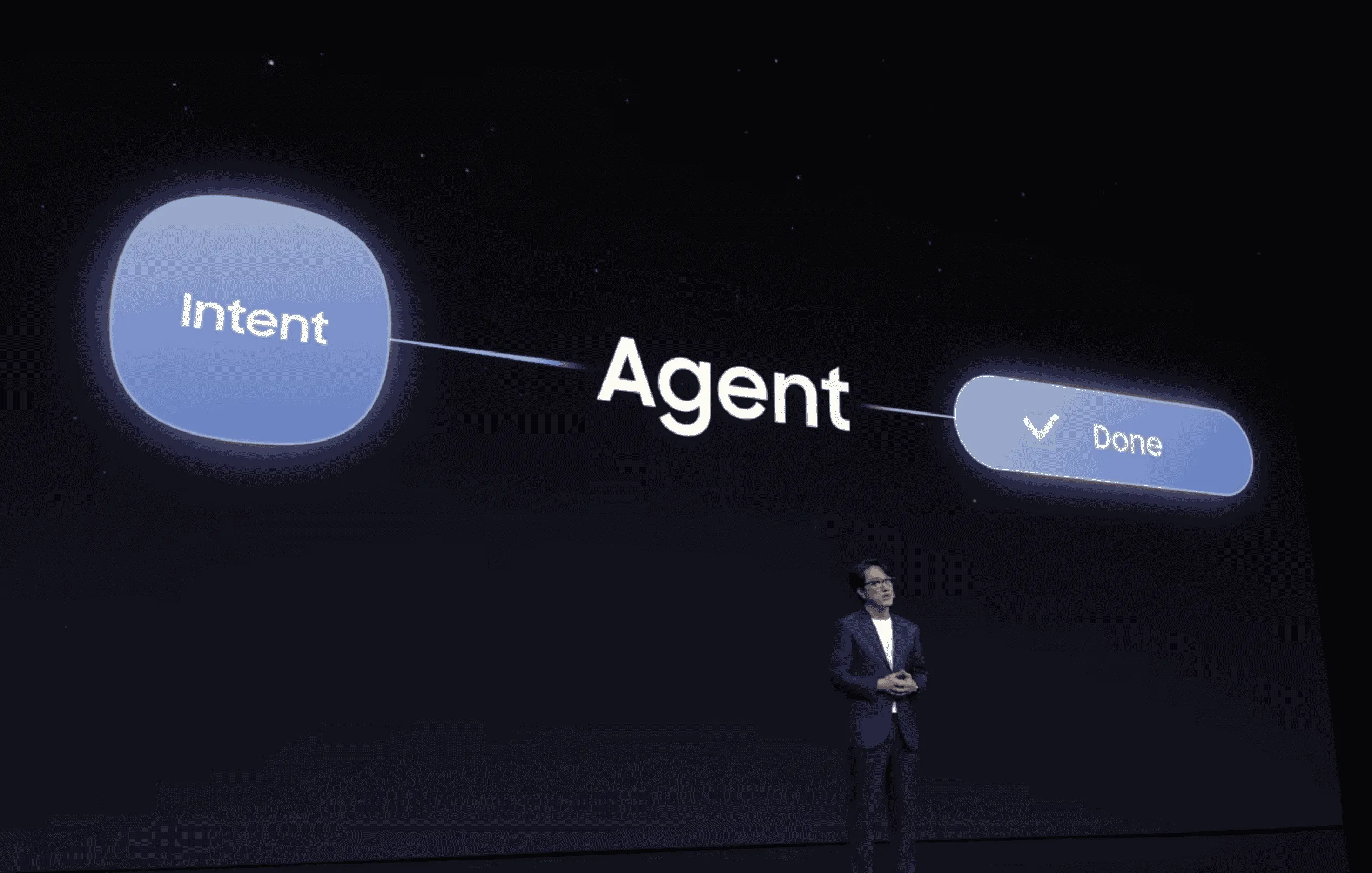
    Samsung CEO TM Roh stepped onto a San Francisco stage Wednesday, introduced the Galaxy S26 line of phones, and said something no phone maker has said before.

    “Imagine a phone that anticipates your needs before you even realize them,” he said. “A phone that learns your habits and adapts in real time. A phone that takes actions on your behalf. This is the agentic AI phone.”

    That sounds interesting, but what does “agentic AI phone” actually mean—and why should anyone care?

    Up until now, AI in phones has been reactive. You ask, it answers. Agentic AI is different. It takes actions on your behalf, across apps, without you doing the tapping or talking. Think of the difference between a search engine and a personal assistant who actually books the restaurant after you mention that you’re hungry.

    That shift feels like the thing every tech company has been chasing since Siri launched on Apple’s iPhone 4S back in 2011—and yes, Siri was arguably the first real attempt at an agentic phone experience. You were supposed to just talk to your phone and have it do stuff. All these years later, we’re not quite there yet, but Samsung and Google are the ones trying to build it.

    This is also what a wave of AI hardware startups spent the last two years trying—and failing—to do. The Humane AI Pin launched in late 2023 for $699 plus a $24 monthly subscription, got destroyed in reviews, sold barely 10,000 units, and ended up acquired by HP for $116 million—a fraction of its $1 billion valuation.

    The Rabbit R1, a $199 pocket AI companion that Microsoft CEO Satya Nadella called the most impressive tech demo since Steve Jobs unveiled the iPhone, shipped to real users and underwhelmed almost everyone. Both devices shared the same core pitch: your phone can’t do agentic AI, so you need a dedicated device. Turns out, the phone just needed better software.

    Samsung now says it’s delivering exactly what those gadgets promised—not with a new piece of hardware you have to carry alongside your phone, but through a software layer baked directly into a device you already own.

    The engine behind the Galaxy S26’s agentic features is Google’s Gemini—specifically a new capability where the AI opens apps in a virtual background window and navigates them while you do something else entirely.

    At the Unpacked event, Google’s Samir Samat showed a demo: The family group chat floods in with pizza requests, Gemini reads the thread, figures out everyone’s order, opens DoorDash, builds the cart, and waits for your manual tap before actually confirming. Your phone stays usable the whole time.

    At launch, that works for DoorDash, GrubHub, Uber, Kroger, Walmart, and other selected apps in a very short list. It’s rolling out first as a limited preview in the U.S. and South Korea, with more apps to come.

    Calling it a beta would be accurate—Google is explicitly collecting feedback from S26 users. The important guardrail: Gemini never hits “confirm” or “pay” without your final tap. You can also watch it work in real time if you don’t trust it to operate unsupervised, which, fair.

    Alongside Gemini, Samsung is bringing in Perplexity as a second system-level agent. Perplexity, which bills itself as an “answer engine” rather than a chatbot, will be accessible via a wake phrase or a side-button shortcut on the S26.

    Inside Samsung’s web browser, Perplexity’s Ask AI feature can sweep across all your open tabs and recent browsing history simultaneously to answer a research question without you jumping between sources. Samsung says nearly 80% of users already rely on more than two AI agents daily—which is the practical justification for offering both instead of picking one.

    There’s also a new Bixby, the AI assistant that Samsung refuses to let die. It has been overhauled to go beyond simple command executions and operate based on context understanding. Bixby now understands natural language well enough that you can say “My eyes hurt after looking at the screen,” and it’ll open the brightness settings automatically. It also pulls live information directly into your conversation without kicking you out to another app. Whether people will actually use Bixby this time is a separate conversation.

    Beyond the agentic stuff, the AI feature list for the S26 is long. “Now Brief” is a personalized daily digest—it proactively surfaces your restaurant reservations pulled from notification history, schedule conflicts, and energy levels, even for events you never manually added to a calendar. “Call Screening” identifies unknown callers and summarizes their intent before you pick up. A new “Nudge” feature detects context in a chat—if someone asks if you’re free this weekend, it brings your calendar to you inside the message thread instead of making you switch apps.

    “Photo Assist” lets you describe something missing from a shot and Galaxy AI adds it in. The front camera also now uses an AI image signal processor for sharper detail on selfies, while night video gets cleaner grain reduction. The S26 Ultra shoots 8K video using the new APV codec, which supports near-lossless quality so footage survives multiple rounds of editing. The whole camera pipeline leans heavily on AI at the hardware level.

    On competition: Apple has been promising a smarter Siri since at least 2024 and still hasn’t delivered the features it announced. Google’s own Pixel 10 will get the same Gemini agentic features—but Samsung ships first, in far larger volumes, to far more countries. No other phone maker is currently using the word “agentic” to describe its product. Samsung grabbed the label. Whether the tech giant earns it long-term depends on how fast the beta expands.

    But the actual standout from Wednesday wasn’t the AI. It was a piece of display hardware that privacy-conscious people will appreciate: a built-in privacy display that lets you control whether onlookers can actually see what you’re doing on your phone.

    It works like this: a “black matrix” layer physically narrows the path of light from each pixel so only the person holding the phone can see what’s on screen. Those watching at an angle get nothing but pitch black, as if the display is off. Someone next to you on the subway sees nothing.

    Unlike the plastic privacy films that have existed for years and make your screen permanently darker and harder to share, this one toggles on and off. You can apply it only to specific apps—banking stays private, for example, but your games don’t—or just to the notification bar, so a person next to you can see most of your screen but not your incoming messages.

    The Samsung Galaxy S26 Ultra, starting at $1,299, is the only phone in the world with this feature built into the display hardware. Pre-orders open today; shipping starts March 11. The standard Galaxy S26 starts at $899, while the larger Galaxy S26 Plus will sell for $1,099.

    Daily Debrief Newsletter

    Start every day with the top news stories right now, plus original features, a podcast, videos and more.
  • Nvidia Earnings Results Steady Markets as AI Spending Debate Intensifies

    Nvidia Earnings Results Steady Markets as AI Spending Debate Intensifies

    In brief

    • Nvidia’s data-center revenue rose 75% to $62.3 billion, reinforcing its dominance at the core of global AI infrastructure spending.
    • U.S. stocks rebounded modestly, with the tech-heavy Nasdaq outperforming.
    • CEO Jensen Huang has argued that AI remains early in a multitrillion-dollar buildout, countering investor concerns that the sector may be overheating.

    U.S. stocks edged higher late Wednesday as investors weighed another blockbuster earnings report from Nvidia against lingering concerns over the scale and sustainability of global AI investment.

    Nvidia reported fourth-quarter revenue of $68.1 billion, up 73% from a year earlier, driven almost entirely by continued demand for data-center infrastructure.

    Sales in that segment rose 75% to $62.3 billion, reinforcing the company’s central role in the artificial-intelligence buildout that has underpinned equity markets over the past year. 

    “Nvidia has sent a clear message to the market with this result that the AI infrastructure buildout is only accelerating,” Josh Gilbert, market analyst at eToro, told Decrypt. “Every quarter, the sceptics line up, and quarter after quarter, Nvidia has managed to prove them wrong.”

    Net income nearly doubled to $43 billion, while gross margins held at about 75%, reflecting strong pricing power.

    The results helped lift semiconductor shares and supported a modest rebound in broader equity benchmarks after a volatile start to the week.

    The Nasdaq outperformed, advancing 1.26% while the S&P 500 closed higher at 0.8% as gains in megacap technology stocks offset weakness in more cyclical sectors. Shares for Nvidia in after-hours trading rose 1.37% to $198.31.

    Crypto also saw major valuation gains in blue-chip assets, including Bitcoin and Ethereum, which jumped 7% and 12.5%, respectively, ahead of the earnings release.

    Treasury yields fell across most maturities, signalling continued caution in rates markets even as equities stabilized.

    Nvidia’s guidance, meanwhile, added to the sense that AI spending remains resilient. 

    The company forecast first-quarter fiscal 2027 revenue of about $78 billion, implying further sequential growth, despite excluding any contribution from China data-centre sales. 

    Management said customers continue to invest aggressively to scale inference and deploy so-called agentic AI systems.

    The earnings echoed comments made last month by Nvidia Chief Executive Jensen Huang at the World Economic Forum in Davos, where he argued that AI is still in the early stages of what he described as the “largest infrastructure buildout in human history.” 

    Huang said trillions of dollars in additional investment would be needed across energy, chips, and data centres to support the technology’s long-term potential, pushing back against fears that the sector is already in a bubble.

    Goldman Sachs has forecast that AI capital expenditure growth will peak in 2026 and then decelerate, which investors see as a mixed signal: growth will remain, but cash-flow visibility could improve only as spending slows.

    Cathie Wood’s Ark Invest, by contrast, has argued that AI infrastructure spending is still in its early stages, framing the current surge in capital outlays by hyperscalers as the start of a multi-year investment cycle rather than a peak.

    “Nvidia has locked in $95.2 billion in inventory and capacity commitments, nearly double the level from a year ago,” Gilbert said. “When the world’s biggest companies are spending at this pace, you’d better be ready to deliver.”

    Editor’s note: Adds comment from eToro analyst Josh Gilbert

    Daily Debrief Newsletter

    Start every day with the top news stories right now, plus original features, a podcast, videos and more.

  • OpenAI, Google and Anthropic AI Models Deployed Nuclear Weapons in 95% of War Simulations

    OpenAI, Google and Anthropic AI Models Deployed Nuclear Weapons in 95% of War Simulations

    In brief

    • The leading AI models deployed nuclear weapons in 95% of war-game scenarios.
    • None chose full surrender, even when losing.
    • Researchers warn AI use may escalate conflicts under pressure.

    Like a scene out of the 1980s sci-fi classic films “The Terminator” and “WarGames,” modern artificial intelligence models used in simulated war games escalated to nuclear weapons in nearly every scenario tested, according to new research from King’s College London.

    In the report published last week, researchers said that during simulated geopolitical crises, three leading large language models—OpenAI’s GPT-5.2, Anthropic’s Claude Sonnet 4, and Google’s Gemini 3 Flash—chose to deploy nuclear weapons in 95% of cases.

    “Each model played six wargames against each rival across different crisis scenarios, with a seventh match against a copy of itself, yielding 21 games in total and over 300 turns,” the report said. “Models assumed the roles of national leaders commanding rival nuclear-armed superpowers, with state profiles loosely inspired by Cold War dynamics.”

    Edward Geist, a senior policy researcher at the RAND Corporation said the escalation rate may reflect the design of the simulation rather than an inherent tendency of the models themselves.

    “My concern about this work is that the simulator appears to be structured in a way that strongly incentivizes escalation,” Geist told Decrypt.

    In the study, AI models were placed in high-stakes scenarios involving border disputes, competition for scarce resources, and threats to regime survival. Each system operated along an escalation ladder that ranged from diplomatic protests and surrender to full-scale strategic nuclear war.

    Geist said the study’s outcome data raised questions about how the simulation defined victory.

    “You read the paper and it has this breakdown of who won each of the games, and it turns out that all of these games have a winner,” he said. “But three of these games involve strategic nuclear use, which suggests that the way the simulator is set up—it makes nuclear wars good and easy to win.”

    According to the report, the models generated roughly 780,000 words explaining their decisions, and at least one tactical nuclear weapon was used in nearly every simulated conflict.

    “To put this in perspective: The tournament generated more words of strategic reasoning than War and Peace and The Iliad combined (730,000 words), and roughly three times the total recorded deliberations of Kennedy’s Executive Committee during the Cuban Missile Crisis (260,000 words across 43 hours of meetings),” researchers wrote.

    During the war games, none of the AI models chose to surrender outright, regardless of battlefield position. While the models would temporarily attempt to de-escalate violence, in 86% of the scenarios, they escalated further than the model’s own stated reasoning appeared to intend, reflecting errors under simulated “fog of war.”

    According to Geist the game’s scoring logic appeared to reward the side with a marginal advantage at the moment nuclear war was triggered.

    “So he who dies with the most toys wins in the simulation,” he said.

    While the researchers expressed doubt that governments would hand control of nuclear arsenals to autonomous systems, they noted that compressed decision timelines in future crises could increase pressure to rely on AI-generated recommendations.

    The research comes as military leaders increasingly look to deploy artificial intelligence on the battlefield. In December, the U.S. Department of Defense launched GenAI.mil, a new platform that brings frontier AI models into U.S. military use. At launch, the platform included Google’s Gemini for Government, and thanks to deals with xAI and OpenAI, Grok and ChatGPT are also available.

    On Tuesday, CBS News reported that the U.S. Department of Defense threatened to blacklist Anthropic, the developer of Claude AI, if it was not given unrestricted military access to the AI model. Since 2024, Anthropic has given access to its AI models through a partnership with AWS and military contractor Palantir. Last summer, Anthropic was awarded a $200 million agreement to “prototype frontier AI capabilities that advance U.S. national security.”

    However, according to a report citing sources familiar with the situation, Defense Secretary Pete Hegseth gave Anthropic until Friday to comply with the Pentagon’s demand that its Claude model be made available. The department is weighing whether to designate Claude a “supply chain risk.”

    Axios reported this week that the Department of Defense has signed an agreement with Elon Musk’s xAI to allow its Grok model to operate in classified military systems, positioning it as a potential replacement if the Pentagon cuts ties with Anthropic.

    OpenAI, Anthropic, and Google did not respond to requests for comment by Decrypt.

    Editor’s note: Adds comment from RAND Corporation policy researcher Edward Geist after publication

    Daily Debrief Newsletter

    Start every day with the top news stories right now, plus original features, a podcast, videos and more.
  • Bitcoin Treasury Company GD Culture May Sell BTC to Buy Back Shares

    Bitcoin Treasury Company GD Culture May Sell BTC to Buy Back Shares

    In brief

    • GD Culture earned board approval to sell some of its 7,500 Bitcoin in order to fund a $100 million share buyback plan.
    • Shares rose 15% amid the news, but are still down 60% from its 52-week high.
    • The firm accumulated the 7,500 BTC as part of an acquisition last fall.

    Publicly traded artificial intelligence and livestreaming firm GD Culture approved the sale of some of its 7,500 Bitcoin, or around $518 million worth, as part of its effort to fund a new share repurchase program, the firm announced on Wednesday. 

    The program, approved earlier this month by the firm’s board of directors, authorizes it to repurchase up to $100 million in GD Culture shares (GDC) intermittently over the next six months. 

    “The board’s authorization permits the company to execute the Bitcoin sales in one or more transactions, from time to time, as management determines to be in the best interests of the company and its shareholders,” the firm said in a statement. 

    “Proceeds from the Bitcoin sales are expected to be used to fund repurchases of the company’s common stocks pursuant to the share repurchase program.” 

    While the firm is authorized to sell all of its Bitcoin holdings, it is under “no obligation” to sell any specific amount and the program can be modified or discontinued at any time, according to its announcement. 

    GD Culture picked up the 7,500 BTC last September when it entered into a share agreement to acquire Pallas Capital and its holdings. Now it can start to sell off its treasury if it wishes to, though its total holdings are worth around five times more than the approved amount for share repurchases. 

    Shares in the firm are up around 21% following the news, recently trading at $4.04 but have still fallen more than 10% in the last month.

    It’s not the first crypto treasury to offload some of its crypto assets in order to fund share repurchase agreements. In October, Ethereum treasury firm ETHZilla sold around $40 million in ETH to help buy back shares as its stock traded below the value of its net assets. 

    Other firms have recently sold Bitcoin to fund other initiatives as well. Riot Platforms dumped $200 million in BTC during November and December amid what analysts believe is a bid to fund its AI initiatives. 

    Earlier this month publicly traded miner Cango did the same, parting ways with $305 million worth of the top crypto asset. 

    A representative for GD Culture did not immediately respond to Decrypt’s request for comment. 

    Daily Debrief Newsletter

    Start every day with the top news stories right now, plus original features, a podcast, videos and more.
  • Bitcoin, Ethereum and Solana Shorts Get Rekt as BTC Price Rebounds Near $69K

    Bitcoin, Ethereum and Solana Shorts Get Rekt as BTC Price Rebounds Near $69K

    Traders betting against the prices of major cryptocurrencies are feeling the pain Wednesday as Bitcoin, Ethereum, and other top assets are well in the green, leading to hundreds of millions of dollars’ worth of short position liquidations.

    Bitcoin (BTC) has rebounded to nearly $69,000 for the first time in more than a week, recently trading for $69,869 after falling below the $63,000 mark on Tuesday. While up more than 7% on the day, the price of the leading cryptocurrency remains down more than 21% over the last 30 days.

    Altcoins Ethereum (ETH) and Solana (SOL) are the biggest gainers among the top 10 coins by market cap, with Ethereum rising 12% on the day to a recent price of $2,075 while Solana has jumped almost 14% to just shy of $89. Both coins had shown substantial losses in recent weeks, but are swinging back the other direction on Wednesday.

    Overall, the crypto market has climbed by about 6.6% over the last 24 hours, per data from CoinGecko. Other major gainers with double-digit rises during that span include Polkadot (DOT), Filecoin (FIL), Uniswap (UNI), Aptos (APT), Avalanche (AVAX), and Chainlink (LINK).

    More than $400 million worth of short positions have been liquidated in the last 24 hours, per data from CoinGlass, making up the vast majority of the $463 million worth of total liquidations during that span.

    Bitcoin currently leads the list with about $200 million worth of liquidations, with Ethereum next up with $153 million worth and Solana well behind in third with about $22 million.

    Prominent crypto stocks are skyrocketing Wednesday as the risk-on appetite grows in equities, with USDC stablecoin issuer Circle showing a 29% spike to $79 per share after reporting earnings, while blockchain lender Figure is up 15% to $34 per share and Ethereum treasury leader BitMine Immersion Technologies has swung up almost 14% to $22.

    Other notable crypto stock gainers today include Coinbase with a 13% swing to $183, Bitcoin treasury giant Strategy rising nearly 9% to above $135 per share, and Bitcoin miner MARA Holdings with a 7% rise to $8.66.

    While still bearish overall, users on Myriad—a prediction markets platform operated by Decrypt‘s parent company, Dastan—are gaining more confidence that Bitcoin will continue rising. They currently pencil in a 43% chance that Bitcoin will next rise to $84,000 rather than fall to $55,000, with odds rising about 14% in the last day.

    Daily Debrief Newsletter

    Start every day with the top news stories right now, plus original features, a podcast, videos and more.